Dragon tattoos for men get flattened into one idea: a big, fierce creature. But the word “dragon” covers at least three different design traditions, each with its own rules for body shape, color, and composition. A Japanese irezumi dragon, a Chinese imperial dragon, and a Western dragon are not the same animal, and the strongest designs on this list pick a tradition and commit to it.
The fourteen ideas below each pull from a distinct tradition or technique, with the practical details that decide the outcome: size minimums, geometry-matched placement, and how each style ages. Then the sections competitors skip: what the Eastern-Western divide actually means, how to match style to dragon family, what large pieces really cost, and how dense dragon work looks after ten or twenty years.
Pick Your Dragon Family First
Three real choices, before you scroll.
Eastern serpentine. Japanese irezumi or Chinese imperial. Wingless, serpentine bodies, clouds and waves or imperial pearl motifs. Suits large, flowing compositions: shoulders, backs, sleeves.
Western winged. Stockier bodies, wings, aggressive posture. Suits realism and bold color on broad canvases: chest, back, thigh.
Graphic and ornamental. Tribal, geometric, fine-line. The dragon as pattern rather than illustration. Suits smaller placements and people who want the design to read as artwork first.
Picking the family first saves you from the most common outcome: a dragon with Japanese clouds, Western wings, and a tribal body that follows no tradition at all.
1. Small Dragon Tattoo Men Design: Minimalist Wrist Coil
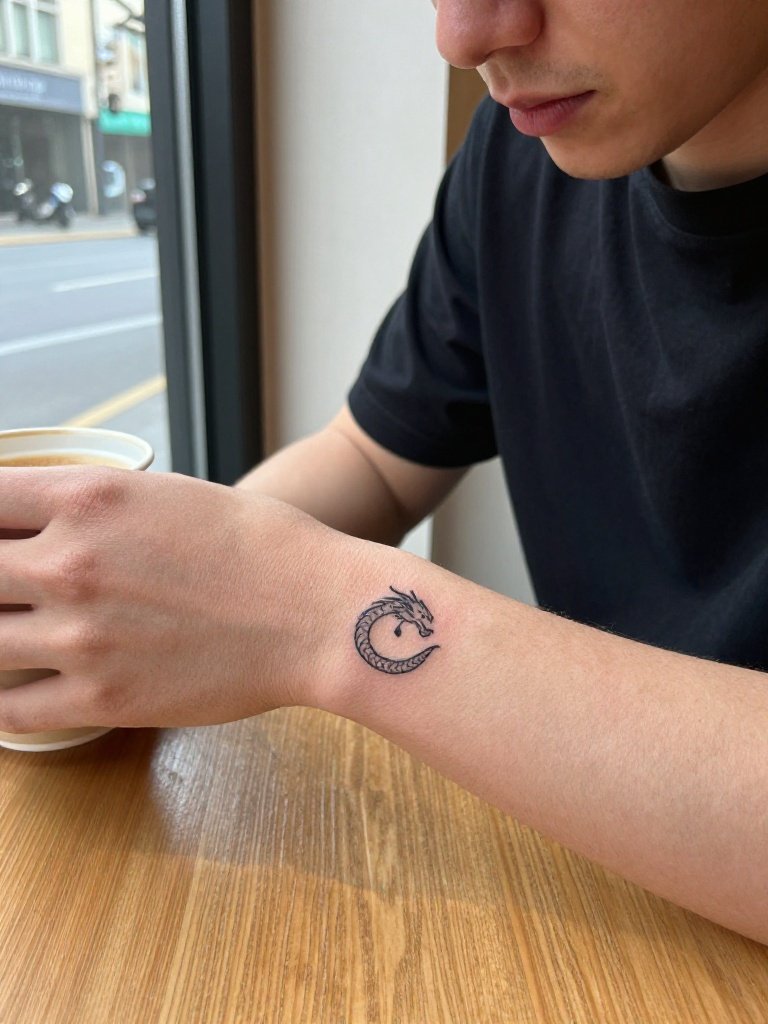
Compressing the dragon’s body into one continuous coil is the trick behind this wrist design. The head and tail meet to form a closed shape, which reads clearly even at two or three inches wide, something crowded miniature designs usually fail to pull off.
Keep it as clean linework. Scales and shading at this scale blur into texture within a few years, so a single-needle coil with a thin line weight holds better than a miniature version of a full sleeve. Ask the artist to draw the coil as one continuous line first, then add facial detail, so the shape survives fading.
2. Dragon Tattoo Men Hand: Wraparound Finger Dragon
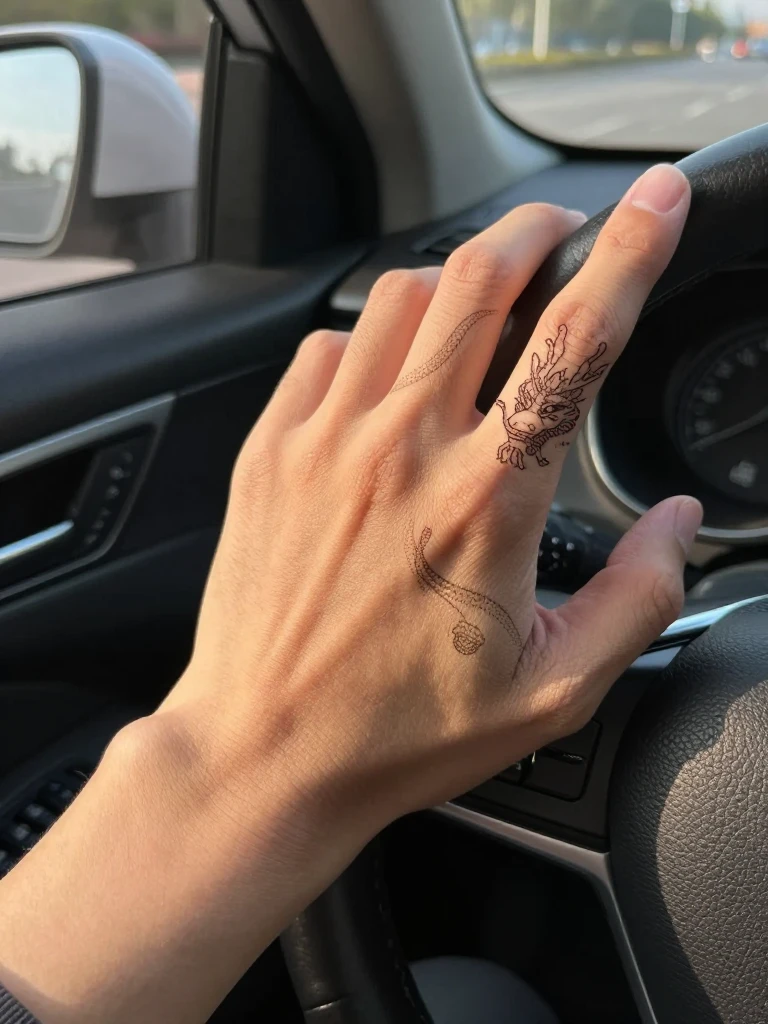
The dragon’s body wraps around one or two fingers, with the head resting on the back of the hand or knuckle. Fine-line dotwork is the usual technique, because bold shading tends to blur fast on hand skin.
Hands fade first
Hands see constant friction, sun, and washing that most placements don’t, so touch-ups within the first year are normal, not a sign of bad work. Ask about the touch-up policy before booking; a studio with real hand-tattoo experience will answer directly. And be honest about visibility: this is among the most visible placements on the body and the hardest to cover for formal settings.
3. Dragon Tattoo Men Shoulder: Japanese Irezumi Design
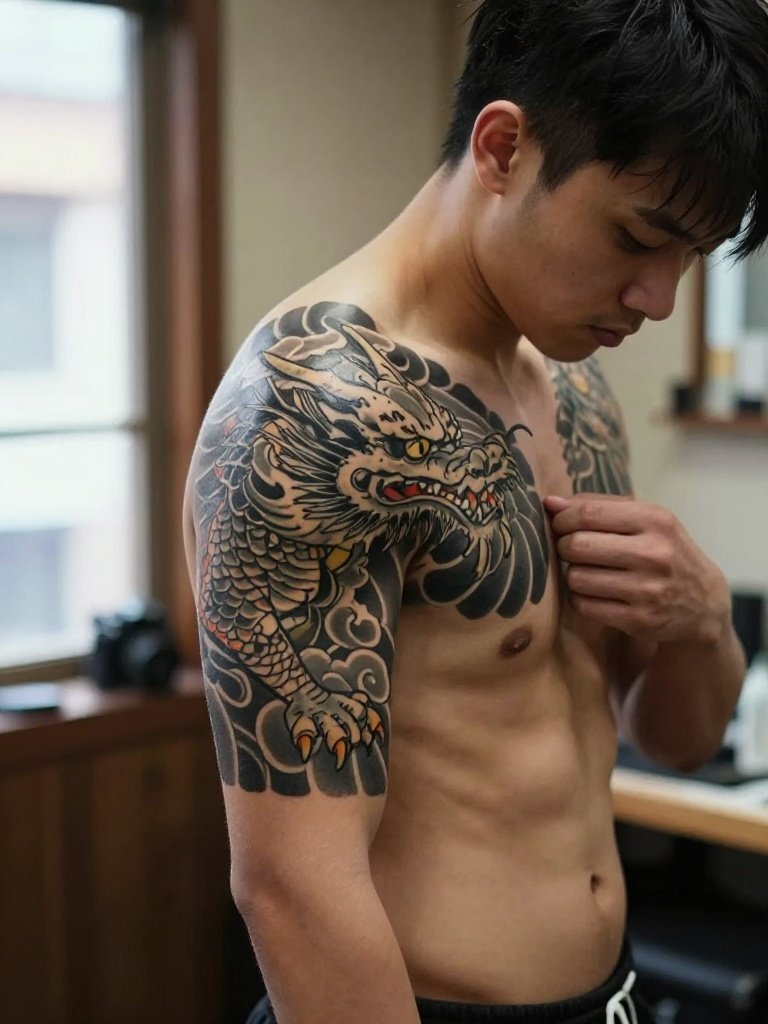
Bold black outlines, controlled color saturation, and a background of clouds or waves mark this as classic Japanese irezumi. The dragon wraps over the top of the shoulder with the head facing down toward the chest or up toward the collarbone. Shoulders are forgiving on pain, with enough muscle to buffer the needle.
Three claws or four
Claw counts signal lineage, and traditional artists take them seriously. Japanese dragons usually have three claws; Chinese imperial dragons have four or five. Tell the artist which lineage you’re referencing when you book, and bring era-consistent reference images. If you want the full cloud-and-wave background, budget for multiple sessions; rushing the background is the most common way this style ends up looking flat.
4. Dragon Tattoo Men Back Piece: Full Chinese Design
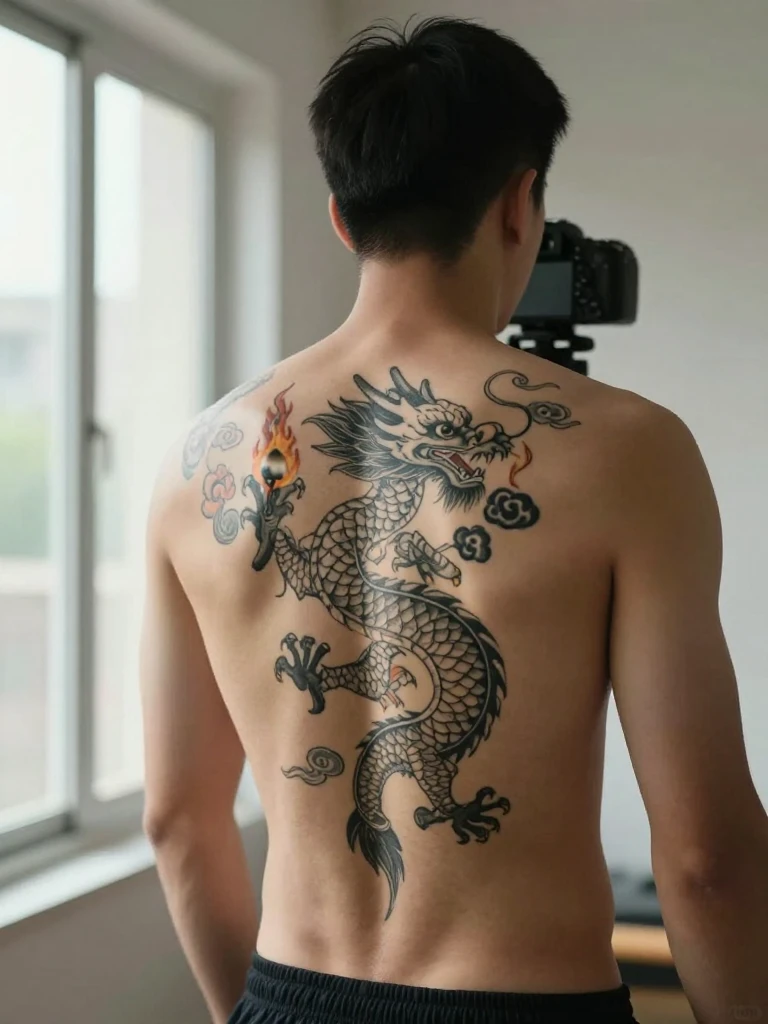
Long and serpentine rather than stocky, the Chinese imperial dragon has no wings and moves down the spine in a flowing S-curve, often holding a pearl. Extending from the shoulder blades past the waistline, it reads elegant and elongated rather than aggressive.
Plan the design on the spine as the centerline, not off to one side; that symmetry is what makes the composition read as intentional. Get a stencil fitting on your actual back before the first session, not just a drawing on paper, because spine curvature changes how the S-curve flows. Expect three or more sessions for a full back, and ask what aftercare wrap the artist recommends, since reaching and dressing a back piece yourself is genuinely harder than with smaller placements.
5. Dragon Tattoo Men Arm: Half-Sleeve Storm Design
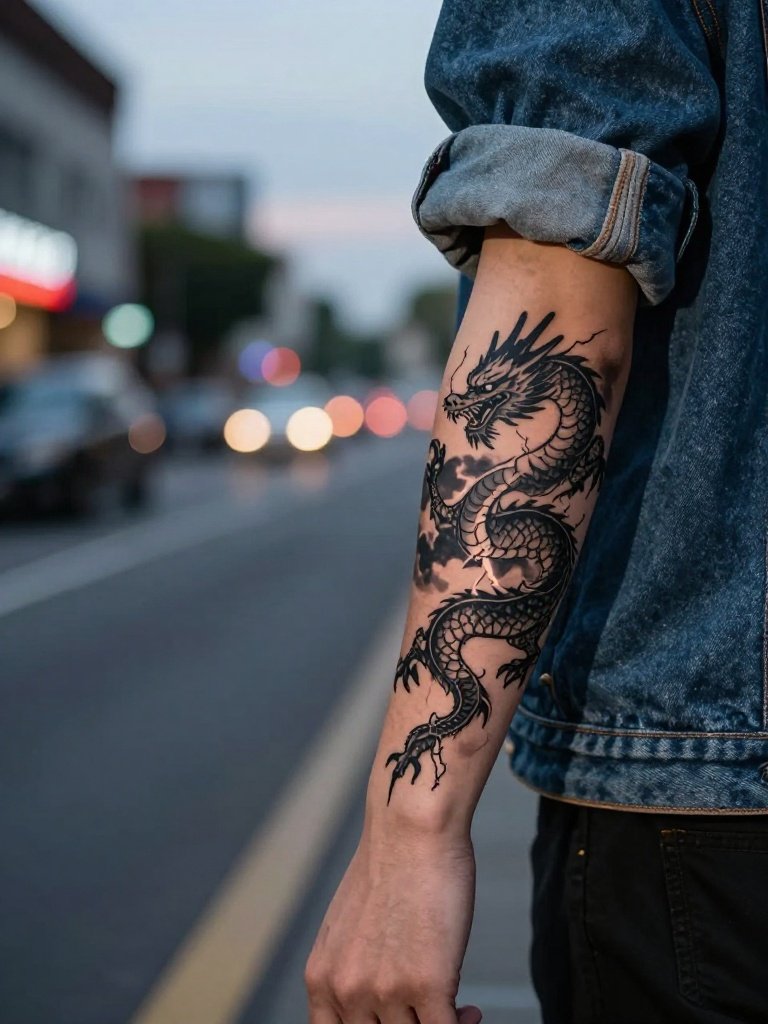
Lightning cracks through dark storm clouds behind a twisting dragon body. This trades the usual wave or cherry-blossom backdrop for something with more visual movement, and the outer arm handles ink well, healing faster than joints or wrists.
Leave negative space around the dragon so the storm elements don’t crowd the main figure; bare skin is doing compositional work here. Plan for two sessions, because a half-sleeve rarely holds up well rushed into a single long sitting. If you tell the artist you want the lightning sharp rather than soft, that one line changes how the background gets drawn.
See Also: 15 Iconic Elbow Tattoo Men Ideas That Are Trending in 2026
6. Tribal Dragon Tattoo Men: Polynesian-Inspired Coil
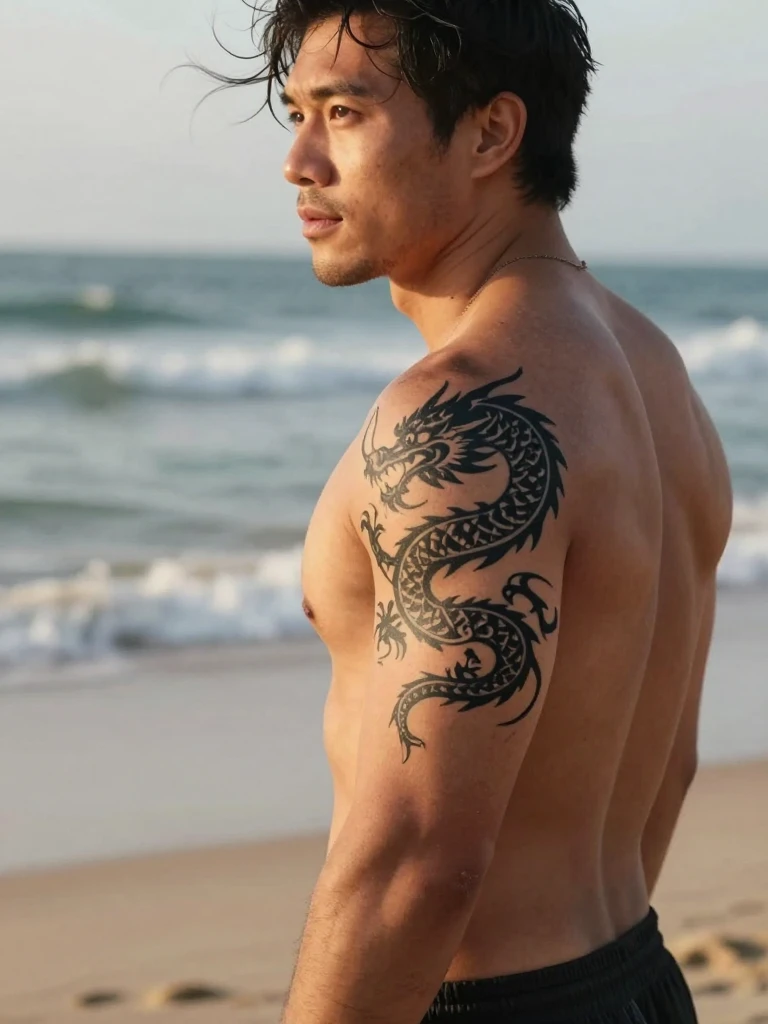
Solid black triangles, curved blades, and negative-space patterns replace color and realistic scales entirely. The dragon shape is implied through the flow of the bold linework rather than drawn literally, giving it the boldest, most graphic look on this list. The purity of the bold black shapes is what makes this style hold up decades later, while thinner linework blurs with age.
Pattern logic
Tribal patterns are meant to follow the body’s contours, so have the design mapped onto your specific muscle shape before the appointment, not chosen from a flat sheet. Work with an artist who specializes in tribal or Polynesian work rather than an illustrative artist; the pattern logic is genuinely different. And avoid mixing in fine detail like scales or eyes, which fight the style’s whole premise.
7. Dragon Tattoo Men and Koi Fish: Transformation Piece
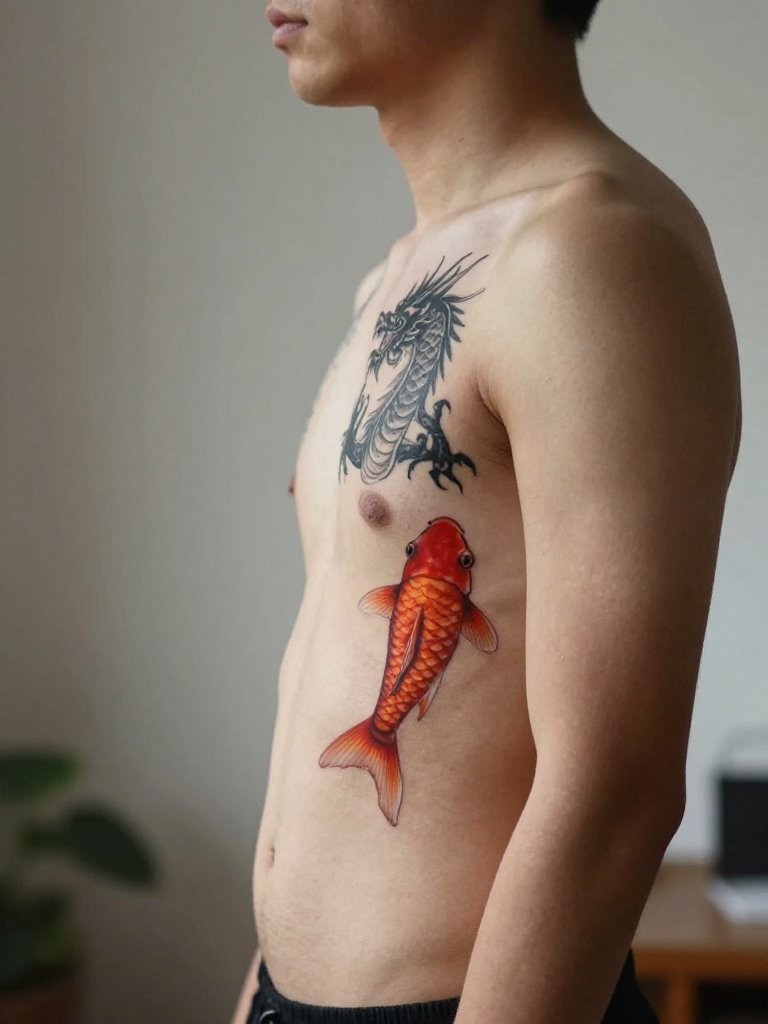
A dragon at the top, a koi fish swimming upward at the bottom. This draws on the East Asian legend of the koi that transforms into a dragon after fighting its way up a waterfall, and the composition runs vertically along the ribs or outer thigh so the transformation reads top to bottom.
Ribs are genuinely one of the more painful placements, with thin skin over bone and almost no padding; the outer thigh is considerably more tolerable. Don’t cram both figures under eight inches tall. The narrative reads weakest when the transformation feels rushed rather than gradual. Say “koi transforming into dragon, the dragon gate legend” in your consult; that phrasing signals the exact composition instead of two unrelated images.
8. Geometric Dragon Tattoo Men: Sacred Geometry Outline
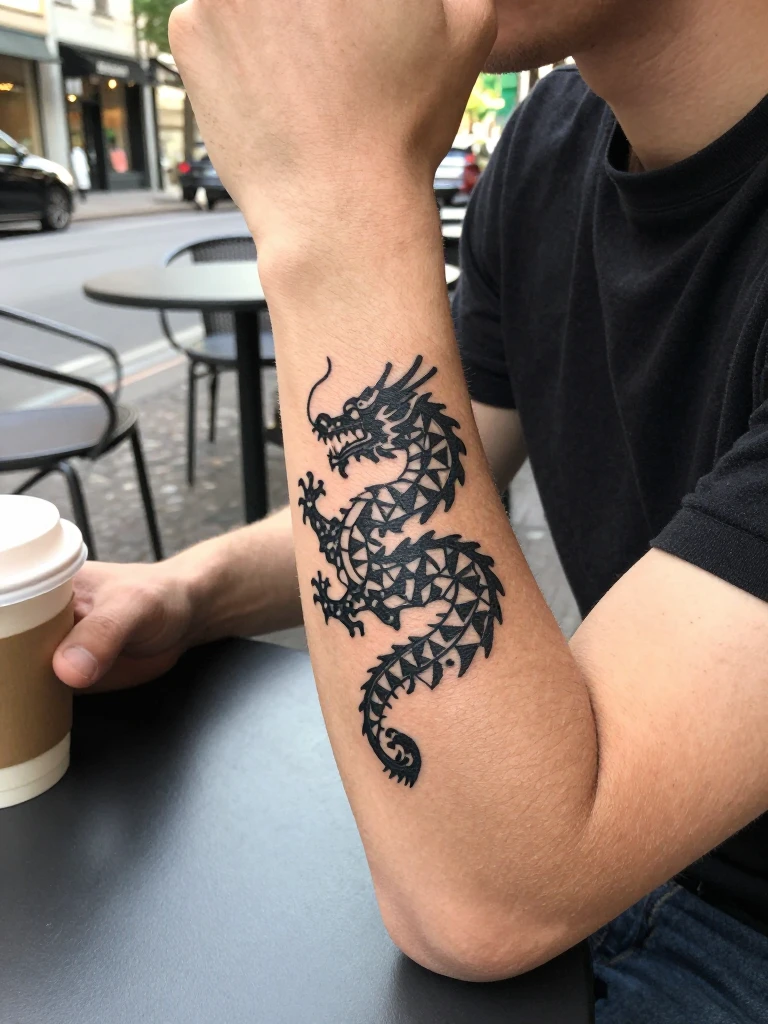
Rather than shading the dragon’s body, this version constructs the creature from interlocking geometric shapes: triangles, hexagons, straight linework arranged so the silhouette emerges from the pattern. It trades Asian iconography for a graphic, architectural look, built around your proportions rather than pulled from flash.
Ruler work
Precision is the entire style. Confirm the artist uses stencil-assisted or ruler-based technique for the straight lines; freehand geometric work is where this style most often falls apart. Solid black reads cleanest, because color competes with the pattern. And keep a first geometric piece under eight inches, since small alignment errors amplify across the whole design at larger scale.
9. Dragon Tattoo Men Chest Piece: Centered Design
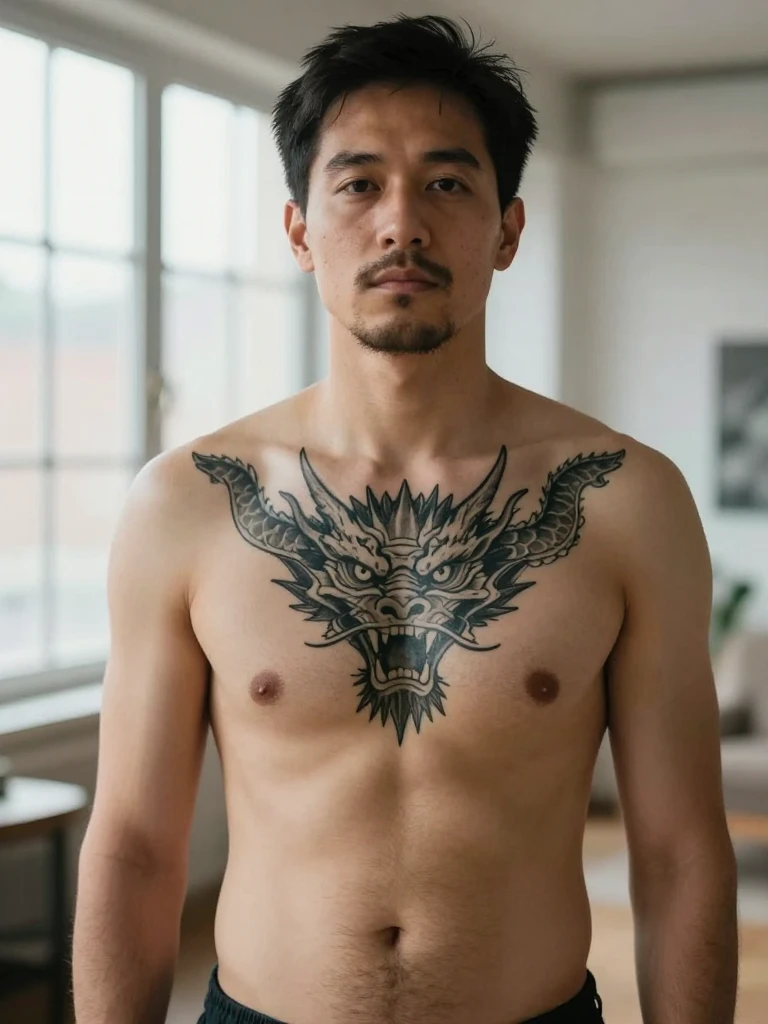
Centered between the pectorals, head as the clear focal point, body and tail extending outward across one or both sides. This placement gives artists room for a genuinely detailed face: sharp eyes, defined jaw linework that smaller placements can’t fit. The sternum is the sensitive part; the surrounding chest muscle is more forgiving.
Get sign-off on the head first, before any body or tail linework begins. The head is what viewers focus on and the hardest part to fix after the fact. Ask the artist to mirror your chest’s natural muscle definition rather than sitting the design flat on top of it, so the piece still looks intentional as your body changes. Keeping it below the collarbone preserves coverability.
10. Neo-Traditional Dragon Tattoo Men: Bold Color Piece
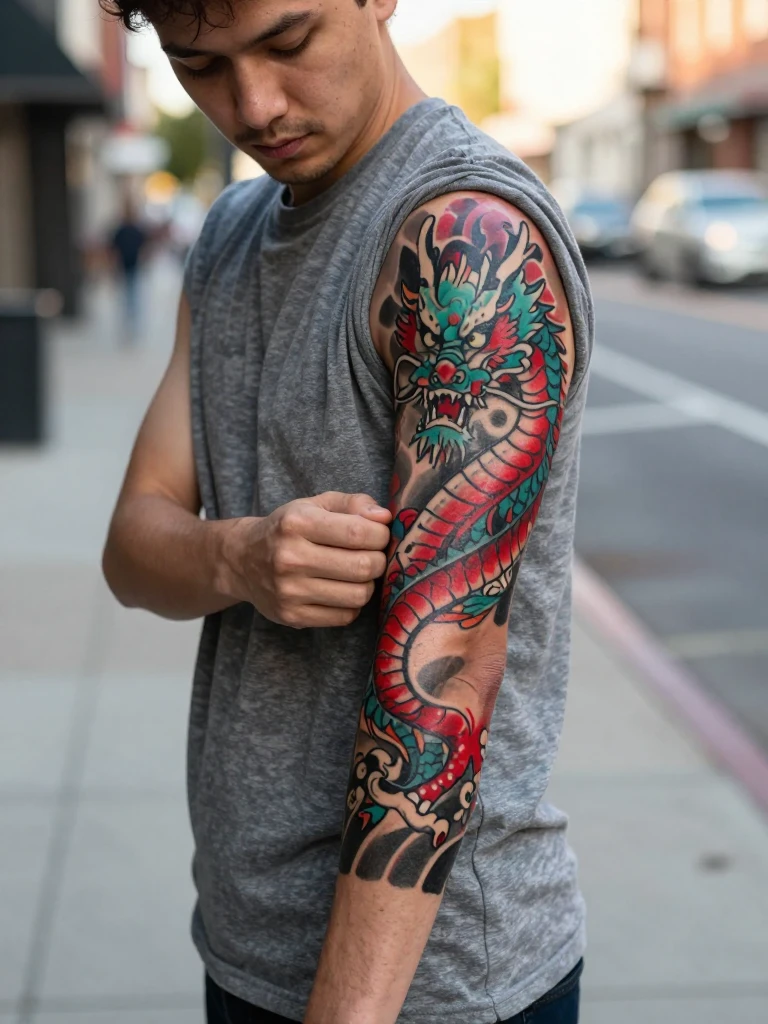
Thick black outlines borrowed from American traditional meet richer, more saturated color: deep reds, teals, purples, with more illustrative shading than old-school flash allows. The result looks bolder and more graphic than a Japanese-style dragon while keeping detail that realism-focused styles lose over time.
Fewer colors
Choose two or three colors over a rainbow. Neo-traditional work reads best with strong contrast, not maximum color variety. The thicker outlines hold against fading better than fine linework over the following decade, which is this style’s real advantage. Expect the outline to look almost cartoonish right after the session; it settles and sharpens as swelling goes down.
11. Dragon Tattoo Men Skull: Dark Gothic Hybrid
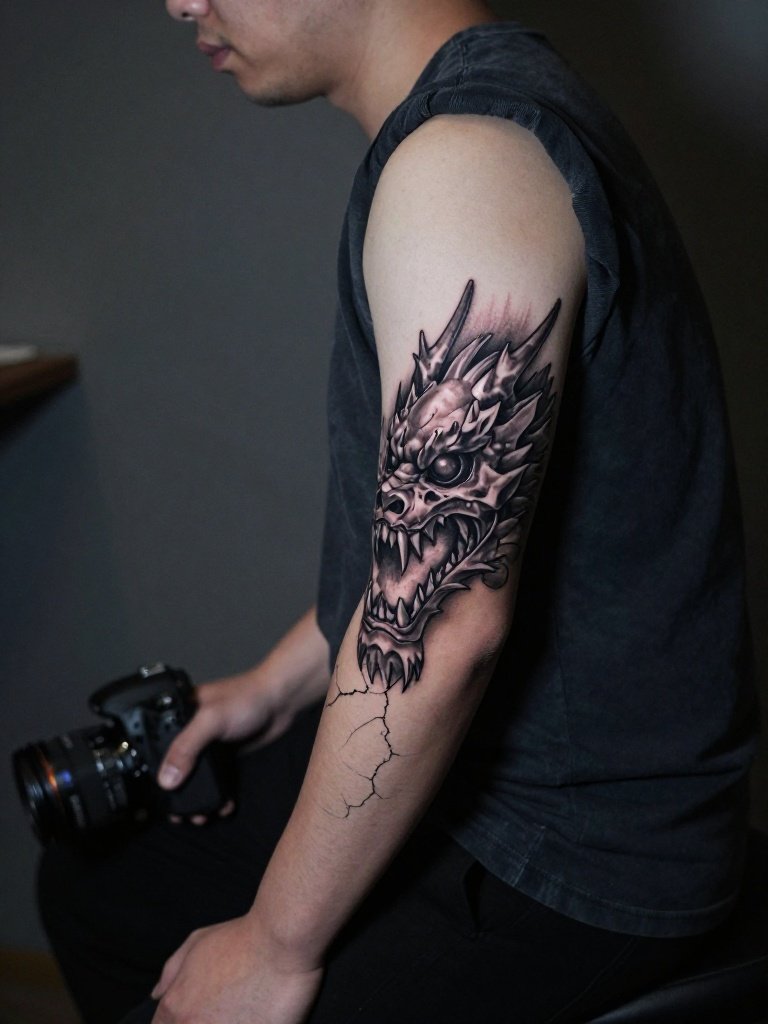
Cracked bone shows through the scales along the jaw and crown in this gothic hybrid, built through grey-wash shading layered gradually rather than solid black fill. It’s darker and more graphic than the traditional versions here, built on shading contrast rather than flat color blocks.
This design depends entirely on shading skill, so look specifically for a black-and-grey realism portfolio, not just a good all-rounder. Ask to see how the artist handles the transition between scale texture and bone texture; that’s the detail separating a well-executed version from a muddy one. Request the mock-up in daylight photos, since gradient shading can misread under studio lighting alone.
12. Celtic Dragon Tattoo Men: Knotwork Coil
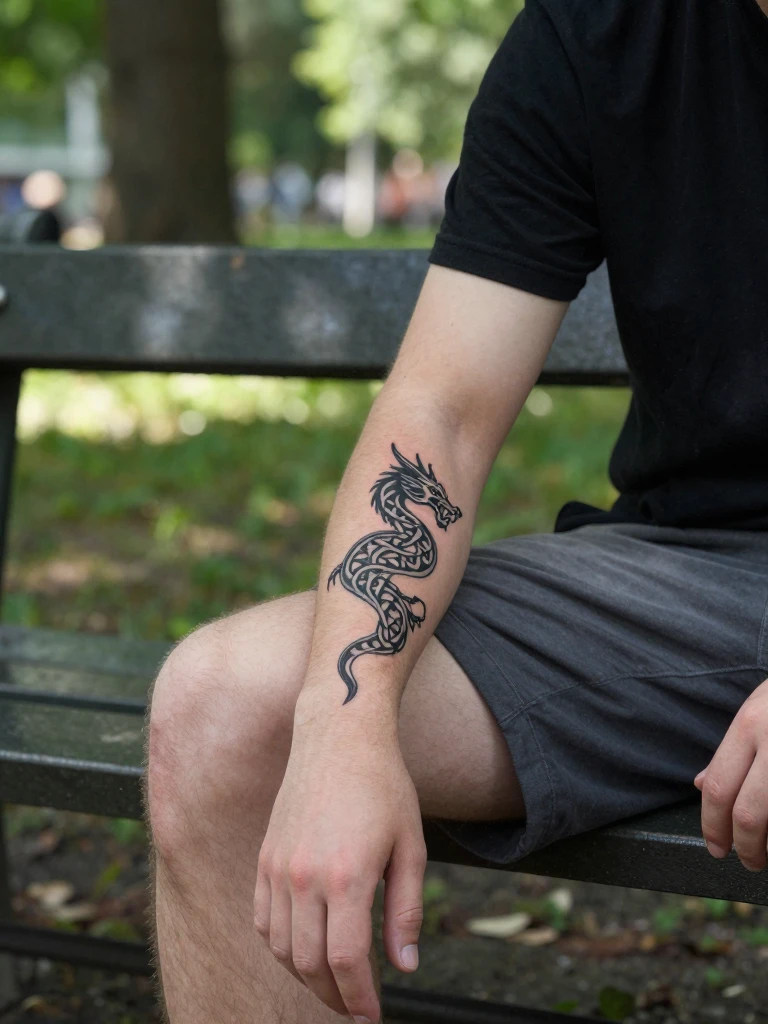
Instead of an East Asian dragon body, this version renders the dragon in continuous Celtic knotwork: interlacing bands forming the head, body, and tail without ever visually breaking, echoing the endless-knot symbolism of Celtic art. It reads as ornamental and pattern-based rather than illustrative.
Check the spacing
Solid black, never color; color obscures the interlacing that makes this design work. Ask for a test sketch of the knot interlacing first, since uneven spacing between bands is the single most common flaw in Celtic work. Keep the design compact rather than sprawling, because knotwork loses its clean structure when stretched across an awkward area.
13. Dragon Tattoo Men and Phoenix: Balance Piece
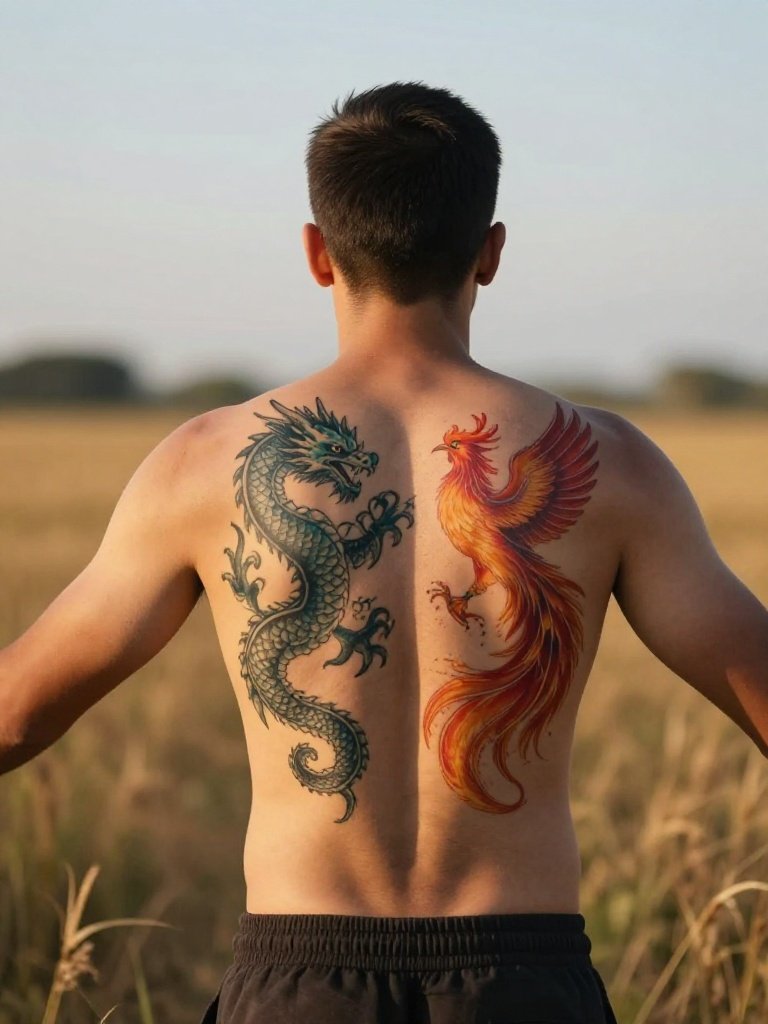
A dragon on one side of the body, a phoenix on the other. The traditional pairing represents balance between opposing forces, often mirrored across the back or both forearms. Cool tones on the dragon and warm reds and oranges on the phoenix keep the pairing readable, and this composition also works well as a cover-up, reworking older smaller pieces into one larger whole.
Plan the placement symmetry before the first session. Mirrored pairs have to be designed together, not tattooed one at a time without a plan. Budget realistically for at least two to three sessions total; this is one of the more involved pieces on the list, and rushing it undercuts the whole point of the pairing.
14. Fine Line Dragon Tattoo Men: Single-Needle Forearm
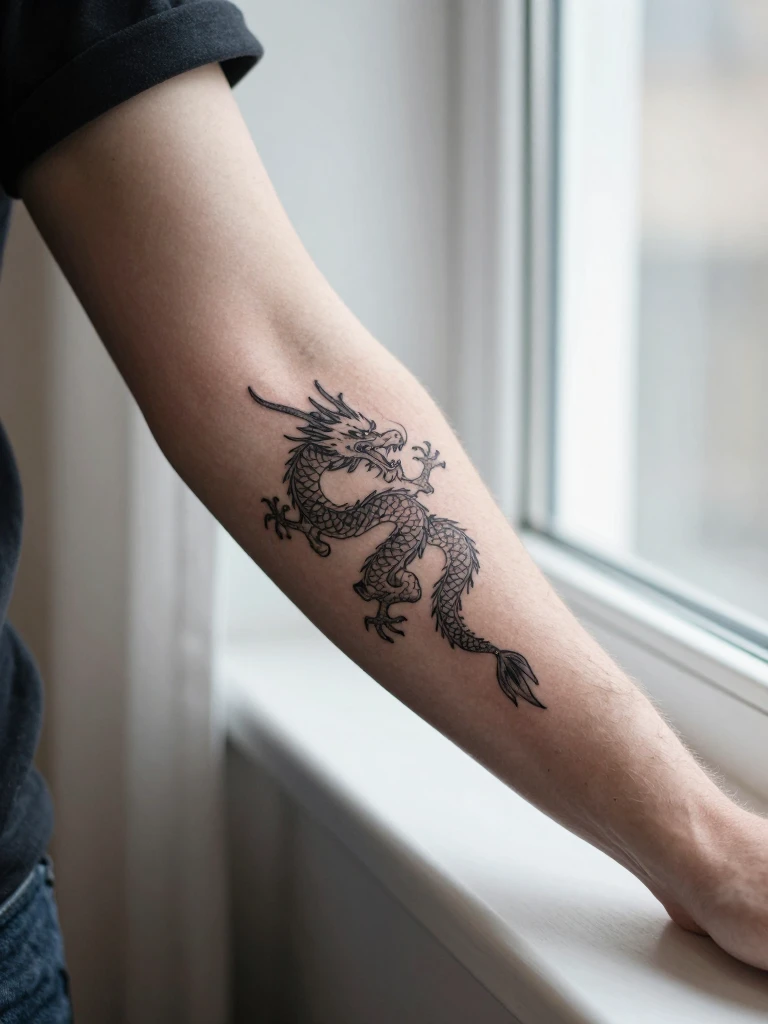
Delicate, almost sketch-like linework with minimal shading sets this apart from the bolder pieces here. A single-needle technique renders the dragon in a slightly curved pose along the inner or outer forearm, reading closer to an illustration than a traditional bold-line tattoo. Fine-line sessions are more tolerable, since the needle spends less time in any one area.
Ask for a slightly larger stencil than you think you need. Fine lines that look right on paper can read as too faint once healed on skin. Confirm the artist specializes in single-needle work specifically; it’s a steadier-hand skill than bold traditional tattooing, and not every artist does it well. Skip the urge to add shading “to finish it.” The clean, sketch-like line is the appeal.
Eastern vs Western: What the Divide Actually Means
Every dragon article runs the Eastern-benevolent versus Western-fierce framing, so here’s the honest version. In their own traditions, Eastern dragons are serpentine, often wingless, and tied to rivers, rainfall, and imperial power. Japanese dragons typically carry three claws; Chinese imperial dragons four or five. Western dragons are winged, fire-breathing, and usually the adversary of the story. The koi-to-dragon legend and the dragon-phoenix pairing are real East Asian traditions, not studio inventions.
Now the caveat: most pose and color “meanings” online are internet folklore, not documented tradition. Wings-spread-means-dominance, downward-flight-means-hostility, red-means-luck: asserted everywhere, sourced nowhere. None of this will be readable to a viewer anyway. Choose the dragon for its art and geometry, and treat the symbolism as yours, not the internet’s.
Match the Dragon to the Style
The mapping nobody provides. Japanese irezumi suits the shoulder, back, and full sleeve: bold outlines, cloud and wave backgrounds, three-clawed dragons. Chinese imperial suits the full back and thigh: longer, more serpentine bodies, pearl motifs, flowing S-curves. Western suits the chest, back, and thigh: winged, stockier, realism or bold color. Tribal and blackwork suits arms, calves, shoulders: pattern logic over illustration, built for the body’s contours. If you want pure pattern rather than illustration, our tribal tattoos for men guide covers how bold blackwork is planned for real bodies. Geometric suits the forearm and upper back: precision, solid black, architectural. Fine-line suits the wrist, ankle, and forearm: restraint, single needle, small scale.
Match the style to the dragon’s rules. A Western dragon with a cloud background is not a tradition; it’s a collision.
Color vs Blackwork: The Real Trade-offs
Bold color shows up best in photos and from across the room. It also demands the most maintenance: more sun protection, earlier touch-ups, and the colors themselves fade at different rates, which changes the design’s balance over time. Neo-traditional’s thick outlines and the tribal coil’s solid black hold against fading far better than fine linework or heavy realism shading.
Blackwork ages the most predictably of anything here. For what black-and-grey done right actually looks like at its best, our chicano style tattoo guide breaks down how grey wash carries a design. The practical rule: if you want color, commit to the maintenance; if you want to forget about it, commit to black.
Placement by Geometry, Not by Visibility
Competitors list placements by how visible they are. Geometry decides better. Serpentine bodies wrap limbs and backs; that’s why sleeves, full backs, and thighs suit the Eastern dragons. Heads and eyes need broad, flattish canvas: shoulders and calves. Wings need broad flat skin: chest, back, thigh, or the piece looks cramped. Coils and compact designs suit wrists, ankles, fingers, behind the ear.
Curved placements distort detail. Faces suffer most on curves; patterns and silhouettes suffer least. And for large pieces, the spine is the natural centerline; placing a back composition off to one side is the fastest way to make it look accidental.
What It Costs and How Many Sessions
Typical reported ranges, not quotes; every shop sets its own numbers. A small minimalist dragon typically lands around 100 to 200 dollars. A half-sleeve or large forearm piece runs into the high hundreds to low thousands, depending on detail. A full back piece typically starts around 2,000 dollars and climbs. Deposits and consultations are normal.
Session count is the part nobody plans for. A full back is three or more sessions. A half-sleeve is usually two. Even a detailed forearm dragon often needs a second pass. Ask for a projected session count before booking, and space sessions so each layer heals fully. For how full-sleeve compositions get planned across those sessions, our sleeve tattoos for men guide covers the planning side in more depth.
Vetting an Artist for Large-Scale Work
Large dragon work is the worst category to gamble on, because removal and cover-up both scale with size. Demand healed large-piece work in the portfolio. Fresh work always looks sharp; healed work shows whether dense shading and fine detail survive. Look for consistency across different bodies, not one good example.
Ask in the consult: how many sessions do you expect for this piece? Can I see the stencil on my body before we start? What’s your touch-up policy? An artist who corrects your reference is more valuable than one who just agrees with it. Red flags: no healed photos, no large work in the book, a flash wall that looks copied from someone else’s designs. For the mechanics of getting the design onto skin accurately, our tattoo stencil ideas guide explains why the stencil stage deserves your attention on large pieces especially.
Dragons as Cover-Ups
One practical section nobody writes. Dragons make excellent cover-ups, and there’s a real reason: large black areas, busy patterns, and bold outlines hide old ink better than almost any other subject. Tribal coils and dense blackwork are the strongest vehicles; the busy pattern breaks up whatever sits underneath. The neo-traditional color piece works too, because saturated color overpowers faded old color.
Don’t expect a fine-line dragon to cover anything. The linework is too light to swallow old pigment, and the honest version is that light cover-ups fail quietly. If cover-up is the goal, say so in the first consult and let the artist design around the existing piece.
Avoid the Generic Dragon
The default coiled silhouette with no lineage, the anime bearded dragon, the dragon-eye close-up: these are the filler designs that pad competitor galleries. They aren’t bad; they’re just what everyone already has.
The fix is simple. Pick a tradition and commit to its rules. Japanese clouds with a three-clawed dragon. Chinese serpentine with a pearl. Western wings with realism. Tribal with pure pattern logic. The moment the design follows a tradition’s rules, it stops being generic, because most dragons on skin follow no rules at all.
Quick Comparison
| Design | Dragon Family | Best Placement | Style Fit | Commitment |
|---|---|---|---|---|
| Minimalist Wrist Coil | Graphic | Wrist, ankle | Fine-line | Low |
| Wraparound Finger Dragon | Graphic | Hand, fingers | Fine-line dotwork | Low, high touch-up |
| Japanese Shoulder Dragon | Japanese irezumi | Shoulder | Irezumi color | Medium |
| Chinese Back Dragon | Chinese imperial | Full back | Illustrative color | Highest |
| Storm Half-Sleeve | Japanese irezumi | Outer arm | Irezumi color | High |
| Tribal Coil | Tribal | Calf, upper arm | Blackwork | Medium |
| Koi and Dragon | Japanese irezumi | Ribs, outer thigh | Illustrative color | Medium-high |
| Geometric Outline | Graphic | Forearm, upper back | Blackwork | Low-medium |
| Centered Chest Piece | Western | Chest | Realism, illustrative | High |
| Neo-Traditional Color | Western | Forearm, calf | Neo-traditional | Medium |
| Skull Hybrid Realism | Western | Forearm, upper arm | Black and grey realism | Medium-high |
| Celtic Knotwork Coil | Celtic | Forearm, calf | Ornamental blackwork | Medium |
| Dragon and Phoenix Pair | Chinese imperial | Back, forearms | Illustrative color | Highest |
| Fine Line Forearm Dragon | Graphic | Inner forearm | Fine-line | Low |
Frequently Asked Questions
What does a dragon tattoo mean for men?
It depends on the tradition, and honestly, less than most articles claim. Chinese symbolism ties dragons to power, good fortune, and imperial authority; Japanese irezumi leans toward strength, wisdom, and protection. But most pose and color decodings online are folklore, not documented tradition. Choose the design for its art and geometry; the meaning is yours to set.
Where should a man get a dragon tattoo?
Let the design’s shape decide. Long, serpentine dragons suit the back, spine, or full arm. Compact coils suit the wrist, hand, or calf. Wings need broad flat canvas like the chest or thigh. The geometry of the body comes before the visibility of the spot.
Do dragon tattoos hurt more than other designs?
Not as a subject. Pain follows placement and session length more than the design. Ribs, hands, and the sternum rank higher because of thin skin over bone; outer arm, calf, and shoulder are generally more tolerable. A multi-hour back session hurts more than a small wrist coil, for reasons that have nothing to do with dragons.
What’s the difference between a Japanese and Chinese dragon tattoo?
A Japanese dragon typically has a stockier, more muscular body with three claws and is usually paired with clouds or waves, while a Chinese dragon has a longer, more serpentine body, often with four or five claws, and is commonly shown holding a pearl. The visual languages are distinct enough that mixing them looks accidental.
How small can a dragon tattoo be and still look good?
A small dragon works when the design compresses into a single coiled loop in clean linework. Detail like individual scales blurs once the design drops below a few inches wide. The wrist coil and finger wrap on this list are the proof of concept; anything smaller than that is a bet against physics.
Final Thought
Fourteen ideas, but the real lesson is in the traditions. A dragon tattoo stops being generic the moment it follows a design language’s rules: Japanese clouds with a three-clawed body, Chinese serpentine with a pearl, Western wings with realism, tribal with pure pattern logic. Pick the family, match the style, vet the artist like it matters, and size the piece for how it will look in ten years, not ten days.


Pingback: Neck Tattoos for Men: 18 Bold, Subtle Unexpected Ideas That Actually Work - Glow Vibes Spot