An elbow tattoo is really two tattoos sharing one joint. The outer cap sits over bone, hurts with a deep grinding vibration, and heals while you keep bending it. The inner ditch folds into the cubital groove, hits a sharper nerve pain, and heals slower because it never stops moving. Every design on this list was chosen for one of those two placements, and the notes say which.
Then the one rule that matters more than any motif: an elbow design has to read bent AND straight. You live at both angles. A compass that centers perfectly with your arm extended but tips sideways when you bend is not a good elbow tattoo. That is the test this whole article runs on, and the reason every idea below carries a bend verdict.
Two Placements, One Rule
The outer cap is the bony point of the elbow. Pain here is bone proximity, a deep grinding vibration that travels up the arm. Most artists and shops report it among the highest spots on the arm. Surface healing runs three to four weeks because the skin keeps stretching while the scabs are on.
The inner ditch is the soft fold inside. Pain here is nerve based, sharper and more electric, because two of the three main arm nerves pass through the cubital groove. It heals slower than the cap for a simple mechanical reason: the fold opens and closes hundreds of times a day, so scabs crack and the work takes longer to settle.
Design rules split the same way. The cap rewards radial designs: compass roses, webs, mandalas, anything built around a center point. The ditch rewards designs that avoid the crease or use it deliberately: bands above the fold, arches that read when bent, nothing with a face placed across the moving line.
The Decision Gate
Be honest about whether this is your placement. The elbow is one of the few spots where many reputable artists will turn away under-inked clients, and ditch work is widely considered not-first-tattoo territory. If you have not sat for a longer session yet, the elbow is an aggressive place to learn what pain means.
Expect the practical side too. Healing looks dramatic here: tight, flaky, uneven, for weeks. Touch-ups are normal, not a failure of the artist or your aftercare; the joint’s movement makes some ink loss the biology of the placement. If any of that sounds like a surprise, it should not be. This is the highest-friction, highest-movement tattoo real estate on the arm.
The same honesty applies to neck tattoos for men, the other placement where pain, visibility, and artist norms demand a gate up front. If you are weighing both, read that one too.
The Bend-vs-Straight Test
Here is the ritual, from a practitioner who works this placement constantly. Check the design at five angles: arm straight, arm bent, in the mirror, in a phone photo, and a casual glance in passing. If the design only looks right in one of those, it is not an elbow design yet.
What survives the bend: radial and symmetric designs (spider webs, mandalas, compass roses, ouroboros), because the circle looks the same from every pose. Open-center designs, where the apex of the bend holds negative space instead of detail. Designs that mirror anatomy, like a biomechanical hinge, because the motion completes the illusion rather than breaking it.
What fails on the cap: faces and portraits, because features shift when the skin stretches. Text across the crease, because letters shear. Micro detail, because fine lines blur fastest on skin that never rests. A design can be beautiful flat and still be the wrong elbow tattoo. The bend decides.
1. Bold Black Compass Rose Elbow Tattoo For Men
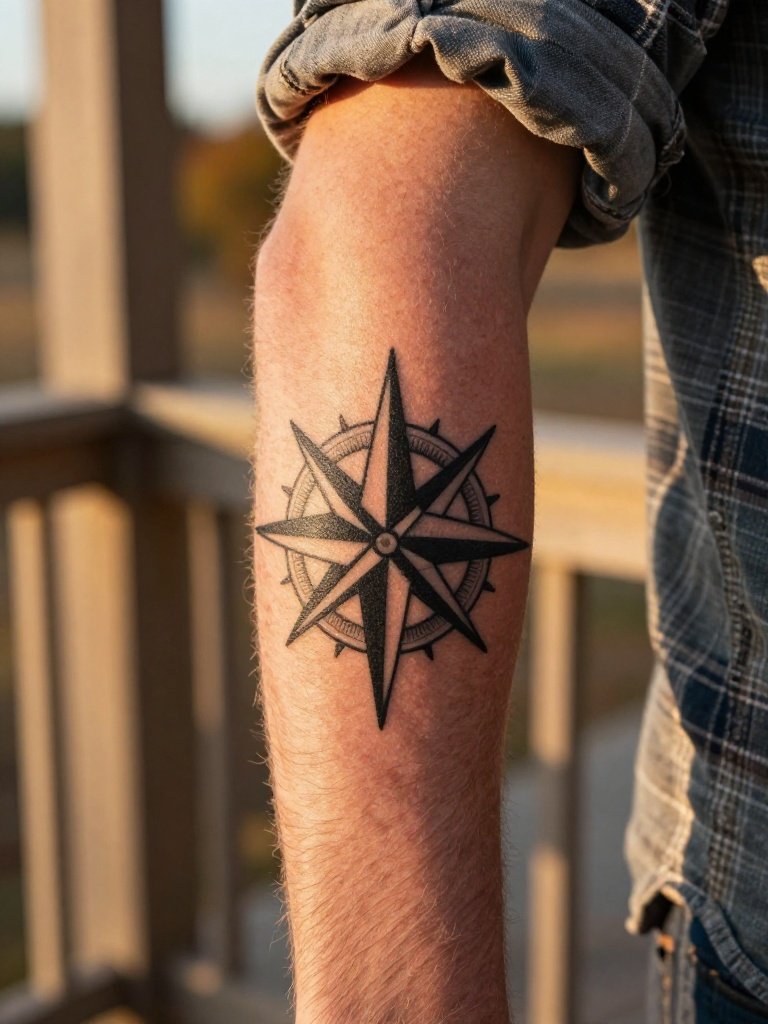
The compass rose belongs on the elbow because its eight or sixteen-point symmetry wants a center, and the joint’s bony point is one. Heavy black fill on the outer ring and points, fine dotwork gradient inside the compass face instead of flat black, and a lightly shaded medallion so the center reads three-dimensional rather than stenciled.
Bend verdict: excellent. Radial symmetry is the bend-proof design family. Straight or bent, the compass reads the same because every direction from center is a mirror of another.
Dead center
A compass that sits a centimeter off center looks crooked the moment the arm bends. Ask for a symmetrical stencil placement check before the needle starts, heavier black on the outer points, and a lighter dotwork center for contrast. If a future sleeve is the plan, leave a few strands open-ended so later work can extend naturally.
2. Shattered Blackwork Elbow Tattoo Men Design
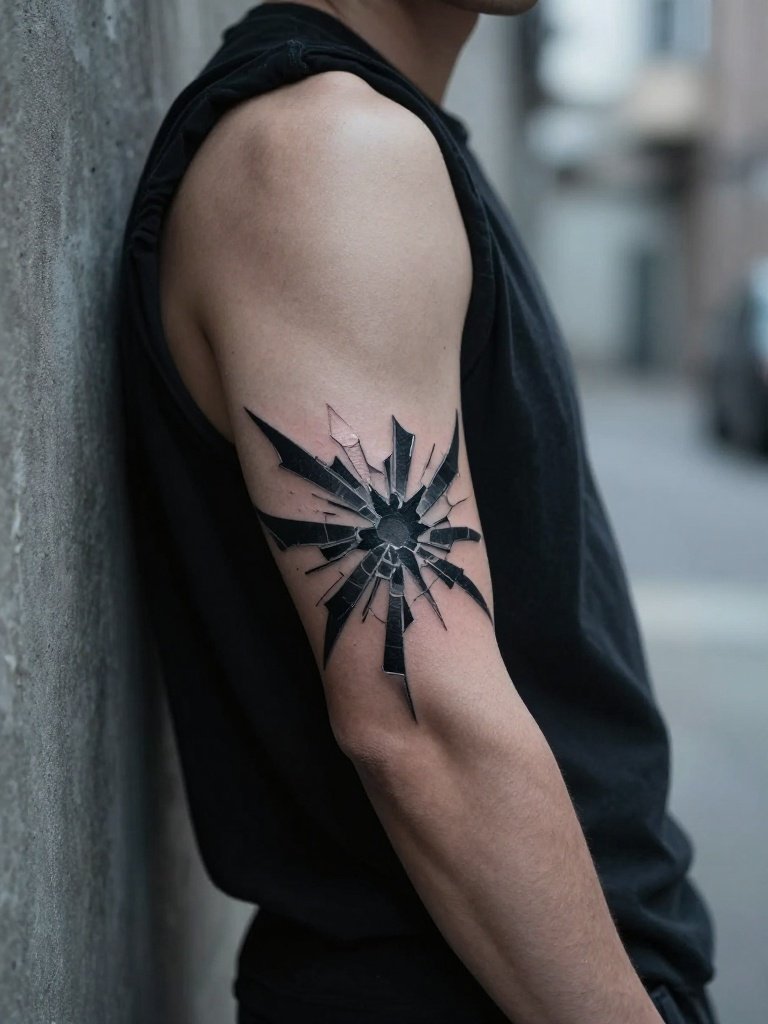
Sharp angular black shards radiate from a single point on the cap, fractured-glass style, with thin untouched skin between them. No curves, no florals, just jagged geometry and negative space. It reads destructive and graphic, closer to illustrative etching than any rounded style on this list.
Bend verdict: excellent. Chaos hides distortion. A shard that shifts slightly when you bend still looks like a shard, which is exactly why asymmetric blackwork suits a joint that never sits still.
Ask for the shards to follow the elbow’s natural bend rather than a flat template, and keep the piece deliberately asymmetrical. A shattered design that is too neatly balanced loses the chaotic effect that makes it work. Describe it to your artist as “fractured glass” or “shattered blackwork”; the word “abstract” alone is too vague to land the same result.
3. Colorful Neo-Traditional Lotus Elbow Tattoo For Men
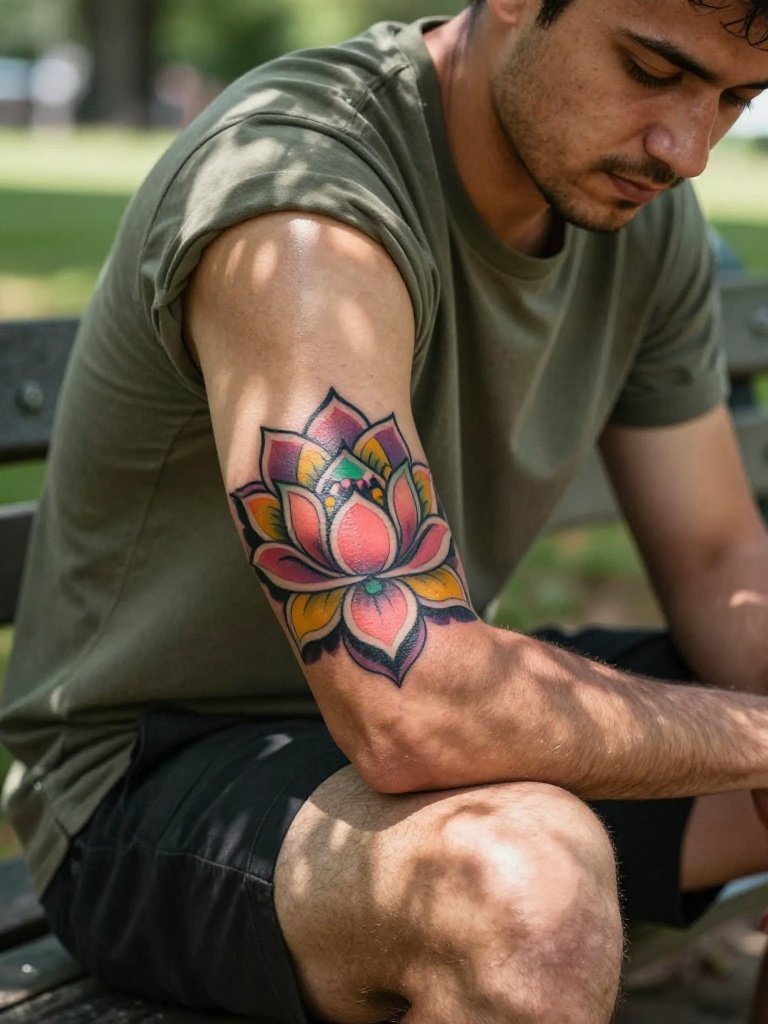
Full color changes the conversation here. A layered lotus, or mandala-style flower, wraps the cap in neo-traditional linework: bold black outlines, saturated coral pink, olive green, mustard yellow, deep purple, petals fanning symmetrically from the joint. The style keeps every shape clean and graphic rather than painterly, which is part of why this kind of color ages better than soft watercolor work.
Bend verdict: good. Symmetrical petals survive the bend. But color on a joint has a real cost: friction and stretch fade it faster than black and grey in the same spot, so budget a touch-up eight to twelve months out.
Plan the color layout so the boldest shade sits on the joint’s most visible point at rest, keep at least one dark saturated tone in the palette to anchor the piece, and ask about your sunscreen habits at the consult. Sun fading shows first in the brightest colors.
4. Traditional Spiderweb Elbow Tattoo Men Classic
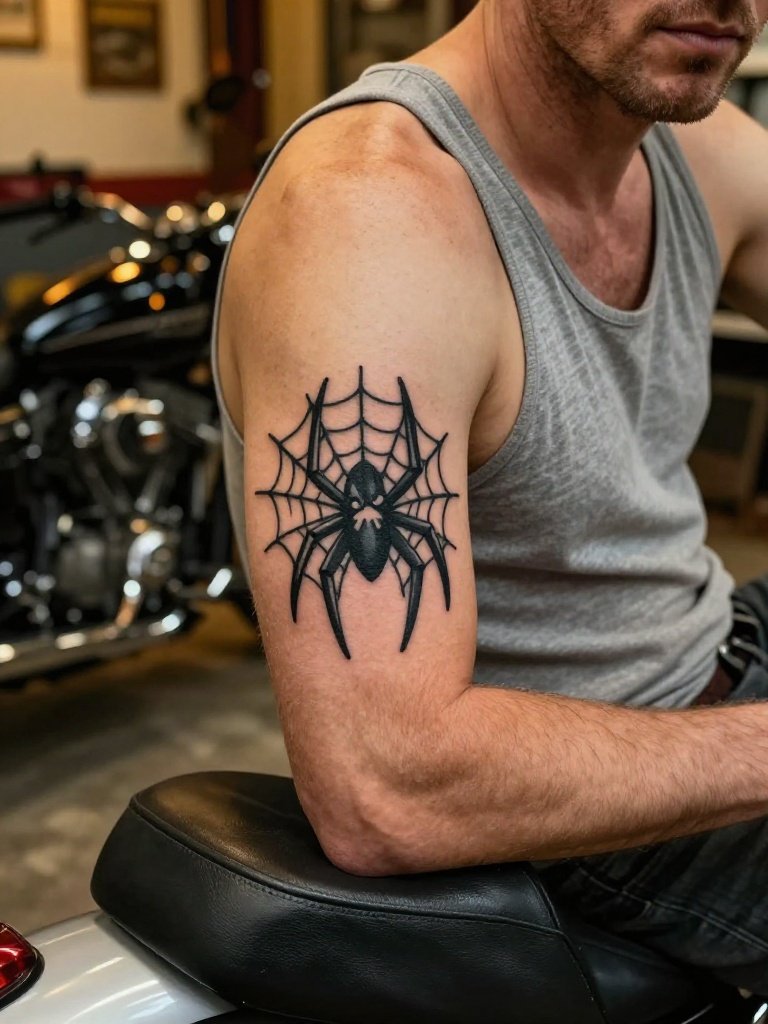
The most iconic design on this list, and it earned that by being the right shape. Concentric rings map almost perfectly onto the joint’s curve. Classic American traditional: solid black, thick outer strands, thinner inner rings, usually unshaded so the graphic quality stays sharp. On its own it is simple and punchy; in a sleeve it becomes connective tissue, tying a shoulder piece to a forearm piece across the bend.
Bend verdict: excellent. The web is literally built for the bend. The joint’s curve mirrors a web’s radial shape, which is why this design has survived every trend cycle.
Six strands
Keep the strand count at six to eight for the cleanest traditional read. Describe it as a “classic elbow spiderweb, thick outer lines, thin inner rings” so it does not come out looking like a Halloween decal. It is a short session with quick healing, usually around two weeks, since there is very little solid fill.
5. Dotwork Mandala Elbow Tattoo For Men
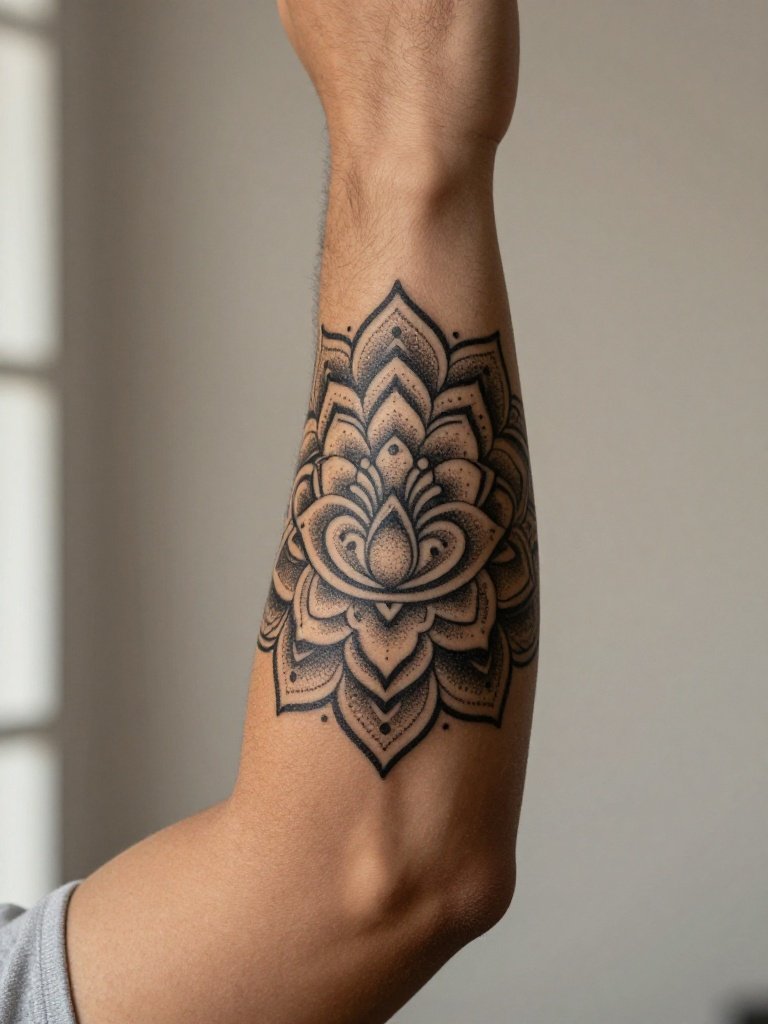
Where the compass goes graphic and bold, the mandala goes the other way: intricate black and grey built entirely from fine dotwork and ornamental line patterns, wrapping from the upper forearm across the cap and tapering toward the bicep. Layered lotus petals, small spirals, and a density gradient made purely from dot spacing give it a soft, almost textile look up close.
Bend verdict: excellent. The mandala’s radial pattern is bend-proof by construction, and the elbow’s curve gives it a natural anchor point that flat skin does not offer.
The trade-off is sitting time. Dense dotwork is slow, and pieces this size are often better split across two appointments. Confirm your artist has specific dotwork or mandala experience first, because uneven dot spacing is the single most common way this style goes wrong.
See Also: 21 Chest Tattoos For Men: Trending And Iconic Ideas
6. Small Minimalist Elbow Tattoo Men Idea
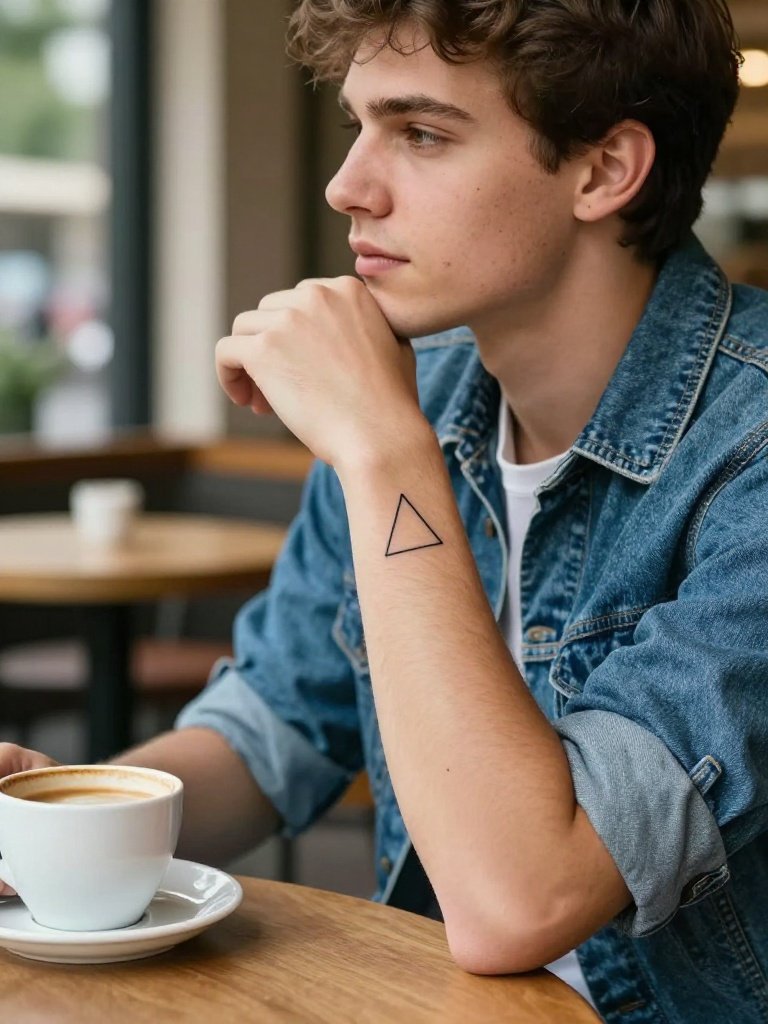
Not everything here needs to wrap the whole joint. A compact single-line design, a small triangle, a minimal arrow, a short abstract line pattern, sits just above or beside the crease rather than directly over the bone. Understated, low-commitment, easy to hide under a rolled-down sleeve.
Bend verdict: placement-dependent. The only reason this works is that it avoids the joint itself. Placed in the crease, a small design distorts with every bend. Placed above it, the design stays readable and the session is one of the quickest on this list.
If you go this route, ask for slightly thicker line weight than you would use on flatter skin. Elbow-adjacent skin needs more ink density to hold, and fine single-line work here blurs a little faster than bolder linework does. A small piece stays coverable under a short sleeve, which is the practical argument for it.
7. Tribal Blackout Elbow Tattoo For Men
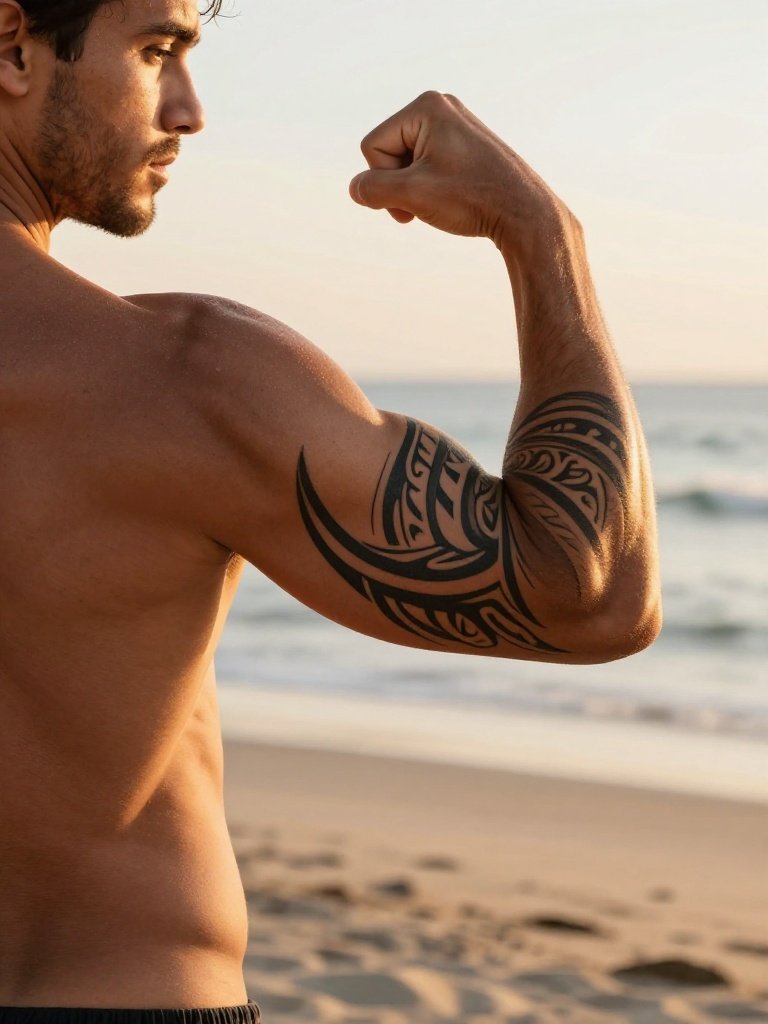
Thick sweeping black bands curve around the elbow’s natural shape in this modern take on tribal styling, with negative-space skin gaps between the bands instead of one solid blackout patch. The lines are smooth and continuous rather than jagged, closer to Polynesian-influenced tribal work than abstract blackwork, and they taper toward the bicep and wrist so the piece feels like it is moving along the arm.
Bend verdict: excellent. Bands that follow the arm’s contour bend naturally with it, which is the whole mechanical advantage of the style.
Have your artist map the flow while your arm is both straight AND bent, because tribal bands can look great still and awkward in motion if that step gets skipped. Vary the band widths, leave visible skin gaps, and consider a thin untouched line running through a band as a negative-space accent. For the deeper logic of how bold black bands get planned for real bodies, our tribal tattoos for men guide covers the pattern-first approach this design depends on.
8. Biomechanical Elbow Tattoo Men Design
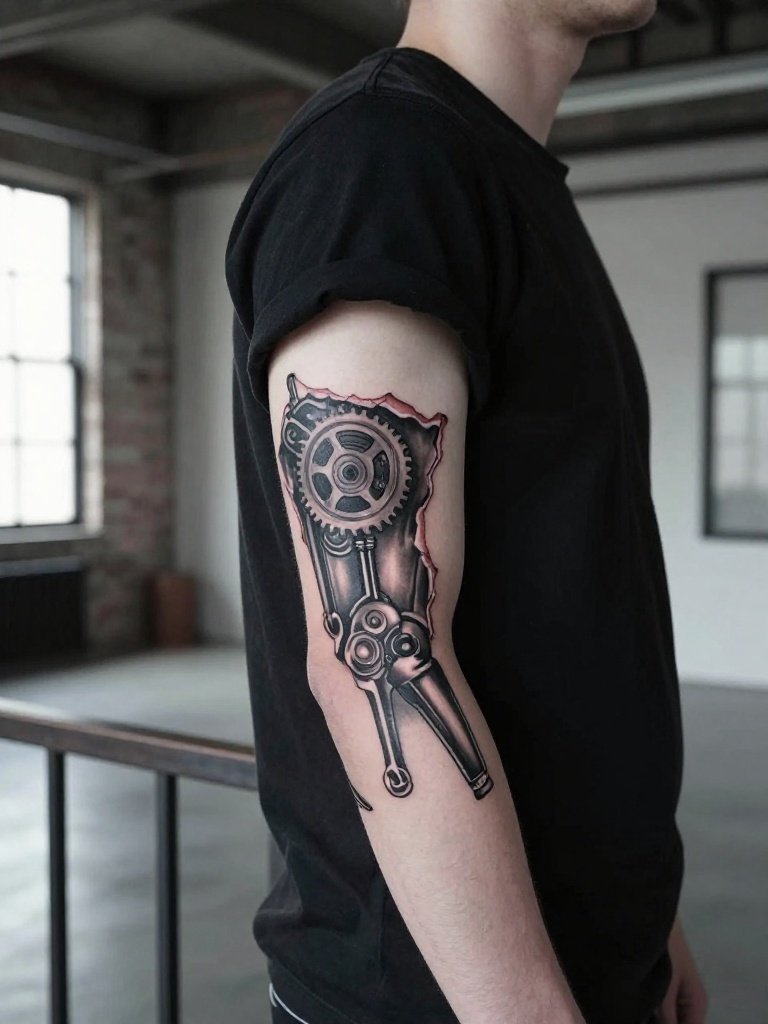
A genuinely different category. Biomechanical work creates the illusion of mechanical parts under torn skin, gears, pistons, exposed structure, and the elbow is one of the best spots on the body for the effect because the joint’s real anatomy already suggests a hinge. Black and grey with heavy grey-wash shading sells the illusion, tricking the eye into reading the joint as part of the machinery.
Bend verdict: excellent, and unique. This is the one style where the bend completes the design. The motion is the illusion.
Follow the hinge
Ask for the torn-skin edges to follow your actual joint lines, not a generic template, because the illusion only holds if the anatomy lines up. Look specifically for an artist with a biomechanical portfolio, since the style lives entirely on realistic shading skill, and expect a longer session than most designs on this list. Believable shading takes real time to build.
9. Skull And Bone Elbow Tattoo For Men
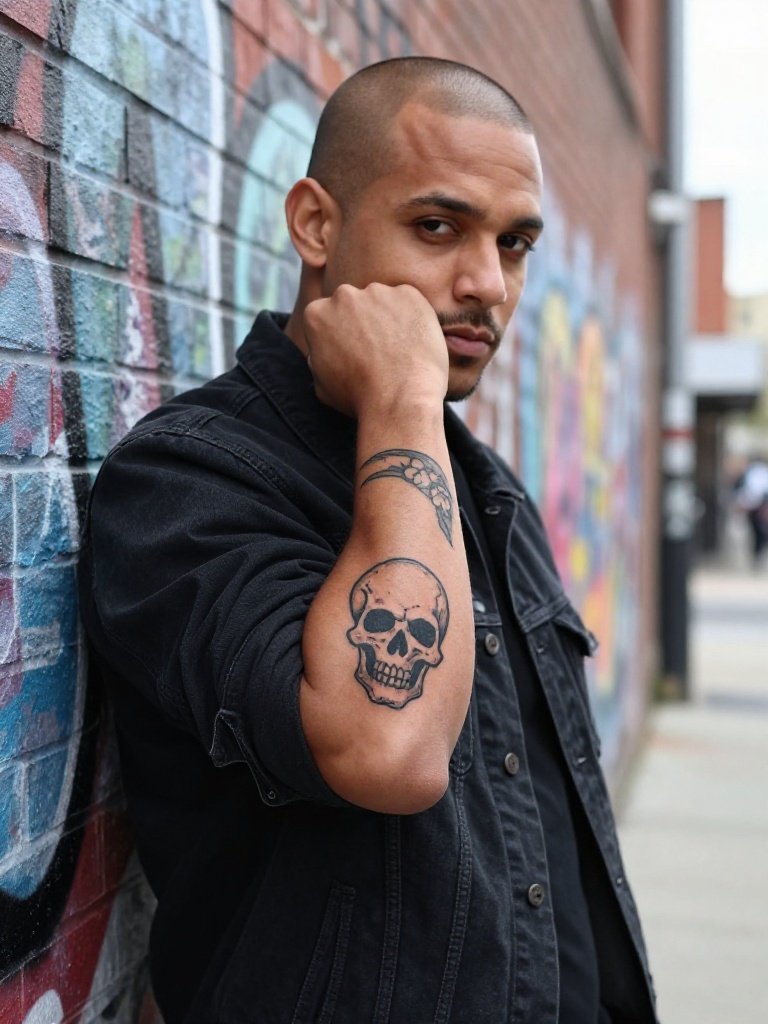
Skull imagery in bold-outline traditional work, centered directly on the cap with limited grey shading and sometimes a small rose or banner as filler. This keeps to solid black outline work rather than fine grey shading, which makes it a cleaner long-term bet than the shaded realism pieces further down.
Bend verdict: good, with a caveat. A symmetric skull survives the bend reasonably well, but this is where the face problem starts. Keep the skull’s proportions slightly compressed to fit the joint’s roundness, and do not ask for fine facial detail on the cap. Faces shift; symmetry survives.
Bold outline work is also more tolerable than dense shading, since the needle spends less continuous time in any one area, and it typically heals within two to three weeks. It pairs naturally with traditional-style sleeve work above or below if you expand later.
10. Wolf Portrait Elbow Tattoo Men Idea
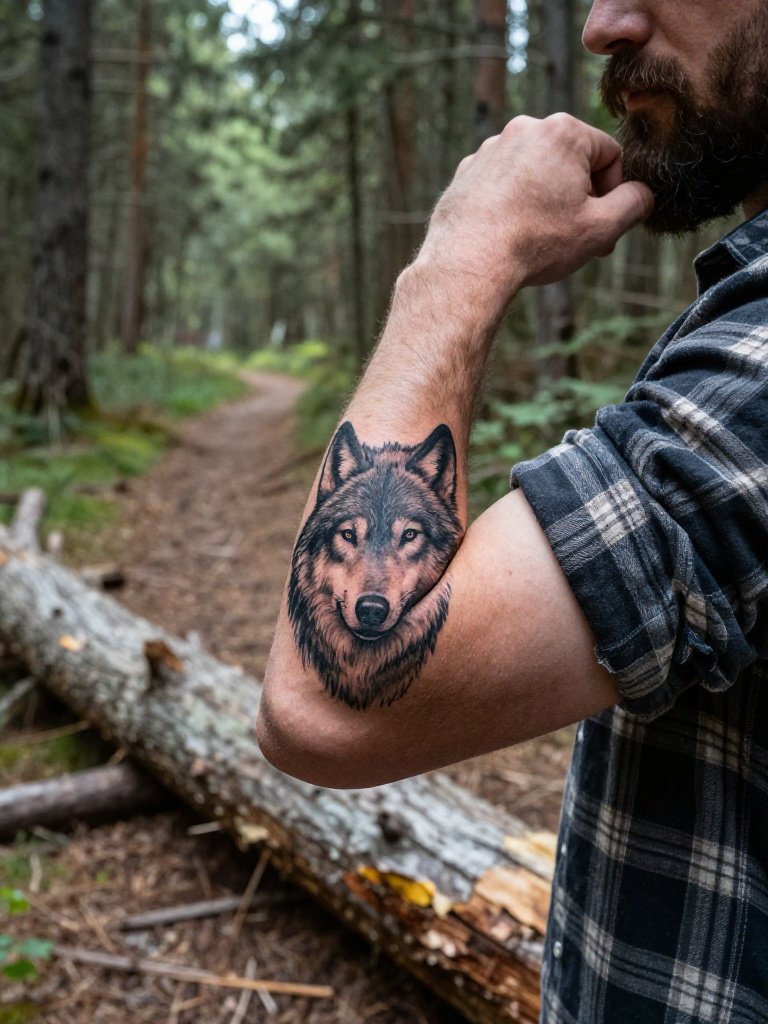
The highest-risk idea on this list. A wolf’s head in black and grey realism, positioned so the elbow’s bend forms the natural break between the upper snout and lower jaw, using whip shading for smooth gradients and fine fur texture. It can look striking. It can also go wrong in a way no mandala can.
Bend verdict: risky on the cap. This is the face problem at full strength. A portrait on a joint that stretches means features that shift between straight and bent. The original design tries to use the crease as the jaw break, which is clever, but it demands an artist who has actually solved this geometry before.
Faces move
Ask directly how your artist plans to use the joint’s crease as part of the composition before any outline goes on. Bring a high-resolution reference, discuss light-source consistency, and plan for at least one touch-up, which is standard for large-scale black and grey realism. If the artist has no healed portrait-on-joint work to show you, this is not the piece to be their first.
11. Sacred Geometry Elbow Tattoo For Men
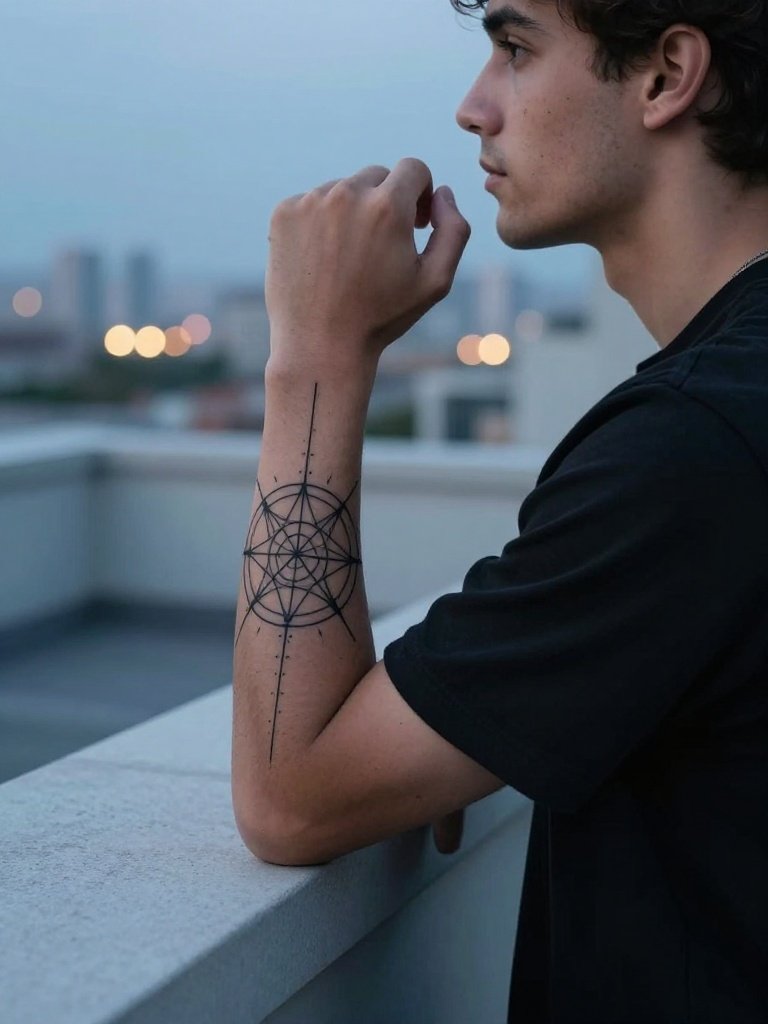
Interlocking circles, triangles, and radiating straight lines build this piece symmetrically around the elbow’s center point. Unlike the dotwork mandala, this relies on precise straight lines and mathematically even spacing rather than organic curves, giving it an architectural, almost blueprint-like feel. The elbow’s rounded shape actually helps here: the joint’s bend adds a subtle sense of depth that flat forearm skin would not give the straight lines.
Bend verdict: excellent. Symmetry radiating from the center point is bend-proof, as long as the symmetry is real.
Paper to skin
Request a stencil test on your actual arm before the session, because geometric symmetry that looks perfect on paper can shift once it wraps a curved joint. Keep the palette to solid black only; shading and color muddy geometric precision. And ask to see line-heavy geometric work specifically in the portfolio, since precision matters more here than in almost any other style on this list.
See Also: 20 Stunning Snake Hand Tattoo Ideas Trending Right Now
12. Sun And Moon Elbow Tattoo Men Design
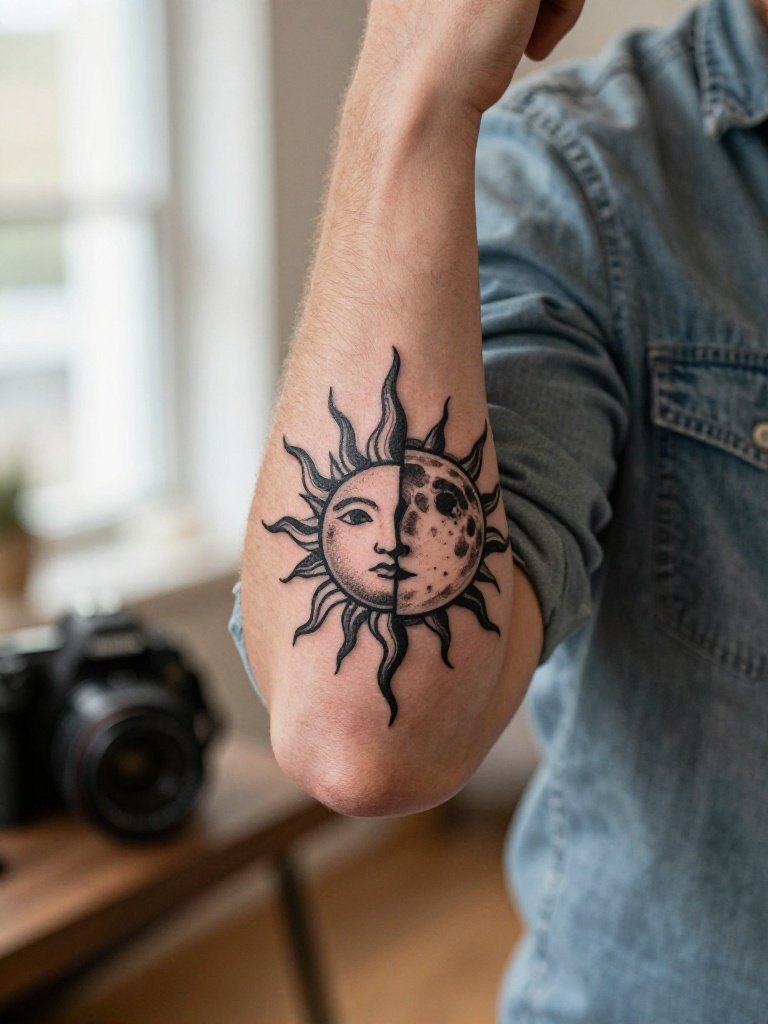
A split design puts a sun on one side of the joint and a moon on the other, meeting right at the elbow’s crease as the dividing line between them. Bold black linework carries the shapes, selective dotwork shades the sun’s rays and the moon’s craters, and the two halves stay stylistically matched so neither side looks like an afterthought.
Bend verdict: good. Splitting across the crease is a genuinely clever use of the joint’s shape. The risk is alignment: have your artist plan the sun and moon so they line up when your arm bends, not just when it is fully extended, because the piece will be seen at both.
Use slightly heavier linework on the sun’s rays to balance the moon’s shading, and keep the line weight consistent between the halves. Because both halves sit close together, this builds easily into a linked sleeve later if you add pieces above or below the joint.
13. Snake Wrap Elbow Tattoo For Men
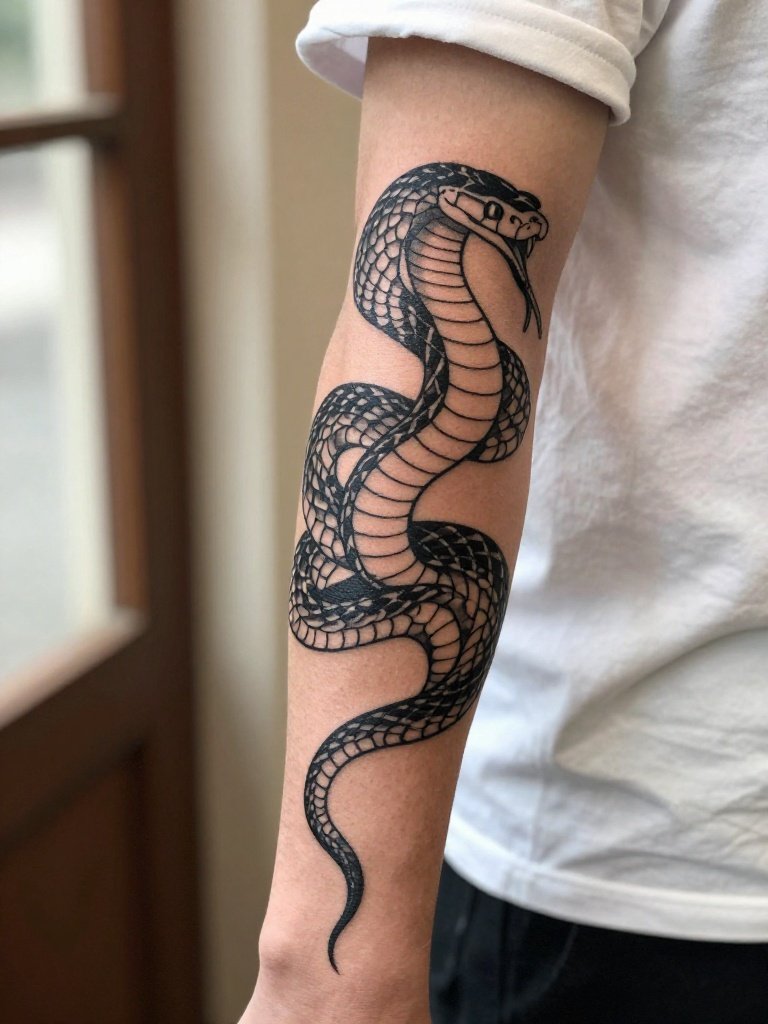
One continuous snake coils around the elbow, head and tail meeting or overlapping near the joint’s outer point, in bold black traditional style with diamond-pattern scale detailing along the body. The sinuous body uses the joint’s curve the way the compass and mandala do, but with a completely different visual rhythm, more fluid and less symmetrical.
Bend verdict: excellent. A coiled shape adapts to the joint rather than fighting it. The wrap-around composition stays legible from multiple angles as the arm moves, which is the whole point of choosing a wrap over a centered piece.
Head or tail
Decide up front whether the head faces up toward the bicep or down toward the wrist, because it changes the entire visual direction of the piece. Ask for the scale pattern to follow the snake’s natural curve rather than a flat repeated stamp, which reads more hand-drawn and less templated. Bold traditional work also heals predictably here, usually within two to three weeks, and the scale pattern gives an artist room to blend fresh linework around an older piece, so this doubles as a strong cover-up option. The same wrap logic suits serpents at larger scales, and our dragon tattoos for men guide breaks down which dragon families work with coiled compositions if you want the bigger version.
14. Above Elbow Tattoo Male Script Band
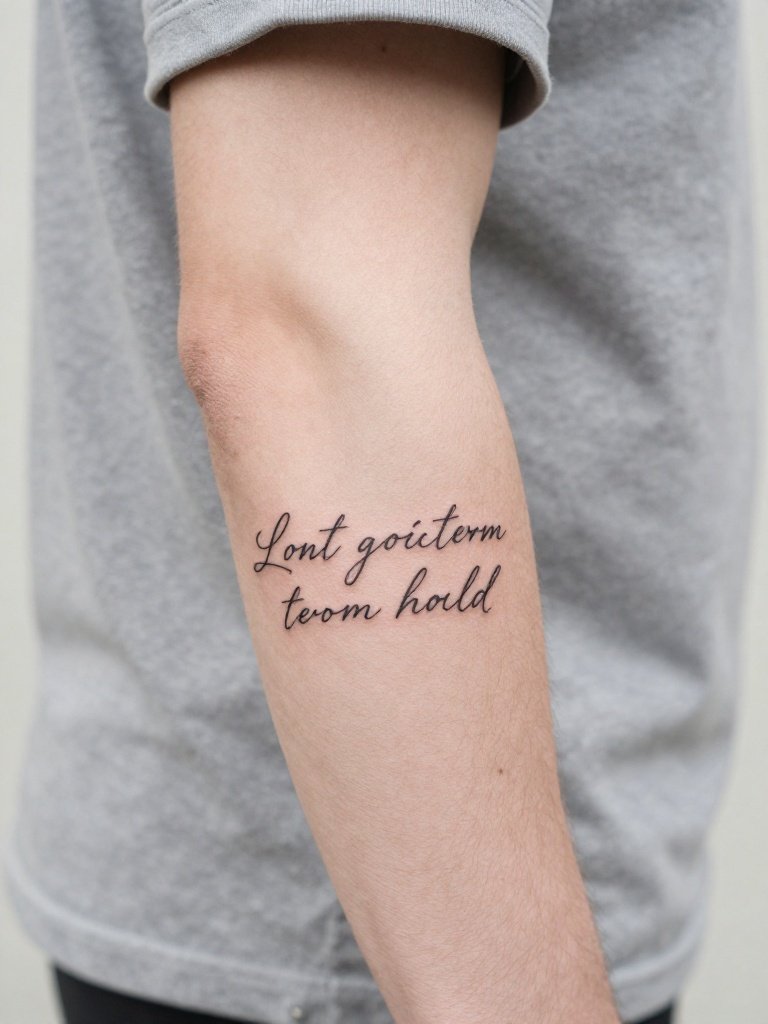
Text-based ink is the quieter alternative on this list: a short script or quote wrapping in a thin band just above the elbow crease, rather than a graphic image. Fine-line single-needle work follows the natural curve of the upper forearm, and it reads at close range instead of making a statement across the room.
Bend verdict: placement-dependent. This survives because it refuses the joint. Sitting above the crease instead of on it is the distortion-safe move, and it is why this is the only text entry on the list that actually works.
Keep the phrase short, five to seven words at most, since longer script curves awkwardly around the arm and loses legibility. Choose clean, simple letterforms over heavy flourishes, and ask for a slightly bolder line weight than you would use on flatter skin. Script is one of the first things to blur at this scale, so the placement and line weight are doing the real work.
15. Japanese Wave Elbow Tattoo For Men
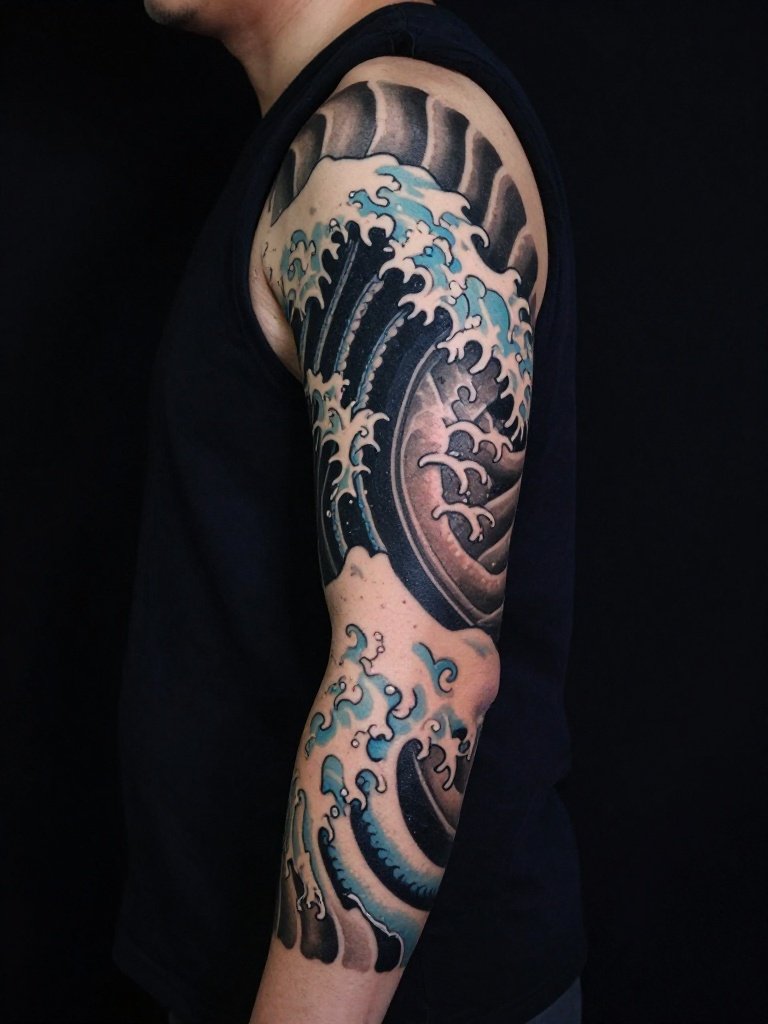
Rooted in the Hokusai tradition, this wave crest wraps the elbow with bold black outlines and layered foam details, so the wave’s curl follows the joint’s natural bend. Black and grey with selective blue or white shading for the foam highlights. It is the design on this list most clearly rooted in a specific art history rather than a modern graphic style, and it is often used as connective work between a shoulder piece and a forearm piece, the way you would see across a half sleeve build.
Bend verdict: excellent. A curl that follows the joint’s bend is bend-native by design.
Curl with the bend
Ask how the wave crest will align with the joint’s bend so the curl looks natural rather than static, and discuss the wave’s flow direction now if a full sleeve is ever the plan, because future pieces will need to connect to this one’s direction. Look for an artist with specific Irezumi or Japanese traditional experience, since wave composition and foam detailing are technical skills specific to that style. Request extra foam detailing near the joint itself, since that is where the design gets the most visual attention.
Cap vs Ditch: The Full Picture
Two placements, two different tattoos, so here is the honest comparison.
Pain. The cap reports as bone-proximity pain, deep and grinding, with vibration traveling up the arm. Reported ladders from tattoo shops commonly put the elbow point at 8 to 10 out of 10. The ditch reports as nerve pain, sharper and more electric, because two of the three main arm nerves run through the cubital groove. Reported ladders put the ditch at 7 to 9, but the character of the pain is what people remember, not the number.
Healing. Surface healing runs three to four weeks for most elbow work, longer than most arm tattoos, because the joint keeps bending while the scabs are on. Full dermal settling takes two to three months. The ditch heals slowest of all, because the fold’s constant movement disrupts the surface continuously. And the firm rule from the specialist sources: do not book a touch-up before six weeks, because the placement is still settling.
Design rules. On the cap: radial and symmetric, bold over fine, no faces, no text across the point. Above the cap: fine work is safe, which is where the script band and small minimalist designs live. In the ditch: arch-shaped designs that read when the arm bends, nothing that needs a flat canvas, and accept that this is the highest-maintenance square inch on the arm.
Vetting an Elbow Artist
The consult is where elbow tattoos get won or lost. Start with healed elbow photos, not fresh ones, ideally work from one to two years out. Fresh elbow work always looks sharp; healed elbow work shows whether the artist’s line weights and spacing survived the joint.
Ask in the consult: how do you handle linework on a convex surface? How do you design so the piece reads both straight and bent? What is your touch-up policy for this placement, and is a touch-up priced in or scheduled as standard? An artist who answers specifically has done this work.
Red flags: an artist who treats the elbow like any other placement. No healed joint work in the book. A promise that it will heal like a forearm piece. The elbow does not heal like a forearm piece, and anyone who says otherwise has not watched one heal.
What It Costs
Reported ranges from tattoo shops, not quotes, and every shop sets its own numbers. Simple designs like a classic spiderweb commonly land in the $150 to $300 range. Detailed work, mandalas, sacred geometry, biomechanical pieces, commonly runs $300 to $600. Elbow work integrated into a sleeve typically prices at $500 to $1,500 and up as part of the larger build.
Why the spread. Pricing here reflects hours on the spot and design complexity, not the size of the area. A small piece on the joint can take longer than a larger piece on the forearm because the artist works slower around the curve. Elbow work is also frequently bundled into sleeve sessions, which is worth discussing if a sleeve is the long-term plan, because standalone small sessions on a painful placement are the least efficient way to buy this work.
Aftercare for a Bending Joint
This placement gets its own protocol, because the joint never stops moving while it heals.
Do not deep-bend in the first days. Let the initial set happen with the arm as straight as comfort allows. Hydrate scabs three to four times a day with a rich balm, because cracking happens when scabs dry out and the joint bends, and hydrated scabs flex instead of splitting. Keep the arm extended when resting for the same reason: give the surface every chance to close without fighting movement.
Wear loose sleeves that do not rub the fresh work. Skip heavy arm workouts for two to three weeks, because repeated flexing under load disrupts healing ink. And when the itch phase hits, pat, do not scratch: the skin over a joint is thin, and a scratched scab here takes ink with it.
The Aging Ledger
What degrades first on an elbow: fine lines, dotwork density, and bright color. The mechanics are simple. The joint stretches the skin thousands of times a day, friction from sleeves and desks adds up, and the cap sits in the sun whenever a sleeve is rolled up. Fine detail spreads; color washes out; bold black holds.
Realistic framing: year one is crisp. Years two to three are when most people notice the first softening, especially in dotwork and color pieces. Touch-ups within six to twelve months are common for detailed work; bold black pieces often hold two to three years before needing a pass, and the ditch needs attention sooner than the cap in almost every style.
The two maintenance rules that actually matter. First, daily SPF on the exposed joint, because the elbow is one of the most sun-exposed spots on the arm and sun is the fastest accelerant of fading. Second, design for the aging you expect: bolder line weights, darker anchors, and fewer micro details if you want the piece to survive the bend for a decade.
Elbow-to-Sleeve Connections
Everyone says elbows “complete” sleeves. The useful direction is the reverse: plan the elbow as the future hub of a sleeve, and everything gets easier.
Design the elbow piece so later work can connect to it. Leave bridge space: unfinished edges, open-ended web strands, mandala bands that taper rather than end. Filler bands and radiating accents are the natural connective vocabulary, because they were built to extend. A standalone portrait on the cap, beautiful on its own, gives a future sleeve nothing to hold onto.
The reverse planning matters too. If you already have a sleeve with an unfinished elbow, match the elbow piece to the existing work’s line weight and style, not to whatever is trending. And know the cascade effect: once the elbow is done, the surrounding arm suddenly looks unfinished. That is not a sales pitch. It is the most common thing people report after getting the joint done, and it is worth expecting before you book.
For how full-arm compositions get planned across sessions, our sleeve tattoos for men guide covers the momentum and budgeting side in depth.
Quick Comparison
| Design | Bend Survival | Pain (reported) | Healing | Touch-Up |
|---|---|---|---|---|
| Compass Rose | Excellent | 8-10 | 2-3 wks | 6-12 mo |
| Shattered Blackwork | Excellent | 8-10 | 3-4 wks | 6-12 mo |
| Neo-Traditional Lotus | Good | 7-9 | 3-4 wks | 8-12 mo |
| Spiderweb | Excellent | 8-10 | 2 wks | 6-12 mo |
| Dotwork Mandala | Excellent | 7-9 | 2 wks | 6-12 mo |
| Minimalist | Placement-dependent | 6-8 | 1-2 wks | 2-3 yrs |
| Tribal Bands | Excellent | 8-10 | 3-4 wks | 2-3 yrs |
| Biomech Hinge | Excellent | 8-10 | 3-4 wks | 6-12 mo |
| Skull | Good | 7-9 | 2-3 wks | 2-3 yrs |
| Wolf Portrait | Risky on cap | 8-10 | 4 wks | 6-12 mo |
| Sacred Geometry | Excellent | 7-9 | 2-3 wks | 2-3 yrs |
| Sun and Moon | Good | 7-9 | 2-3 wks | 6-12 mo |
| Snake Wrap | Excellent | 7-9 | 2-3 wks | 2-3 yrs |
| Script Band | Placement-dependent | 6-8 | 1-2 wks | 2-3 yrs |
| Japanese Wave | Excellent | 8-10 | 3-4 wks | 6-12 mo |
Frequently Asked Questions
Does an elbow tattoo hurt more than other spots on the arm?
Generally yes, and in two different ways. The outer cap hurts with a deep, vibrating bone pain that most people rate near the top of the arm’s scale. The inner ditch hurts with sharper nerve pain because the arm’s nerves pass through the fold. Neither one is a casual first session.
What is the smartest elbow tattoo for a first piece here?
A small, simple design, or the classic spiderweb. Both are short sessions, heal quickly, and give you a real read on how your skin handles ink in this spot before you commit to something larger and more demanding.
When can I train arms again after an elbow tattoo?
Hold off on heavy arm workouts for two to three weeks. Repeated flexing under load disrupts the healing surface, and the elbow is already the slowest-healing spot on the arm. Light movement is fine; loaded bending is the enemy.
Will my elbow tattoo need touch-ups?
Almost certainly, and that is normal here. Detailed and color work commonly needs a touch-up within six to twelve months; bold black pieces often hold two to three years, and ditch work needs attention sooner than the cap. Touch-ups are the biology of the placement, not a sign something went wrong.
What do elbow tattoos mean?
There is no single meaning. The spiderweb has carried different associations depending on context, and everything else here is generally chosen for its visual and personal symbolism rather than any universal code. Be skeptical of meaning lists that claim otherwise.
Final Thought
Fifteen designs, but the real lesson is in the bend. The elbow rewards the pieces that were drawn for a joint instead of a flat template: the web that mirrors the curve, the mandala that radiates from the point, the snake that wraps the bend. Run the five-angle test on anything you consider, pick the piece that survives straight and bent, and let the joint do half the design work. That is what separates an elbow tattoo from a tattoo that happens to sit on an elbow.