A neck tattoo is the most visible commitment in tattooing. Not the biggest, not the most expensive, but the one you cannot take off for a job interview, a wedding photo, or a bad morning. That is the whole premise of this article: the ideas matter, but the decision around them matters more.
So here is the gate before the gallery. Many reputable artists refuse to tattoo necks on clients whose other visible space is still empty. That is not an insult. It is a quality signal from people who watch clients regret rushed neck work for a living. If two or three good shops tell you to wait, believe them.
What follows: eighteen ideas organized by the neck zone they belong to, each with the design analysis that decides whether it works on a curved, moving, sun-exposed surface. Then the sections the galleries skip: what ages first, the career conversation done honestly, how to vet a neck specialist, real pricing, and the removal ledger nobody prints.
Are You the Right Person for a Neck Tattoo?
Three honest questions. Answer them before you scroll.
Do you have other tattoos already? Shops treat the neck as a second act, not an opening. A bare neck on a bare body reads as impulse, and most established artists will say so to your face. This is the norm across good studios, not one shop’s policy.
Can you live with it showing everywhere? Side neck and throat designs show above every shirt collar ever made. The nape hides under a collar or longer hair. The concealment math is simple and unforgiving, and it is covered properly below.
Are you choosing it, or chasing it? Neck tattoos photograph well and trend hard. If your reason is a photo you saw last week, run the trial below. If your reason survives ninety days, it is yours.
Wear It Before You Ink It
The cheapest insurance in tattooing. Buy a pack of temporary tattoos close to the design and zone you want, wear one for two weeks straight, and watch what happens: who notices, how it feels in the mirror every morning, whether you still like it on day fourteen.
Then do the ninety-day version. Print the design at real size, tape it to your bathroom mirror, and look at it every day for three months. Designs you still love on day ninety are designs. Designs you are bored of by week six were never designs, they were moods.
Bring the temporary-tattoo photos to your consult. An artist who sees you tested the placement takes you more seriously, and the conversation starts from evidence instead of enthusiasm.
1. Side Neck Script Tattoo for Men – One Word, Maximum Impact
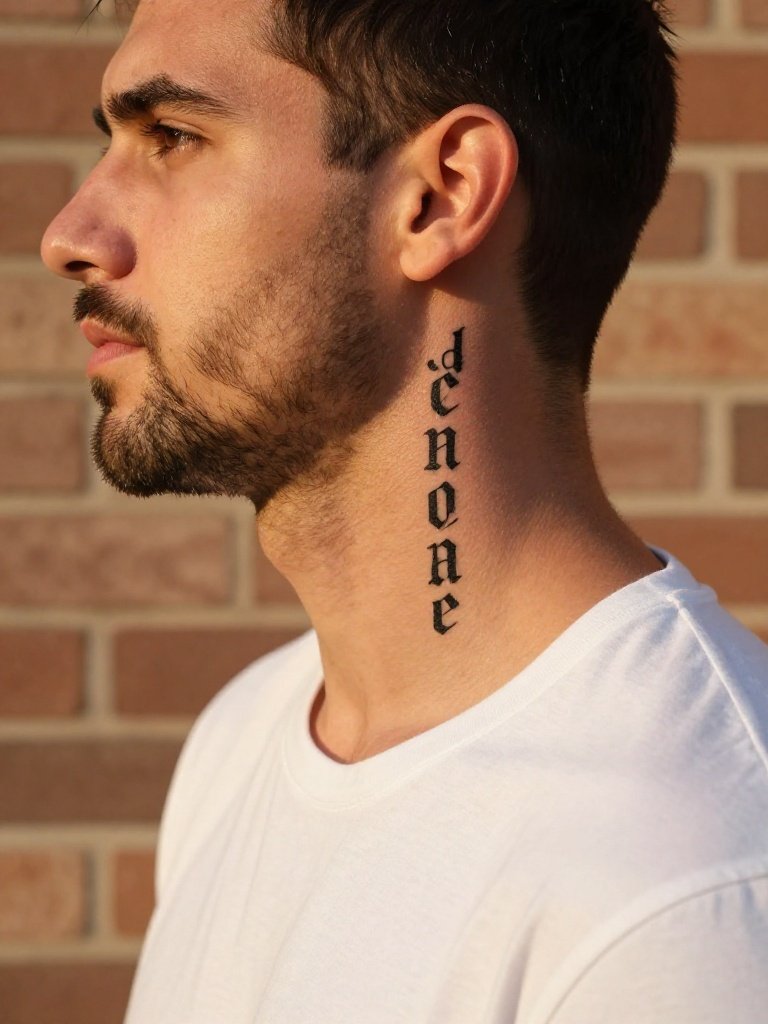
The side of the neck is the most popular men’s zone for a reason: it sits in the natural sightline, it follows the jaw-to-collar slope, and it photographs clean. A single word in strong lettering uses that visibility without asking the skin to do more than it can.
The design discipline is restraint. One word, not a sentence. Script across the side neck has limited horizontal run before it collides with the ear or the collarbone, and two words either shrink past legibility or wrap awkwardly around the curve.
One word max
Lettering style carries the whole piece. Block or blackletter reads bold and masculine; fine script reads elegant but thins out faster under sun and friction. Ask for the letterforms at final size on paper first, because script that looks good on a screen often needs thickening to survive on neck skin.
2. Behind-the-Ear Micro Tattoos – A Subtle Men’s Neck Tattoo
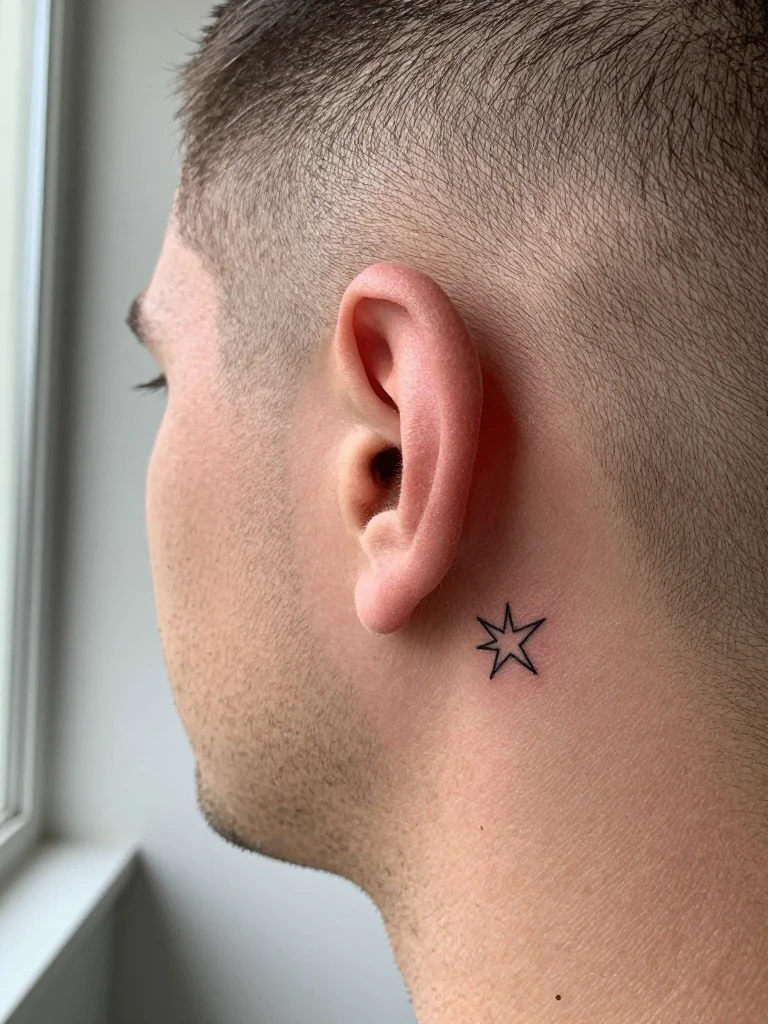
Behind the ear is the quietest neck placement: small, partially hidden by the ear itself and by hair, and the least painful of the neck zones. It suits a first visible tattoo the way a whisper suits a loud room.
The trade-off is scale. Micro means micro here, and micro means maintenance. Fine detail behind the ear sits on thin skin over bone with constant sun exposure, so expect the earliest touch-up of any idea on this list. Keep the design to one simple element, a tiny symbol or two or three letters, and let the placement be the statement.
Brief the artist on hair. If you wear your hair short, the piece is fully visible; if it grows out, it hides. Decide which version you are getting before the session, not after.
3. Front Neck Mandala – A Symmetrical Neck Tattoo for Men
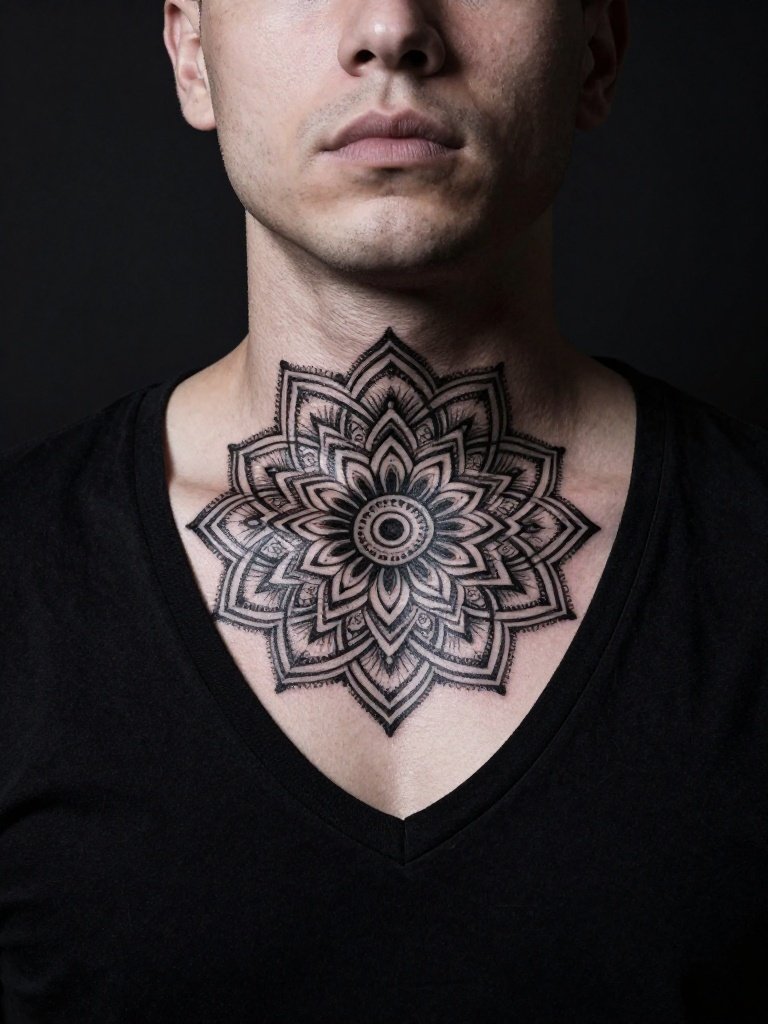
The front of the throat is the boldest canvas on this list and the most punishing: shops consistently rate throat pain at the top of the neck ladder, and the skin moves over the Adam’s apple with every swallow. A mandala earns that real estate because symmetry gives the eye something to lock onto across a difficult surface.
Geometry is everything here. The design must be mirrored perfectly across the throat’s centerline, because any drift reads instantly on a symmetric pattern. Ask the artist to stencil it, photograph it straight-on, and check the mirror image before any ink goes in.
Mirror test
Mandala detail is dense by definition, which is an advantage on the throat: more ink, more staying power. But dense detail also means a longer session on the most sensitive zone. Split it across two sittings if the artist offers; a rushed mandala on a flinching throat is how symmetry dies.
4. Coiled Snake – A Dynamic Men’s Neck Tattoo
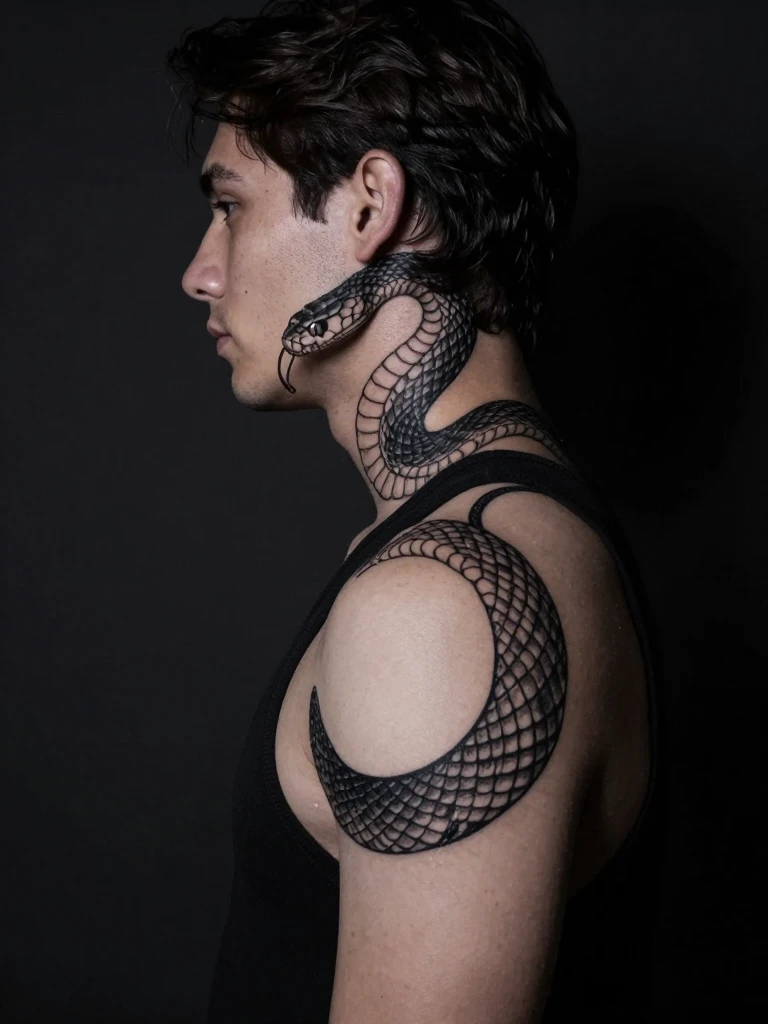
A snake’s body is built for the neck’s geometry. It coils, it wraps, it follows curves instead of fighting them, which is why this motif keeps appearing on side necks across every style from blackwork to neo-traditional.
Composition decides the outcome. The head should land on the flattest available panel, usually the upper side neck below the ear, while the body coils down toward the collar. A snake that runs straight down reads as a stripe; a snake that coils reads as a design. The difference is one conversation at the stencil stage.
Scale is the risk. Too small and the coils merge into a blob within a few years; too large and it collides with the jawline. Palm-sized is the floor for a coiled design with any detail in the scales.
5. Nape of the Neck – A Hidden Tattoo for Men
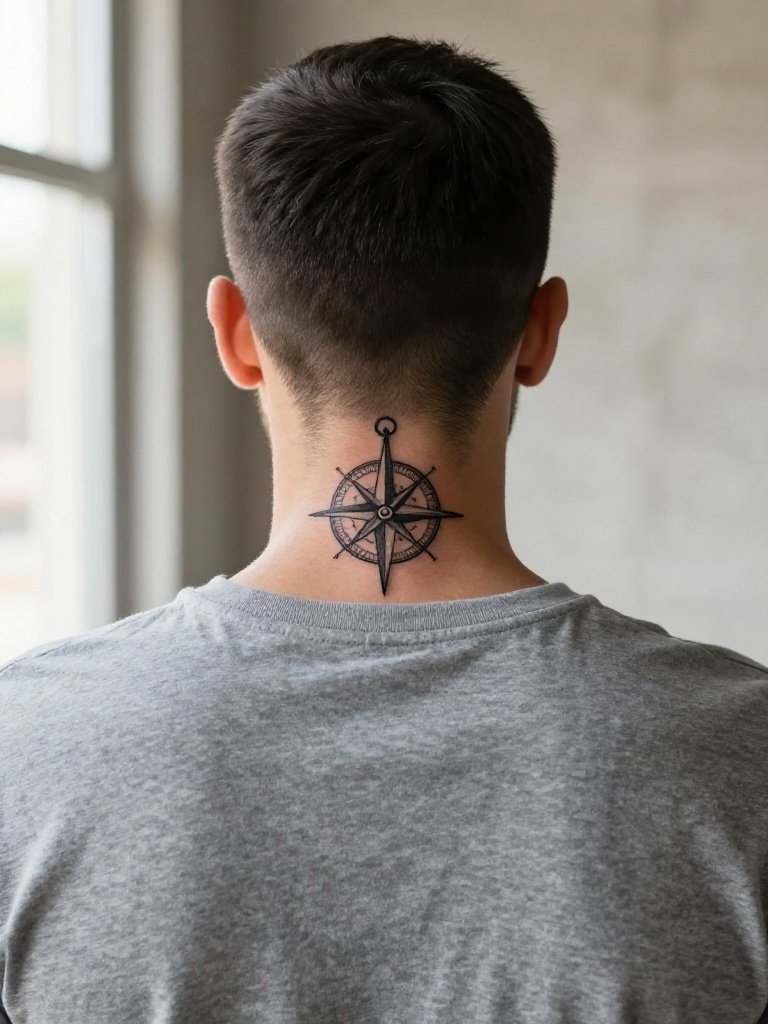
The nape is the strategist’s placement. It hides under a collar, under longer hair, and out of your own sightline, which makes it the only neck zone that functions as a private tattoo. It is also among the least painful neck placements, and it heals with less drama than the front.
That privacy changes what the design can be. Without the pressure of constant visibility, the nape suits personal work: memorial dates, small symbols, the designs you got for yourself rather than for the room. If you want more hidden-placement inspiration, these nape tattoos show how much variety fits back there.
Hide test
Test the concealment before you commit. Put on your actual work shirts, your actual jacket, and check a mirror from the side and back. Hair length matters as much as collar height here. The nape hides well, but only under the conditions you actually live in.
See Also: 14 Iconic Dragon Tattoo Men Ideas With Insider Tips
6. Lion Portrait – A Powerful Men’s Neck Tattoo
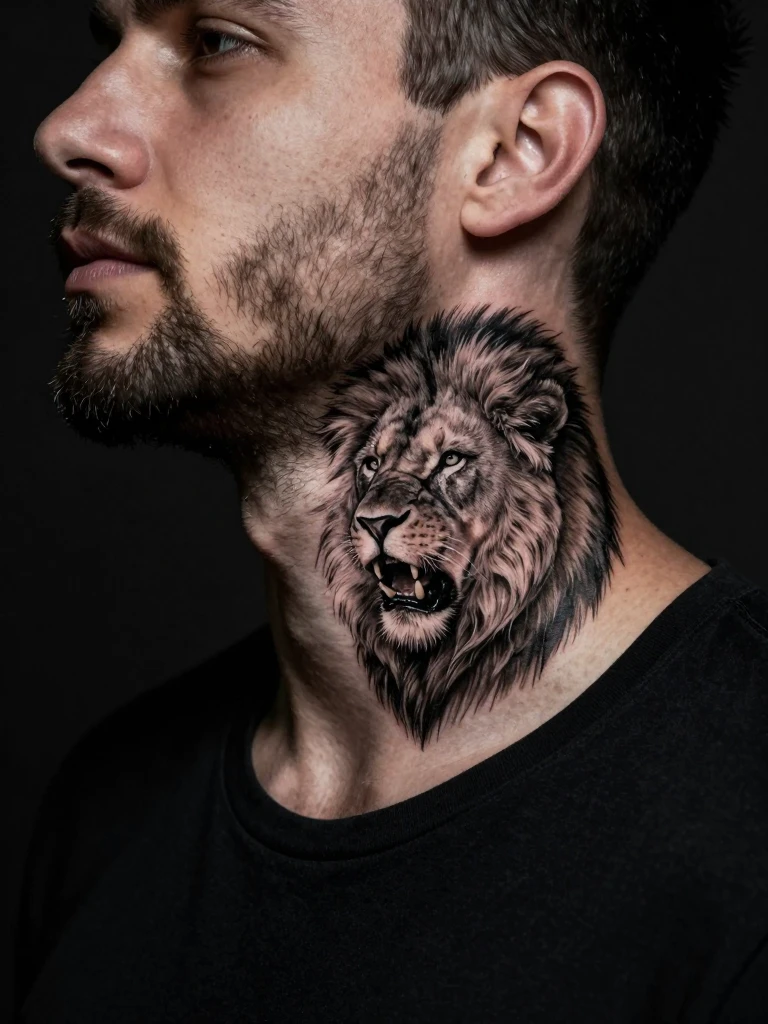
The side neck fits a lion’s head the way a frame fits a portrait: the jawline gives the top edge, the collar gives the bottom, and the mane fills the middle. It is one of the most requested men’s neck designs because the geometry is so forgiving.
The mane is the technical crux. A mane rendered in layered blackwork holds for years; a mane rendered in fine detail softens fast on a high-movement, high-sun surface. Ask to see the artist’s healed animal portraits specifically, not just fresh ones, because mane texture is where aging shows first.
Face direction matters more than people think. A lion facing forward reads confrontational; a lion in three-quarter profile reads composed. Decide the attitude before the stencil, because you will wear it at eye level with everyone you meet.
7. Geometric Blackwork – A Modern Neck Tattoo for Men
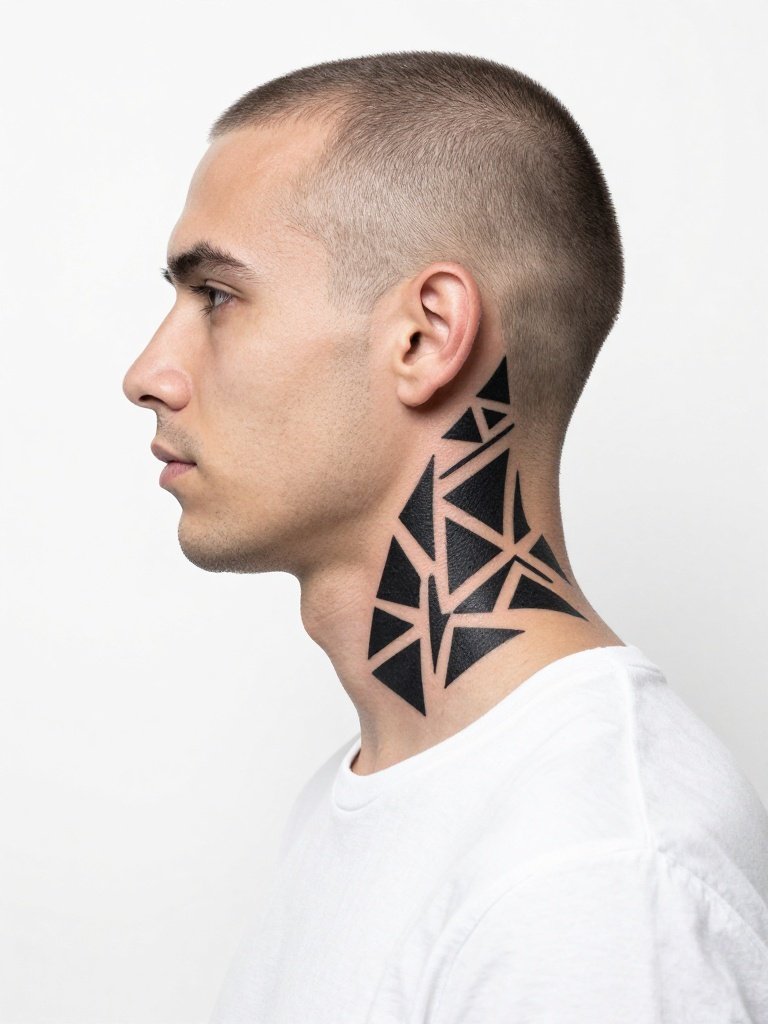
Geometric blackwork and the side neck are a natural pairing: bold shapes read clearly at conversational distance, and the style’s solid fills age better than almost anything else on a sun-exposed placement. It is the lowest-maintenance aesthetic on this list.
Precision is the entire style, and the neck is not a flat canvas. Confirm the artist maps the geometry onto your specific neck, not onto a template, because a pattern drawn for a flat sheet will warp across the jaw-to-collar curve. Ask how they handle the ear-to-jaw transition; that answer tells you whether they have done this before.
Line drift
Keep the pattern bold. Hairline geometric detail on the neck drifts as the skin moves, and thin lines that look crisp in the shop soften within a couple of years. If you love fine geometry, the nape holds it better than the side.
8. Eagle or Bird – A Symbolic Men’s Neck Tattoo
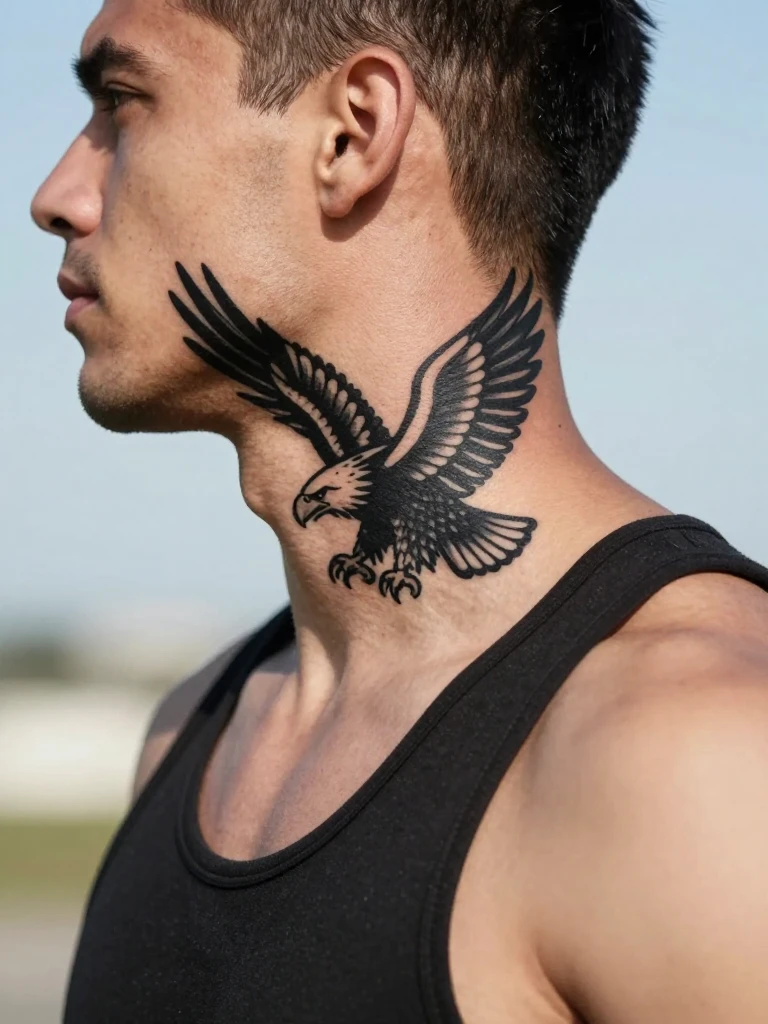
Wings want width, and the neck gives height, so this design lives or dies on how the artist solves that mismatch. The strong versions compress the wingspan into a vertical composition: wings folded, bird diving, or the head and shoulders as the focal point with wings suggested rather than spread.
Placement flexibility is the advantage. An eagle head fits the side neck cleanly; a diving bird suits the nape’s vertical drop; a small bird in flight works behind the ear. Match the pose to the zone instead of forcing one drawing onto every spot.
On symbolism, keep it honest. Birds carry plenty of traditional associations, but the meaning of your eagle is whatever you decide when you get it. Nobody reading it on the street knows your story, and that is fine.
9. Cross – A Classic Tattoo for Men on the Neck
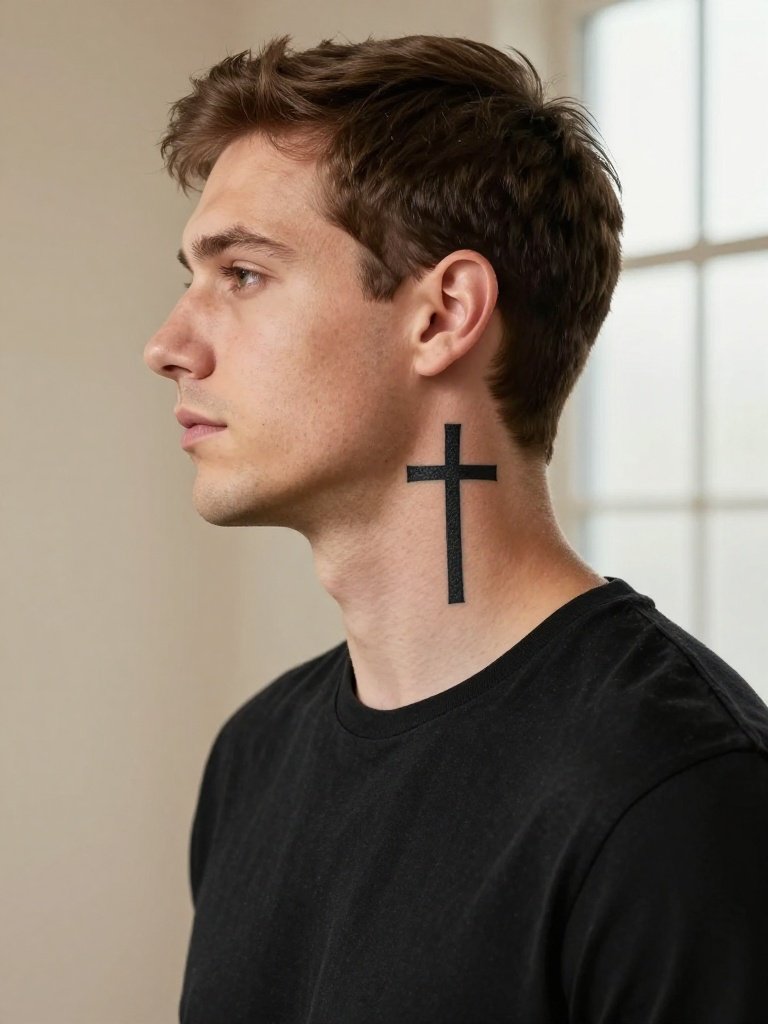
The cross is the most traditional neck motif for men, and its strength is simplicity: a clean shape that reads instantly at any size, on any zone. Side neck, nape, behind the ear, even the throat, it works everywhere because it asks so little of the skin.
That simplicity is also the demand. A plain cross has nowhere to hide weak linework. Every wobble shows, every blowout shows. This is a design to give to your most precise artist, not your cheapest, and the consult should include a straight discussion of line weight on neck skin.
Style the cross to the zone. A bold black cross suits the side neck; a fine-line cross suits behind the ear; an ornate or stone-textured cross needs the nape’s flat panel to hold its detail.
10. Thorn Necklace – An Edgy Men’s Neck Tattoo
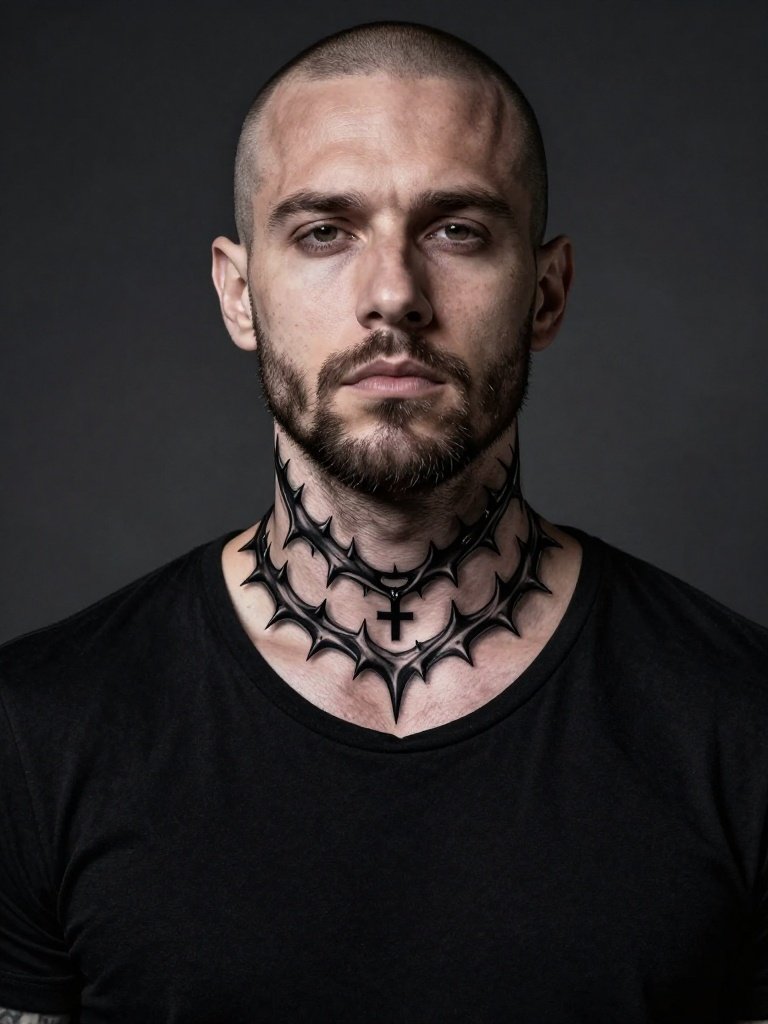
A thorn band circling the throat reads as a necklace made of barbs, which is exactly the point: it uses the neck’s cylindrical shape as the design rather than fighting it. Few motifs fit the throat zone this naturally.
The collar line is the practical constraint. The band must clear your actual shirt collars, or every workday becomes a friction session on healing or healed ink. Bring the shirts you wear most to the consult, or at least know your collar height. This is a design detail nobody mentions and everybody should.
Collar clearance
Pain is real on this one. A full circle means the artist works the front throat, the most sensitive zone, plus the sides in one design. Plan for the throat passes to be the hardest part of the session, and do not schedule it the day before anything that requires a collar.
11. Minimalist Compass or Arrow – A Small Neck Tattoo for Men
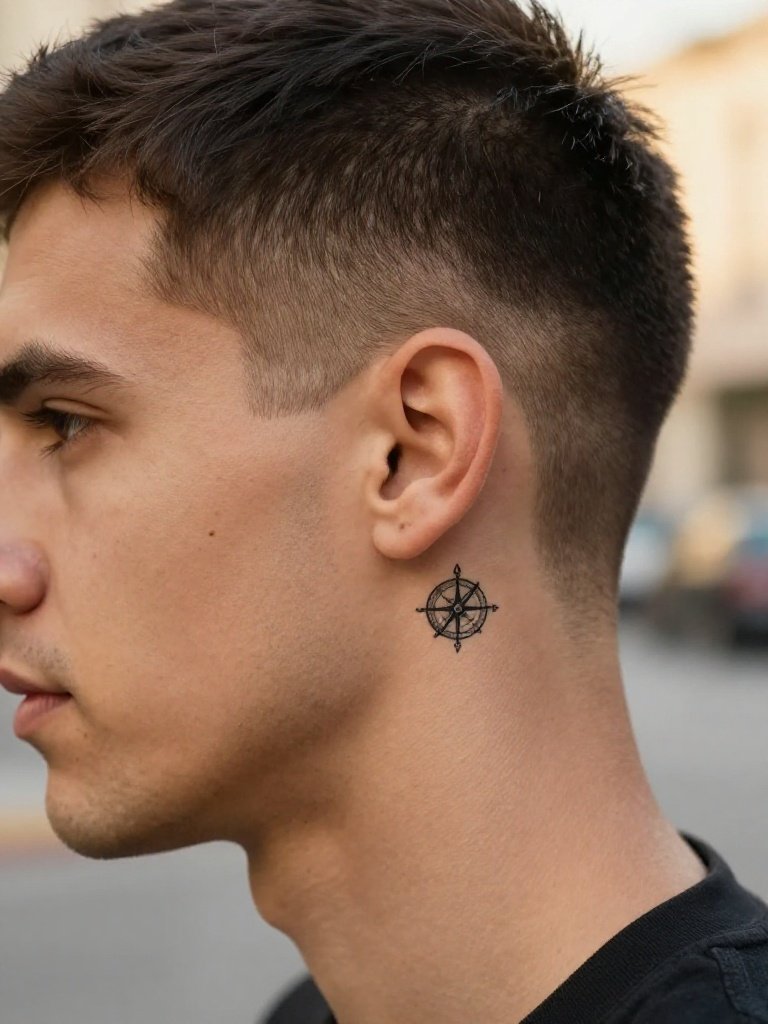
Small, clean, directional: the compass or arrow is the nape’s signature design. It sits on the flat panel at the back of the neck, points up or down the spine, and stays completely out of your own sightline, which suits people who want the tattoo for themselves.
Direction is a real decision here. An arrow pointing up reads as aspiration; pointing down reads as grounding; a compass rose is neutral. It sounds minor until you realize you chose the direction you will never see. Pick the one whose meaning you want, not the one that photographs best.
Keep it truly minimal. The nape panel is small, and a compass loaded with extra banners and stars crowds fast. One clean element, well placed, beats a busy one.
12. Dragon Wrap – A Mythological Neck Tattoo for Men
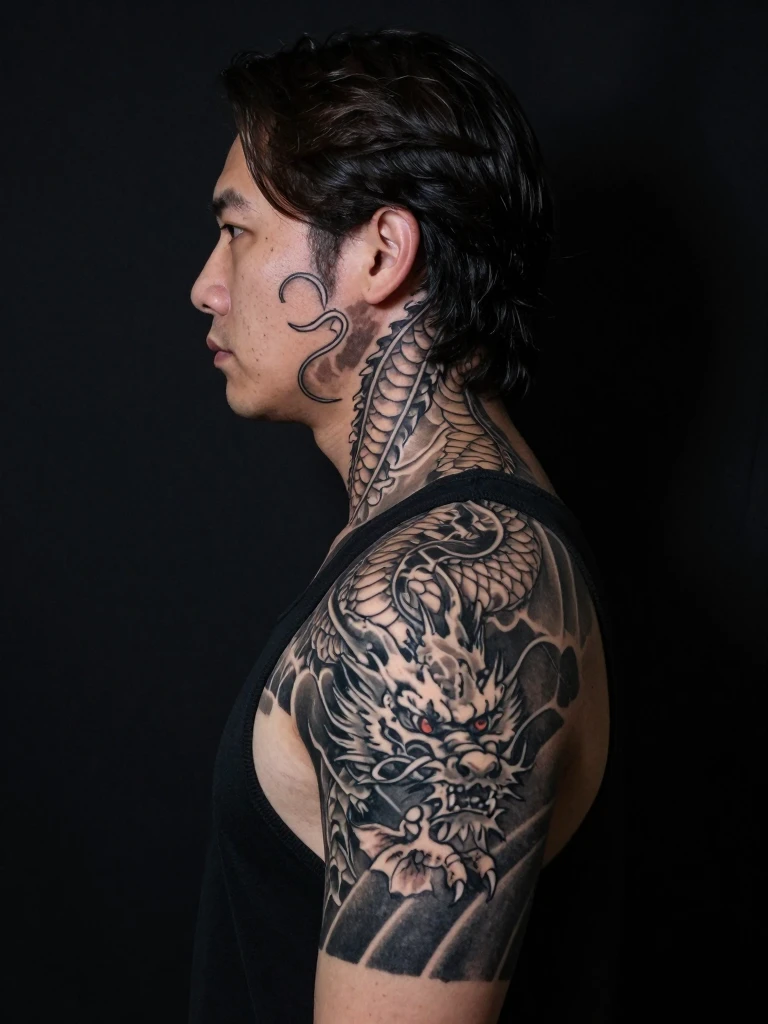
A dragon wrapping the neck is the most ambitious idea on this list: a full composition that uses the entire cylinder, usually with the head as the focal point on the side or front and the body coiling around. It is a commitment piece disguised as a single design.
Continuity is the technical challenge. The design has to read as one creature from every angle, which means the artist is composing in the round, not on a flat plane. Ask to see the full wrap drawn as a flat layout before the session; if the artist cannot show you how the head connects to the tail around the back, they have not planned it.
Wrap continuity
This is a multi-session piece on high-pain territory. Budget for at least two sittings, and expect the throat passes to set the pace. A dragon wrap rushed into one session is how the back half ends up weaker than the front.
13. Abstract Shapes – A Unique Men’s Neck Tattoo
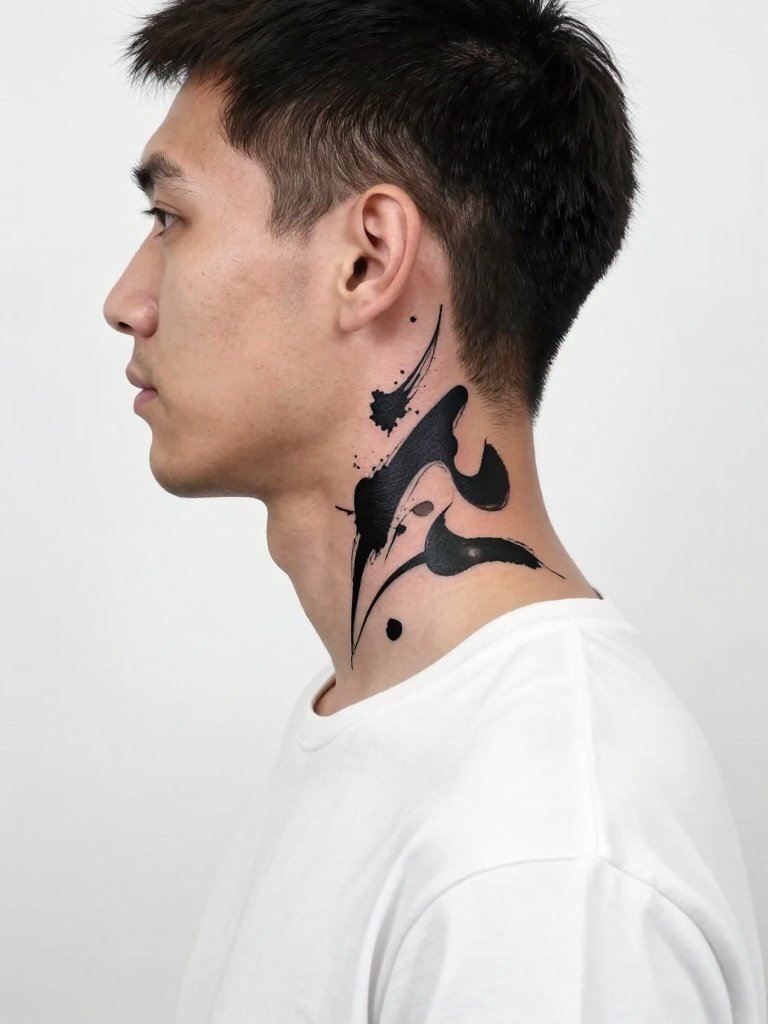
Abstract work frees you from every motif on this list, which is its appeal and its risk. Without a recognizable subject, the design lives entirely on composition: balance, negative space, and how the shapes sit on the neck’s curves.
The consult matters more here than for any literal design. Bring references for the feeling, not the drawing, and let an artist who actually works abstract translate it. Copying someone else’s abstract piece defeats the purpose; the style only works as original work.
Scale abstract up slightly. Small abstract shapes on the neck read as random marks; larger ones read as intentional composition. The side neck gives the most room to let shapes breathe.
14. Floral – A Refined Neck Tattoo for Men
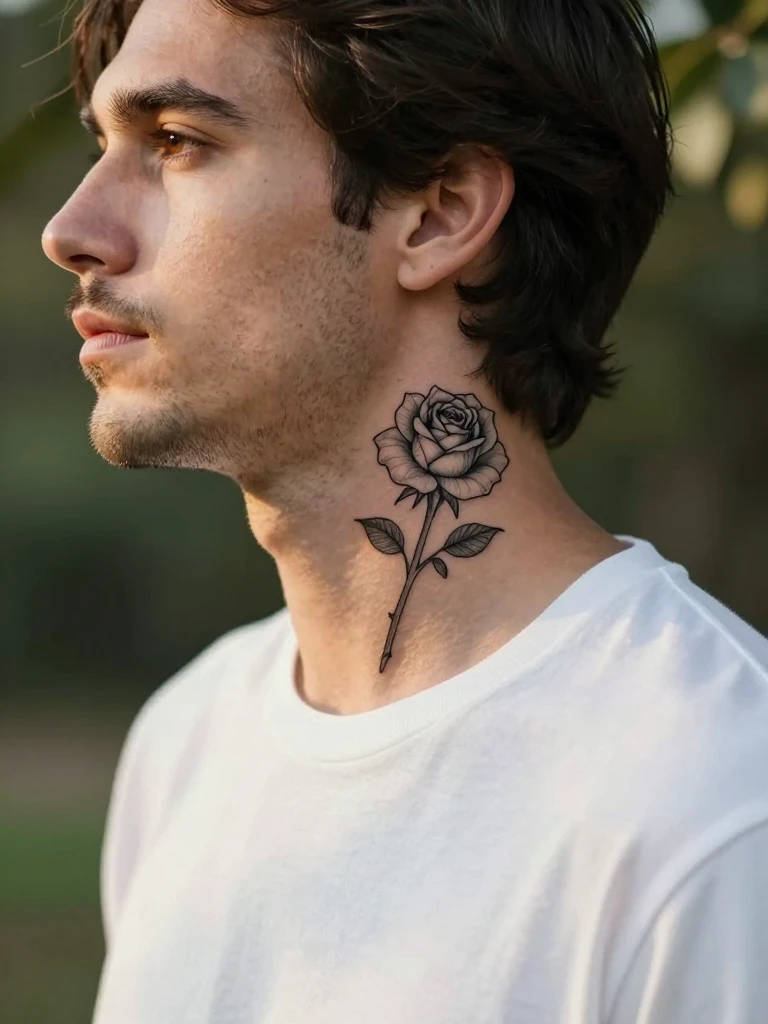
Floral neck work on men has moved from edge case to established choice, and the side neck suits it: stems follow the jaw-to-collar slope naturally, and blooms give the artist places to put detail without crowding. Roses, peonies, and cherry blossom all translate well.
The aging math is honest. Petals rendered in fine detail soften faster on the neck than anywhere except the hands, thanks to sun and constant movement. Bold blackwork florals hold far better than delicate fine-line ones. Choose the rendering for the placement you have, not the reference photo you saved.
Fading softness
Color is a maintenance decision here. Black and grey florals age gracefully on the neck; color needs sun discipline and earlier touch-ups. If you want color, commit to the sunscreen habit before you commit to the tattoo.
15. Spider Web – An Iconic Men’s Neck Tattoo
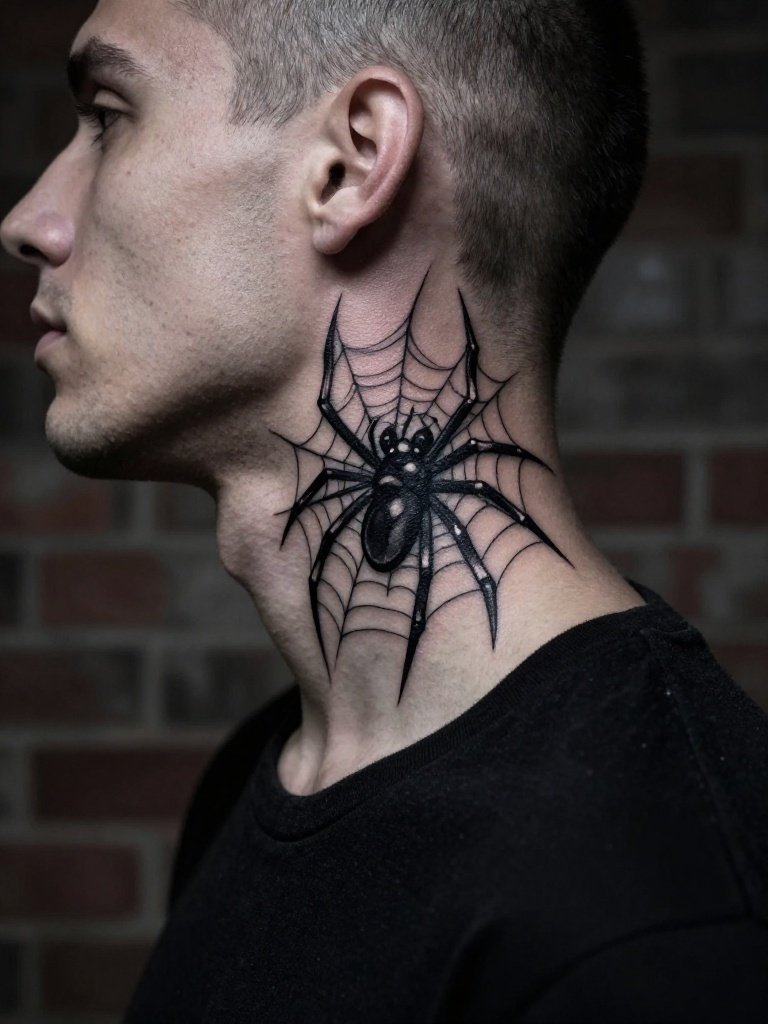
The spider web carries more cultural baggage than any other design here, and that deserves a straight sentence: it has associations, including prison-related ones, that you do not control once the ink is in. Know what you are wearing before you wear it. If the history gives you pause, that pause is the answer.
Design-wise, the web suits the spots where skin stretches over bone: the side of the neck, behind the ear, the elbow-adjacent zones. The radiating lines need a center point, and the neck’s curve gives the web a natural anchor.
Keep it small and clean. A web is linework, and linework on the neck either holds crisp or it does not. This is a precision piece, so vet the artist’s linework the way the vetting section below describes.
16. Wolf – A Loyalty-Inspired Neck Tattoo for Men
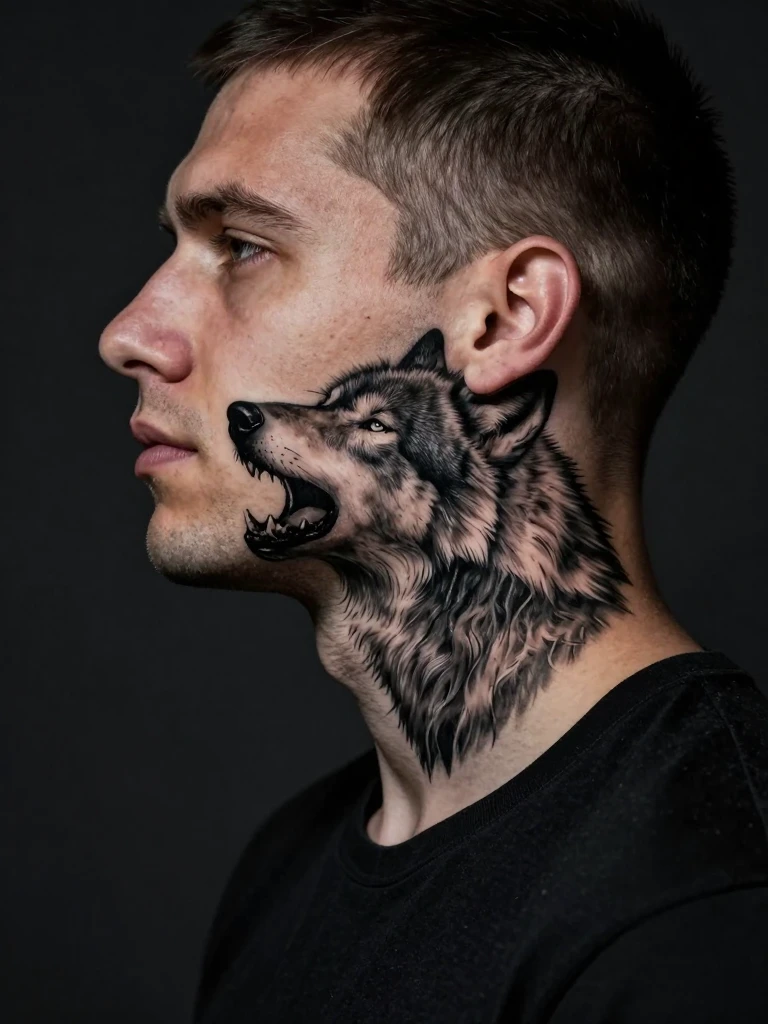
The wolf works the same frame as the lion: head-and-shoulders portrait fitted to the side neck’s natural panel, fur texture filling the middle. Where the lion reads power, the wolf reads pack, loyalty, endurance. Same geometry, different story.
Fur is the aging variable. Layered fur texture in black and grey holds; single-needle fur detail blurs on a placement that never stops moving. Ask the artist how they build fur at neck scale, and listen for spacing and line weight in the answer, not just confidence.
The eyes carry the portrait. A wolf’s gaze direction changes the whole read, direct stare versus turned head, so settle it at the stencil stage. At conversational distance, the eyes are what people actually see.
17. Birth Year or Roman Numerals – A Personal Men’s Neck Tattoo
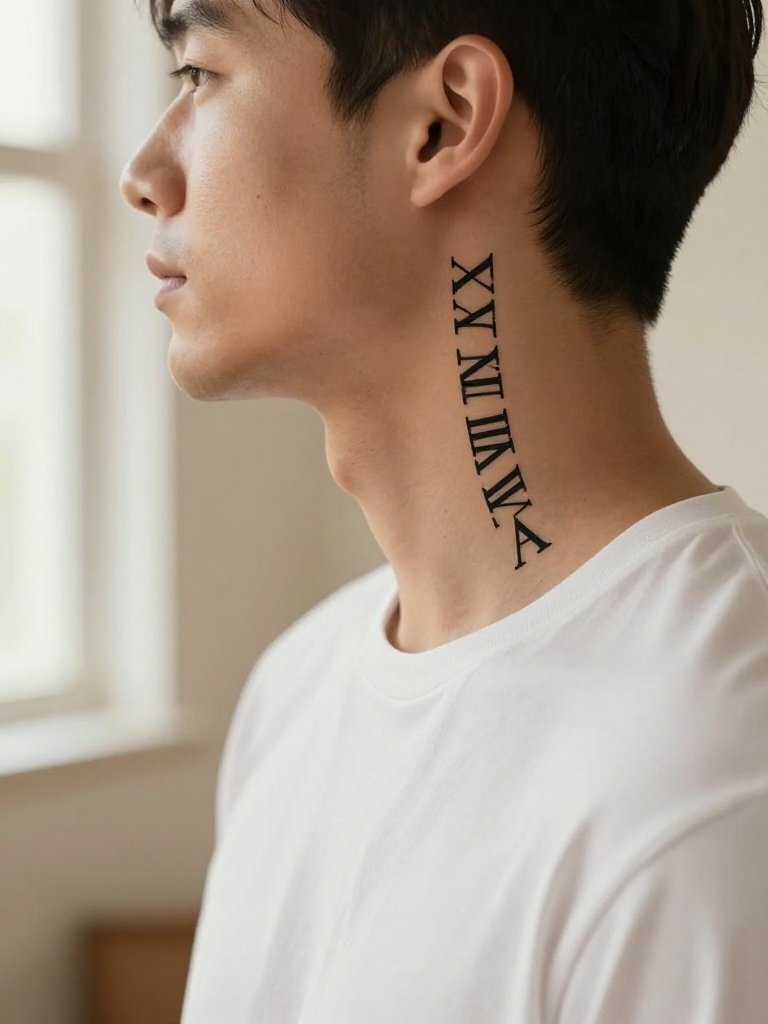
Dates are the most personal small tattoo, and the neck gives them weight: a birth year on the nape or side neck turns four digits into a statement. Roman numerals add a classical frame that suits the formality of the placement.
Typography is the whole design. The font choice matters more than the date itself. Roman numerals in a weak font look like a receipt; in a strong serif or blackletter they look carved. Ask for three font options at final size, and compare them on paper, not on a screen.
Font check
Placement logic: the nape keeps dates private, the side neck makes them public. A birth year is forever either way, so choose the visibility deliberately. Behind the ear splits the difference, visible but small.
18. Full Neck Tribal – The Boldest Neck Tattoo for Men
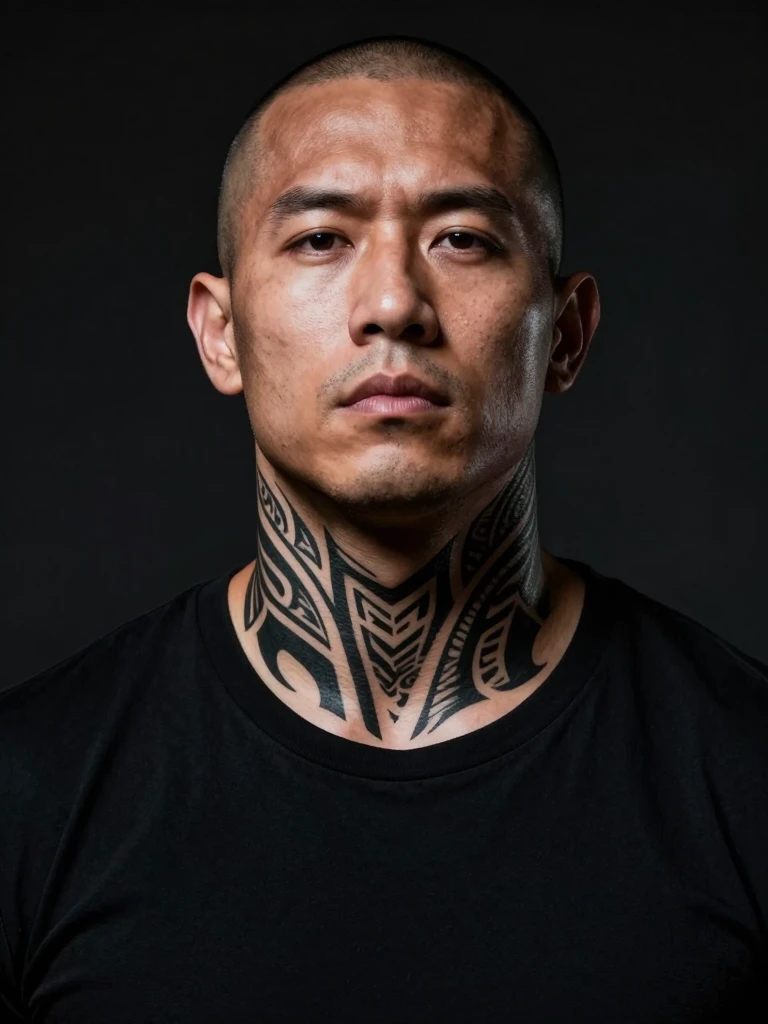
Full neck tribal is the maximum-commitment option: bold blackwork wrapping the entire neck, usually flowing from behind the ears down to the collarbone. It does not hide, it does not whisper, and it cannot be lasered away cheaply. Everything in the removal section below applies double here.
The pattern must be drawn for your neck, not pulled from flash. Tribal pattern logic follows the body’s contours, and a neck has more complex curves than an arm. Work with an artist who specializes in blackwork or tribal, and expect a custom drawing process, not a same-day piece. If you want to understand how bold blackwork is planned before it touches a neck, our tribal tattoos for men guide covers the style’s rules.
Commitment check
This is the design where the decision gate at the top of this article matters most. If any part of you is unsure, you are not ready for this one. A full neck piece closed off from removal, from cover-ups, and from professional camouflage is a life decision wearing a tattoo’s clothes. Sit with it for the full ninety days, then sit with it longer.
Read the Neck Like a Map
The neck is not one placement. It is five zones with different pain, different visibility, and different geometry, and the design has to match the zone.
Behind the ear is small, low pain, partially hidden. It suits micro designs and punishes detail.
The nape is the flat panel at the back, moderate pain, the most concealable. It suits vertical designs, dates, and anything you want to keep private.
The side neck is the showcase: moderate-high pain, zero concealment, the jaw-to-collar slope. It suits portraits, script, and anything meant to be seen.
The front throat is the hardest zone: highest pain, skin moving over the Adam’s apple, always visible. It suits only designs that earn it, symmetric pieces and bold bands.
The full wrap is all of the above at once. It suits nothing tentative.
Three geometry facts nobody mentions. The Adam’s apple distorts lines placed directly over it, so designs should frame it, not cross it. The ear-to-jaw transition is where side pieces either flow or die; the artist has to plan that corner. And the collar line is where neck work meets everything else: a piece that runs to the collarbone can connect into chest or sleeve work, which is a planning decision to make before the first session, not after. If the neck piece will grow downward, read our sleeve tattoos for men planning guide first.
What Ages First
The neck fades faster than protected placements. That is the consensus across shops and guides, and the reasons are mechanical: near-constant sun, skin that never stops moving, collar and seatbelt friction, and thinner skin with faster cell turnover.
What degrades first, in order: fine linework softens, color washes out, bold black holds. A fine-line script on the side neck will need attention years before a blackwork band on the same spot. Plan the rendering for the placement, not the other way around.
Year one looks sharp. Years three to five bring the first softening, mostly in the finest lines. The typical touch-up window for neck work is every five to seven years, earlier for fine detail, later for bold black. Budget it as part of the tattoo’s cost, not as a surprise.
Beards complicate the throat and jawline zones. Growing a beard through a fresh throat piece means no shaving over healing skin for weeks; growing one through healed ink is fine, but shaving over a tattoo demands a light touch and a sharp razor, because dragging a dull blade across inked skin wears it faster. Collar friction is the quieter killer: stiff collars rub the same inch of neck all day, every day. Looser collars during healing are not optional.
The Career Conversation, Done Honestly
Every neck tattoo guide prints the same paragraph about growing acceptance and researching your industry. Here is the version with specifics.
The concealment decision tree is short. The nape hides under a collar or longer hair. Everything else, side, throat, behind the ear on short hair, shows above every shirt you own. There is no middle ground, so choose the zone with your actual wardrobe and your actual workplace in mind.
Makeup concealment works until it does not. Sweat, heat, and long days kill coverage, and a neck is the sweatiest visible placement. If your plan is “I will cover it at work,” test that plan on a hot day before the tattoo, not after.
Beards do not hide throats the way men assume. A full beard covers the jawline and upper throat partially, but the front of the throat below the beard line stays visible, and beard styles change. Do not outsource concealment to facial hair.
The industries that still care are the ones you expect: client-facing finance, law, conservative corporate roles, uniformed services. The ones that mostly do not: trades, kitchens, creative fields, tech. Your industry is knowable; ask people in it, not the internet.
Vetting a Neck Specialist
“Choose a skilled artist” is where every guide stops. Here is the actual process.
Demand healed neck photos specifically. Fresh neck work always looks sharp; healed neck work shows whether the artist’s line weight and spacing survived sun, movement, and friction. An artist with no healed neck photos in the book has not proven they can do this placement.
Check line consistency over curves. Look at how their lines behave across the jaw-to-collar transition in healed photos. Wobbles and blowouts show there.
Ask three questions at the consult: How do you adjust line weight for neck skin versus arm skin? What is your touch-up policy for this placement? Have you ever refused a neck tattoo, and why? The third question is the tell. An artist who has refused neck work on under-inked clients is an artist with standards, and standards are what you are buying.
Red flags: no healed photos, a portfolio of only fresh work, willingness to do a full throat piece as your first tattoo with no discussion, or a price far below every other quote. Cheap neck work is expensive regret.
What It Costs
Reported ranges from shops and guides, not quotes. Every shop sets its own numbers, and neck specialists charge a premium for the difficulty.
Small designs, behind the ear or a tiny nape piece, typically land in shop-minimum territory: roughly $150 to $500 depending on the city and the artist.
Medium to large pieces, side neck portraits, wraps, detailed bands, run roughly $500 to $1,500 or more. Detail and reputation move this number fast.
Full neck or throat work is priced as a major project: roughly $2,000 to $5,000 or more, often across multiple sessions. Deposits are normal. Treat these as planning brackets and confirm the total before booking.
Aftercare for a Placement That Never Sits Still
Neck aftercare is standard tattoo aftercare with one complication: the neck never stops moving. Every turn of the head, every swallow, every collar rubs the healing skin.
Wear loose collars for the full healing period, typically two to four weeks for surface healing. Tight collars, turtlenecks, and heavy chains stay in the drawer. Sleep with your head slightly elevated and try not to twist onto the fresh side.
Keep it clean with fragrance-free soap, keep it out of the sun, and do not pick at flaking skin. The movement means healing may look dramatic, with more flaking than a still placement. That is normal, not a problem, unless redness spreads or heat builds, in which case call the shop.
Shaving waits. Do not shave over or around the fresh tattoo until the artist clears it, usually after the surface has fully closed. When you resume, go slow and gentle over the inked area for the first few weeks.
The Removal Ledger
Nobody plans for removal, which is why the numbers belong here. Laser removal is a real option with real costs, and the neck has one counterintuitive advantage.
The reported course: 6 to 12 sessions, spaced 6 to 8 weeks apart, running 1 to 2 years total. Average cost per session runs a few hundred dollars, putting a full removal typically in the $1,000 to $10,000-plus range depending on size, ink colors, and clinic. Black ink clears fastest; green, yellow, and light blue are stubborn.
Here is the part nobody prints: neck and face tattoos tend to clear faster than tattoos on the extremities, because blood circulation near the heart helps the lymphatic system carry away the broken-down ink. Your most visible tattoo is also, biologically, one of the more removable ones.
That is not a reason to get one carelessly. Removal hurts, it costs real money, and it takes years. It is a reason to know the exit exists before you need it.
Quick Comparison
| Design | Zone | Pain | Concealability | Aging Behavior |
|---|---|---|---|---|
| Side Neck Script | Side | High | None | Line-dependent, plan touch-ups |
| Behind-the-Ear Micro | Behind ear | Low | High with hair | Fastest fade, earliest touch-up |
| Front Neck Mandala | Throat | Highest | None | Dense ink holds well |
| Coiled Snake | Side | High | None | Holds if scaled generously |
| Nape Design | Nape | Moderate | High | Best aging of the zones |
| Lion Portrait | Side | High | None | Mane texture softens first |
| Geometric Blackwork | Side | High | None | Excellent, boldest option |
| Eagle or Bird | Side | High | None | Pose-dependent, keep it simple |
| Cross | Any | Varies by zone | Varies by zone | Simple shapes hold well |
| Thorn Necklace | Throat | Highest | None | Bold band holds, mind the collar |
| Compass or Arrow | Nape | Moderate | High | Clean minimal holds well |
| Dragon Wrap | Full | Highest | None | Multi-session, plan maintenance |
| Abstract Shapes | Side | High | None | Composition-dependent |
| Floral | Side | High | None | Fine detail fades first |
| Spider Web | Side/behind ear | High | Low | Linework must stay crisp |
| Wolf Portrait | Side | High | None | Fur texture is the variable |
| Birth Year/Numerals | Nape/side | Moderate-high | Varies | Typography holds if bold |
| Full Neck Tribal | Full | Highest | None | Excellent if bold, hardest to remove |
Frequently Asked Questions
Do neck tattoos hurt more than other placements?
Reported pain ladders consistently put the throat at the top, the side neck high, the nape moderate, and behind the ear low. Pain follows the zone, not the design. For a comparison to another high-sensitivity joint placement, our elbow tattoo ideas cover what the elbow ditch feels like. On numbing cream, policies vary by shop: ask yours directly, because some artists refuse it and some allow it.
Will a good artist turn me down for a neck tattoo?
Possibly, and that is information, not insult. Many reputable artists refuse neck or hand work on clients with little existing ink, because they have watched rushed neck tattoos become regrets. If it happens, the professional response is to ask what they would need to see from you, not to find a cheaper shop that says yes.
Can I realistically cover a neck tattoo for work?
Only the nape, and only under the right collar or hair. Side neck and throat designs cannot be covered by any normal wardrobe. Makeup works for short stretches but fails with sweat and long days. Choose the zone with your actual job in mind, not an imagined future where covering it is easy.
Do neck tattoos fade faster than tattoos elsewhere?
Yes. Sun exposure, constant skin movement, collar friction, and thinner skin all accelerate fading compared to protected placements. Fine linework softens first, color washes second, bold black holds longest. The typical touch-up window is every five to seven years. Daily sunscreen on the neck is the single highest-value habit for any neck tattoo.
What does removal actually involve?
A reported course of 6 to 12 laser sessions, 6 to 8 weeks apart, over 1 to 2 years, typically costing $1,000 to $10,000 or more in total. Neck ink tends to clear faster than ink on the arms or legs because circulation near the heart aids the cleanup process. Black clears fastest; lighter colors resist. It is a real exit, but a slow and expensive one.
Final Word
Eighteen ideas, but the article’s real point fits in one paragraph. The neck is the one placement where the decision is the design. Get the zone right, get the artist right, test the choice for ninety days, and the motif almost takes care of itself. Rush any of those steps and no motif saves it.
Start with the gate at the top, not the gallery. If you pass it honestly, pick the zone that fits your life, match the design to the geometry, and vet the artist like the placement demands. That is how a neck tattoo becomes a good decision instead of a visible one.


Pingback: 21 Sleeve Tattoos for Men: Proven Styles Worth Copying - Glow Vibes Spot