A hummingbird tattoo has to solve a problem most subjects don’t: capturing constant motion in a single still image. Every style below solves it differently, and the style you choose determines how the tattoo ages more than the design does. That’s the lens this guide uses. Thirteen distinct approaches, each with the sizing and placement thinking that decides whether it holds up, then the outcome comparison that lets you choose like someone who’ll live with the result.
Pick your lane first. Everything else gets easier.
1. Fine-Line Smoke-Trail Hummingbird Tattoo
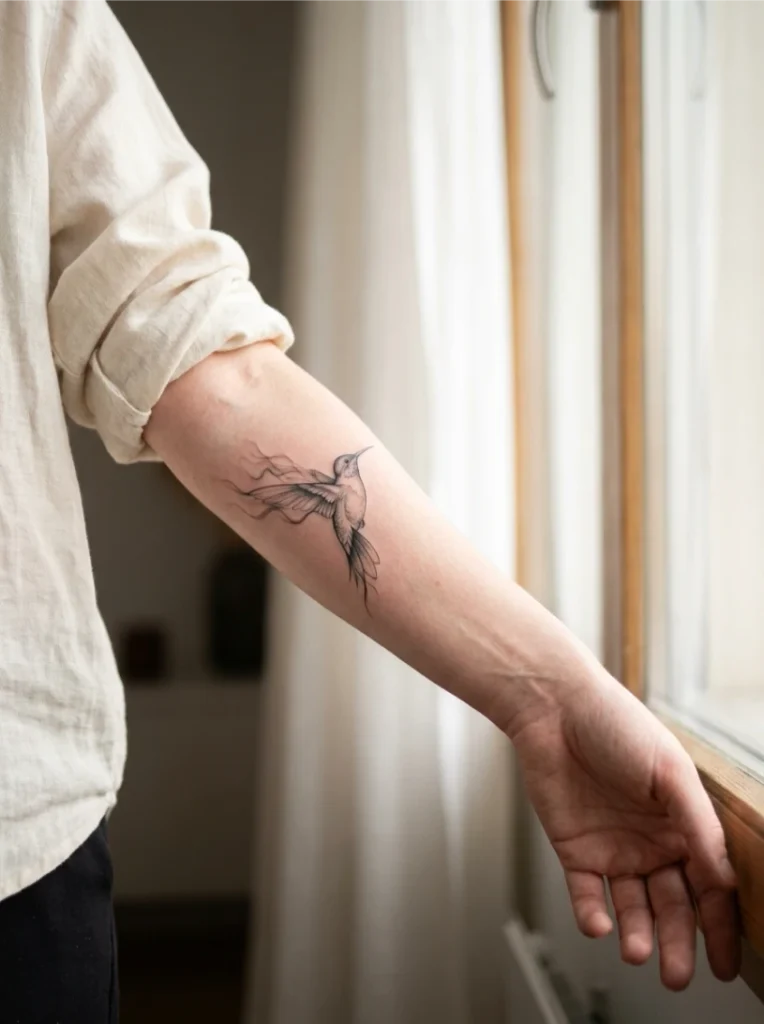
Single-needle fine-line work turns the wingbeat into layered smoke-like trails instead of solid feathers, like a long-exposure photograph on skin. With no color to hide behind, the whole piece depends on line weight and negative space.
The size floor is real here. Below four inches, the trail detail gets lost and the design reads as scratches rather than motion. Ask to see line-weight variation across the artist’s portfolio, not one polished piece; consistency across many pieces is what predicts your outcome.
2. Watercolor Splash Hummingbird Tattoo with Floral Accent

Watercolor pairs a clean black outline with color bleeding outward, as though the bird flew through wet paint. A single flower stem anchors the composition, and slightly uneven, asymmetrical drips read as more convincing than a perfectly even splash.
The outline is doing structural work. Color needs the black outline to age around; without it, the splash softens into an unrecognizable blur within a few years. Ask about the artist’s touch-up policy upfront, since watercolor fades faster than any style on this list, and request a stencil preview since splash placement is harder to picture in advance.
Outline first, splash second
If an artist proposes watercolor without a strong black anchor, walk away. The outline is what your tattoo looks like in year five; the splash is what it looks like in month one.
3. Hyperrealistic Ruby-Throated Hummingbird Tattoo
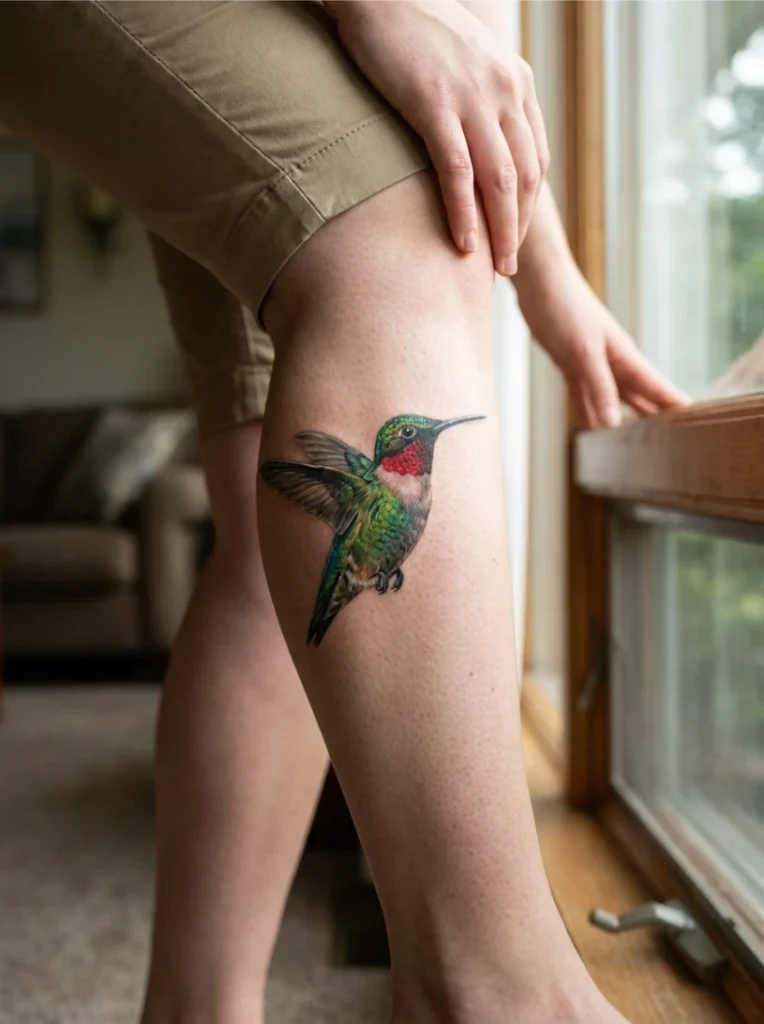
Hyperrealism reproduces actual feather texture and the red gorget patch almost photographically. Getting the iridescent green and red tones right takes multiple shading passes, which is why sessions run noticeably longer than fine-line or watercolor work.
Two things to discuss in the consult. First, skin tone and undertone change how colors appear once healed; bring this up before design, not after. Second, book with an artist whose portfolio shows multiple birds, not one standout piece. Feather texture is a specialty, and one good bird doesn’t prove a bird specialist.
Read Also: Rocky Horror Tattoo: 18 Iconic Ideas Worth Booking
4. Bold Watercolor Splash Hummingbird Tattoo, Large Scale
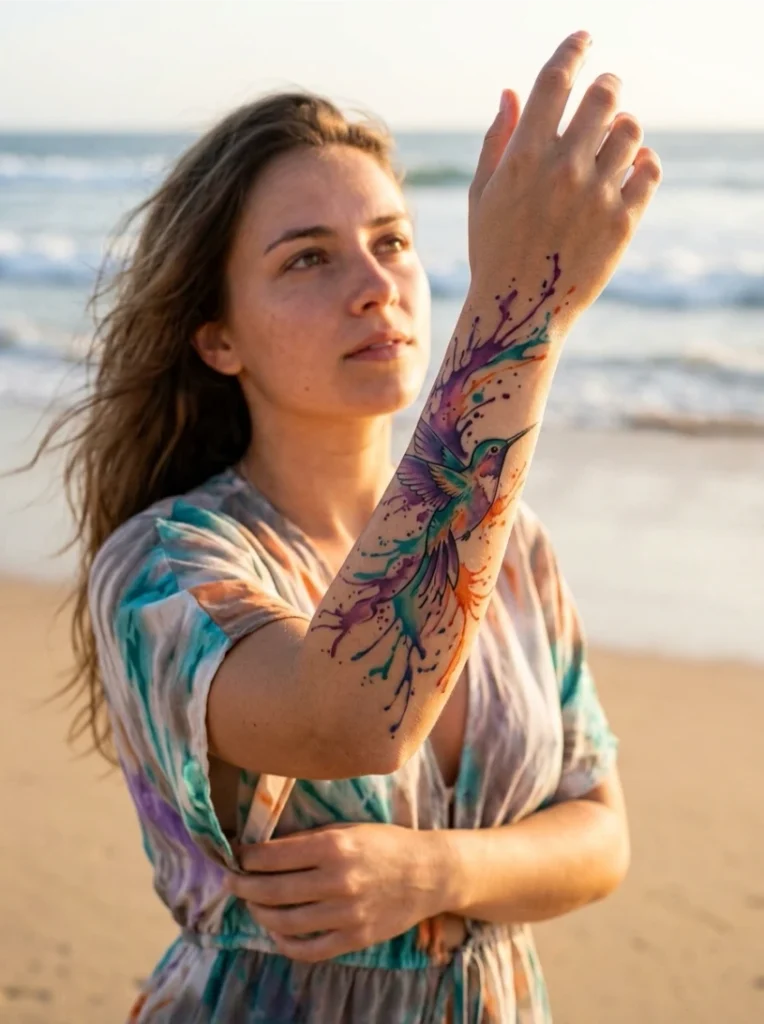
Scaling watercolor up turns the bird into a full forearm or calf centerpiece, with splatter extending past the wings. At this size, purple, teal, and orange can layer into a real composition instead of a small accent.
Large color has a specific enemy: sun. Bright color at this scale fades unevenly under years of sun exposure, so placement matters as much as design. Ask for a color-matched consult; some pigments hold up better long-term, and an honest artist will tell you which ones.
5. Neo-Traditional Hummingbird Tattoo with Flowers and Butterflies
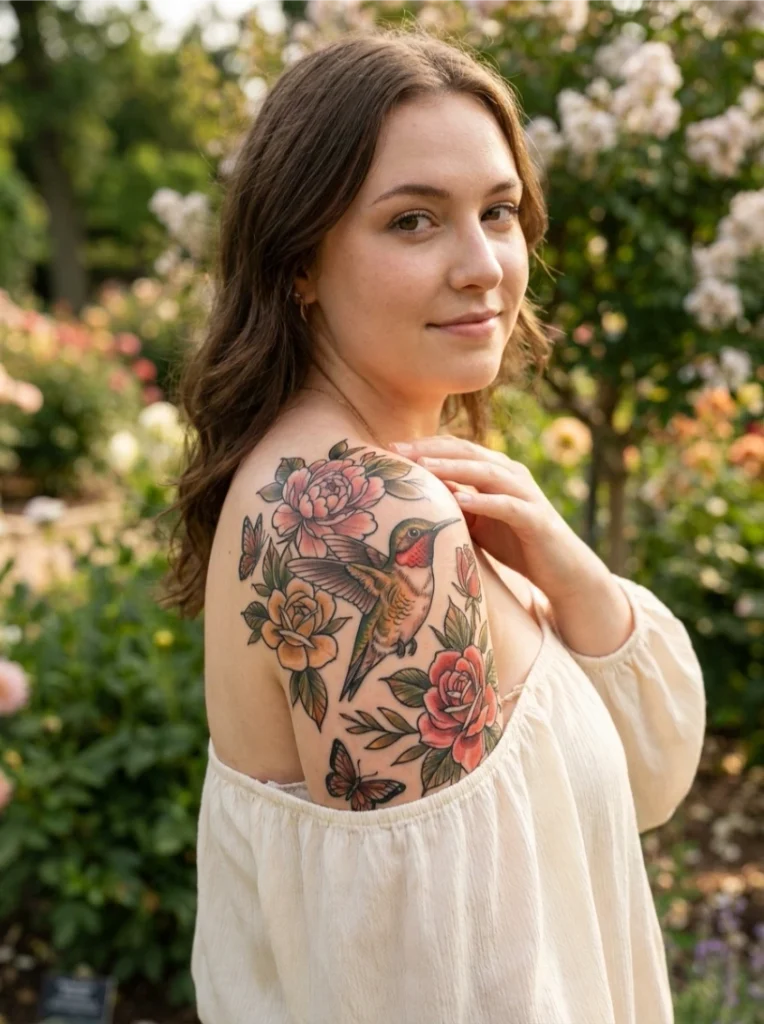
Neo-traditional gives the bird bold outlines and a warmer illustrative palette, then builds a scene with flowers and butterflies. Thicker outlines keep the hummingbird dominant even as the composition gets busier.
The failure mode is overcrowding. Decide how much surrounding detail actually earns a place before the design is drawn; every added flower competes with the bird. Have the artist sketch the bird first, then build florals around it. If the bird can’t carry the design alone, the florals won’t save it.
6. Delicate Hummingbird Tattoo with Cherry Blossom, Small Scale
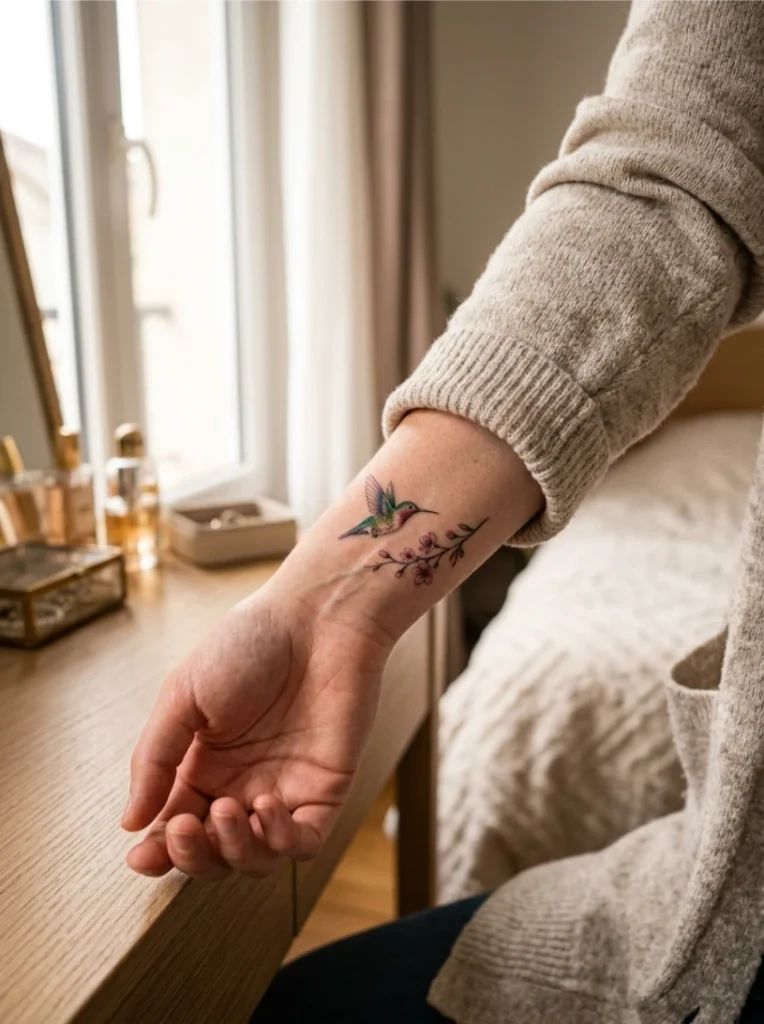
The small hummingbird people search for when they want meaning without a statement piece: a single bird with a short cherry blossom branch, fitting neatly on the wrist. The color stays genuinely detailed in miniature rather than simplified.
Small and detailed is a trade-off, not a free lunch. Fine detail at two to three inches can blur within a few years, so go in understanding this piece may need a touch-up sooner than a bolder design. Position the branch along the wrist’s natural curve, not flat across it; the curve is part of the composition.
7. Minimalist Single-Line Hummingbird Tattoo on the Hand
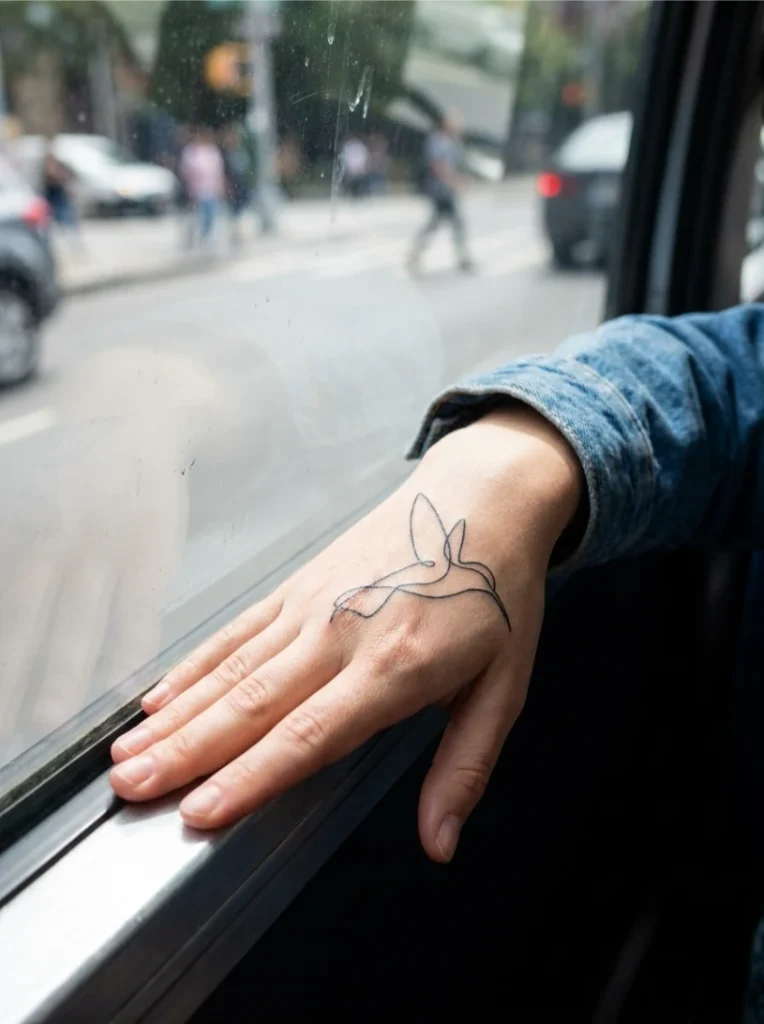
Single-line work strips the bird to one unbroken outline with no shading, reading like a quick sketch on skin. On the hand, that restraint is the entire appeal.
Hands are the highest-maintenance placement on the body. Hand tattoos fade faster from washing and sun exposure than anywhere else, and they heal slower from daily friction. Choose an artist experienced specifically with hand placements, and accept touch-ups as part of the plan, not a failure of it.
8. Geometric Dotwork Hummingbird Tattoo
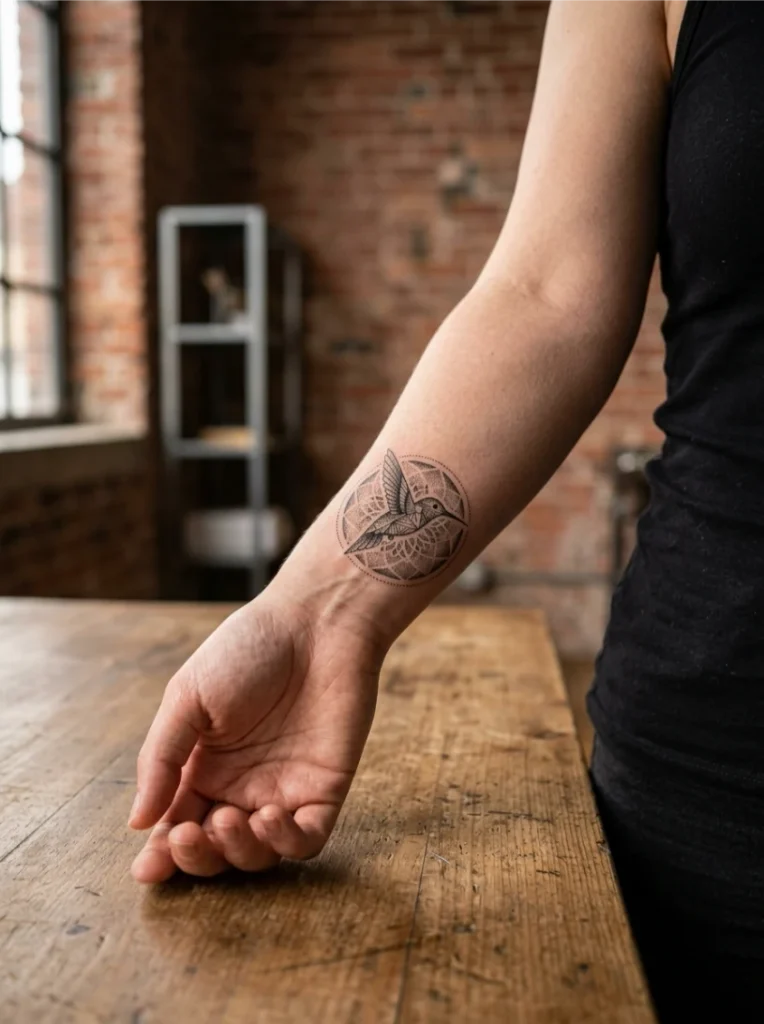
Dotwork trades solid lines for thousands of stippled dots, often framed by a triangle or circle for an abstract, modern feel. Each dot is placed individually, so sessions run long and the texture only fully shows once healed.
Dot density that looks fine fresh can appear patchy healed, which is why you need a dotwork specialist, not a generalist. General artists rush dotwork; specialists understand the patience it demands. Look specifically for healed dotwork in the portfolio before booking.
Specialist only
Dotwork, watercolor, and hyperrealism are the three styles on this list where a generalist portfolio is a red flag. If their book doesn’t show your style healed, keep looking.
9. Blackwork Silhouette Hummingbird Tattoo
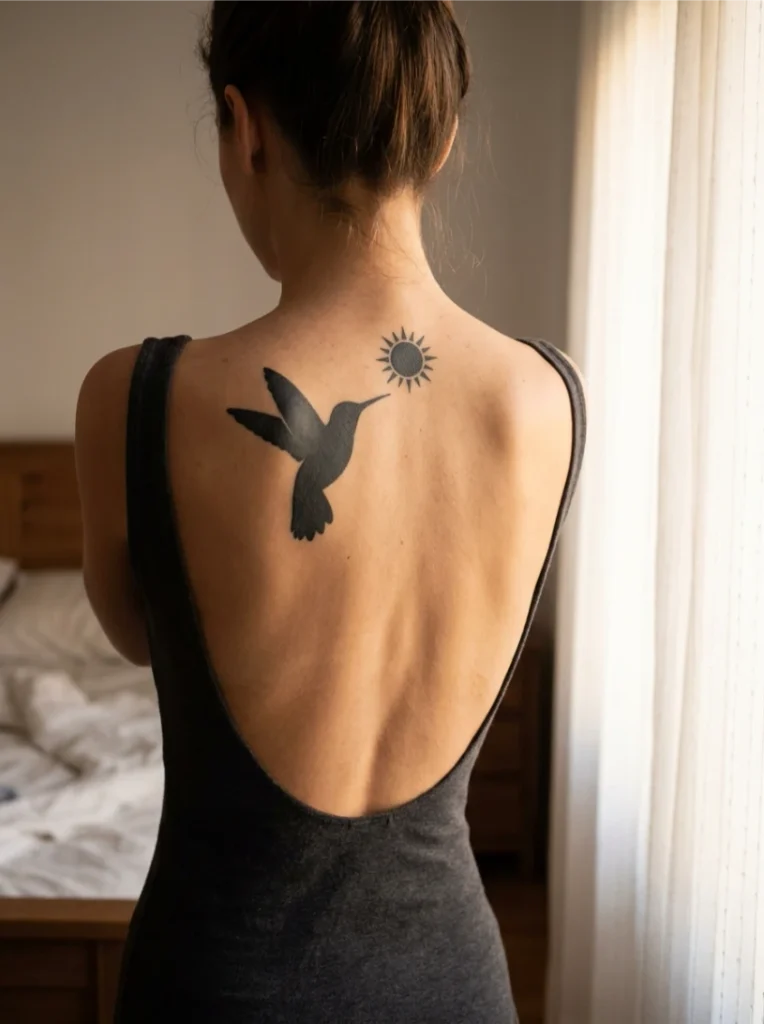
A blackwork silhouette removes color and detail entirely: a solid black shape, sometimes set against a sun or mandala. Solid black holds up better over decades than fine detail, though the design leans on wing angle alone to stay recognizable.
The wing angle is everything. An ambiguous wing position reads as a generic bird; a mid-hover or mid-dive angle reads unmistakably as a hummingbird. Ask to see the design at actual size before the appointment. Silhouettes are unforgiving of proportions that look fine large but wrong small.
10. Mirrored Hummingbird Pair Tattoo
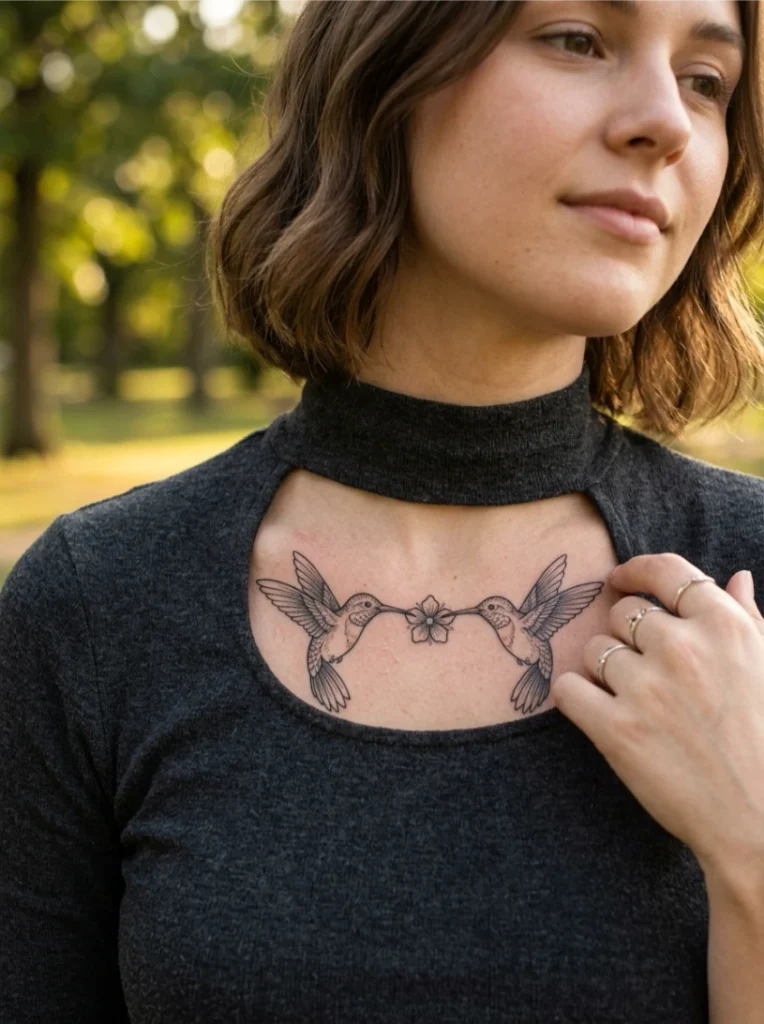
Two hummingbirds facing each other, often flanking a flower or heart: partnership symbolism rather than a single decorative bird. Here’s what most mirrored designs get wrong: exact mirrors look stiff once healed.
Ask for slight variation between the two birds, one angled differently, one wing position shifted. Asymmetry within the mirror reads as lifelike; perfect symmetry reads as a logo. Confirm the artist can freehand adjust for true compositional balance rather than tracing a flipped copy.
11. Hummingbird Tattoo with Script Lettering
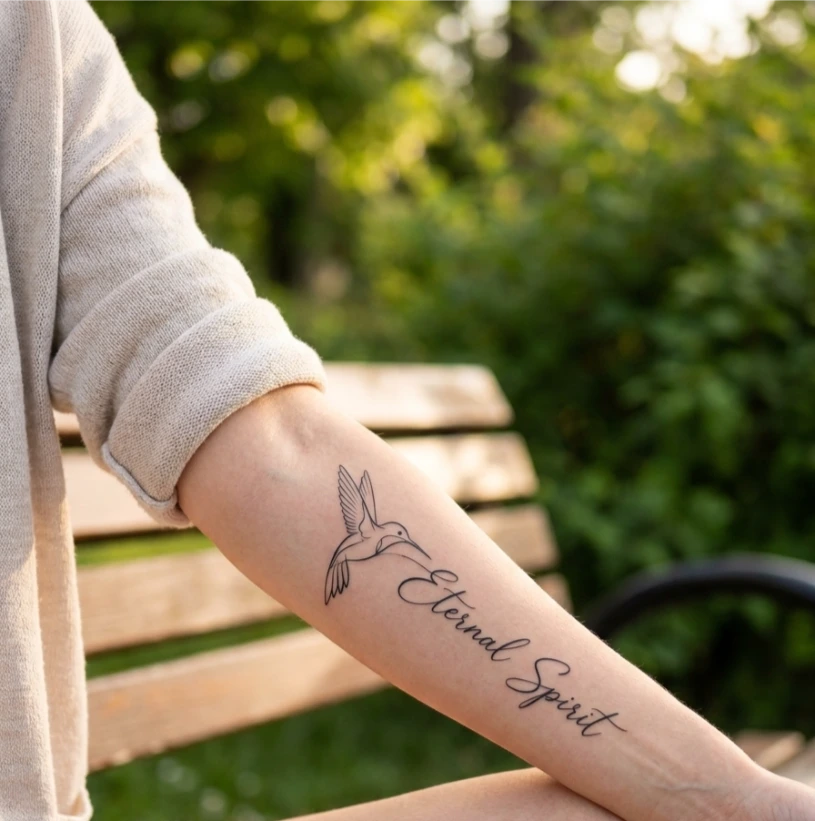
Pairing the bird with a short word, name, or date, often using the wing or tail to visually connect with the script. Keep the lettering short; a long phrase crowds the composition and shrinks the bird.
Have the artist sketch bird and text as one piece, not two elements placed together. And respect the aging math: small script blurs faster than bold script over years, so size the lettering for year five, not day one. Script over bone feels sharper than over fleshier areas, worth knowing before choosing ribs or spine.
See Also: 14 Stunning Coraline Tattoo Ideas Worth The Obsession
12. Bold Masculine Hummingbird Tattoo
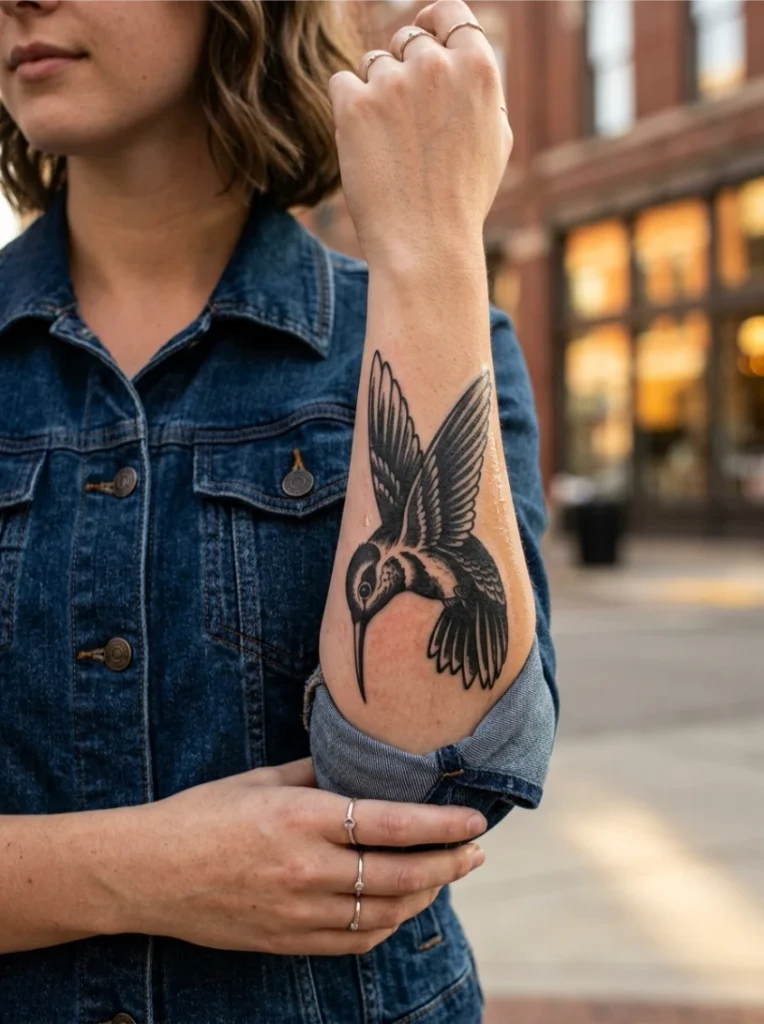
Heavier linework, a muted or black-and-grey palette, sharper wing angles instead of soft curves. A mid-dive wing position reads as dynamic without losing the bird’s identity.
This works because it commits to a lane. The design doesn’t apologize for the subject; it renders it with weight. Bold black linework heals cleanly and predictably, making this one of the lowest-maintenance options on the list. If low upkeep matters to you, bold black is the answer across every subject, not just this one.
13. Micro Hummingbird Tattoo
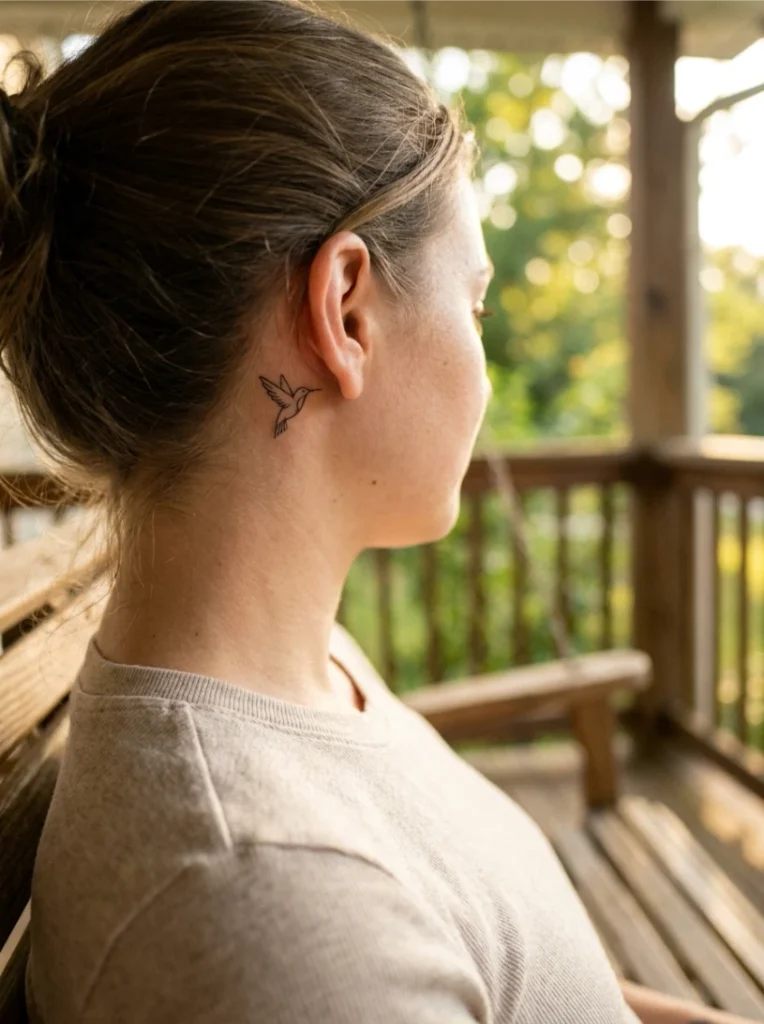
Under an inch and a half, meant to be noticed only up close. Wing detail is the first casualty at this scale, so simpler shapes hold up far better long-term than ambitious ones.
Ask the artist to slightly oversize the design from what’s pictured; references always look bigger on screen than on skin. And understand the honest trade: micro tattoos are shorter-lived by nature. Our small tattoo ideas guide covers exactly what survives at tiny sizes and what doesn’t. Behind the ear, ankle, and side of finger all rank higher on sensitivity, so plan accordingly.
Styles Compared by Outcome
This is the comparison nobody makes. Same bird, different futures:
| Style | Minimum viable size | Aging | Maintenance |
|---|---|---|---|
| Fine-line | 4+ inches | Blurs faster than bold | Low, eventual touch-up |
| Watercolor | 3+ inches | Softens visibly, fades fastest | High, planned touch-ups |
| Hyperrealistic | 5+ inches | Holds if large enough | Medium, sun protection |
| Neo-traditional | 4+ inches | Predictable, bold lines hold | Low-medium |
| Single-line / minimal | 2+ inches | Blurs fastest at tiny sizes | Low, shorter-lived |
| Dotwork | 3+ inches | Good if specialist work | Low |
| Blackwork silhouette | Any size | Best long-term | Lowest |
| Micro | Under 1.5 in | Detail goes first | Medium, expect refresh |
The pattern: boldness and size are what age well. Every delicate choice trades longevity for subtlety. That’s a legitimate trade, but make it knowingly.
Color vs Blackwork: The Real Trade-offs
The decision most people agonize over, stated plainly. Color gives you vibrancy and species accuracy (that ruby throat needs red) but demands sun protection, planned touch-ups, and an artist who understands pigment behavior on your skin tone. Blackwork gives you longevity and the lowest maintenance but sacrifices the iridescence that makes hummingbirds distinctive.
Skin tone belongs in this decision. Very light and very deep skin tones render pigment differently; what glows on one may mute on another. Discuss it with your artist before the design is finalized, not after the first session. And sun exposure is the great equalizer: no color survives years of unprotected sun, regardless of style.
Sizing Rules: Ink Spread Is Physics
Ink spreads under skin over time. That’s not a flaw; it’s physics. Any interior detail smaller than a millimeter will blur, and thin gaps between lines close up. This is why every style above has a minimum viable size, and why shrinking a detailed design to fit a small placement fails.
The practical test: print the design at the exact size you want and look at it from arm’s length. If you can’t clearly see every element, neither will anyone else in five years. For the full mechanics of what survives small, our tattoo stencil ideas guide explains why the stencil at real size is the last honest preview you get.
Vetting Your Artist: Healed Photos or Nothing
For hummingbirds specifically, demand healed photos of the exact style you want, at least six months old. Fresh watercolor always looks luminous; healed watercolor tells the truth. Fresh fine-line always looks crisp; healed fine-line shows whether the artist’s line weight survives.
Red flags: a portfolio with no healed work in your style, vague answers about touch-up policies, willingness to shrink a detailed design below its viable size to fit your budget, or no bird work at all in a hyperrealism portfolio. Any of these means keep looking. The right artist will discuss aging with you unprompted; that conversation is the green flag.
A Note on Cultural Roots
Hummingbirds carry real cultural weight: Huitzilopochtli in Aztec tradition, healers and luck-bringers in several Native American traditions, resurrection symbolism in Christian readings. If you’re drawn to tribal or prehispanic-inspired framings of the bird, understand what you’re borrowing. Decorative use of sacred motifs without knowledge reads as costume. The bird itself is universal; specific cultural framings deserve specific understanding.
Quick Comparison
| Design | Best Placement | Longevity | Commitment |
|---|---|---|---|
| Fine-Line Smoke-Trail | Forearm, calf | Good at 4″+ | Low-medium |
| Watercolor Splash | Thigh, calf | Fades fastest | High |
| Hyperrealistic | Calf, shoulder | Good at 5″+ | Medium |
| Large Watercolor | Forearm, thigh | Needs sun care | High |
| Neo-Traditional | Shoulder, upper arm | Predictable | Low-medium |
| Cherry Blossom Small | Wrist, forearm | May need touch-up | Medium |
| Single-Line Hand | Hand, finger | High maintenance | High |
| Geometric Dotwork | Forearm, sternum | Good (specialist) | Low |
| Blackwork Silhouette | Ribs, spine | Best long-term | Lowest |
| Mirrored Pair | Chest, upper back | Varies by style | Varies |
| Script Pairing | Forearm, ribs | Script blurs first | Medium |
| Bold Masculine | Forearm, chest | Predictable | Low |
| Micro | Ear, ankle | Detail fades first | Medium |
Frequently Asked Questions
What does a hummingbird tattoo generally symbolize?
Lightness, resilience, and joy are the consensus meanings, though mirrored pairs and script pairings shift it toward relationships. The bird’s cultural roots run deeper, Aztec and Native American traditions among them, if you want meaning beyond the generic.
Is a small hummingbird tattoo a good first tattoo?
It can be, especially in simplified linework. But detailed small designs blur faster and may need a touch-up sooner than larger pieces. Go slightly larger than your instinct for a first tattoo.
Which placement hurts the least for a hummingbird tattoo?
Forearm and calf generally rank lower on discomfort than hands, ribs, or spine. That said, placement should follow the design’s needs first; the least painful spot for the wrong design is still the wrong spot.
Do watercolor hummingbird tattoos fade faster than black ink designs?
Yes. Bright, unshaded color fades faster than solid black linework over the same years in the sun. Watercolor needs sun protection and planned touch-ups; that’s the price of the luminosity.
Can a hummingbird tattoo work for men?
Yes. Heavier linework, a muted palette, and sharper wing positioning move it away from the softer floral versions common in feminine designs. The bird’s symbolism, resilience and vitality, was never gendered to begin with.
Thirteen Birds, One Question Worth Sitting With
Every design here solves the same problem differently: how to hold a moment of pure motion still on skin for decades. The style you choose is really a choice about the future: how much maintenance you’ll accept, how large you’ll go, and how honest you are about aging.
Sit with that before booking, not after. The bird will still be beautiful in every version on day one. Choose the version you’ll still love when it’s softer, slightly blurred, and unmistakably yours.