Tribal tattoos never really left. They came back sharper, with better linework, cleaner negative space, and placements that flatter the body instead of just sitting on it. What hasn’t changed is the question every man considering one has to answer: which tradition are you drawing from, and is it yours to draw from?
“Tribal” is not one style. It is a Western tattoo category that borrows loosely from several Indigenous traditions: Samoan, Māori, Marquesan, Celtic, Aztec, and more. Those traditions have their own patterns, meanings, and rules about who may wear them. The sixteen designs below respect that difference. Each one notes where its visual language comes from, what you can honestly say about its meaning, and what you can’t. Then come the sections the galleries skip: how to vet a blackwork artist, what this work actually costs, and how dense black ink looks at year twenty.
Pick the Tradition Before the Design
Most men pick a pattern first and ask questions never. Reverse that. Choosing a tradition first is the single decision that prevents most regret with this style.
If you want something rooted, pick one tradition and learn its rules: Samoan tatau is ceremonial, tā moko is genealogical and reserved for Māori, Celtic knotwork follows its own geometry. If you want something modern, pick Neo-Tribal on purpose: abstract blackwork with no cultural claims attached. The worst option is the default one, a pattern that looks Polynesian, carries motifs with meanings you can’t verify, and sits in the uncomfortable middle. Know which of the three lanes you’re in before you book.
1. Classic Armband
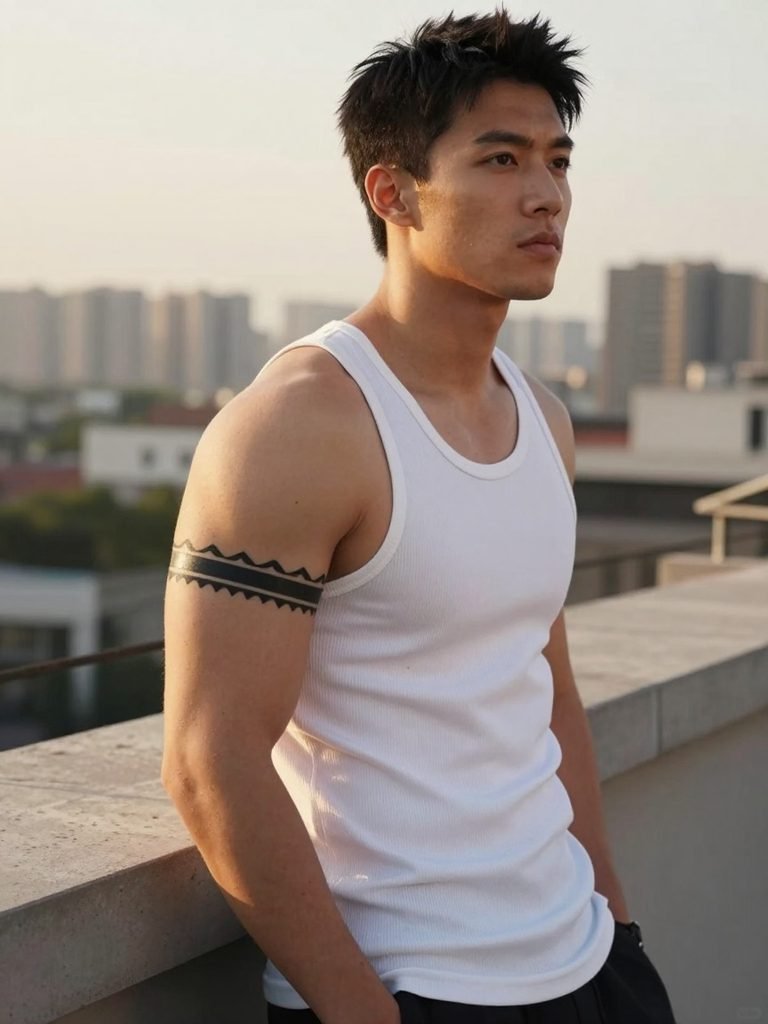
A narrow black band circles the middle of the upper arm, zigzag edges top and bottom, no pattern inside the strip. The pointed edges carry the whole design. This is the 90s armband reduced to its cleanest form, and that restraint is what keeps it from looking dated.
The failure mode is width. A band too narrow for your arm reads as a bracelet; a band too wide swallows the upper arm. Size it against your actual arm, not a flash sheet. Have the artist draw it on your skin before the session and check it in a mirror from across the room. If it holds its shape at distance, the width is right.
Width rules
Ask how the band will look when you flex. Bands sit on a muscle that changes shape, so a design that fits at rest can distort when the bicep engages. A good blackwork artist checks both states.
2. Forearm Sleeve
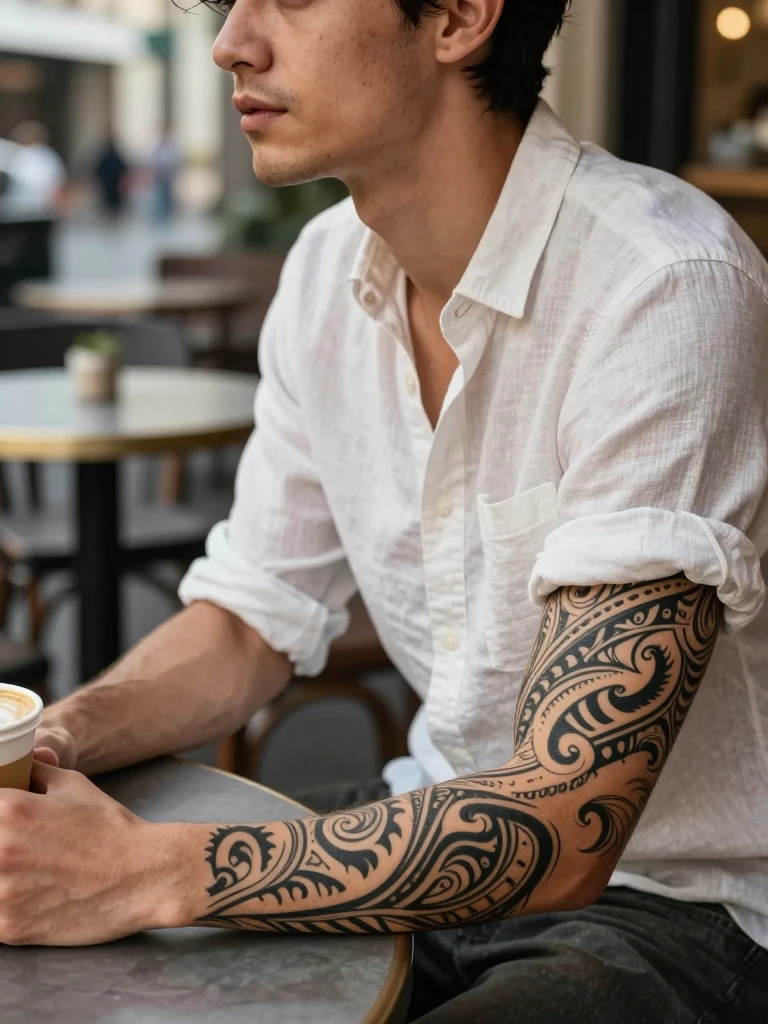
Spirals and curls flow from the wrist up past the elbow in solid black, skin showing between the curves. Rounded forms suit a tapering limb, and this one was drawn to narrow toward the wrist along with the arm.
The visual language here is Polynesian-style: curved, curling, wave-like. Bring reference photos of your own forearm to the consult so the artist fits the pattern to its specific taper and length. A sleeve that fits someone else’s arm is a sleeve that fights yours.
3. Small Wrist Accent
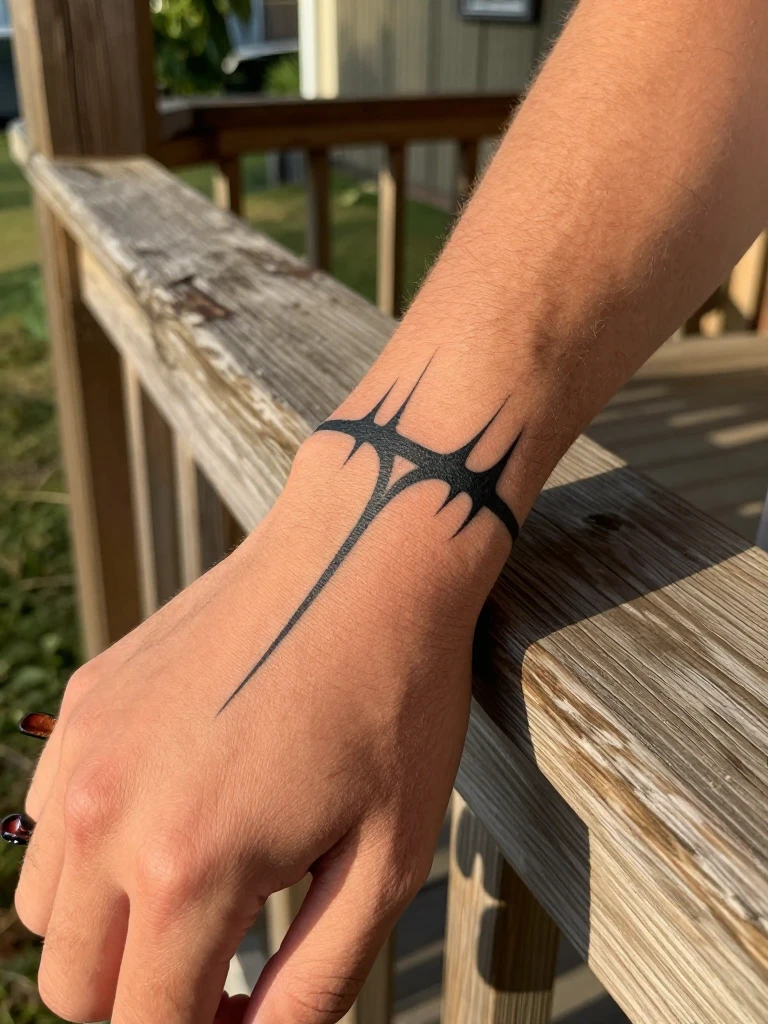
A thin black band circles the wrist with sharp, thorn-like points, and one long spike trails across the back of the hand toward the knuckles. This is the closest thing on this list to the 90s barbed look, which means it is the one most at risk of looking like a period piece. It works only if you actually want the reference.
The trailing spike changes the math: it crosses onto the hand, which is among the most visible placements a man can choose. That is a career decision as much as a style one. If you want the look without the commitment, keep the spike off the hand and contained at the wrist.
4. Shoulder Piece
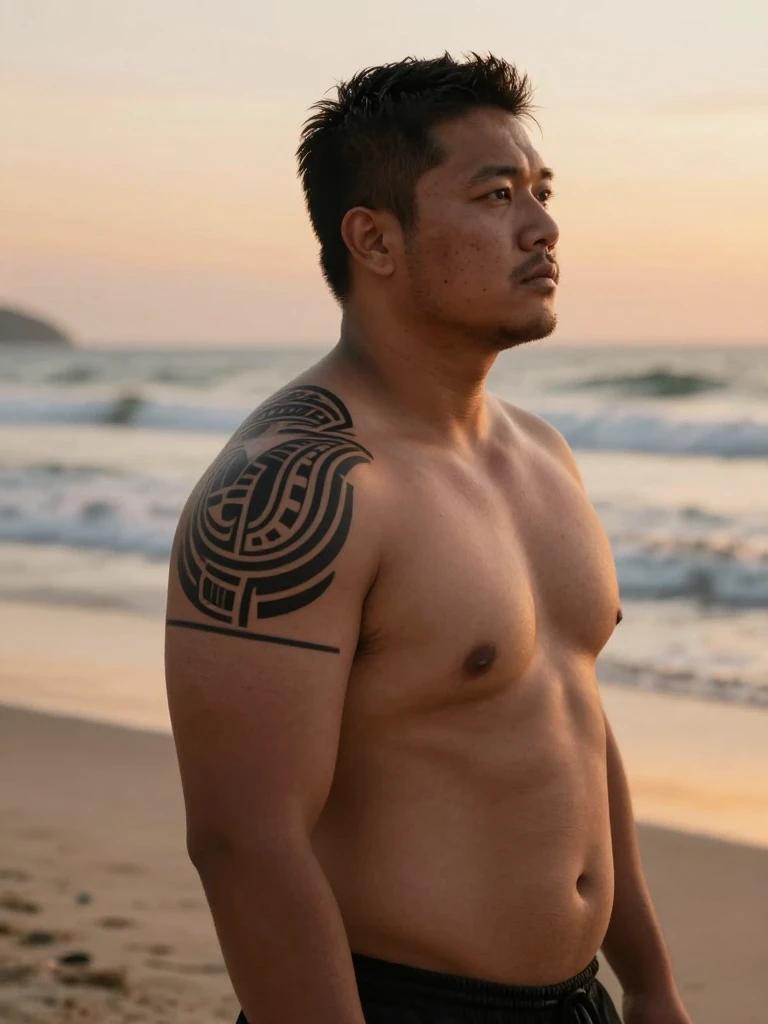
A rounded medallion of concentric and angular shapes sits on the shoulder cap, closed by a single thin line that rings the upper arm. Circular layouts belong on round surfaces, and the deltoid is the best one on the body.
The thin border line is doing double duty: it finishes the medallion and gives you a starting point for a later sleeve. If there is any chance you extend, tell the artist now. Designs built without an extension plan often fight whatever gets added later.
Cap anchor
Shoulder-cap pieces live and die on how they sit on the deltoid’s peak. The center of the medallion should anchor on the highest point of the muscle. If it slides forward or back, the whole piece reads crooked when the arm moves.
5. Chest Piece
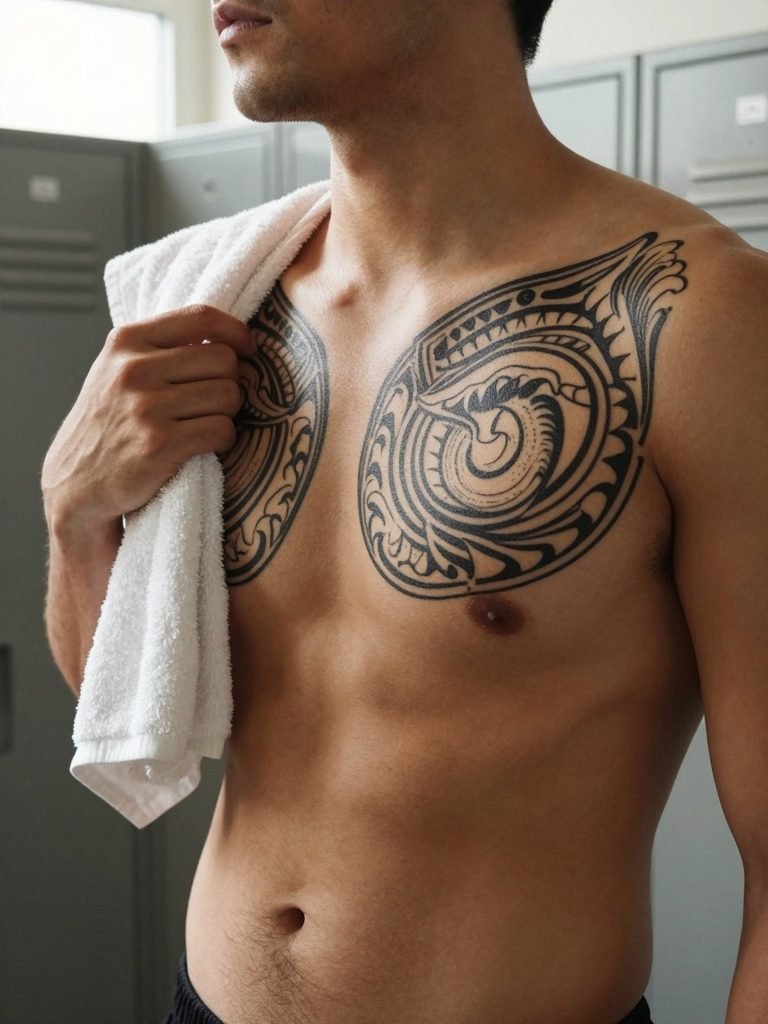
A large design spreads across both pectorals, anchored by a big spiral on the right, sweeping toward the shoulder in pointed tips. Fine linework inside the bands makes it more intricate than solid-block work.
The chest is a mirrored surface, so centering matters more here than on any limb. Ask the artist to mark the centerline on your skin and step back before a single needle goes in. Asymmetry that is invisible in a mirror up close shows clearly in a photo.
Fine lines, thick skin
The fine internal detail depends on how your skin takes ink. Chest hair, texture, and stretch can blur small lines over time, so discuss the smallest line weight with your artist honestly rather than approving a detail level the skin won’t hold.
6. Māori-Inspired Back Piece
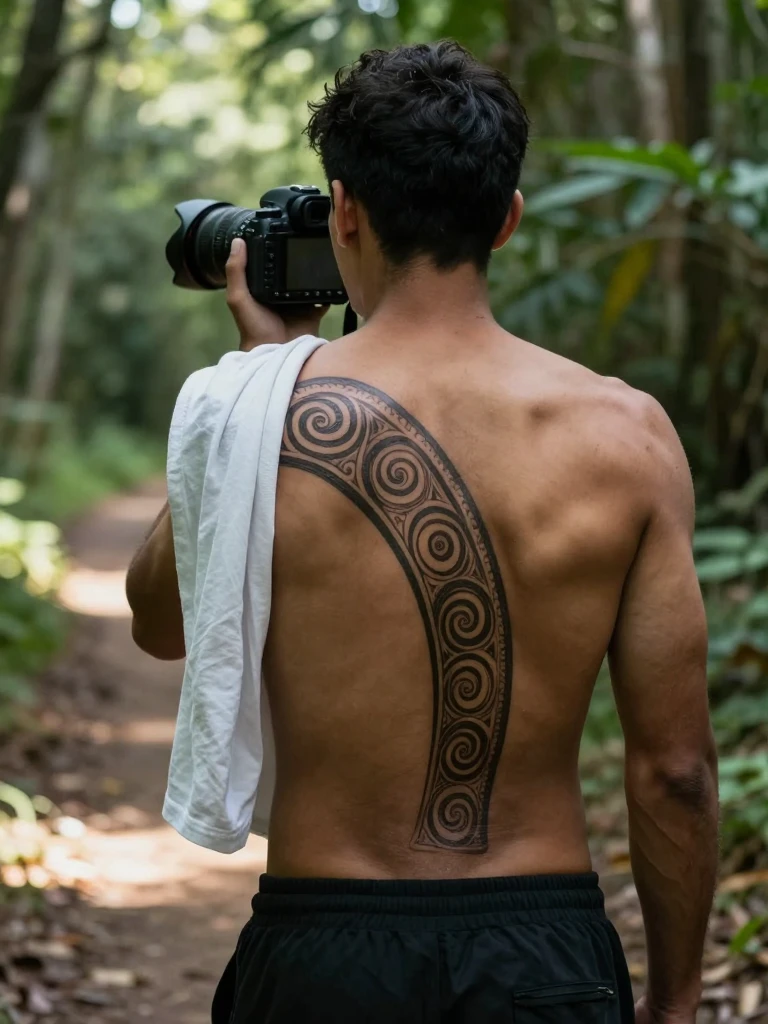
A single crescent band of small concentric spirals runs from the shoulder blade toward the lower back along one side of the spine. The lines are finer than the other designs here and read lighter than solid black. The koru, based on the unfurling fern frond, is a common Māori motif widely read as growth or new beginnings.
The honest label matters. A Māori-inspired design is not tā moko, which is personal and tied to ancestry. Non-Māori wearers who want this look usually choose kirituhi, ideally made with an artist trained in that tradition. If your artist can’t explain the difference, find one who can. Small spirals also need clear spacing between them; the broad curve of the back gives them that room.
See Also: 21 Sleeve Tattoos for Men: Proven Styles Worth Copying
7. Hand Accent
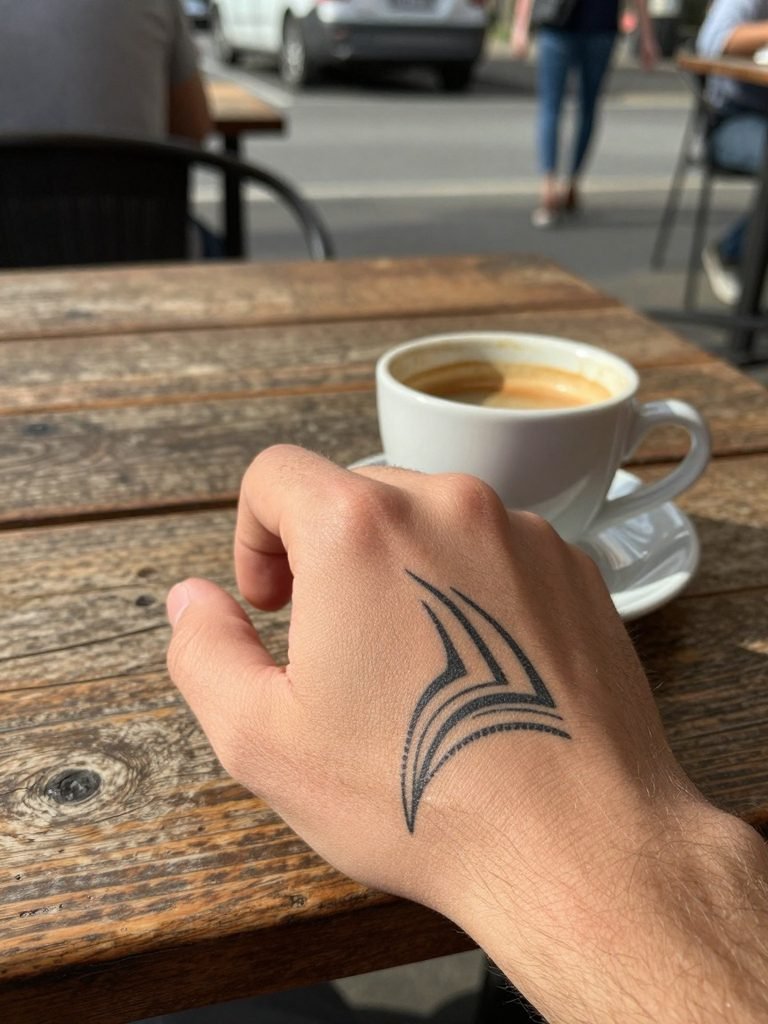
Three nested curved lines taper to a point on the back of the hand, between the knuckles and the wrist, shaped like a blade or claw. The hand is always visible. That is both the appeal and the commitment.
Hands move constantly and get washed constantly, and hand tattoos are widely reported to need touch-ups sooner than other placements. Bold lines hold up better than fine detail here. Think about how visible you want this to be day to day, at work, in photos, for the next decade, before you commit a design to your hands.
8. Geometric Sleeve
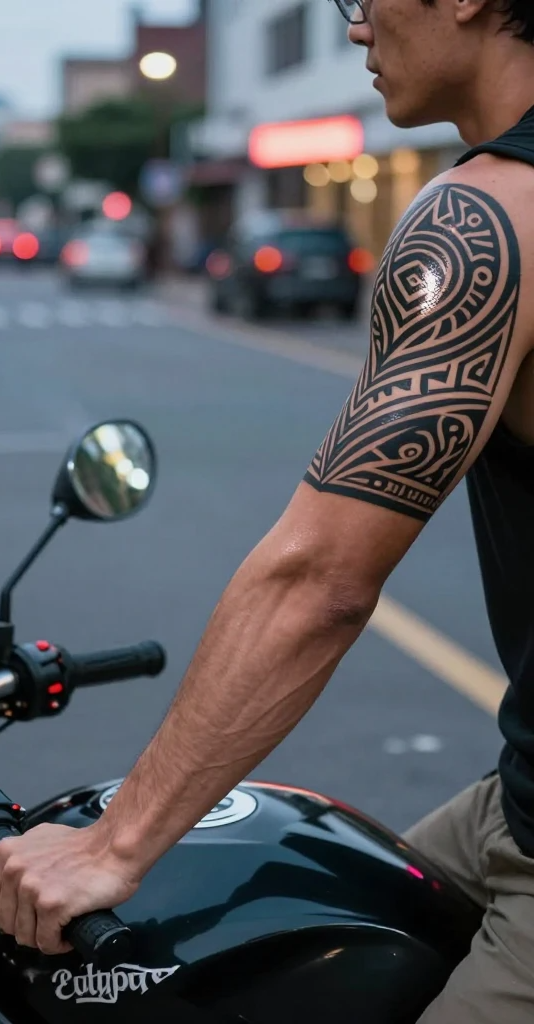
A dense teardrop-shaped medallion covers the upper arm from shoulder to just above the elbow, built from concentric shapes with sharp zigzag edges along the bottom. The forearm stays bare, so the piece stops cleanly at the elbow.
Crisp negative space is what separates this from a block of black. The gaps between the shapes need to stay clear, and the zigzag edge is where that shows first. The bare forearm is a choice, not a gap: it leaves room to continue later. If you might extend, map the full sleeve before the first session so the later section lines up with the medallion.
9. Skull Hybrid
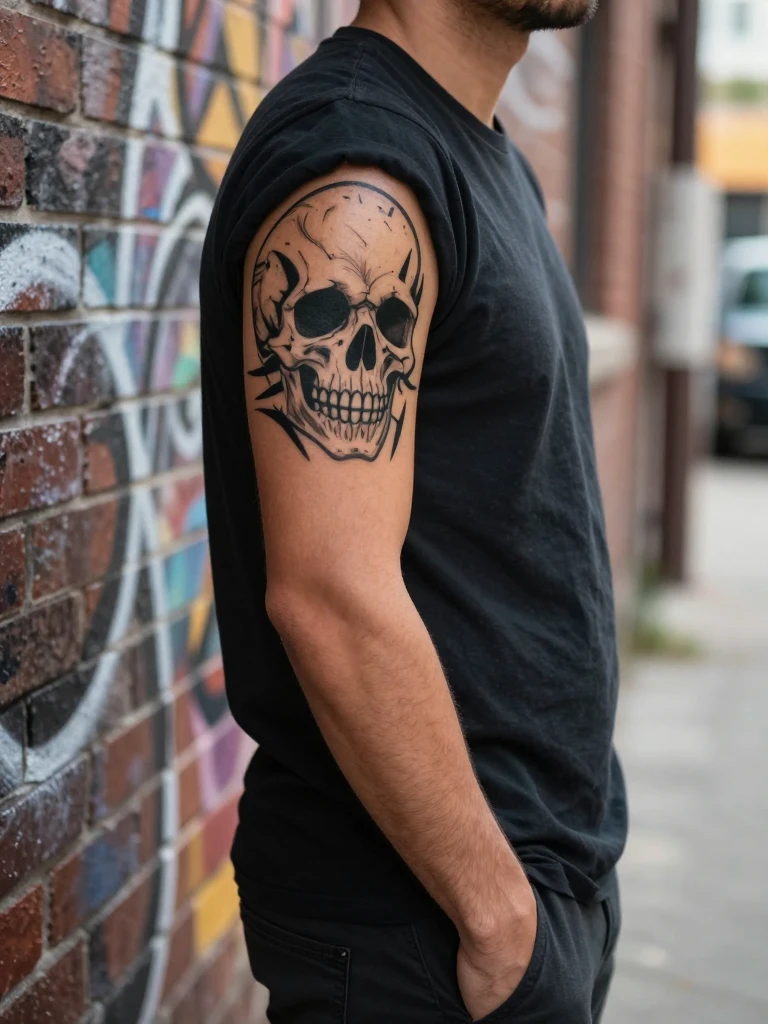
A skull sits on the outer upper arm in a rough, etched style with ragged edges around the bone. Be direct about this one: a skull is not a traditional tribal motif. It belongs to a separate tattoo tradition and shares only the heavy black. The tribal link here is the bold outline, not a tribal fill.
If you want a true crossover, don’t just place a skull near a band. Ask your artist to work tribal shapes into the outline or build bands around it so the fusion is structural, not decorative. A skull reads through contrast in the eyes, nose, and teeth, so heavy fill inside those features will swallow them. This design benefits from a fully custom layout, not a mashup of two flash pieces.
10. Sun Motif
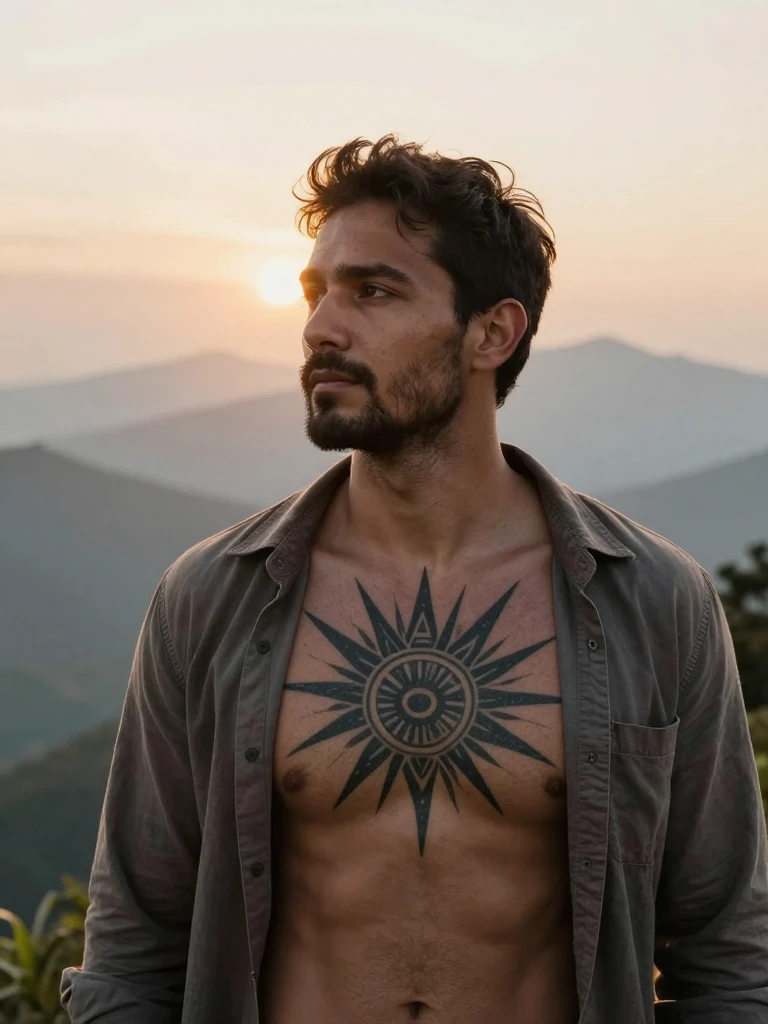
Sharp rays of alternating length radiate around a ringed center, placed on the sternum between the pectorals. The circular form suits a flat, symmetrical area, and the center chest gives it the mirror axis it needs.
Sun designs appear in many traditions with different meanings, so if the meaning matters to you, trace your reference to its tradition instead of accepting whatever the gallery caption says. Solid rays read bold; dotwork rays read lighter. Pick the texture deliberately, because the sternum is not a placement you casually cover.
Center it once
Sternum pieces have no second chance on symmetry. The centerline of your body is the centerline of the design, and being off by a few millimeters is visible forever. Mark it, photograph it, sleep on it.
11. Small Calf Piece
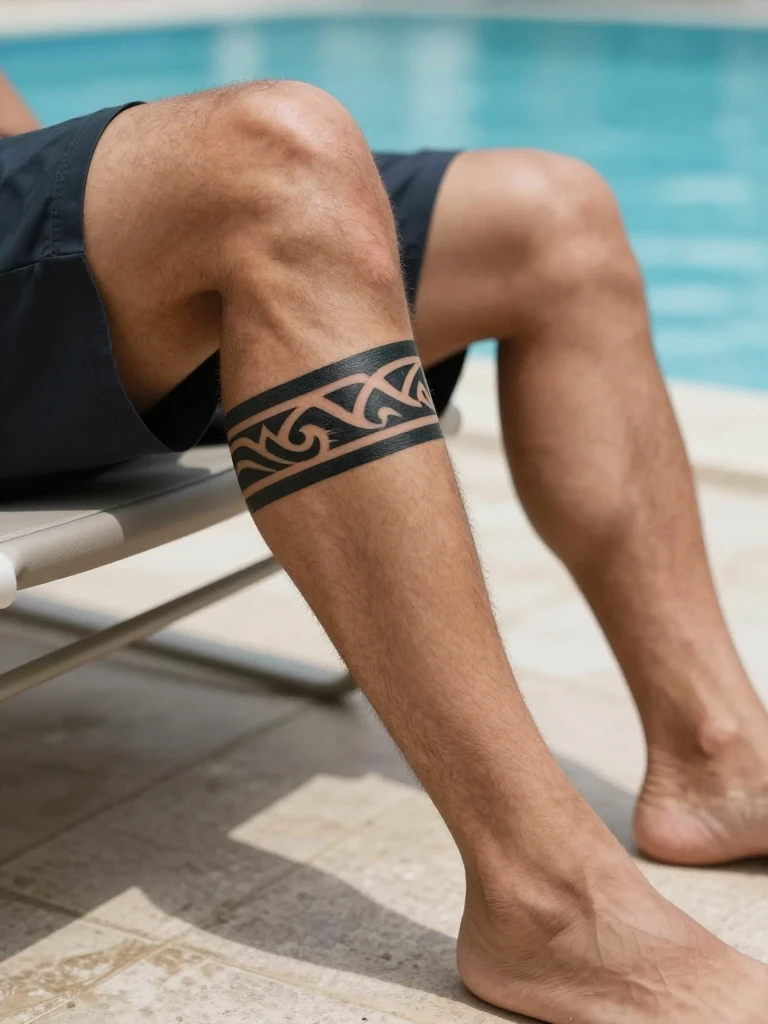
A band wraps the upper calf just below the knee, two heavy border lines framing a wave-like scroll pattern between them. Shorts show it, trousers hide it, which makes it one of the most flexible placements on this list.
The call here is how the band sits on the taper. The calf narrows below the knee, so a straight band can look tilted if it isn’t fitted to the leg. Ask how it looks when the leg is bent, not just standing straight. The scroll pattern between the borders needs to keep moving; a static scroll flattens into wallpaper.
12. Minimalist Forearm Line
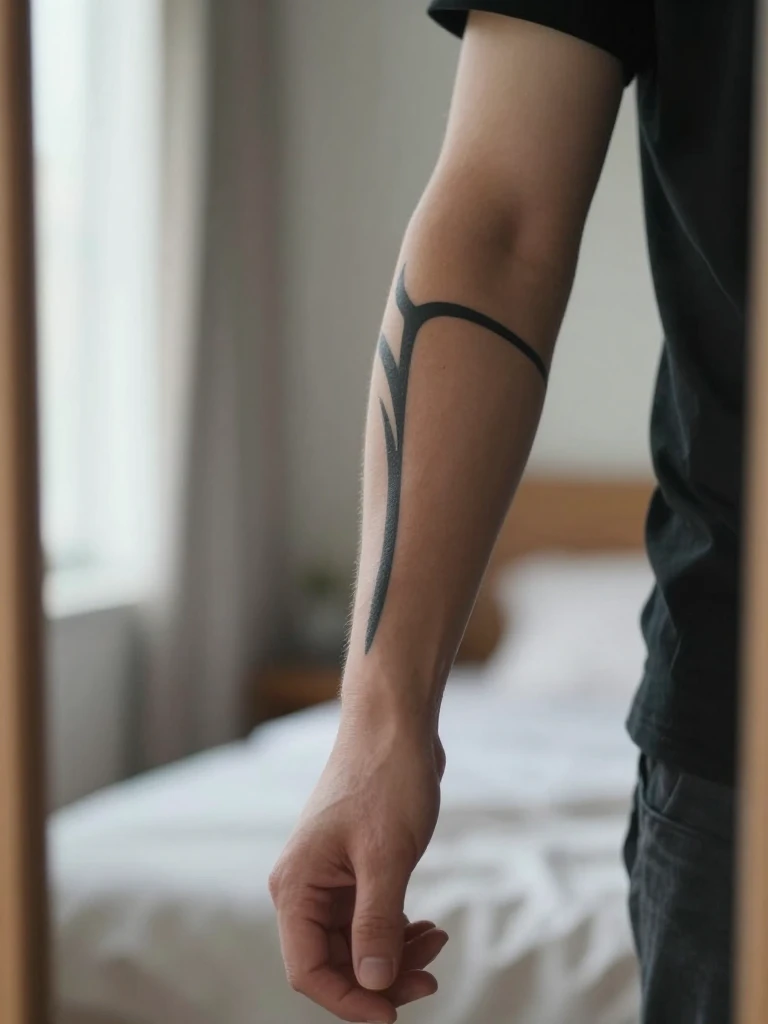
A thin arc wraps part-way around the upper forearm near the elbow, with one long tapering stroke running from it toward the wrist. No fill at all. With nothing but linework carrying the design, the taper and quality of the line is the entire tattoo.
Running lengthwise along the arm, the stroke lengthens the forearm visually. Fine lines can soften over time, so ask your artist what line weight suits the piece rather than requesting the thinnest possible line. Thin for thinness’ sake is how minimal designs become illegible ones.
13. Rib and Side Piece
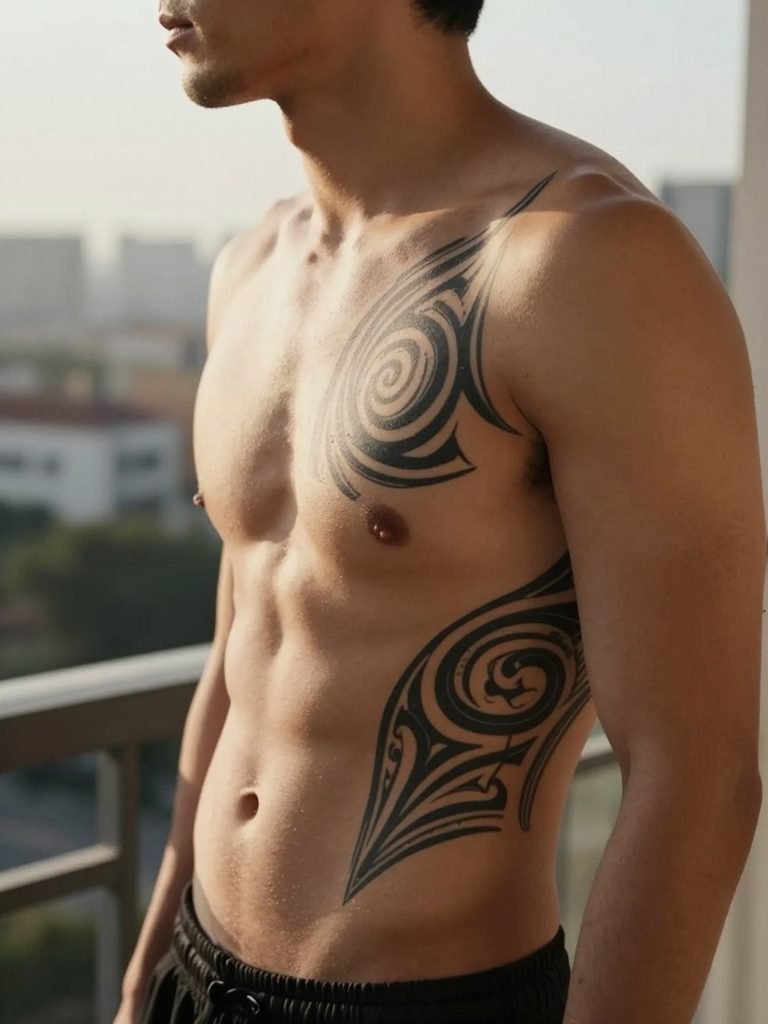
A spiral near the shoulder on the upper chest connects to a larger spiral-and-teardrop panel on the side of the ribs, ending in a point near the hip. Together they run diagonally down one side of the torso, following the line of the waist.
Skin here moves with breathing, so the design has to flow with the curve of the rib cage rather than sit flat on it. Many people find ribs among the more uncomfortable placements, though experiences vary. If this is your first tattoo, talk the placement through with your artist before you commit a large panel to it.
14. Neck Accent
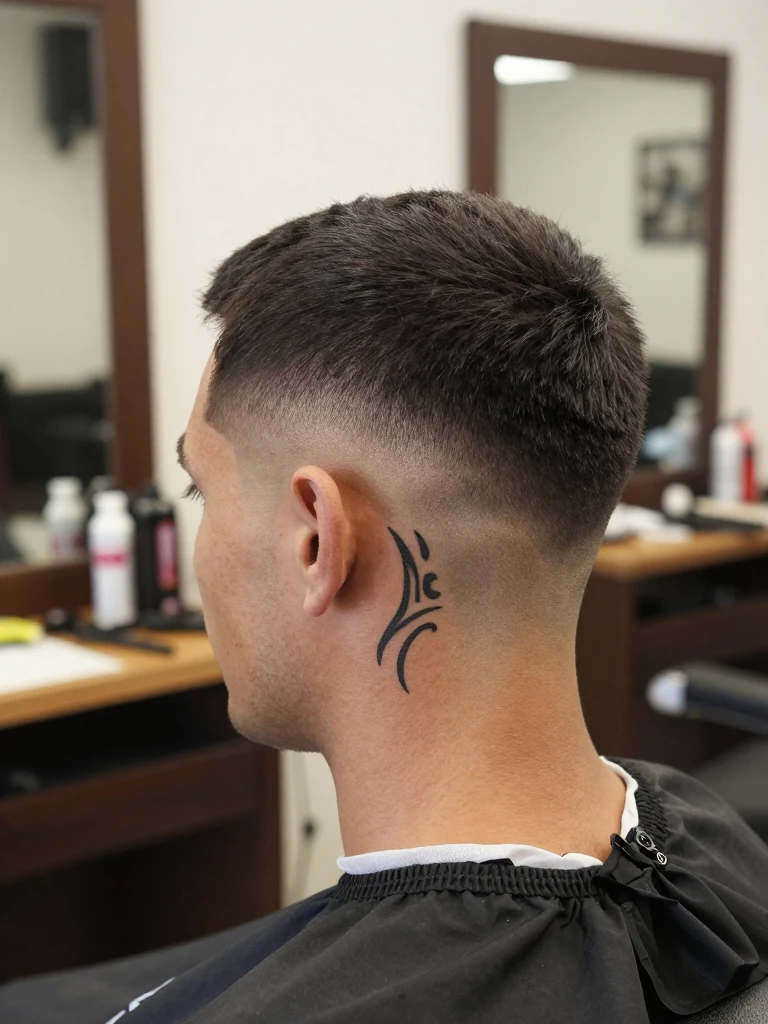
A small cluster of curved, hook-like strokes sits behind the ear, fully exposed by the short haircut in the photo. Simple strokes with clear spacing hold up best where skin moves constantly.
Haircut decides how much shows. Short hair reveals the design; longer hair covers part of it. Treat this as a long-term decision, not a phase. The neck is one of the hardest placements to hide and one of the most committed. If you might grow your hair out later, consider that version of the tattoo too.
Behind the ear
The area behind the ear is curved and compact. Designs here work when they are small enough to sit flat and simple enough to read at a glance. Intricacy has nowhere to go.
15. Arm Half-Sleeve Combo
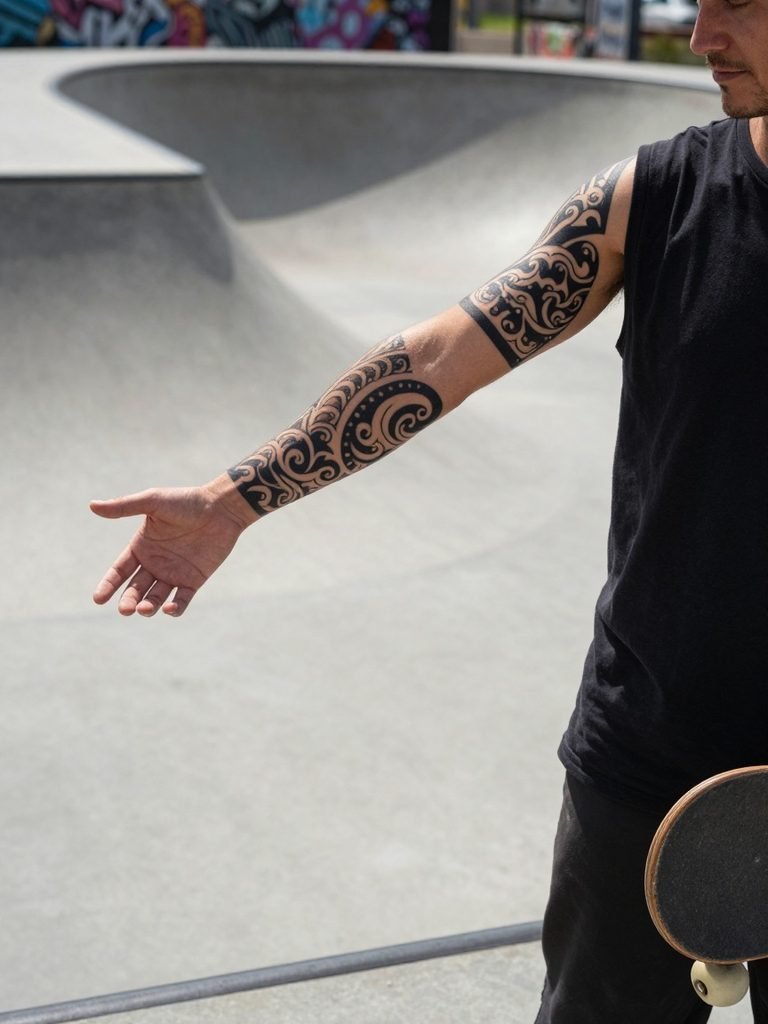
Two patterned sections on one arm: a band of spirals and curls around the forearm, a larger denser piece on the upper arm, bare skin between them near the elbow. Both sections use curls and spirals, which keeps them reading as one arm.
Decide at the start whether the gap is a deliberate break or a future bridge. A shared line weight across both sections and one repeated motif carried across the elbow will tie them together if you extend. Decide whether the arm becomes a full sleeve before either part is finished, because that choice changes how each section is drawn.
16. Blackout Fusion
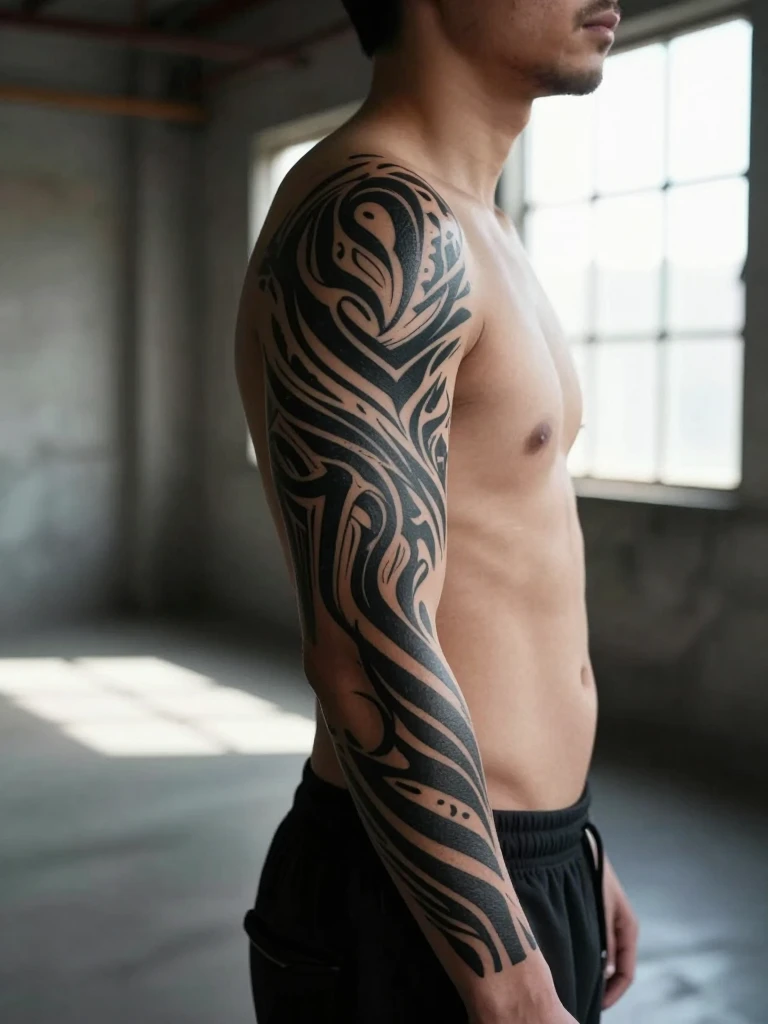
Bold blade-like and flame-like black shapes sweep from shoulder to wrist, skin showing between them. Heavy blackwork, but more open than a true blackout. The skin between the black shapes is the design, so its placement matters most. Ask to see the layout mocked up before the session.
Heavy saturation is hard to alter later, which makes this the highest-commitment piece on the list. Think about whether you want that much black before you start. And ask about the artist’s experience with dense blackwork specifically, looking at healed examples of full-sleeve work, not just fresh photos.
Before You Borrow: The Cultural-Honesty Checklist
Run through this before you book anything with a tradition’s name attached to it.
Can you name the tradition your pattern comes from? If the answer is “tribal” and nothing more specific, you don’t have an answer. Samoan, Māori, Marquesan, Celtic, Aztec: each has its own patterns and its own rules. Our chicano style tattoo ideas guide shows what researching a style’s real roots looks like in practice.
Are the meanings documented or internet folklore? The web repeats “shark teeth = protection” and “spearheads = courage” identically on every site, which should make you suspicious, not confident. Meanings that are well-documented (tā moko encoding genealogy, the pe’a as a ceremonial rite) are different from meanings that are widely repeated. If your artist can’t tell you which is which, keep looking.
Is this design sacred to someone else? Tā moko, the Samoan pe’a, sacred face and body markings: these are tied to identity and ancestry in their own communities. They are not designs to borrow. Kirituhi exists precisely so non-Māori can wear Māori-style work without taking what isn’t theirs.
Are you copying a celebrity’s tattoo? Walking in with a photo of a famous actor’s Polynesian sleeve and asking for the same is how designs become clichés. Commission an original pattern from your artist instead. It will fit your body better and it will be yours.
Vetting a Blackwork Artist: The Checklist
Blackwork is unforgiving. There is no color to distract the eye and no shading to hide a weak line. Vet harder than you would for any other style.
Demand healed blackwork in the portfolio. Fresh black always looks saturated. Healed black shows whether the fills stayed solid or went patchy, whether edges stayed crisp or blurred, and whether dense areas spread. An artist with no healed photos is an artist you can’t evaluate.
Ask how they handle saturation. Good questions: how many passes does heavy black take? How do you avoid blowouts in dense fills? What line weights do you use for borders versus detail? An artist who answers specifically has done the work; an artist who waves it away hasn’t.
Red flags: patchy grey fills presented as a style choice, no healed photos anywhere, a portfolio of only small pieces for someone quoting you a half-sleeve, or agreement with every reference you bring. An artist who corrects your reference is worth more than one who just nods.
The stencil stage matters more here than most people think. Blackwork has to be placed with precision, because there is no shading to forgive a misaligned band. Our tattoo stencil ideas guide explains why this stage deserves your attention.
What It Costs and How Long It Takes
Reported ranges from established shops, and every shop sets its own numbers. Treat these as planning brackets, not quotes.
A small band or wrist accent typically lands in the $150 to $300 range, mostly shop-minimum territory. A forearm or calf piece runs $400 to $800. A half-sleeve is a serious commitment: $800 to $2,000+, usually 10 to 20+ hours across 3 to 5 sessions of 3 to 4 hours each. A full back or chest piece runs $2,000 to $5,000+. Heavy blackwork needs repeated passes, which means more time per session and more soreness between sessions than linework of the same size.
Always confirm the total before booking, not the per-session estimate. Deposits are normal and usually applied to the price. Tip 15 to 20 percent per artist.
How Blackwork Ages: Year 1, 10, 20
Bold black lines age well, and that is tribal’s genuine structural advantage. But “ages well” is not “ages unchanged.”
Dense black areas can spread slightly over the years, softening the crisp edges that made the design sharp on day one. Designs with disciplined negative space (ideas 8 and 16 on this list) give the spread somewhere to go; designs packed edge to edge have no margin. Over decades, black ink can take on a blue-grey cast. Sun is the accelerator: consistent SPF on exposed blackwork is the highest-return habit in tattooing, and it costs almost nothing.
Plan on touch-ups every 5 to 10 years to keep contrast sharp, especially on high-movement areas like hands and wrists. And the risk nobody mentions: the dated-look problem. The 90s armband became a joke because everyone got the same flash from the same wall. The designs on this list that will still look good in twenty years are the ones built as originals, fitted to one body, not copied from a trend. For the small pieces that show the most wear, our small tattoo ideas guide covers how detail holds up at scale.
Design to Body: The Geometry Calls
Everyone says tribal should “flow with the body.” Here is what that actually means, placement by placement.
Shoulder caps need a center anchor. A medallion like idea 4 lives on the peak of the deltoid. If it isn’t centered on that peak, the piece reads crooked every time the arm moves.
Chest plates need bilateral symmetry. The sternum is the axis, the pectorals are mirrors. Mark the centerline, step back, check the photo, then commit. Ideas 5 and 10 both live or die here.
Calf bands wrap a taper. The calf narrows below the knee, and bands that ignore that look tilted. The design in idea 11 follows the taper; make sure yours does too, and check it with the leg bent.
Ribcages curve and move. Idea 13 runs diagonally because the torso isn’t a flat canvas. Designs that sit flat on paper will fight a curved, breathing surface.
Skin tone changes the read. Heavy black on deeper skin tones reads with less contrast than on light skin, which means negative space and line separation matter even more. No competitor covers this, but any experienced blackwork artist will discuss it with you before the session. Ask yours to.
Quick Comparison
| Design | Style Family | Best Placement | Pain Level | Aging |
|---|---|---|---|---|
| Classic Armband | Neo-Tribal | Upper arm | Mild-moderate | Holds well |
| Forearm Sleeve | Polynesian-style | Forearm | Moderate | Holds well |
| Small Wrist Accent | Neo-Tribal | Wrist, hand | Moderate-high | Points soften |
| Shoulder Piece | Neo-Tribal | Shoulder cap | Moderate | Holds well |
| Chest Piece | Neo-Tribal | Chest | Moderate | Holds well |
| Māori-Inspired Back Piece | Kirituhi-style | Back | Moderate | Spacing-dependent |
| Hand Accent | Neo-Tribal | Hand | High | Needs touch-ups |
| Geometric Sleeve | Neo-Tribal | Upper arm | Moderate | Holds well |
| Skull Hybrid | Fusion | Upper arm | Moderate | Holds well |
| Sun Motif | Multi-tradition | Center chest | Higher | Holds well |
| Small Calf Piece | Neo-Tribal | Calf | Mild-moderate | Holds well |
| Minimalist Forearm Line | Neo-Tribal | Forearm | Mild | Softens over time |
| Rib and Side Piece | Polynesian-style | Ribs, side | Higher | Movement-dependent |
| Neck Accent | Neo-Tribal | Behind ear | Moderate-high | Simple holds |
| Arm Half-Sleeve Combo | Neo-Tribal | Full arm | Moderate-high | Holds well |
| Blackout Fusion | Blackwork | Full arm | High | Spread possible |
Frequently Asked Questions
Is “tribal” one culture’s style?
No. It is a Western tattoo category inspired by several traditions, each with its own patterns and meanings. Samoan tatau, Māori tā moko, Marquesan, Celtic, Aztec: none of them is interchangeable with the others, and “tribal” is the label shops use for the Western category, not for any one tradition. If you are drawn to a specific tradition, research that tradition rather than the category.
Is getting a tribal tattoo cultural appropriation?
Opinions differ, but the practical line is clearer than the debate. Traditional tattoos such as tā moko and the Samoan pe’a are tied to identity, ancestry, or ceremony in their own communities; those are not designs to borrow. General tribal-style blackwork is a separate Western category. If a design draws on a specific tradition, ask a tattooer from that tradition, or one who works closely with it, about its origin and meaning before you commit.
What is the difference between tā moko and kirituhi?
Tā moko is the Māori tattoo tradition, tied to the wearer’s ancestry and personal story. Kirituhi are designs in a Māori style made for people who are not Māori; they do not carry that genealogical meaning. For tattoo culture beyond these traditions, the same principle applies: wearing the style is fine, claiming the story is not. More on placement for men and women alike in our sleeve tattoos for women guide.
Can a small tribal tattoo be extended later?
Often, if it was designed with that in mind. Armbands and forearm pieces are commonly planned so more pattern can be added, so tell your artist early if you want a sleeve eventually. A design drawn without an extension plan often fights whatever gets added to it.
Will a tribal tattoo look dated in ten years?
It can, and the 90s armband wave is the cautionary example: everyone got the same flash from the same wall, and it aged into a punchline. Original patterns, fitted to your body and drawn by your artist, don’t date the way copied trends do. If your design could be anyone’s, in ten years it will look like everyone’s.
Closing
A good tribal tattoo depends on three things: how cleanly the black and the skin work together, how well the pattern fits the part of the body it sits on, and honesty about where the design comes from. Judge the first two against your own arm, shoulder, or back, not the reference photo. Settle the third by asking your artist directly, and if a design draws on a specific tradition, ask what its patterns mean before you commit. The men who love their tribal ink at year twenty are the ones who got an original, fitted to their body, for reasons they could name.


Pingback: 20 Trending Soul Mate Tattoo Ideas Couple Designs - Glow Vibes Spot