A women’s elbow tattoo is the smallest canvas that reads the biggest. A two-inch sun on the point of your elbow gets noticed in a t-shirt from across a room, the way a two-inch piece on a calf never does. That visibility is the draw, and joint movement is the design variable nobody warns you about first.
Here is the honest premise: the women’s elbow canon is mostly fine-line and small-scale work, and fine-line is the most vulnerable style on a moving joint. A hairline lily wrapping your elbow bends every time you bend your arm, and ink on a hinge ages faster than ink on a flat arm. That does not make elbow tattoos a bad idea. It makes them tattoos where line weight, zone choice, and artist selection decide everything.
Twelve ideas below, each with the analysis that actually matters for this placement. Then the sections no gallery writes: the four-zone strategy, the five-view angle check, what fine-line does on a joint over the years, honest pain by zone, and real pricing.
The Four Zones, Decided First
Every elbow tattoo sits in one of four zones, and each zone is a different decision.
The cap: directly on the point of the elbow. The statement spot. Never hides in a t-shirt, moves the most, and fights micro detail the hardest. Ideas 1, 4, 5, 7, and 9 live here.
Above the elbow: the flatter skin just north of the joint. The hideable option: it sits under sleeves, bends less, and holds fine detail the best of all four zones. Ideas 6 and 12 live here.
Below the elbow: the taper toward the forearm. The flow option, good for pieces that trail downward and connect to existing forearm work. Ideas 8 and 11 live here.
The ditch: the inner crease. The private option, visible only when the arm straightens. Also the most painful and the worst bet for fine-line aging. Idea 10 lives here, and it gets its own warning.
Decide your zone before you scroll the ideas, because zone narrows the field faster than style ever will.
Pick Your Lane
Four lanes cover everything worth getting on this joint.
Radiating florals. Peony, rose, chrysanthemum, lily. Petals radiating outward match the joint’s roundness, which is why florals dominate this list. Organic curves survive bending better than rigid shapes.
Symmetry. Mandala, ornamental, dotwork suns. The joint’s roundness begs for radial symmetry, and a well-centered mandala looks inevitable on an elbow. The cost is precision: every wobble shows.
Delicate. Fine-line butterflies, script, celestial, coquette bows. The prettiest lane and the riskiest on a joint. Fine lines on hinges blur first, so the ideas in this lane come with a survival guide in the aging section below.
Playful. Bats, bees, tiny creatures. Small, characterful, and ideal as bridge pieces between existing tattoos. For the full storybook version of this lane, our whimsical tattoo ideas cover small-scale character work in depth.
One lane per arm keeps small pieces reading as a collection rather than clutter.
1. Dotwork Sun Mandala Elbow Tattoo
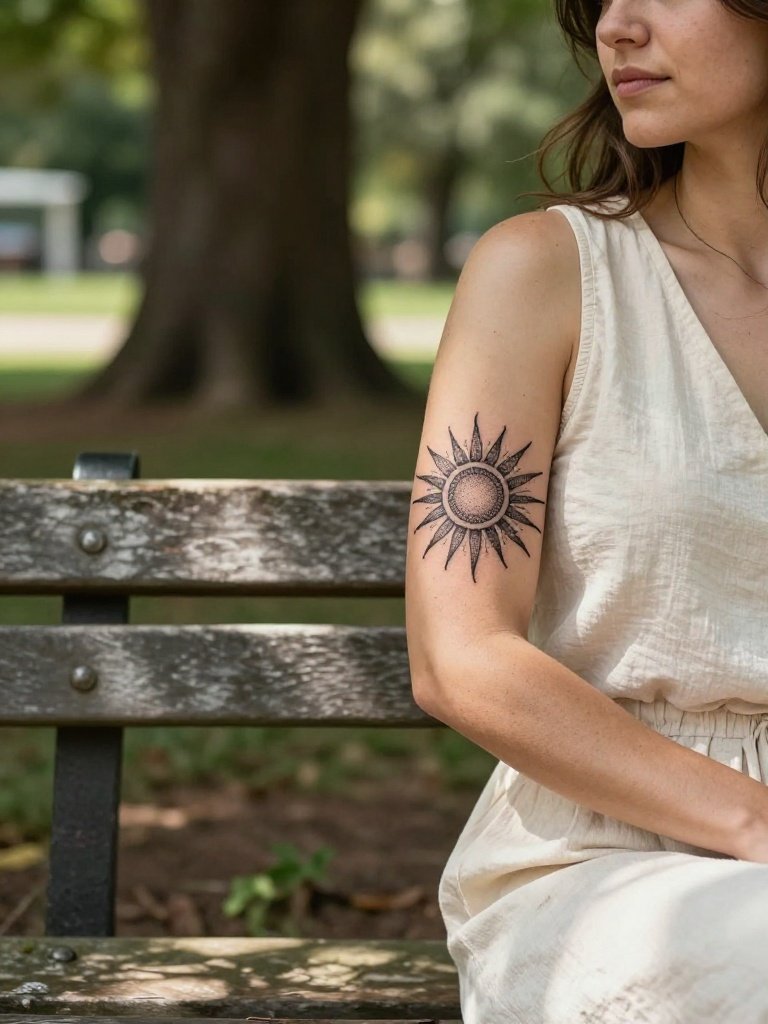
A radiating sunburst built from stippled dots and fine radial lines turns the elbow’s point into the design’s center. The rays fan across the forearm and upper arm so the piece reads as one continuous burst rather than a circle sitting on top of the joint. Because the rays are the longest lines, uneven dot spacing shows up fast here, and this is not the piece for an artist without dotwork-specific experience.
The joint changes the math on healing. Skin over the point is thin and close to bone, so discomfort runs higher than a flat forearm piece, and fine dotwork on bending skin can soften faster than the same technique somewhere flatter. That is a touch-up question, not a dealbreaker. If radial symmetry is what draws you, our ornamental tattoo ideas break down the symmetry and spacing rules that carry linework-heavy designs on curved skin.
Gradient, not fill
Ask for radial dot-gradient shading rather than solid fill, so the sun reads as light, not a black disc. Keep the center dot cluster tight: a hollow-looking center only gets worse as the piece settles.
2. Wraparound Floral Lily Elbow Tattoo
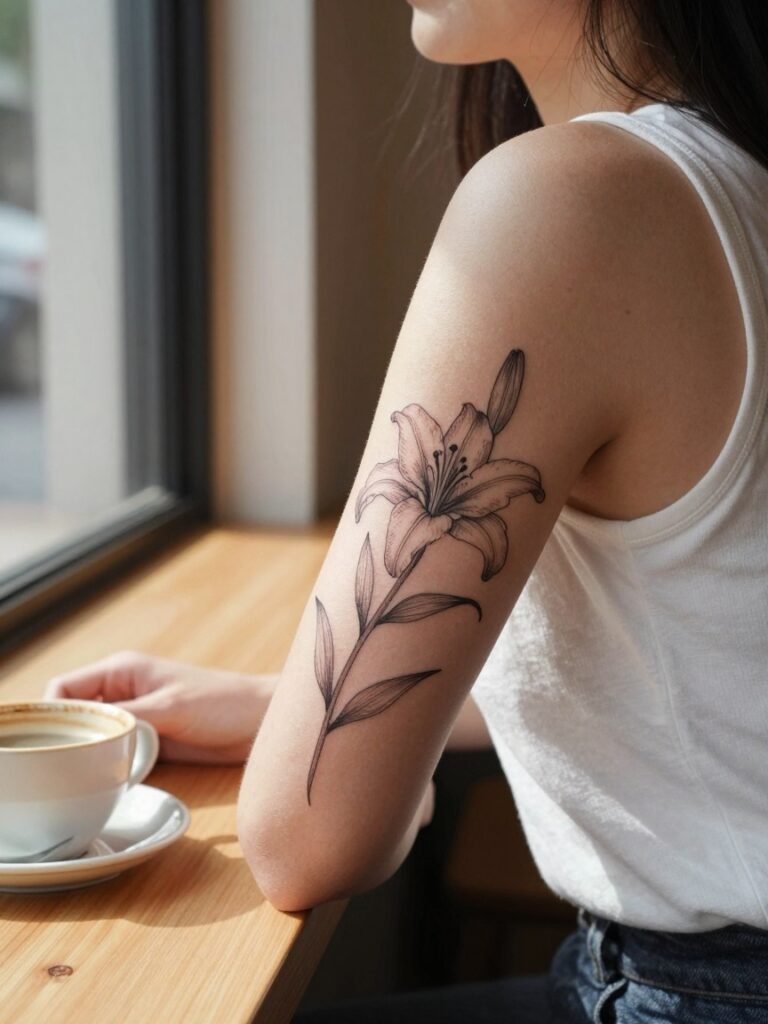
A single open lily curves around the outer elbow, trailing into buds and loose leaves down the back of the forearm, in fine black linework with almost no shading. This is the safest first elbow tattoo on this list for anyone who wants something soft: floral wraps follow the arm’s creases instead of fighting them, so an illustrative botanical piece holds up better long-term than a rigid geometric shape crossing the same joint.
The briefing that matters is botanical, not decorative. Bring a photo of the actual flower species, because “lily” covers a lot of variation, and ask for varying line weight: thicker on the outer petal edges, finer inside, which gives depth without added shading. Have the artist sketch the wrap directly on your arm first. A pre-drawn stencil rarely wraps evenly around a real elbow.
3. Neo-Traditional Eye and Spiderweb Elbow Tattoo
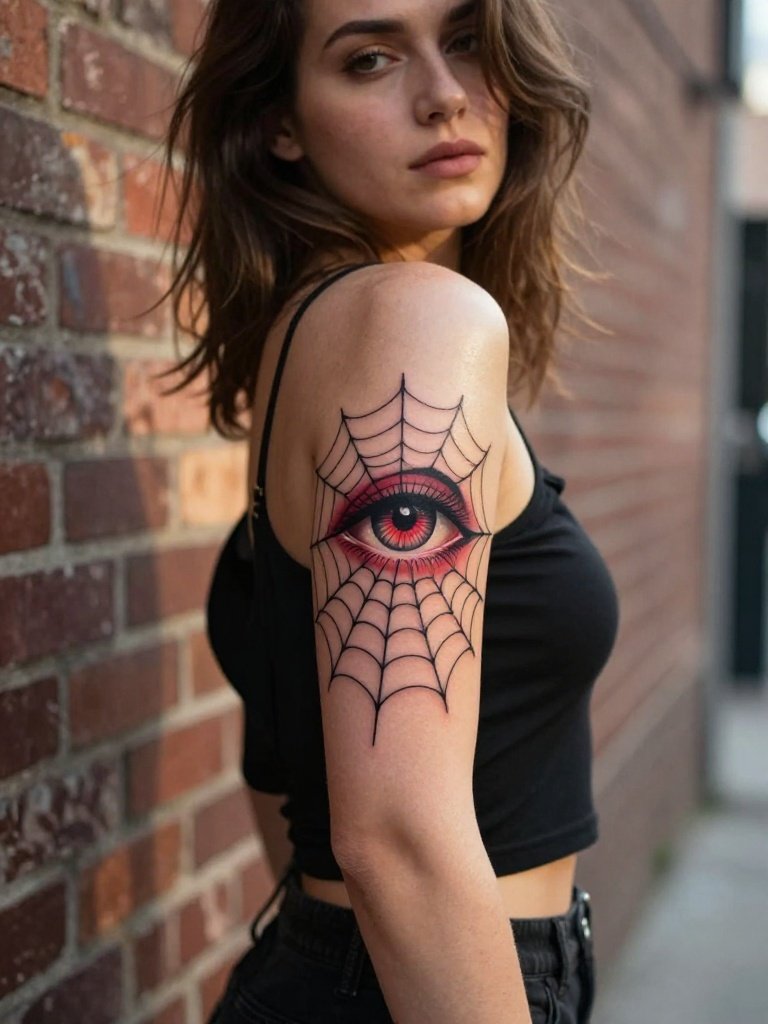
A realistic, color-shaded eye sits just above the joint while a fine linear spiderweb radiates across the crease itself, using the bend as the web’s natural center. The placement split is smarter than it looks: the eye keeps its detail on flatter skin while the web gets the joint it deserves. Color sessions on a joint run longer and feel more intense than black linework, and healing takes three to four weeks before the color fully settles.
The web also makes this an anchor piece. The eye gives a future sleeve a natural focal center, so this is the idea to pick if colored arm work is in your plans. One aging rule for the color: request desaturated tones, since bright color fades faster than muted shades on constantly moving skin.
Desaturate the iris
Ask specifically for a color-shaded iris with fine web linework, so the artist balances detail against the smaller scale. Plan a touch-up six to eight weeks out: detailed color pieces on joints commonly need one.
4. Vibrant Color Mandala Elbow Tattoo
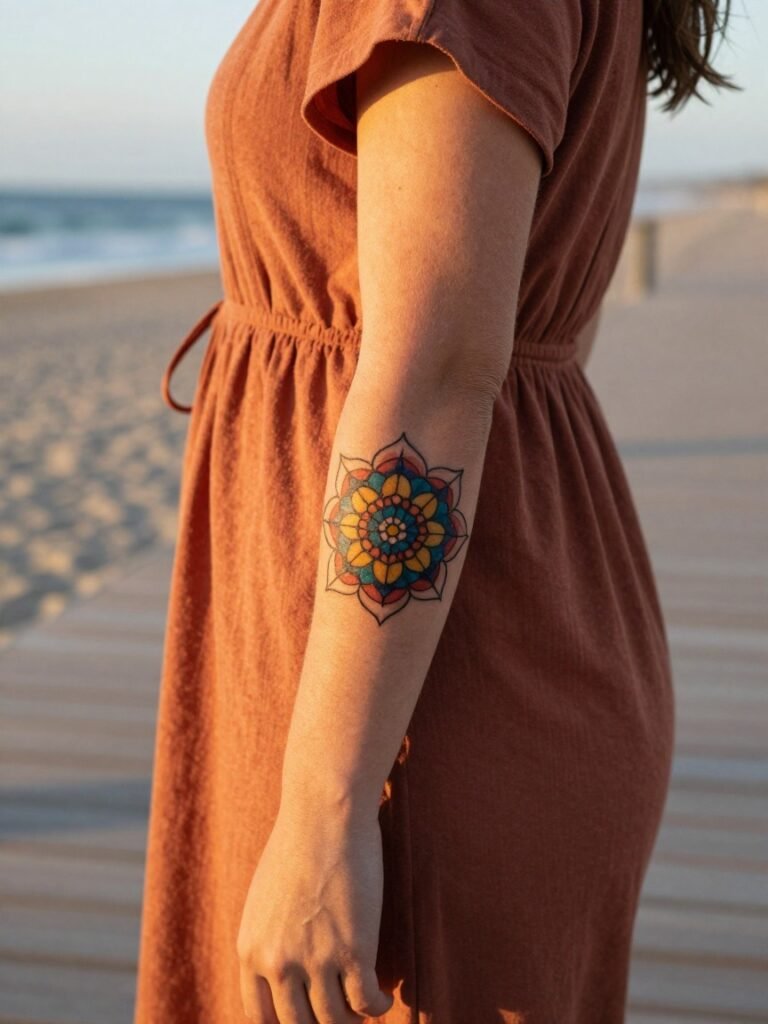
Layered petals in warm coral, deep teal, and mustard build outward into concentric rings, sized to cover the elbow like a medallion. It reads stained-glass rather than graphic silhouette. Covering the whole joint in solid color makes sessions longer and more intense than a comparable black-and-grey piece, with healing closer to a month before the colors look settled.
This is the boldest commitment on the list and it should be booked like one. Choose one temperature of color upfront rather than mixing warm and cool, since mandalas read cleaner that way, and ask for slightly thicker black outlines between color sections so the shapes stay crisp as the ink settles. Size the outer ring to stop just short of the crease, which reduces how much the design distorts when you bend.
5. Black Lotus Mandala Cap Elbow Tattoo
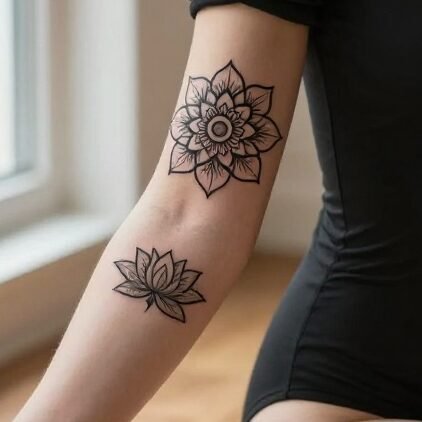
Solid black petals fan symmetrically from the elbow’s point in a layered lotus, mixing tight geometric patterning at the center with open, simple outer petals. The lotus shape mirrors the joint’s rounded contour naturally, which is why it looks inevitable as a standalone cap. Two things make this the best-aging design on this list: solid black holds on moving skin better than fine grey shading, and there is no color to fade unevenly.
Centering is the entire consult. The design must sit exactly on the elbow point, since even a slight offset becomes obvious the moment the arm bends, so bring reference photos from several angles and have the artist plan for bent and straight. Discomfort runs on the higher end for this zone, but solid fill heals in about two to three weeks and then holds.
Empty center
The pro tip nobody writes: ink does not hold cleanly on the very tip of the elbow. The skin there is thick and callous-like, and artists with real elbow experience leave a hole or a simple minimal pattern at the center rather than fighting it. If your artist insists on solid ink dead-center on the point, find another artist.
6. Traditional Rose Elbow Tattoo
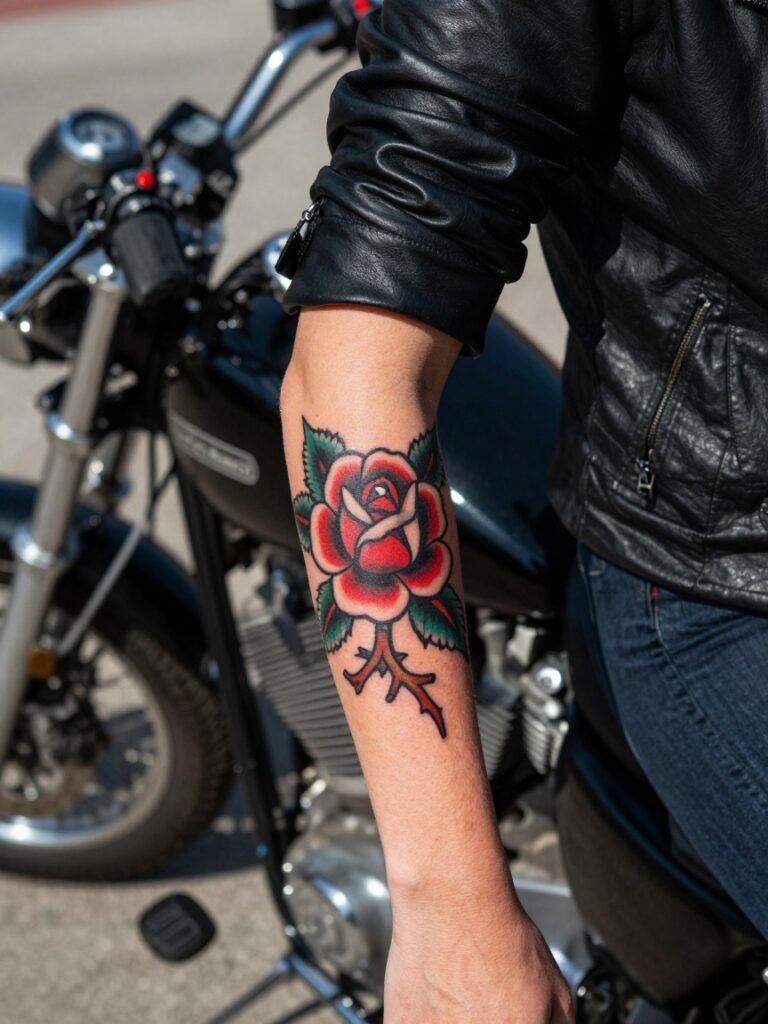
Bold black outlines and heavy shading give this rose its classic American traditional look, angled just above the elbow joint with thorny leaves trailing beneath the bloom. This is the longevity champion of the list for a mechanical reason: it sits on flatter muscle instead of the bony point, the thick linework survives decades, and the skin here does not stretch the shading out of shape.
The trade-off is pure aesthetic. If you want delicate, this is not it. But if you want one elbow tattoo that looks as good at year fifteen as day one, bold traditional above the joint is the answer, and it pairs easily with other American traditional pieces if a themed sleeve is in your future. Leave breathing room between the rose and the crease so nothing pulls when you bend.
See Also: 14 Stunning Feminine Christian Tattoo Ideas Trending Now
7. Blackwork Thorn Vine Elbow Tattoo
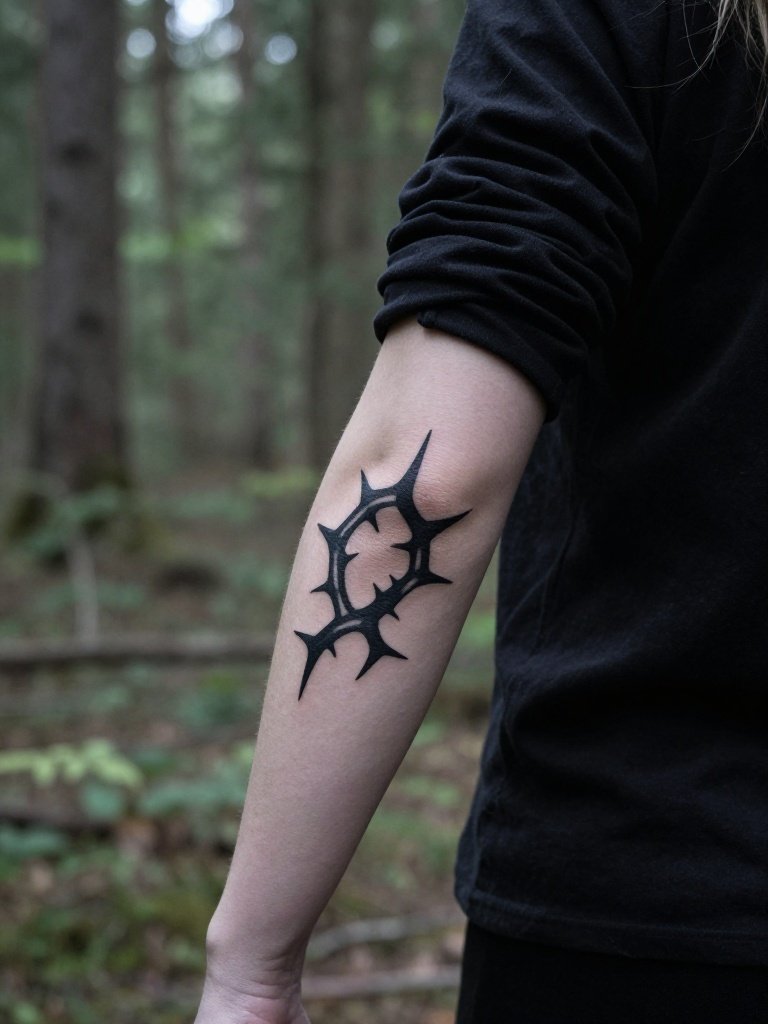
Sharp angular thorns in solid black stack directly over the elbow point, forming a spiky silhouette with clean negative space between each thorn. No shading, no gray, just shape against skin, which is the most age-proof thing you can put on a joint. It reads almost as graphic as a blackout from a few feet away, without actually being one.
The honest cost is subtlety. Centered on the point, this is visible whenever the arm is straight and partly obscured when bent, and it leans aggressive rather than soft. Some artists prefer to freehand the thorn placement directly on skin so the shape follows your specific contour, which is a good sign of an artist who understands elbows. Before booking, ask to see healed photos of the artist’s past blackwork: solid fill heals patchy in inexperienced hands, and there is nowhere to hide on a joint.
8. Bold Flame Silhouette Elbow Tattoo
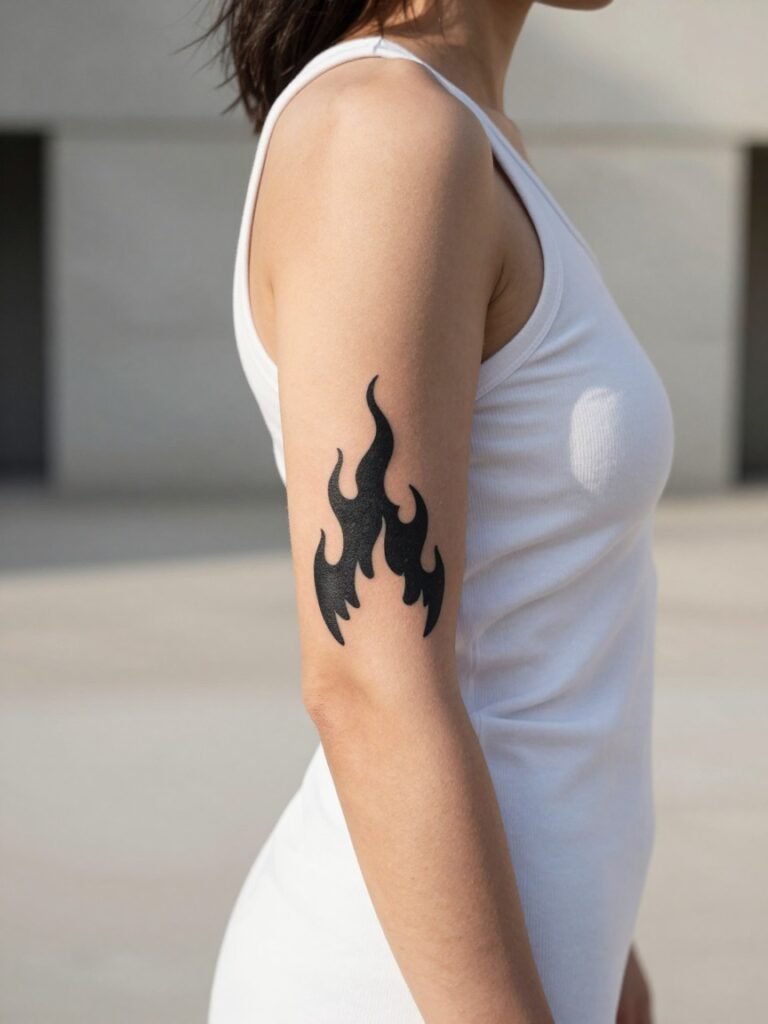
A single black flame with a jagged, windblown edge curls up and over the elbow, drawn as a solid silhouette with zero interior detail. Of the graphic designs here, this is the simplest to execute well: a clean silhouette leaves little room to age awkwardly, and solid black on the outer curve is about as low-maintenance as an elbow tattoo gets.
Placement does the compositional work. Keep the tip of the flame pointed toward the shoulder rather than the wrist for a natural upward flow, and resist any urge to add shading inside the shape. One direction for the consult: have the artist sketch the flame directly on your arm, because the curve has to follow your specific elbow geometry or it reads pasted-on.
9. Fine Dotwork Flower Mandala Elbow Tattoo
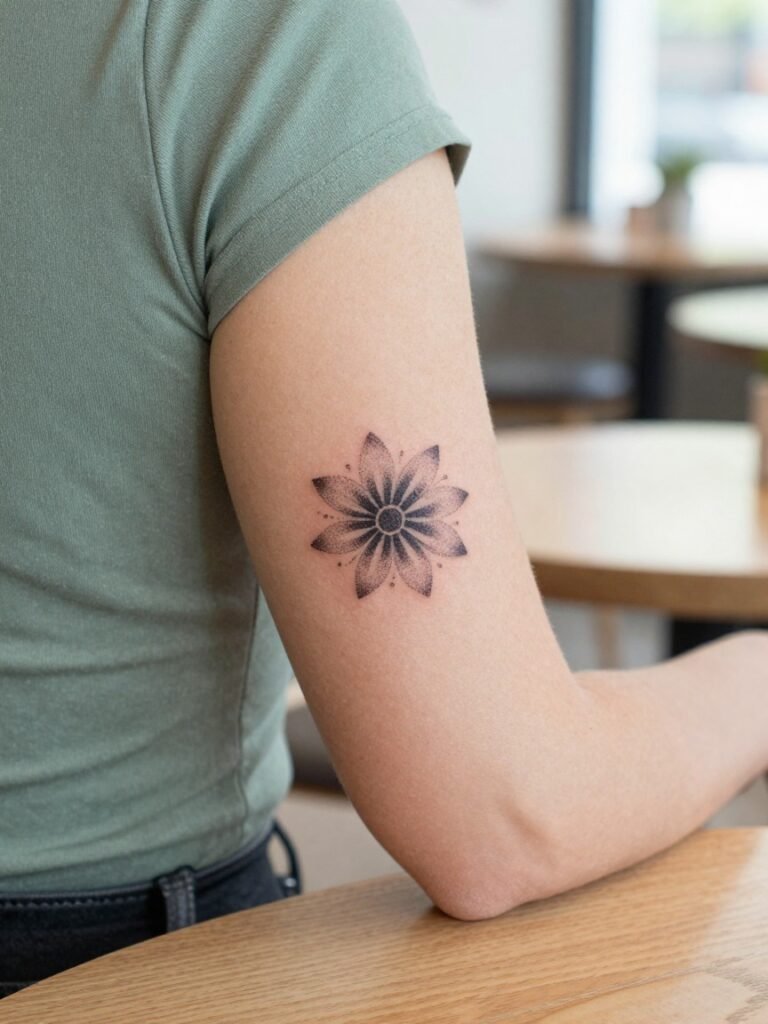
A single small flower built from fine dot shading sits neatly on the elbow point, its petals using gradient dot density, darker at the center, softer toward the tips. It is the mandala look at a smaller commitment: somewhere between a micro tattoo and a full statement cap, and less ground for the needle to cover, which makes the session more manageable.
The risk is scale. Fine dots settle differently than they first appear, so look at healed photos before committing to this size, and confirm the size in inches with your artist. If the design keeps shrinking in the consult, stop shrinking it. For how detail survives at small sizes generally, our small tattoo ideas guide covers the legibility math that applies here too.
Size floor
Dotwork detail gets muddy below a certain scale. Ask for a slightly denser dot pattern in the center to avoid a flat, empty middle, and keep the outer petal ring small enough that it does not crowd the crease when your arm bends.
10. Inner Elbow Spiderweb Tattoo
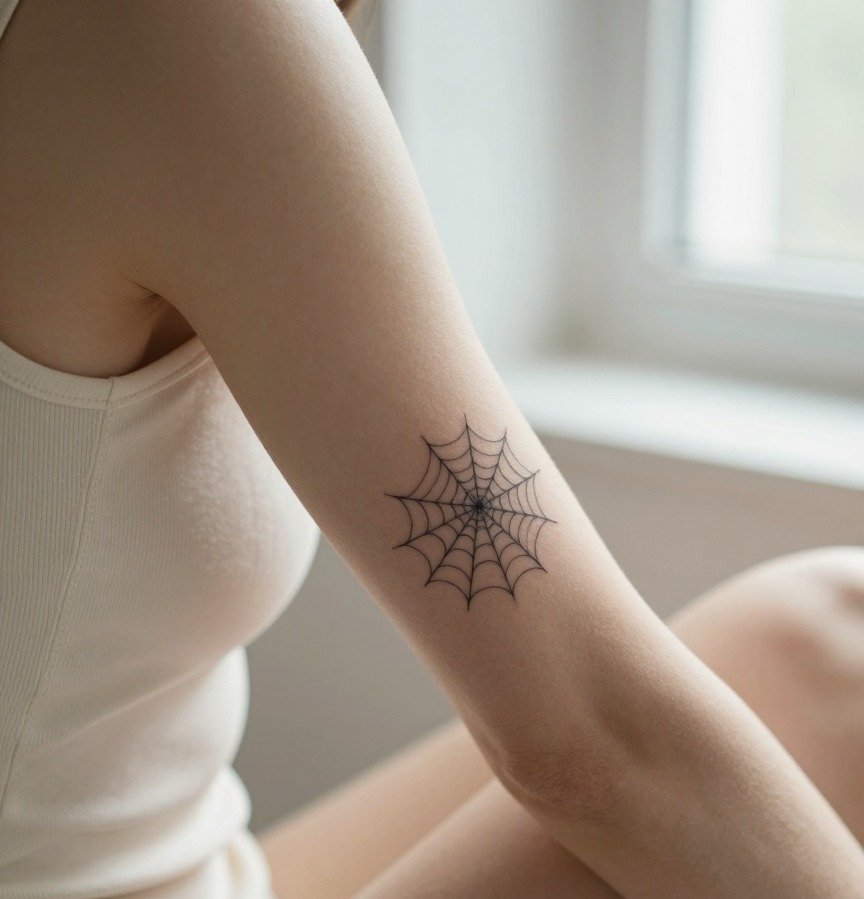
Thin, uniform fine-line work traces a delicate spiderweb across the inner elbow crease, the ditch, using the skin’s natural fold as the web’s radial center. It is a popular placement because the shape follows the crease so naturally it barely needs adjusting to fit. It is also the worst combination of fine-line and joint on this entire list, and that deserves plain language.
The ditch sits over the median nerve under thin skin. The pain is sharp and electric and, unlike most tattoo pain, does not settle into background ache as the session continues. Thin single-needle lines in a crease soften over time, so expect distortion when the arm is fully bent and budget a touch-up in the two-to-three-year range. None of that means don’t get it. It means get it with the ditch-specific details below, not with gallery optimism.
Nerve zone
Keep the web small and centered with fewer radial spokes, and ask for thin single-needle linework rather than thicker traditional lines to keep it delicate. Expect swelling for the first few days, which is normal for this zone. Read the pain and numbing sections below before you book.
11. Geometric Maze Pattern Elbow Tattoo
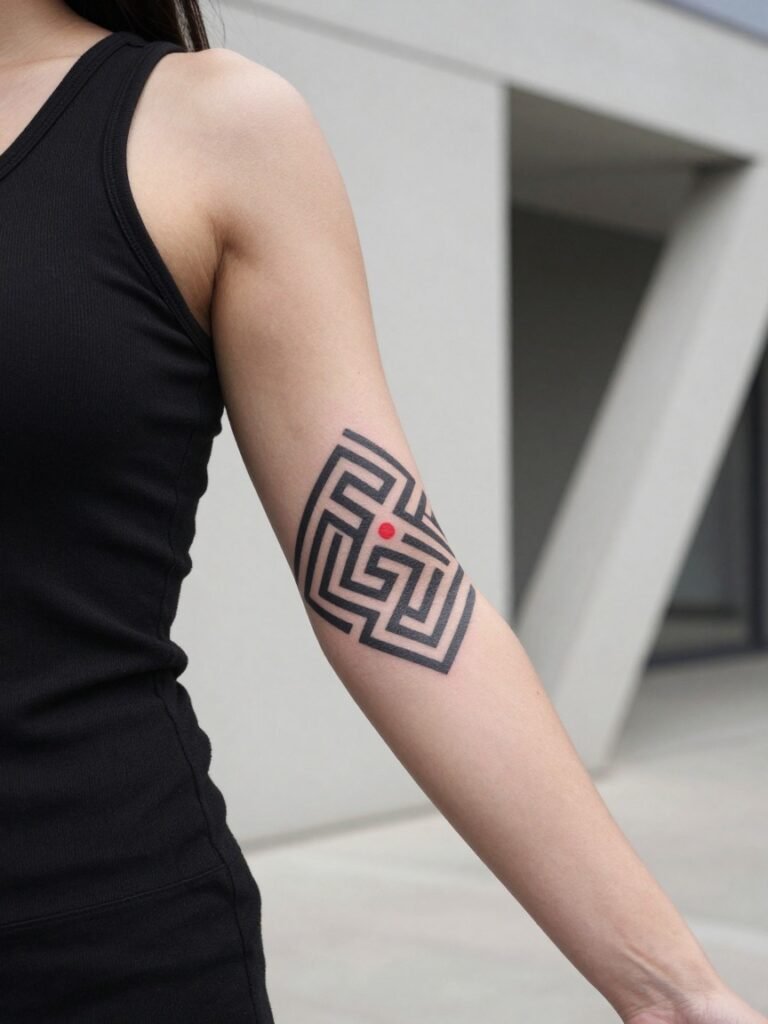
Sharp ninety-degree turns build an angular, interlocking maze just below the elbow, anchored by a small red or colored dot at its center. It is the intentionally rigid option on a floral-heavy list, drawing loosely on sacred geometry rather than decoration. Sitting below the joint instead of on it, it stays visible in short sleeves while avoiding the heaviest distortion, and it heals in about two weeks.
The trade-off is precision. A structured design shows every wobble far more obviously than a floral piece would, so confirm your artist has specific linear-pattern experience before booking. Request a stencil preview on your actual skin, not paper, and double check the spacing between lines before the outline starts: gaps too tight blur together once healed. Keep the color accent to one small area so it does not fight the black pattern.
See Also: 18 Gorgeous Forearm Tattoo Women Ideas That Are Trending
12. Minimalist Linework Sun Above Elbow Tattoo
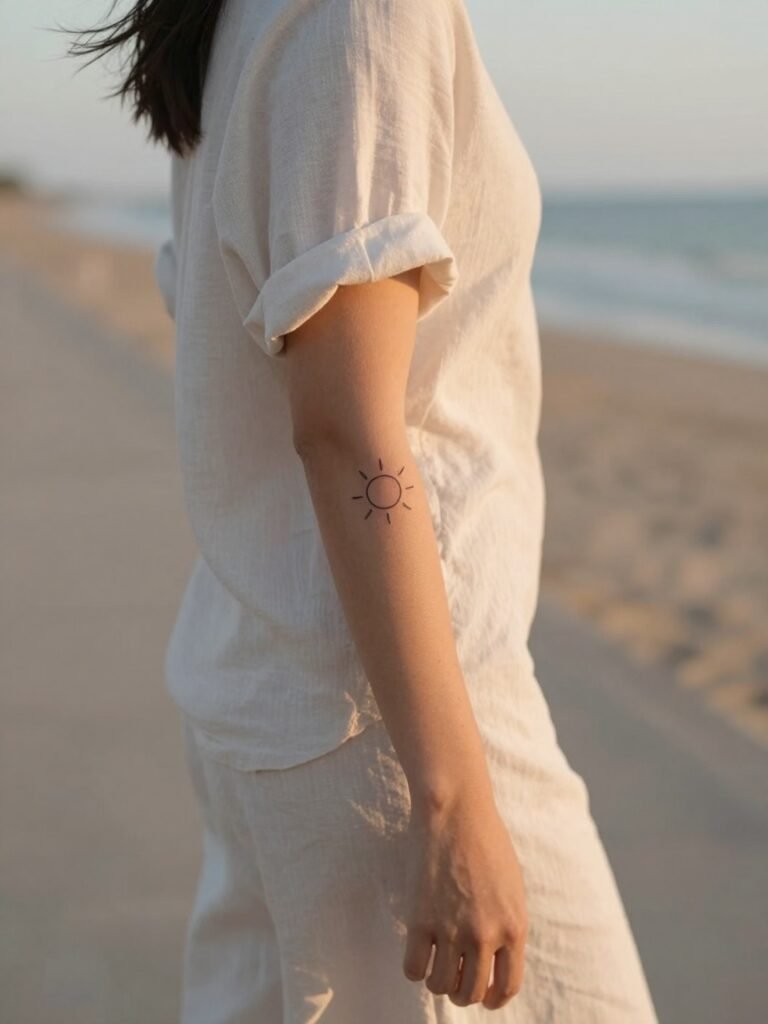
A small single-line sun with simple triangular rays sits an inch or so above the elbow, using thin, consistent linework and zero shading. It is the quietest and most coverable idea on this list, and the easiest first tattoo: above-joint skin is flatter, the session is short, discomfort runs lower than every other entry here, and healing is often done in ten days to two weeks.
The restraint is the technique. Keep the ray count between six and eight for a cleaner look at small scale, and ask for slightly uneven line thickness between the center and the rays so it reads hand-drawn rather than stamped. Position it an inch above the crease so bending never distorts the shape, and request a stencil sizing check against a coin so you know the real scale before it is inked.
One inch up
Above-elbow placement is the visibility compromise the whole list orbits around: mostly flat, mostly undistorted, mostly hideable. If you want sun symbolism without the joint’s maintenance, this is the idea.
The Five-View Angle Check
The design-validation framework this placement deserves. Before your artist starts the outline, check the stencil five ways, because an elbow tattoo is seen from more angles than any flat-arm piece.
Straight: arm extended, seen head-on. This is how most people will see it, and how most stencils are checked. It is not enough on its own.
Bent: arm fully bent. This is the stress test. Faces stretch, rings compress, radial designs breathe. If a design fails here, it fails as an elbow tattoo, no matter how good it looks straight.
Mirror: the back view. You never see it; everyone behind you does. A cap design that looks centered straight-on can read off-center in a mirror.
Phone: a photo at normal social distance, not a close-up. Close-ups flatter joints; distance tells the truth about how the piece reads.
Casual: the natural resting arm, half-bent, mid-conversation. This is how your tattoo lives in the world most of the time.
A good elbow artist does this unprompted. An artist who checks the stencil once, straight-on, has not thought about the joint.
Zone Strategy and the Coverability Map
The one career-planning axis nobody writes for women. Visibility by zone:
Above the elbow hides. Short sleeves cover it, the skin is flatter, and it is the zone to pick if you want an elbow tattoo without the elbow tattoo’s visibility.
The cap never hides. It shows in every t-shirt and every tank top, year-round. Pick a cap design only if you are comfortable being visibly tattooed in every setting, or your work life already accommodates it.
Below the elbow partially hides. It shows with short sleeves and disappears under three-quarter sleeves, the compromise zone, and it connects naturally to forearm work.
The ditch is the private option. Visible only when the arm straightens, which is rarely. It is also the zone with the worst pain and worst aging, so the privacy has a price.
Map your actual life against these before you pick an idea: scrubs, uniforms, client-facing roles, family events where you would rather not field questions. Forearm pieces have not ended careers in 2026, but a cap design has ended the option to hide.
The Fine-Line-on-Joint Ledger
This is the section the galleries need and none of them write, because the women’s elbow canon is mostly fine-line and small, and fine-line is the most vulnerable style on a hinge. Here is the honest ledger.
Thin lines spread and blur as they age, and a joint accelerates everything. The skin over the elbow folds and stretches with every movement, and seasoned artists report broken, pulled lines on joints that heal dramatically and unevenly. Elbows and the ditch are consistently named among the worst-aging placements for delicate work, alongside hands and feet.
Survival design has three levers. First, a line-weight floor: nothing hair-thin on the point or the crease, because the thinnest lines are the first to go. Heavier line weights in the ditch, where crease softening is guaranteed. Second, spacing: uncrowded fine-line ages dramatically better than packed micro detail. Third, the silhouette test: squint at the design. If it reads blurred, it survives the joint. If it only works at full detail, it is a drawing, not yet a tattoo.
Touch-up windows, flagged as reported norms: the ditch, two to three years. The outer cap with fine work, five to seven years. Above-elbow pieces on flatter skin, the longest of the four zones. Budget the touch-up into the tattoo’s cost, not as a surprise. And sun discipline matters more here than on most placements, because UV is the number one accelerant of the fade the joint is already causing.
Pain, Honestly
The pain ladder is real, but the gallery version of it scares more than it informs. Zone by zone:
The outer cap, demystified. It is bone, not nerve. The sensation is grinding vibration rather than sharp pain, and one honest first-person account rates it a five out of ten. Uncomfortable, completely doable, and the most exaggerated spot in the terror-ladder retellings.
The ditch, warned. The median nerve sits directly under thin skin in the inner crease. The pain is sharp and electric, and unlike most tattoo pain, it does not adapt or settle as the session continues. This is the eight-to-nine-out-of-ten spot, the one real warning on this page. Sessions here go better with the arm extended and the body limp, and long sessions should be split.
Numbing honesty. For ditch work, a proper numbing protocol means application sixty to ninety minutes before the session, covered in plastic wrap. Tell your artist in advance if you plan to numb; some adjust their timing around it. It takes the edge off, not the whole experience.
Above and below the joint. Noticeably easier than either. These zones read like standard forearm work with a bone nearby, which is why ideas 6, 8, 11, and 12 are the sensible picks for anyone whose pain budget is limited.
Healing the Elbow Specifically
Elbows heal on joint time, not arm time. Reported norms: three to four weeks for surface healing, up to four to six months for full dermal settling, because the skin folds and stretches with every movement and the flaking phase is heavy.
Three rules from people who do this for a living. First, keep the arm extended as much as possible during week one, especially ditch work; creasing a fresh tattoo in the fold traps moisture and slows healing. Second, thin frequent moisturizing layers rather than thick coats; the crease traps moisture and thick ointment macerates the skin. Third, no pulling, climbing, or heavy arm workouts until the surface closes, and sleep with the arm straight for the first week or two.
The heavy flaking is normal. The dramatic uneven look in week two is normal. What is not normal is heat, spreading redness, or pus, which means a clinic visit, not a forum search.
Vetting an Elbow Artist
Delicate work on a hinge needs its own checklist.
Demand healed elbow photos. Fresh elbow work always looks sharp. Healed elbow photos show whether the artist’s line decisions survived the joint, which is the only portfolio evidence that matters for this placement. No healed joint work in the book is a red flag.
Check curved-line control. Ask whether the artist maps the design to your arm directly and whether they can work the needle around the curve with control. An artist who only tattoos from flat flash has not solved the elbow’s geometry. The stencil must go on your skin, checked in the five views above, before any outline starts.
Ask the joint questions. How do you handle the center of the point? What line weight do you use in the ditch? When would you schedule a touch-up? An artist who answers specifically has done the work. An artist who tells you the tip won’t hold ink is the artist you want.
What It Costs
Nobody in this niche gives pricing, so here are the reported ranges from working shops. Small pieces, two to four inches, the size of most elbow tattoos, typically land in shop-minimum territory, often $80 to $300 depending on the city. That covers the minimalist sun, the small flower mandala, the single-line pieces.
The joint premium is real and small. Elbows are technically harder than flat areas and most shops price them a little higher for the same size. Color adds roughly fifteen to thirty percent more time, and therefore cost. Ditch work with numbing and a likely touch-up belongs in the higher end of its bracket.
Those are planning numbers, not quotes. Every shop sets its own. Deposits are normal, tips are standard, and a touch-up in the two-to-three-year window for ditch work should be priced in from the start.
Your Elbow as Connector
The elbow is the hinge of the arm, which makes it the natural bridge between existing pieces. A mandala cap can connect a bicep piece to a forearm piece; a below-elbow design can flow into wrist work; an above-elbow piece can sit quietly beside a shoulder design. Artists who plan patchwork arms treat the elbow as the keystone, not an afterthought.
This also makes the elbow the gateway piece. If a full feminine sleeve is in your future, an elbow cap designed with the sleeve’s visual language is the smartest first session: it commits less skin than a shoulder piece while establishing the style. For how a planned sleeve absorbs and connects pieces over time, our sleeve tattoos for women guide covers the coverability and planning side in depth.
Tell your artist about every existing piece on the arm in the first consult. A connector designed around your current ink reads as a composition. A connector designed on top of it reads as an accident.
Quick Comparison
| Design | Zone | Linework | Aging Outlook |
|---|---|---|---|
| Dotwork Sun Mandala | Cap | Fine dotwork | Good if bold, touch-ups likely |
| Wraparound Floral Lily | Cap to below | Fine-line botanical | Strong, organic ages well |
| Eye and Spiderweb | Above + crease | Neo-traditional color | Medium, color fades first |
| Vibrant Color Mandala | Cap | Color solid | Medium, month-long settle |
| Black Lotus Mandala Cap | Cap | Solid black | Strongest on this list |
| Traditional Rose | Above | Bold traditional | Champion, decades |
| Blackwork Thorn Vine | Cap | Solid black | Excellent, graphic holds |
| Bold Flame Silhouette | Outer curve | Solid black | Excellent, simplest aging |
| Fine Dotwork Flower Mandala | Cap | Fine dotwork | Fragile, watch the scale |
| Inner Elbow Spiderweb | Ditch | Single-needle fine-line | Worst bet, touch-up in 2-3 yrs |
| Geometric Maze Pattern | Below | Linear blackwork | Good if lines stay true |
| Minimalist Linework Sun | Above | Single-line | Strong, flattest skin |
Frequently Asked Questions
Will fine-line hold up on my elbow?
It depends on the zone. Above the elbow, on flatter skin, fine-line ages about as well as it does anywhere. On the cap, expect softening and plan a touch-up in the five-to-seven-year window. In the ditch, thin lines are guaranteed to soften; use heavier line weights there and budget a touch-up in two to three years. The combination of fine-line and joint is the worst bet in tattooing, so design for it: line-weight floor, generous spacing, and the silhouette test.
Which elbow zone hurts the most?
The ditch, by a wide margin. The median nerve sits under thin skin in the inner crease, and the pain is sharp and electric, rated eight to nine out of ten, and it does not settle as the session continues. The outer cap is bone vibration, far more manageable, honestly around a five. Above and below the joint feel like standard arm work.
Can I hide an elbow tattoo for work?
It depends on the zone, and this is the decision to make before you pick a design. Above-elbow pieces hide under short sleeves. Below-elbow pieces hide under three-quarter sleeves. The cap shows in every t-shirt, year-round. The ditch hides whenever the arm bends, which is most of the time, but you pay for the privacy with the worst pain and worst aging.
How much should I budget?
Reported ranges: most elbow pieces are two to four inches and land in shop-minimum territory, often $80 to $300 depending on the city. Elbows carry a small technical premium over flat areas. Color adds roughly fifteen to thirty percent. Budget the likely touch-up in, especially for ditch work, and treat these as planning brackets, not quotes.
How do I know an artist can actually do elbows?
Ask for healed elbow photos specifically, not fresh work and not healed flat-arm work. Ask how they handle the center of the point, what line weight they use in the ditch, and whether the stencil goes on your skin in all five views before inking. An artist who refuses to ink the very tip is the artist you want.
The Takeaway
Elbow placements reward designs that work with the joint’s curve rather than against it, whether that’s a wraparound floral piece or a mandala centered on the point. If you are still deciding, start with the zone, not the style: decide how visible you want to be, pick the lane that fits that zone, and run the five-view angle check before anyone picks up a machine. Then trust an artist who is specifically comfortable working on a joint that moves constantly, because that comfort is the whole job.


Pingback: 16 Traditional Heart Tattoo Ideas That Still Feel Iconic - Glow Vibes Spot