Quick-answer opener
The forearm has two sides that behave like two different placements. The outer forearm is thick, flat, and holds bold work well, but it takes the most sun of almost any tattoo spot. The inner forearm stays out of the sun but is thin, tender skin where fine detail blurs faster. Neither side is the better choice. They just age differently, and most of what decides a forearm tattoo’s outcome is choosing the right design for the right side.
That is the frame for everything below: match the design to the zone, and the zone to how you live.
Inner vs Outer: The Honest Reconciliation
Every guide says the inner arm holds ink longer and the outer is the “Goldilocks zone,” and both are half true. The outer forearm is flat and stable, so bold lines and heavy blackwork stay crisp for decades. Its problem is UV. Arms live in the sun, and sun is the fastest fading force in tattooing, faster than friction, faster than time itself.
The inner forearm dodges the sun but pays for it with thin skin. Fine lines bleed easier there, and tiny script has a documented habit of turning into illegible blobs by year five. Thin skin also raises the blowout risk, where ink spreads under the surface into a faint halo. So the honest trade is this: outer ages by sun, inner ages by softness. You manage the outer with sunscreen discipline. You manage the inner by choosing bolder lines and an artist who knows how deep to go on thin skin.
The fifteen ideas
1. Crowned Skull and Rose Forearm Tattoo Men Design
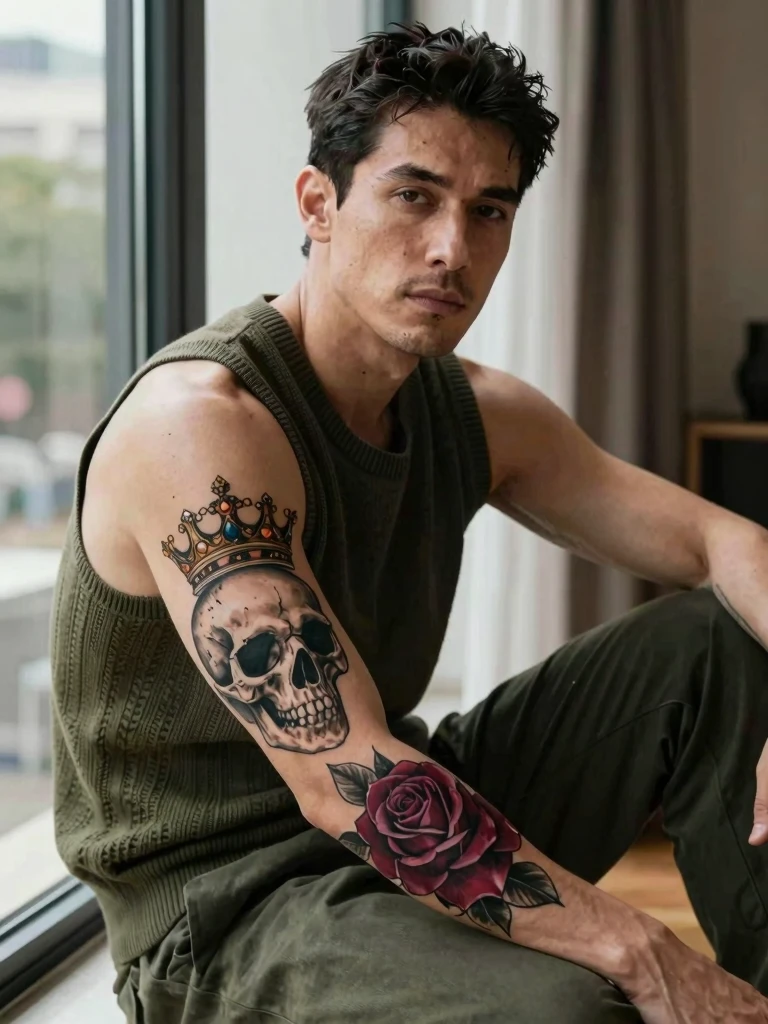
A vertical stack of crown, skull, and rose, narrowing from the wide elbow end toward the wrist. The composition works because it respects the taper: the biggest mass sits where the arm is thickest, and the piece narrows as the arm narrows. That is the single design move that separates fitted forearm work from a rectangle pasted on skin.
The narrow skin breaks between teeth and crown jewels are doing real work too. At year five those gaps keep the face from collapsing into one dark block. Keep color restraint: limited teal and orange accents read as deliberate. Spread those accents wider and the piece stops being black-and-grey realism with color notes and becomes a color piece that needs color-piece maintenance.
Preserve the gaps
2. Outer Forearm Tattoos for Men With Orange Flames
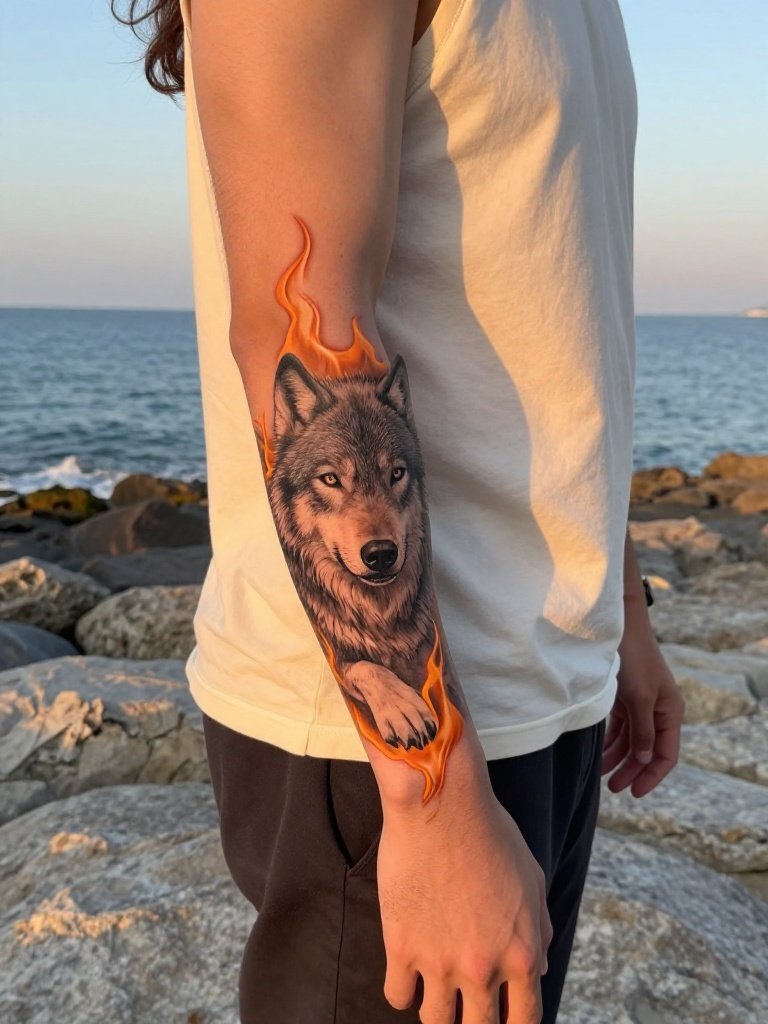
Wolf portrait realism wrapped in controlled orange flames. The important decision here is where the color lives. Flames hug the edges while the wolf’s face stays grey, which keeps the eyes and muzzle as the undeniable focal point. Color at the edges, meaning in the center is a sound rule for any partial-color forearm piece.
For the expression, decide before the stencil: closed mouth reads watchful, bared teeth reads confrontational. Artists can shade either, but they cannot swap the attitude after the lines are in.
Eyes on the flat
3. Guardian Lion Forearm Tattoo Men With Temple Details
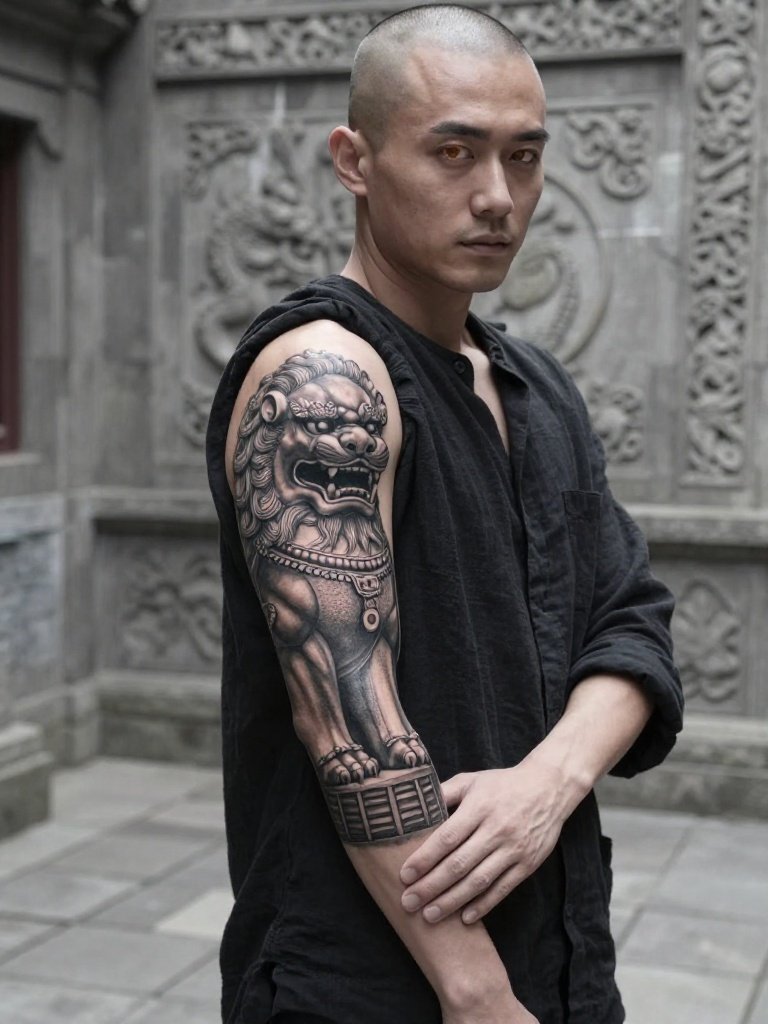
A guardian-lion carving, stone-textured, on the inner forearm. This placement choice matters. Carved detail with stippled stone texture sits well on the inner arm because the viewer sees it close, in private rotation. But thin inner skin punishes over-detail. Ask the artist to keep the stippling looser than the reference looks; stipple is one of the first textures to blur on soft skin, and overworked stipple reads as mud at year five.
On meanings: guardian figures carry protection and watchfulness in several traditions, but the temple gate here is ornamental rather than sourced from a specific lineage. Treat it as decorative symbolism unless you research the actual source first.
4. Small Forearm Tattoos Male: Sketch-Style Compass
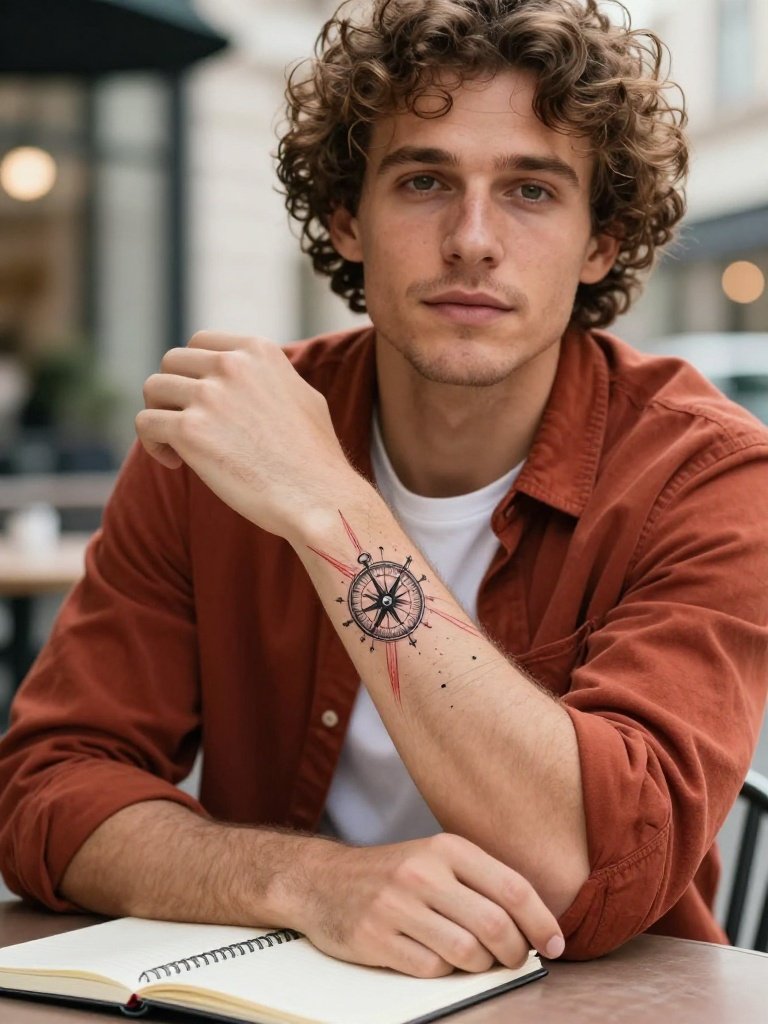
A compact compass with sketch marks bleeding past the circle. This is the sleeve-on-ramp piece: small, clean, and designed to grow. The scattered red and black splashes give later pieces a visual language to join, which matters if this becomes one corner of a map-and-travel sleeve later. When you book it, tell the artist the long-term plan. A compass designed as a standalone and one designed as a seed are different tattoos.
Keep the directional letters at a readable size. Which brings us to the rule this article keeps repeating: script on skin has a legibility floor.
5. Inner Forearm Tattoos for Guys With a Veiled Portrait
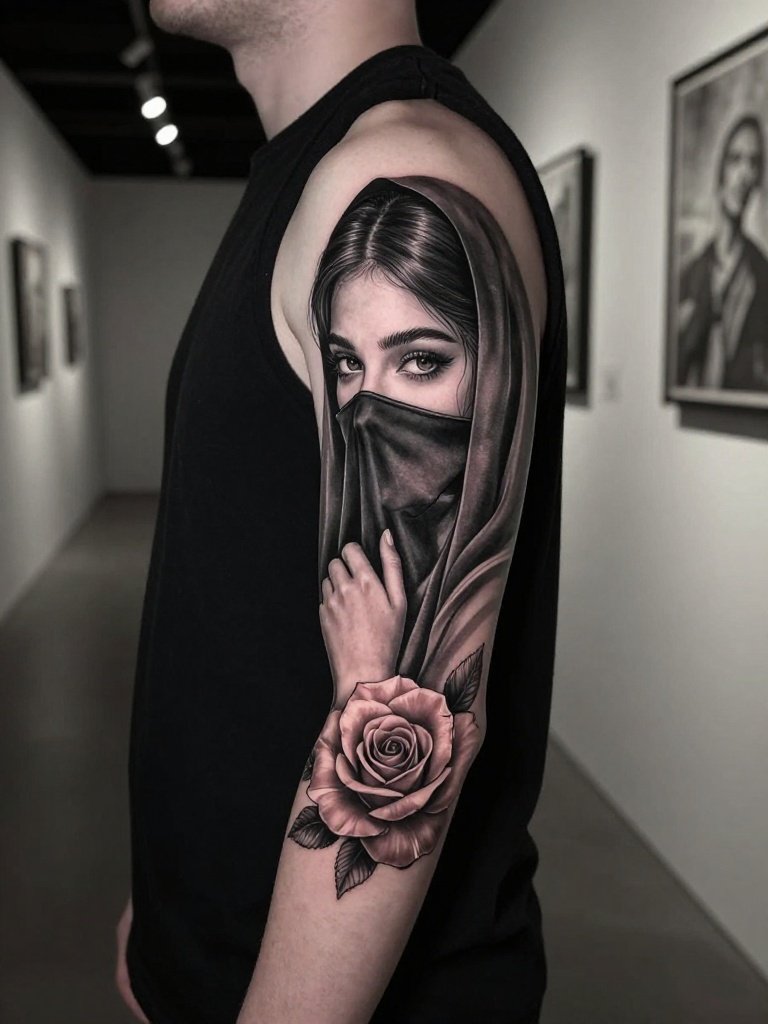
Smooth portrait shading with the emotion carried entirely by the eyes. Portrait realism on the inner forearm is a bold call for two reasons. First, the thin skin stretches the artist’s shading margin. Second, portraits age by softening, and on inner skin the softening starts earlier. Only book this with an artist whose healed portrait work you have seen, not fresh photos. Fresh portraits always look impressive.
See Also: 17 Stunning Shoulder Tattoo Men Ideas: Ultimate Guide
6. Fine-Line Snake and Floral Forearm Tattoo Men Idea
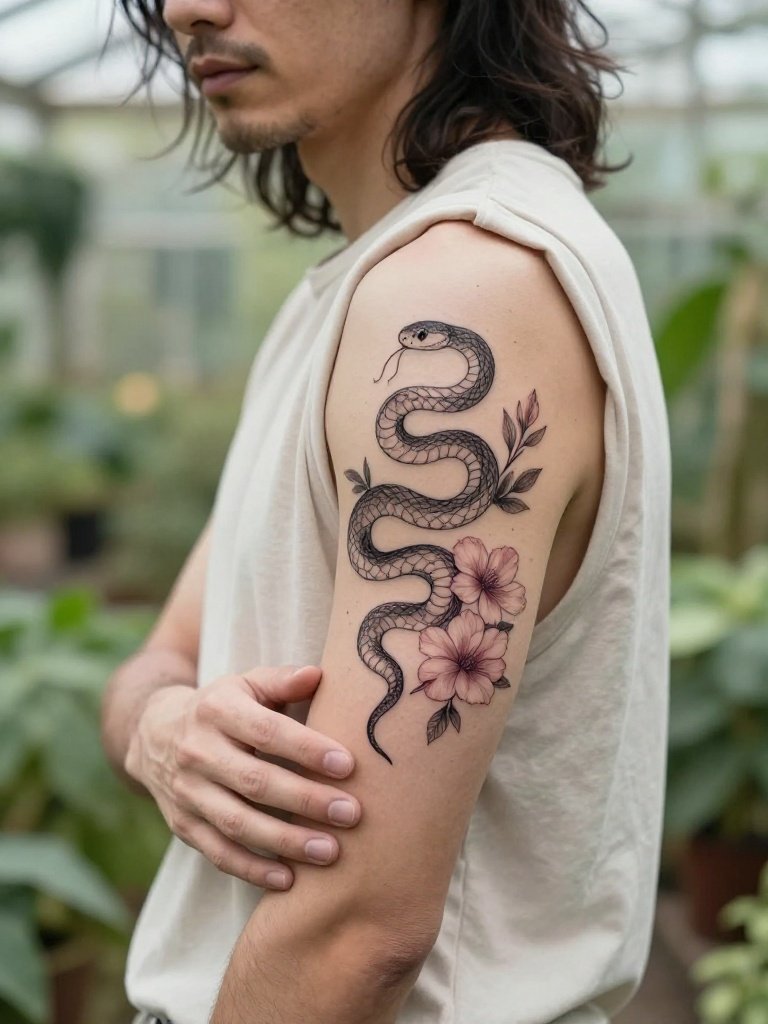
A slim snake winding through light florals, all open composition. This is the highest-risk style on the inner arm done right: the linework is fine but not hairline, the negative space is generous, and the strongest lines sit around the head and main curves. Fine-line on the forearm survives when the artist designs for the healed version, with slightly heavier lines than the drawing suggests.
For growth: the open coils invite additions that follow the snake’s curve. Moths, stars, and herbs can join later as long as they follow the existing flow instead of forming a separate block beside it.
Heavier than drawn
7. Biomechanical Panels Over the Lower Forearm
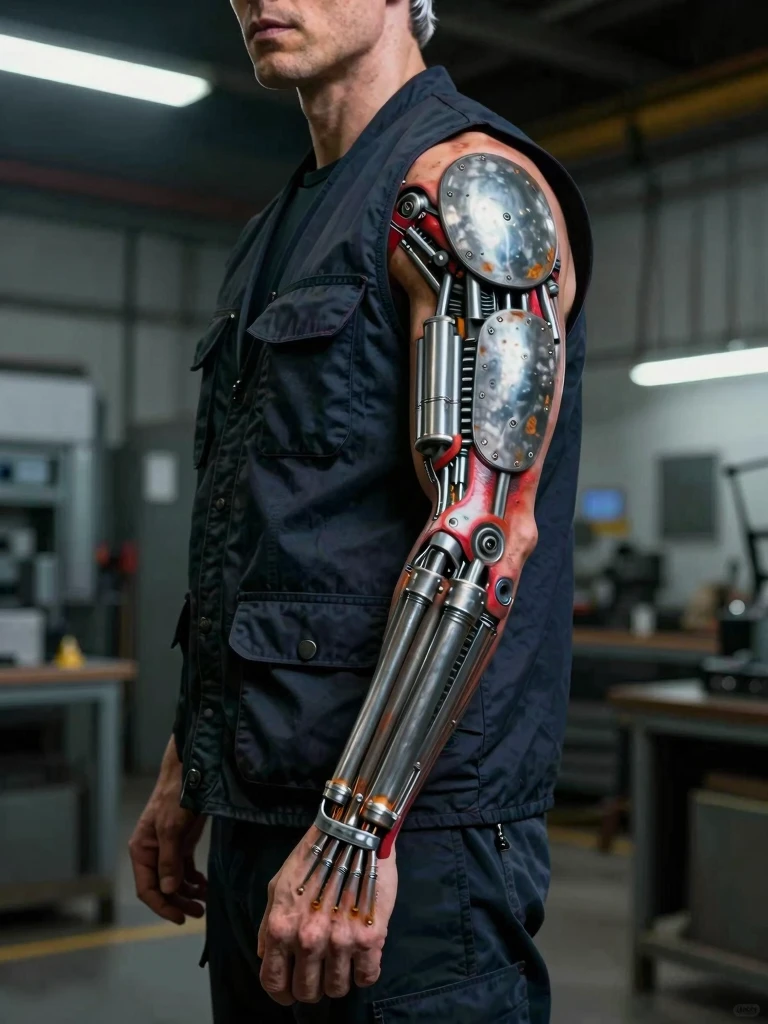
Metal machinery beneath opened skin, parts angled toward the hand like tendons. The illusion lives or dies on one discipline: every plate and rod must share the same light direction. Mixed lighting breaks the three-dimensional read instantly, and no amount of detail fixes it. Vet the portfolio for consistent rendered metal, not just a lot of mechanical subject matter.
This is also the densest session on the list. Heavy shading over the lower forearm takes longer than its size suggests, so budget the time honestly rather than treating it as a quick piece.
One light direction
8. Polynesian-Inspired Full Forearm Tattoo Men Wrap
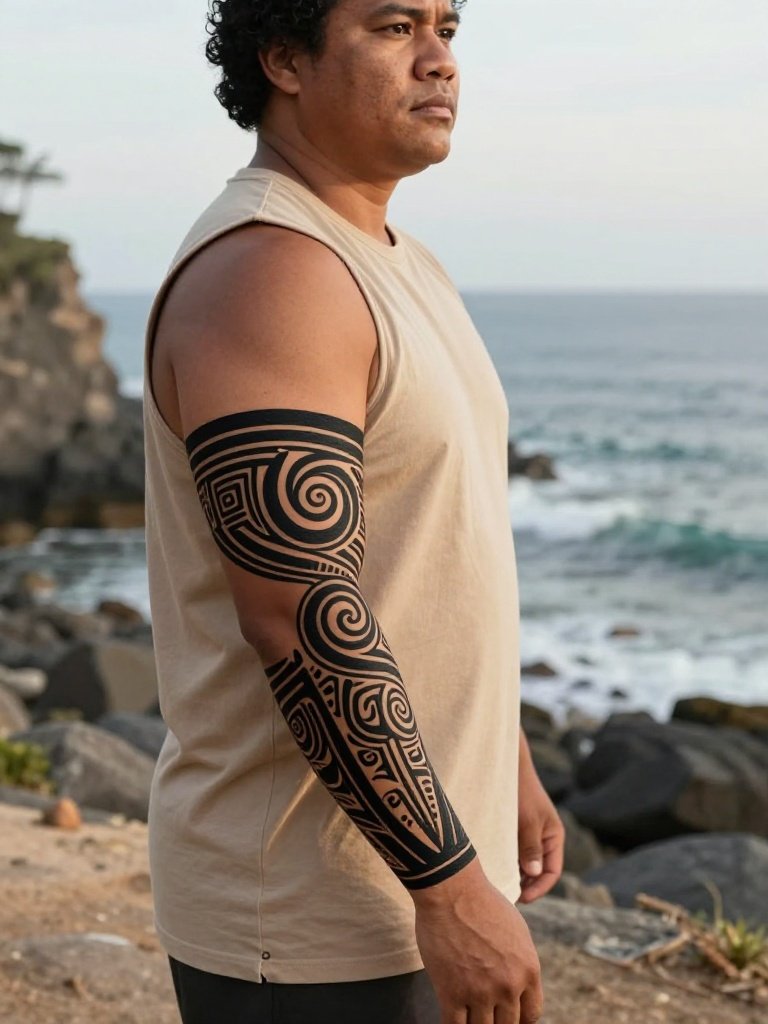
A full wraparound in broad black curves, spirals, and bands. Two things decide this one. First, the wrap must be mapped on your actual arm before inking begins, because a pattern drawn flat joins badly around a cylinder. Second, the cultural honesty matters more here than with any other idea on this list. Polynesian-inspired motifs can carry family, regional, and spiritual meaning in their source traditions. Using them as pure decoration is a real decision with real weight; an artist who understands the source is not optional.
Set clear stopping points below the elbow and above the wrist. A wrap that drifts onto the hand crosses a visibility line you should choose deliberately, not accidentally.
Map it first
9. Astronaut Forearm Tattoo Men With Planet Shading
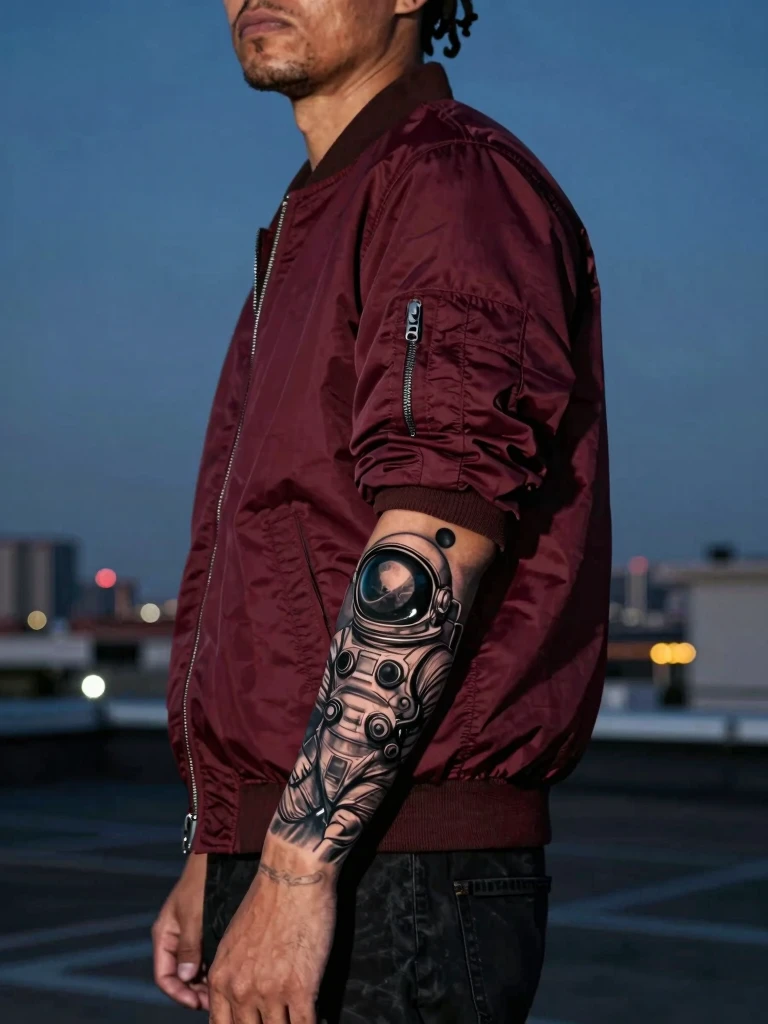
An astronaut silhouette fitted to the forearm’s length, helmet at the wide upper end, suit narrowing toward the wrist. This is textbook taper-respecting composition. The custom detail that changes everything is the visor reflection. A horizon in the visor tells a different story than an empty one, and it costs nothing to decide before the stencil. Small customizable details beat large generic ones for making a piece feel personal.
10. Lone Tree With Fine Branches and Drifting Birds
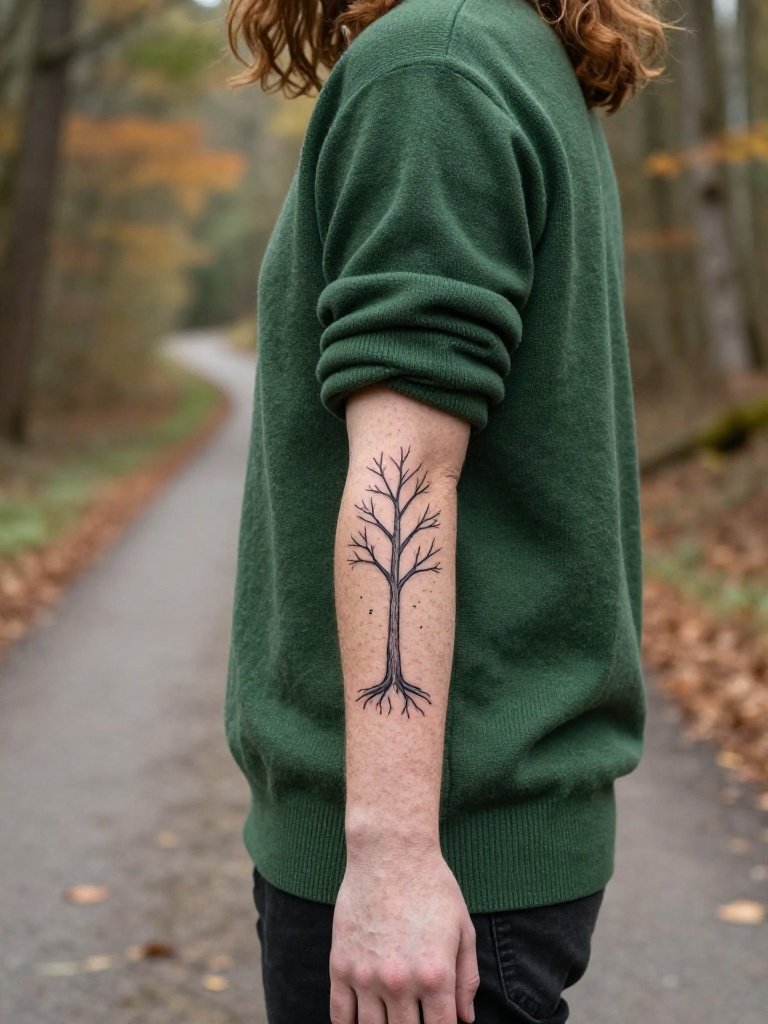
A narrow fine-line tree, trunk at the wrist, branches opening toward the elbow. Same survival rule as the snake: keep the smallest twigs slightly stronger than the drawing. On the inner forearm especially, twigs that look perfect on paper go first. The drifting marks need a decision too. Leaves, seeds, or birds should read clearly as one of the three, because ambiguous marks just read as blur at distance.
Stronger twigs
11. Geometric Woven Forearm Tattoo Men Blackwork
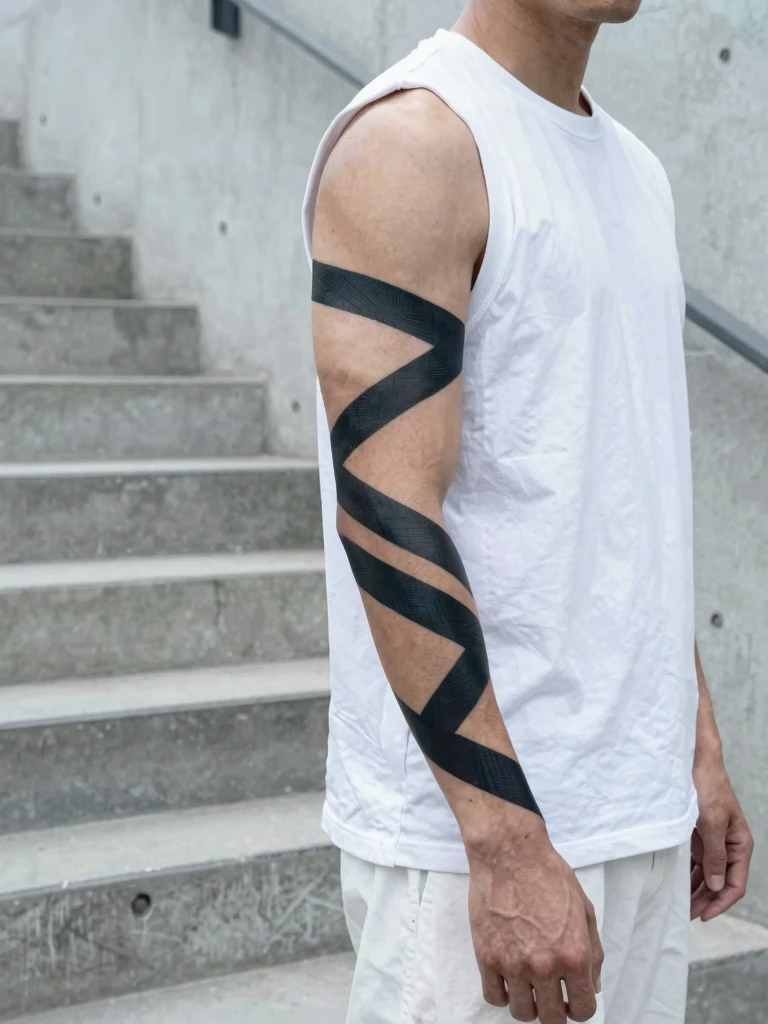
Interlocking bands weaving over and under, structural rather than decorative. Geometry is the least forgiving style on this list. One misplaced crossing or uneven border destroys the illusion, where a sketchy style would hide it. Ask the artist to map or number every crossing at the stencil stage. If they wave that off, that is information about them.
The hand extension is a visibility decision, not a design one. One band continuing onto the hand looks bolder; stopping above the wrist keeps the same geometry easier to cover. Choose with your career tree in mind, below.
12. Classical Marble Statue With Covered Face
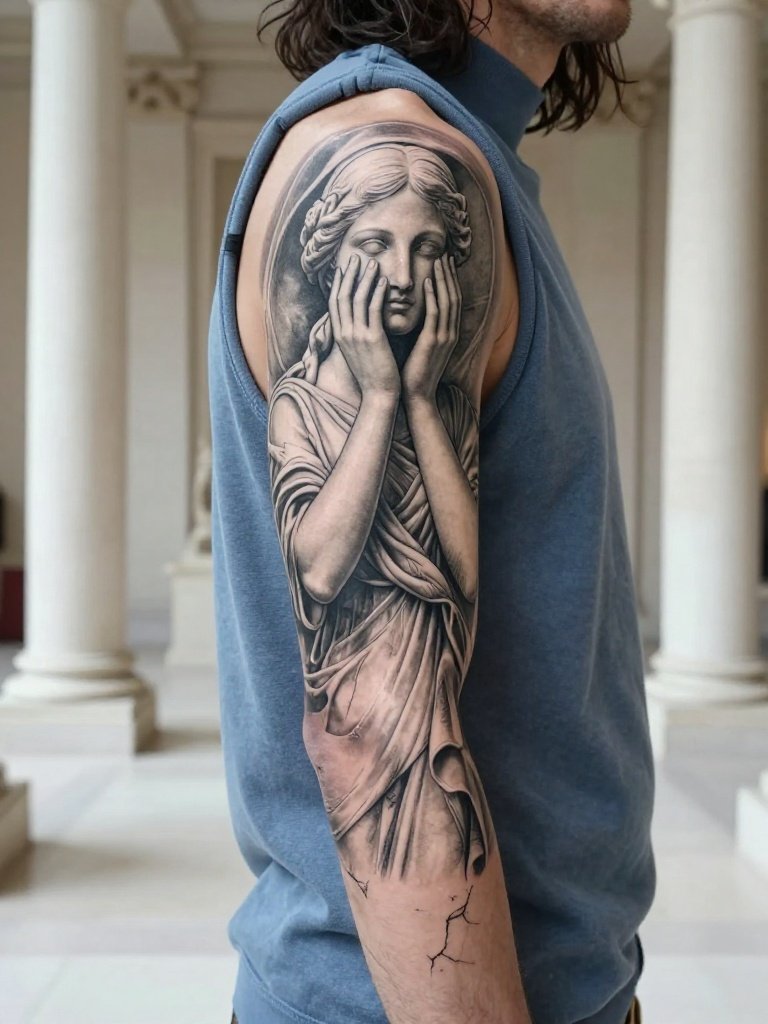
A veiled classical figure in carved-marble greys, hands over the face. The technical demand is specific: the artist must render believable stone AND accurate hands at small scale. Finger spacing over the eyes is the make-or-break detail. Reference choice matters more here than usual, so bring a statue photo with strong side lighting; flat light in the reference becomes flat stone on skin.
Restraint with cracks. A few selected cracks read as marble. Cracks everywhere read as damage.
13. Watercolor Stag Forearm Tattoo Men With Teal Washes
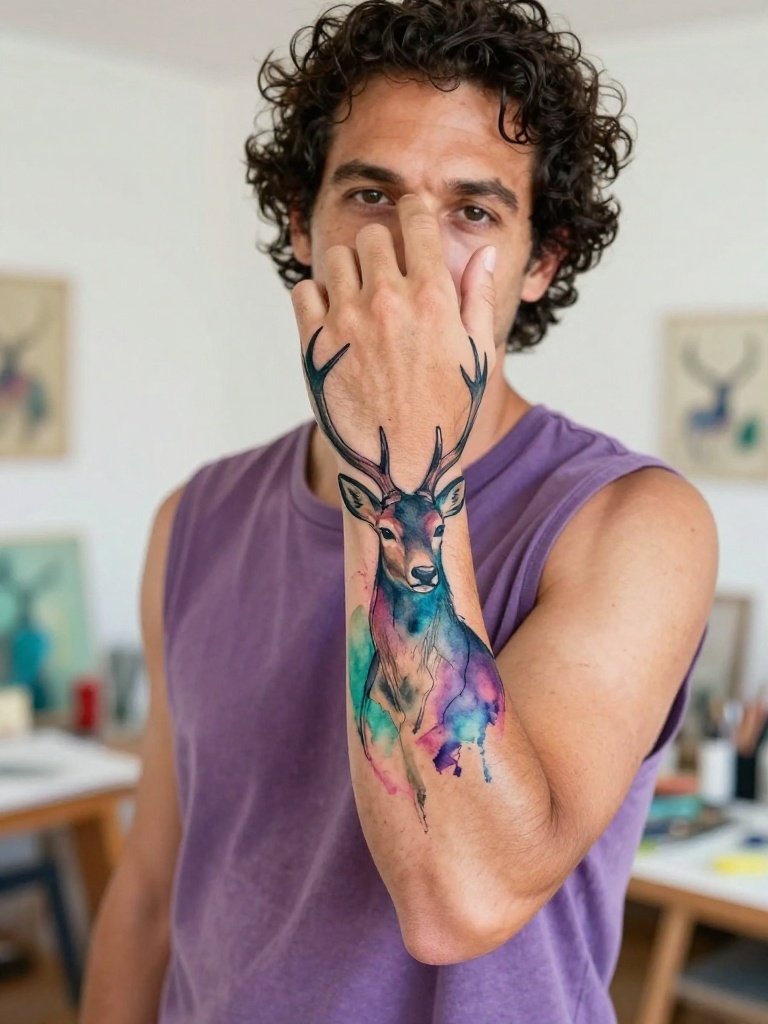
Loose teal and violet washes over a controlled stag outline. The structural rule of watercolor on skin: keep the black framework. The eyes, nose, and major antler branches need defined dark edges, or the washes have nothing to hold onto as they fade. Bright watercolor on the outer forearm faces the sun problem directly, so this piece demands the strictest SPF discipline on the list. Expect washes to soften noticeably within a few summers. That is not failure. It is the style.
14. Realistic Color Lion Forearm Tattoo Men Portrait
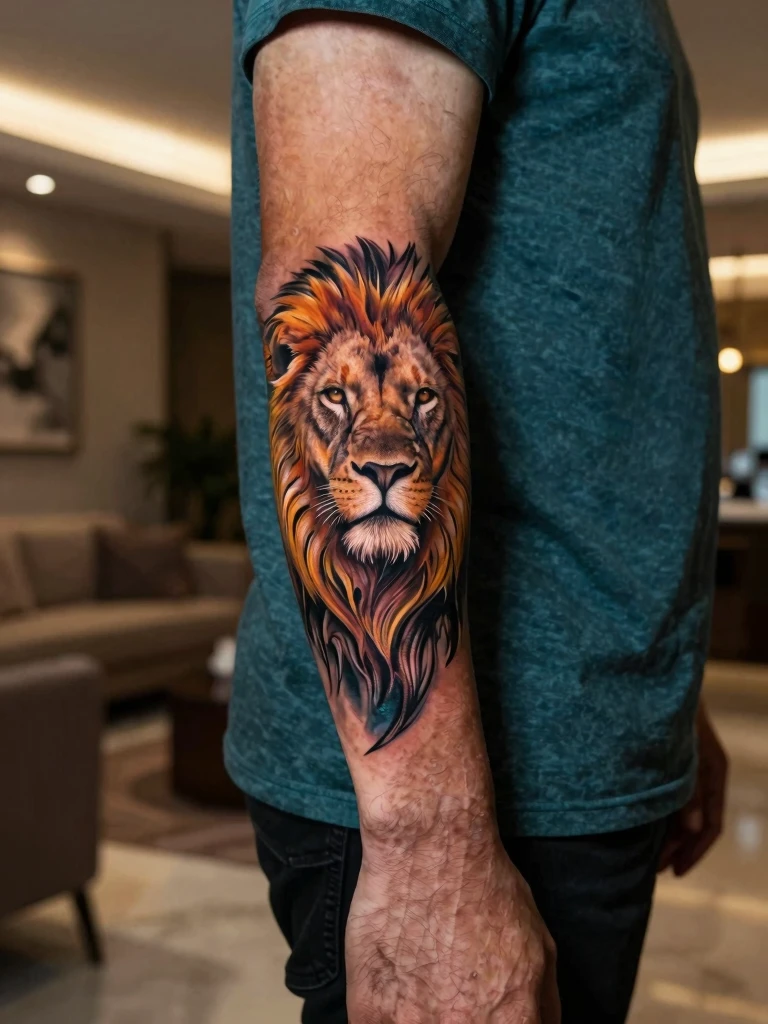
Saturated color realism, orange and gold mane against controlled blue accents. Color realism is the highest-maintenance style here by a clear margin. Dense color packing takes longer sessions, fades faster under sun, and usually asks for a refresh within the first years. The payoff is impact: nothing on this list hits harder on day one. Go in knowing the upkeep is part of the price, not a surprise later.
Vet the artist on healed color specifically. Fresh color always photographs well. Healed color tells the truth. For how large color pieces are staged across sessions, our dragon tattoo ideas for men break down multi-session planning for the biggest color commitments.
Healed color only
15. Feather Wing Forearm Tattoo Men in Black and Gray
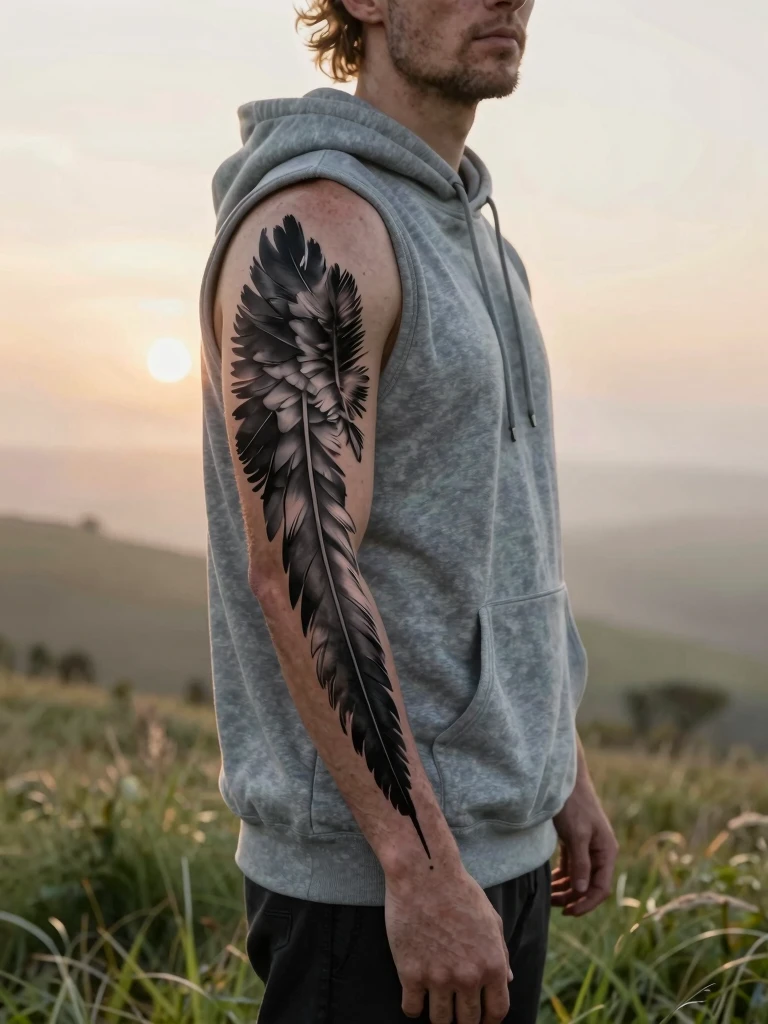
A wing expanding from a narrow wrist point into layered feathers toward the elbow. Near-full coverage without sleeve density, and the composition respects the taper by construction. The design note that matters: vary feather sizes and keep outer edges slightly irregular. Perfectly uniform feathers read as mechanical. Slight irregularity reads as a wing. Put the darkest shading where feathers overlap, where real shadows would fall, and the depth builds itself.
Design to Zone: What Suits Each Side
Outer forearm takes bold linework, realism, tribal and geometric blackwork, traditional color. The flat stable skin holds crisp edges, and the constant visibility suits statement pieces. Inner forearm takes script, minimalist symbols, fine-line with a line-weight floor, personal pieces. The private rotation suits work you look at more than you show.
The legibility rules cross both zones. Script needs a letter-height floor around half a centimeter. Small inner-arm script is the single fastest thing on this list to become unreadable. If the words matter, size them like they matter.
The Curve Problem: Distortion-Safe Design
The forearm is not a flat canvas. It tapers toward the wrist, and the muscle flexes. Two placement families handle this. Panel designs sit on the flat center of the outer or inner arm and read best straight-on. Wrap designs travel around the arm and read from every angle. What fails is the in-between: a panel drawn as if the arm were flat, then wrapped far enough that the edges distort. Faces and text suffer most, because the eye notices a warped face or a bent letter instantly. Put faces and script on the flat center. Let patterns and texture do the wrapping.
Pain, Honestly, Plus the Blowout Warning
The outer forearm is one of the easier large placements, commonly described in the 2 to 4 out of 10 range. The inner side runs sharper, especially near the wrist and elbow crease where tendons and thin skin sit close to the surface. None of this is extreme by tattoo standards. The more useful warning is technical, not about pain: thin inner skin raises blowout risk, the faint halo where ink spreads past the line. Blowouts are mostly an artist-depth problem, which is why inner-forearm work punishes a careless artist more than outer work does. Pain fades in a day. A blowout is permanent. Work that creeps toward the elbow crease enters harsher territory; our elbow tattoo ideas for men cover that zone’s pain and healing in full.
The Sleeve-On-Ramp: Design the First Piece Like It Is Not the Last
The forearm is where most sleeves start, so the first piece should be planned like a beginning. Leave a deliberate open edge on at least one side rather than centering the piece with nowhere to grow. Keep style continuity in mind: a realism anchor plus geometric filler can work, but a watercolor anchor plus blackwork filler fights. Tell the artist the sleeve plan at the first consult. An anchor piece designed with filler zones in mind looks intentional at every stage. One designed as a standalone looks crowded the moment piece two arrives. Our sleeve tattoos for men guide walks through the full planning math once the forearm work starts expanding.
Coverability: The Actual Decision Tree
“Long sleeves cover it” is true and useless. The real tree has three branches. Outer forearm: visible in anything short of long sleeves, which in warm climates means visible most of the time. Inner forearm: hidden palm-down at a desk, visible the moment you gesture, shake hands, or roll sleeves. Wrist edge: the hardest to hide, peeking out of cuffs constantly. Map your actual days against this, not an imagined formal event. If your work runs on video calls and short sleeves, the outer forearm is a public tattoo. Decide like it is one.
The Aging Ledger: What Each Style Does Over Time
Outer forearm: sun is the enemy, and it is a fast one. Bold black lines hold for decades with sunscreen. Color realism softens and usually wants a refresh within the first years. Watercolor washes fade fastest of all. Inner forearm: sun matters less, but thin skin means fine detail blurs sooner and tiny script can go illegible by year five. Across both sides, a touch-up assessment around year five is normal maintenance, not a repair. Ink clearing gradually is biology, not bad work.
SPF discipline is the single highest-leverage habit. Thirty-plus on healed ink, reapplied, every exposure day. Nothing else you do for a forearm tattoo matters as much.
What It Actually Costs
Reported ranges from working shops, not quotes. Small forearm pieces typically land around $150 to $400. Medium half-arm work runs roughly $350 to $700. A full high-detail forearm from wrist to elbow usually lands between $700 and $1,200 or more, and complex color or realism can push past that. Expect two to five hours for a full forearm session, sometimes split across sittings. Confirm the full total before booking: deposit, design time, and tips across sessions, not just the headline rate.
Vetting an Artist for Forearm Work
Forearm work needs its own checklist. Ask for healed forearm photos, not fresh ones, and look specifically at how lines held on inner-arm pieces. For script or lettering, ask to see a lettering portfolio with healed examples; the letter-height floor means nothing if the artist cannot execute it. Ask how they handle depth on thin inner skin. A good answer mentions adjusting machine depth for the zone. A vague answer is a warning. For wraps, ask to see a wrap mapped on a real arm before inking. For cultural patterns like the Polynesian-inspired wrap above, the artist should be able to discuss the source of the motifs, not just draw them. The same care applies to bold traditional work; our tribal tattoo ideas for men guide covers the cultural-honesty checklist that travels well to any blackwork piece.
Quick Comparison
| Design | Best Zone | Style Fit | Aging Outlook |
|---|---|---|---|
| Crowned Skull and Rose | Outer | Black-and-grey realism | Strong; gaps keep it readable |
| Wolf and Orange Flames | Outer | Partial color realism | Good; color edges need sun care |
| Guardian Lion Temple | Inner | Ornamental realism | Moderate; keep stipple loose |
| Sketch Compass | Either | Fine-line sketch | Good; built to grow |
| Veiled Portrait | Inner | Portrait realism | Demanding; needs the right artist |
| Fine-Line Snake Floral | Inner or side | Fine-line botanical | Fair; line-weight floor is everything |
| Biomechanical Panels | Outer lower | Black-and-grey illustrative | Strong; dense shading holds |
| Polynesian-Inspired Wrap | Full wrap | Ornamental blackwork | Strong if mapped on the arm |
| Astronaut and Planet | Outer center | Black-and-grey illustrative | Strong; taper-fitted composition |
| Lone Tree and Birds | Inner | Fine-line minimalist | Fair; twigs need extra weight |
| Geometric Woven | Outer and side | Geometric blackwork | Strong; precision is the price |
| Marble Statue | Outer | Black-and-grey realism | Good; restraint with texture |
| Watercolor Stag | Outer | Watercolor | Softest; strictest sun discipline |
| Color Lion Portrait | Outer | Color realism | Highest maintenance, biggest impact |
| Feather Wing | Outer | Black-and-grey illustrative | Strong; taper does the work |
Frequently Asked Questions
Which forearm zone should a first tattoo go on?
The outer forearm is the friendlier first placement: thicker skin, easier sessions, and bold designs hold well. The inner forearm suits a second piece better, once you know how your skin takes ink and you have an artist you trust with thin skin.
How do I keep script readable for years?
Size it like it matters. Keep letter height around half a centimeter at minimum, choose a bolder hand than the reference suggests, and avoid the inner forearm for anything tiny. Small inner-arm script is the fastest thing on this list to turn illegible.
Can a forearm tattoo become a sleeve later?
Yes, and most sleeves start exactly this way. Leave a deliberate open edge on the first piece, keep style continuity across additions, and tell your artist the long-term plan at the first consult. A planned anchor grows cleanly. A standalone centerpiece crowds.
Outer or inner: which ages better?
Neither wins outright. The outer forearm has stable skin but heavy sun exposure, so bold work holds for decades with sunscreen discipline. The inner forearm dodges the sun but has thin skin, so fine detail blurs sooner. Match the design to the zone and both age well.
What should I ask an artist before booking forearm work?
Ask for healed forearm photos, a lettering portfolio if there is script, and how they adjust depth on thin inner skin. For wraps, ask to see the pattern mapped on a real arm. For cultural motifs, ask about the source of the patterns. Vague answers on any of these are a reason to keep looking.
The Takeaway
Choose the coverage level and viewing angle before settling on the final subject. A strong forearm design should follow your arm’s taper, preserve enough negative space for important details, and remain readable when the wrist rotates. Match the design to the zone, and the zone to your life: bold work on the outer arm with sunscreen discipline, delicate work on the inner arm with bolder lines than the drawing. Plan the first piece like a sleeve might follow, because it often does. And bring clear references so the artist builds a custom stencil for your proportions rather than copying artwork shaped for a different forearm.