A Septum Piercing Black Women goes through the thin, soft tissue between the nostrils, just in front of the firmer cartilage wall. It sits at the center of the face, so jewelry that is slightly too big, too heavy, or the wrong tone gets noticed immediately. For Black women, four questions shape most good decisions: how metal tones read against deeper skin, how the jewelry works with textured hair and bold makeup, how a personal or family history of raised scarring affects the choice to pierce, and whether your nose anatomy suits this placement at all.
This guide covers what to settle before booking, eight jewelry and styling ideas, how to choose materials and sizes, and what healing generally involves.
Septum Piercing Essentials at a Glance
- The piercing belongs in the soft tissue just in front of the septal cartilage, which piercers often call the “sweet spot.” It is not meant to go through the cartilage.
- Material matters more than color. Implant-grade titanium and solid, nickel-free gold are the usual recommendations for a new piercing.
- Gold, silver-toned, and black finishes all work on deeper skin. Your undertone, makeup, and style decide which suits you.
- Keloids can occur in anyone, but people with deeper skin tones are reported to be more prone to them. If raised scars run in your family, talk to a piercer or doctor first.
- It is one of the few facial piercings you can flip up and hide, which helps with work or school dress codes.
Understanding the Piercing
Where It Sits
The septum is the wall dividing the nostrils. Its upper part is firm cartilage, but toward the tip of the nose it softens into a thin, flexible strip. A well-placed piercing passes through that soft strip, which is why many people describe the sensation as pressure rather than the sharper pain associated with cartilage piercings. Pain tolerance varies, so treat that as a general description and not a promise.
Why Proportion Matters So Much
Unlike a nostril piercing, which sits on the side of the nose, a septum piercing sits on the center line and frames the lips and the space between nose and mouth. A ring that looks delicate on one person can look heavy on another, depending on nostril shape, the distance between nose and lip, and how far the nose tip projects.
Anatomy Can Limit Your Options
Some people have a very narrow soft area, a deviated septum, or tissue that sits too close to the cartilage. A careful piercer checks this before marking, and an honest “this may not work for you” is a sign of a professional who puts the client first.
What Is Different for Septum Piercing Black Women
Skin tone affects both style and skin behavior, and the two are worth separating.
Style and Undertone
Deeper skin tones span a wide range of undertones, from golden and red-brown to cooler, blue-leaning browns. Gold often looks warm and luminous, silver-toned titanium looks crisp and graphic, and black or dark-finish jewelry reads as a fine outline rather than a bright accent. No single metal is correct for everyone. The simplest test is to hold a sample against your face in natural light.
Hair
Black women wear locs, braids, twist-outs, wash-and-gos, silk presses, wigs, and many other protective styles. Hair worn forward can brush the nose, and loose strands can catch on jewelry, so your usual hairstyles should influence whether you choose a ring, a hoop, or a horseshoe.
Scarring and Bumps
Keloids are raised scars that grow beyond the original wound, and they are reported to be more common in people with deeper skin tones. Irritation bumps are far more common and can look similar to an untrained eye. This does not mean Black women should avoid piercings. It means a personal or family history of raised scarring is worth sharing with a piercer or doctor before the appointment, and any persistent raised bump should be assessed by a professional rather than guessed at.
8 Septum Piercing Black Women Ideas
The first four ideas describe the reference photos. The last four are additional options suited to deeper skin tones and a range of hairstyles.
1. A Slim Ring With a Deep Plum Lip

A thin septum ring beside a dark berry lip and defined brows. The ring is fine enough to act as an accent to the lip color rather than competing with it. Because metal and lipstick sit in a similar visual range, the look feels deliberate. This works best when the makeup is already bold and the piercing should support it, not lead.
2. A Horseshoe With the Ends Turned Down
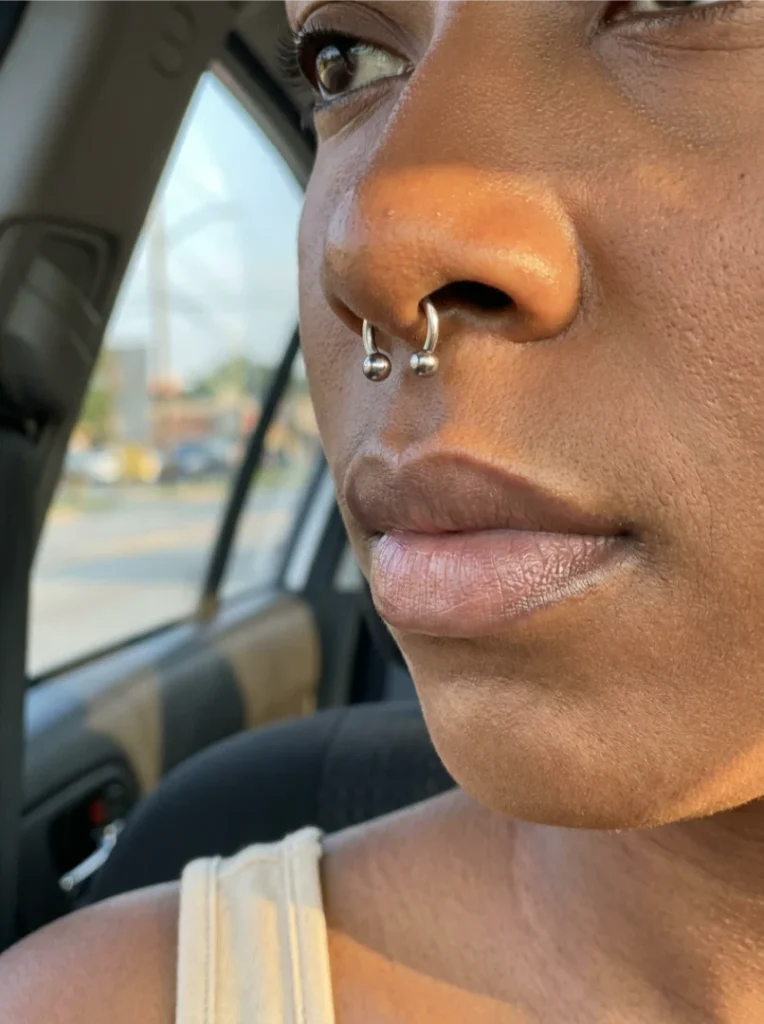
A small horseshoe barbell with ball ends pointing down, sitting just below the nostrils. This is the standard way to wear a septum piercing visibly, and the close crop shows how well-fitted jewelry sits: an even gap with no obvious pulling or tilt. If the ends sit unevenly, the cause could be the jewelry size, the angle of the piercing, or how the piece is positioned, and a piercer can tell which. The ball ends can also be swapped for small gems or other tips once the piercing has healed.
3. A Delicate Ring With Long Locs

A thin, close-fitting ring beside long locs with lighter tips. The jewelry stays quiet so the hair remains the focal point. Locs and braids worn forward can brush the nose, so a smooth, seamless ring is less likely to snag than a decorated piece. This pairing suits anyone whose hair is their signature feature.
4. A Small Hoop With Voluminous Curls

A small hoop under the nose, framed by full, defined curls, with soft shimmer on the nose and a glossy brown-nude lip. With this much volume around the face, a small hoop keeps the center of the face from feeling crowded. The highlight already adds light, so the jewelry works best kept simple.
5. A Gold Seamless Ring

Gold-toned jewelry is often chosen for its warmth against brown skin, and a thin seamless ring gives a clean, polished line. Look for solid, nickel-free gold or a gold finish on implant-grade titanium rather than inexpensive plating, which can irritate sensitive skin. It pairs easily with most lip colors, which makes it a practical everyday choice.
See Also: Industrial Piercing Ideas That Transform a Classic Ear Design
6. A Black or Dark-Finish Ring

Black-finished titanium gives a graphic, low-key look that suits minimal makeup and monochrome outfits. Dark finishes can look quite different in photos than in person, so check the color in natural light. Coatings can also wear over time, so ask how the finish is applied.
7. A Small Gem or Bead Accent

A tiny gemstone, a ball, or a captive bead ring adds a point of sparkle without making the jewelry large. Keep the accent small so it does not compete with a glossy lip or a highlighted nose. It suits people who like a little shine but still want a refined look.
8. A Flip-Up Horseshoe for Work or School

A horseshoe worn with the ends turned up into the nostrils hides the piercing when you need it hidden. It is less a look than a practical feature, and one of the main advantages of this piercing over most others. If you may need to conceal it, tell your piercer beforehand so the placement and jewelry suit flipping up.
See Also: Neck Piercing Styles Explained: 15 Designs From Minimal to Bold
Choosing Jewelry
Material
For a new piercing, piercers commonly recommend implant-grade titanium or solid, nickel-free gold, which are generally considered gentler on healing tissue than plated or unidentified metals. Nickel is a common cause of skin reactions, so jewelry advertised as hypoallergenic without naming its material deserves a question. If you have a known metal sensitivity, mention it at the appointment.
Shape
- Seamless and captive rings look minimal. Captive bead rings add a small focal point, while seamless rings give a continuous line.
- Horseshoe barbells can be worn ends down for a visible look or flipped up to hide the piercing.
- Small hoops sit slightly lower and look softer against curls and rounder faces.
- Large or decorative pieces read as statement jewelry and work best when the rest of the look is pared back.
Size
Two measurements matter: gauge, the thickness of the post, and diameter, the width of a ring or the span of a horseshoe. A hoop that is too wide hangs low and moves more, while one that is too tight can press on the skin. The right size depends on your anatomy, so a piercer’s fitting is more reliable than a general chart. If you plan to change jewelry later, ask for your measurements so you buy pieces that fit.
See Also: Medusa Piercing Inspiration: Jewelry, Styles, and Tips
Styling With Hair and Makeup
Hair
- Locs and braids: Smooth, seamless jewelry reduces snagging.
- Curls and twist-outs: A small hoop or horseshoe is the cleanest choice, since oversized rings can look busy against a lot of texture.
- Wigs and protective styles: Lace edges, bangs, and hair worn close to the nose can catch on jewelry, so test the combination in a mirror first.
- Sleek, slicked-back styles: The nose is fully exposed, so decorative jewelry reads best here.
Makeup
- Lip color: Deep plum, berry, and chocolate shades pair well with dark or gold jewelry. Matching the jewelry’s tone to the depth of the lip gives the look a deliberate feel.
- Highlighter: Shimmer on the nose competes with metal, so keep the jewelry simple or place the highlight slightly higher.
- Application: Dab foundation and concealer around the piercing rather than rubbing near it, especially in the early weeks.
Healing and Skin Considerations
Many sources describe septum piercings as taking a few months to fully heal, and some people take longer. Your own timeline depends on your body, your jewelry, and your care routine, and your piercer or doctor is the right source for your case.
- Aftercare: Follow your piercer’s instructions. General guidance commonly includes cleaning with sterile saline, washing hands before touching the area, avoiding twisting the jewelry, and keeping makeup and hair products away from the piercing.
- Irritation versus keloids: Irritation bumps are more common and are often linked to jewelry movement, poor-quality metal, or product contact. A bump that keeps growing or does not settle should be assessed by a professional.
- Changing jewelry: Swapping the starter piece too early can set healing back. Ask your piercer when it is safe.
- Warning signs: Persistent swelling, severe pain, heat, spreading redness, or unusual discharge should be checked by a medical professional.
Frequently Asked Questions
Does a septum piercing hurt?
Experiences vary. Many people describe brief pressure and watering eyes rather than sharp pain, partly because the piercing goes through soft tissue. Pain tolerance and placement both affect the experience.
Are Black women more likely to get keloids from a septum piercing?
Keloids can occur in anyone, but they are reported to be more common in people with deeper skin tones. That does not mean you will get one. It does mean you should share any personal or family history of raised scars with a piercer or doctor before deciding.
Can I hide a septum piercing?
Yes. A horseshoe barbell can be flipped up into the nostrils. Tell your piercer in advance so the piercing and jewelry suit it.
Can I get one with a deviated septum?
Sometimes, but not always. A deviated septum can make the standard placement difficult, and a professional piercer can examine your nose and tell you honestly whether it is a good fit.
Before You Book
Bring reference images to your appointment. They help a piercer understand the scale, jewelry style, and finish you want, and give them a basis for telling you whether it suits your anatomy. Ask about jewelry materials, aftercare instructions, and how jewelry changes are handled later. A piercing never sits identically on two people, so treat any reference as a direction rather than an exact result.