A Jason Voorhees tattoo is built around the hockey mask worn by the antagonist of the Friday the 13th film franchise — one of horror’s most recognizable silhouettes, designed from the start to read clearly at a distance. That same quality makes it unusually well-suited to tattooing: it holds up across a range of sizes, doesn’t depend on color to stay identifiable, and adapts to almost any linework style.
The design covers more ground than a single reference photo can show, though. Below are nine ways it typically gets interpreted, followed by the practical decisions — style, size, placement, and stencil prep — that determine whether the tattoo still reads clearly years from now.
What Is a Jason Voorhees Tattoo?
A Jason Voorhees tattoo is a design based on the masked antagonist from the Friday the 13th horror film franchise. The character is defined almost entirely by one visual element: a white hockey mask marked with red or dark brown stripes, which has become one of the most recognized symbols in horror cinema since it first appeared in the series.
Because the character’s identity rests on that single, graphic image rather than a detailed face or costume, the tattoo translates unusually well to skin. It doesn’t require color, fine detail, or a large canvas to stay recognizable, which is why it shows up across such a wide range of styles and sizes — from a full back piece showing Camp Crystal Lake to a small mask outline on the wrist. Most versions build outward from that same core shape, adding elements like the machete, weathering, or background scenery depending on how much detail and space the wearer wants.
9 Jason Voorhees Tattoo Ideas
1. Classic Black-and-Grey Mask Portrait

A front-facing mask rendered with shading and highlights that mimic the texture of the actual plastic — scuffs, depth around the eye holes, soft shadowing along the stripes. This version relies on gradient shading, so it needs enough surface area to render properly; it suits the forearm, calf, or upper arm rather than anything small.
2. Graphic Blackwork Mask
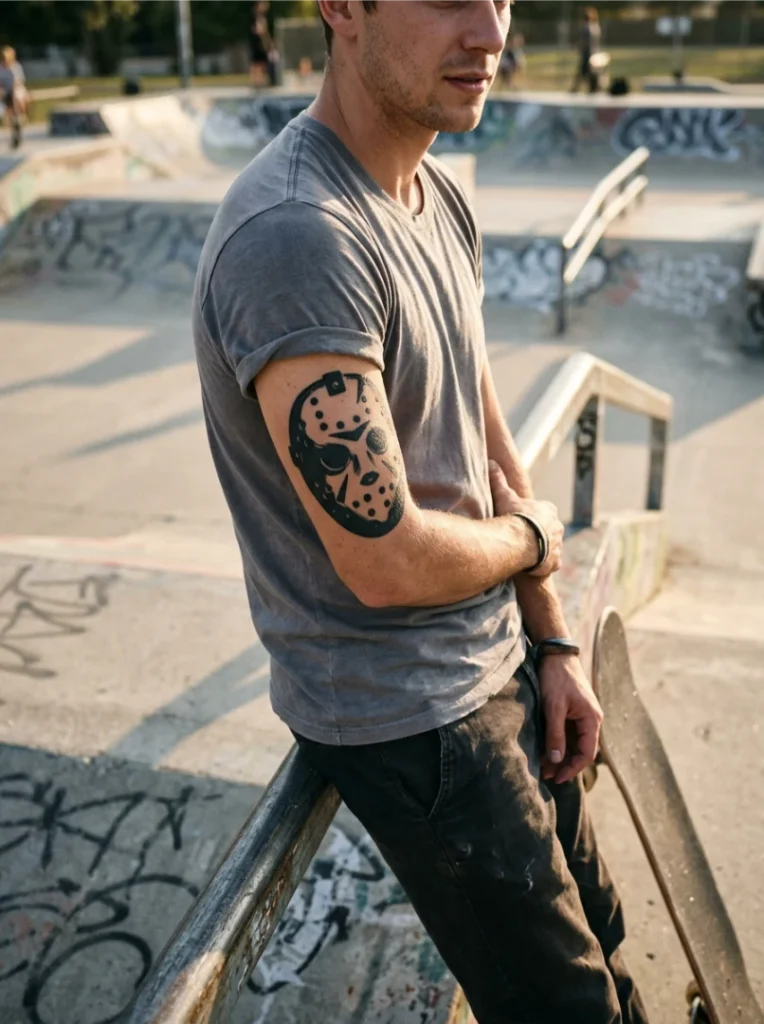
The opposite approach: the mask reduced to solid black shapes, with negative space doing the work for the eyes and stripe pattern. This is the most stencil-friendly and size-flexible version of the design, since bold shapes hold their form as a tattoo ages — making it the strongest option if you eventually want to scale the piece down.
3. Mask and Machete Composition
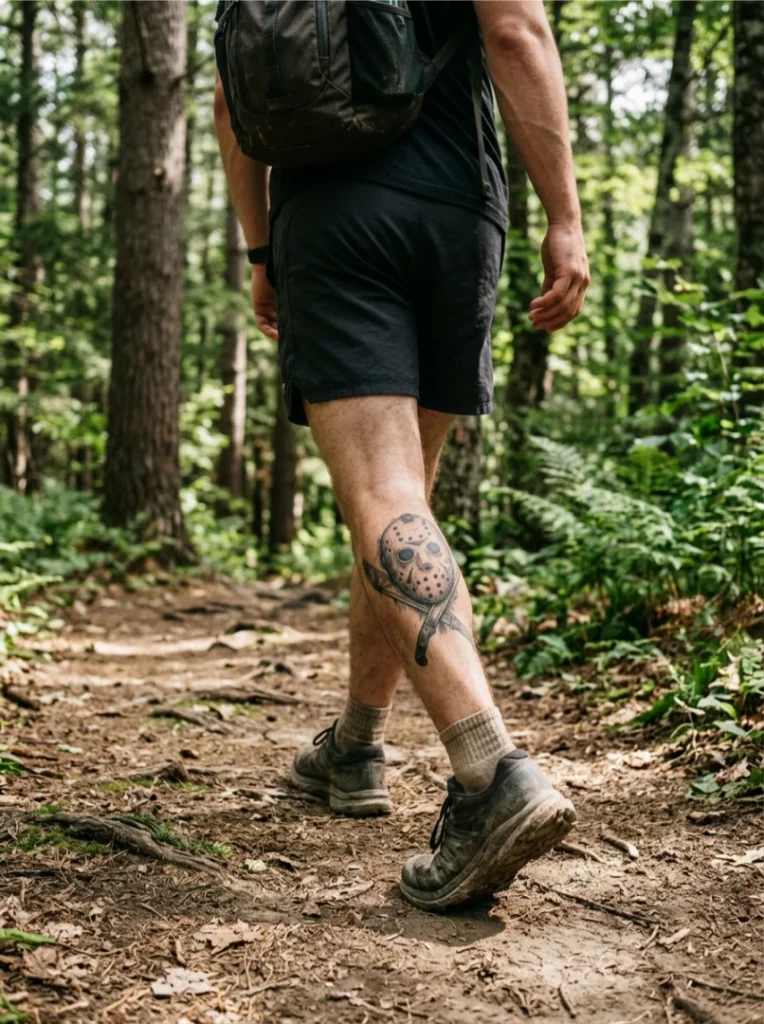
The mask centered with the machete crossed behind it at a diagonal, often with the blade extending past the mask’s edge for visual balance. This adds a second recognizable element without requiring a full background scene, and works well at mid-size on the forearm or calf.
See Also: 10 Iconic Michael Myers Tattoo Ideas for Men by Placement
4. Weathered Mask with Blood Detail
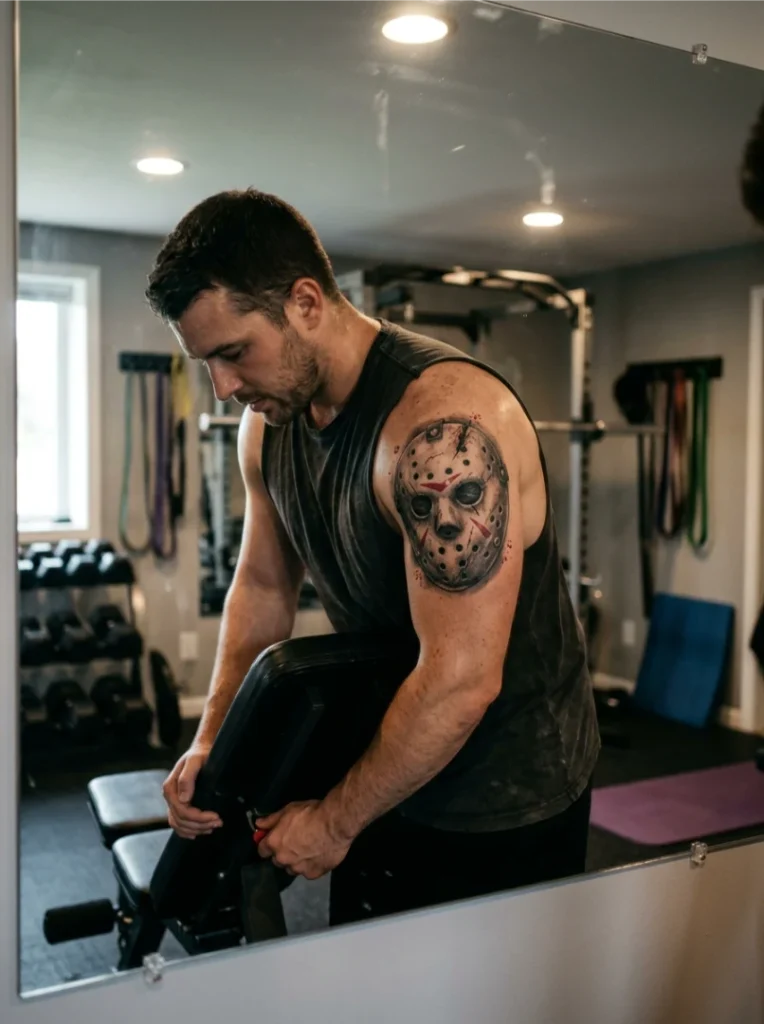
The same mask shape treated with cracks, scratches, and red spatter accents for added horror texture. The weathering is usually kept in black and grey while blood is the only color element, which adds a harder edge without cluttering the composition.
5. Full Camp Crystal Lake Scene
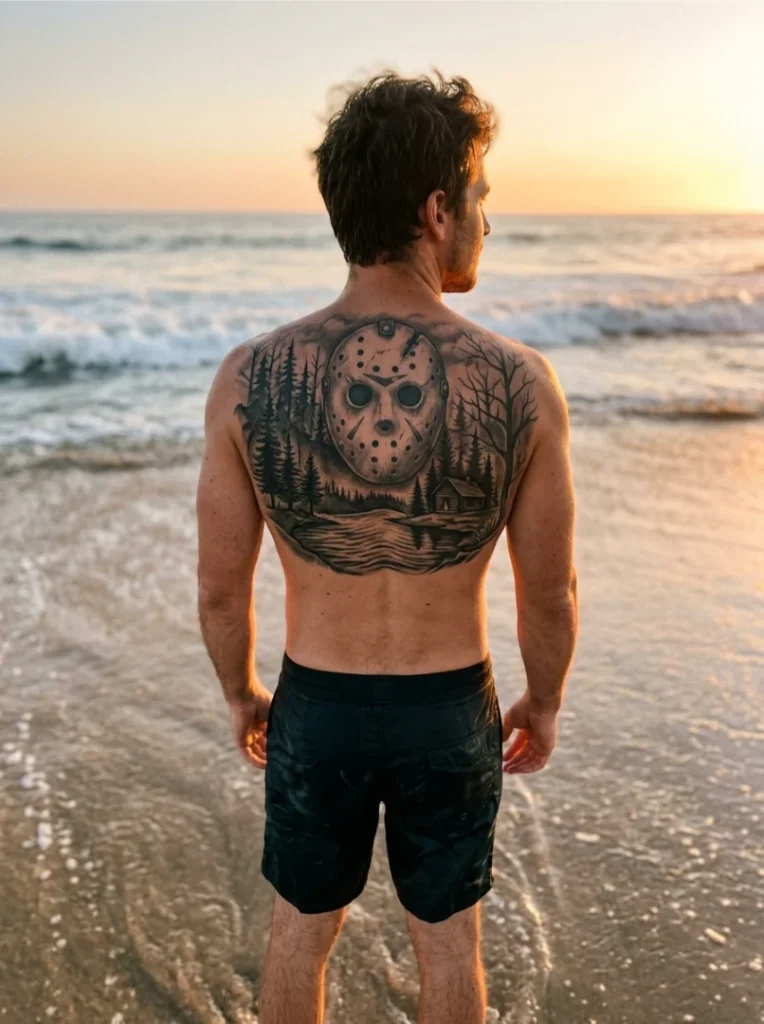
A larger composition placing the mask against tree lines, a lake silhouette, or a cabin, building out the film’s setting rather than isolating the character alone. This only works at scale, typically as a chest or back piece, since smaller versions tend to lose the background entirely.
6. Minimalist Mask Outline

A simplified outline with the stripe pattern reduced to two or three clean shapes instead of full detail. This is the version most people mean by a small Jason Voorhees tattoo — it trades realism for legibility at reduced size, which is the right trade-off once space is limited.
7. Jason Rising From the Lake
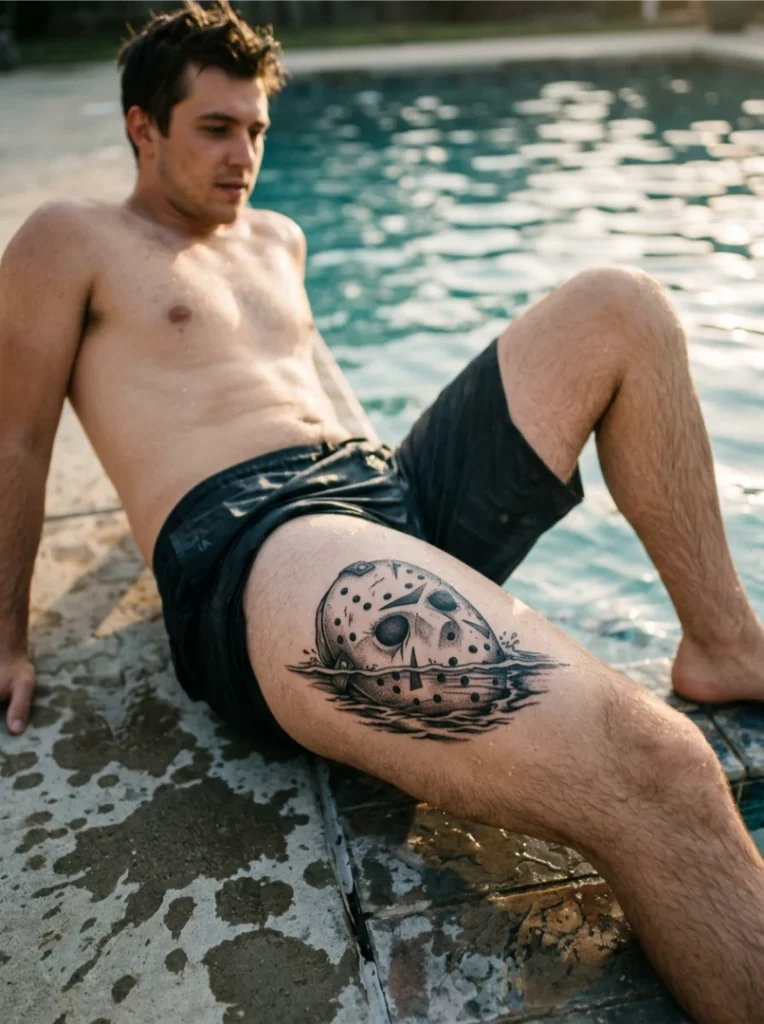
A reference to one of the franchise’s most iconic visual beats: the mask emerging from water, often with a ripple or waterline cutting across the lower portion of the design. This is an illustrative, scene-based piece rather than a straightforward portrait, and reads best on a larger canvas like the calf or thigh, where the composition has room to breathe.
8. Mask With Numeral Accent
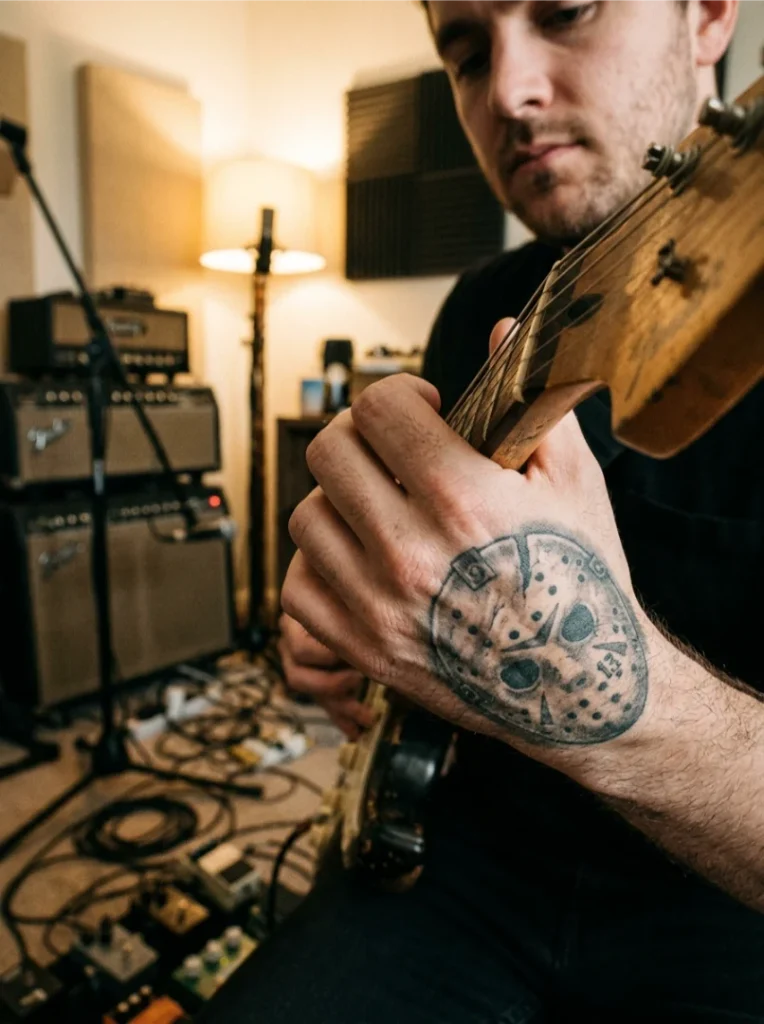
The mask paired with a small “13” worked into the composition, sometimes integrated into the stripe pattern, sometimes placed nearby as a separate accent. This version is popular for a hand or forearm tattoo specifically because the numeral adds a second focal point without requiring much extra space.
Read Also: Chicano Style Tattoo Ideas: 14 Proven Looks for Men
9. Neo-Traditional Color Mask
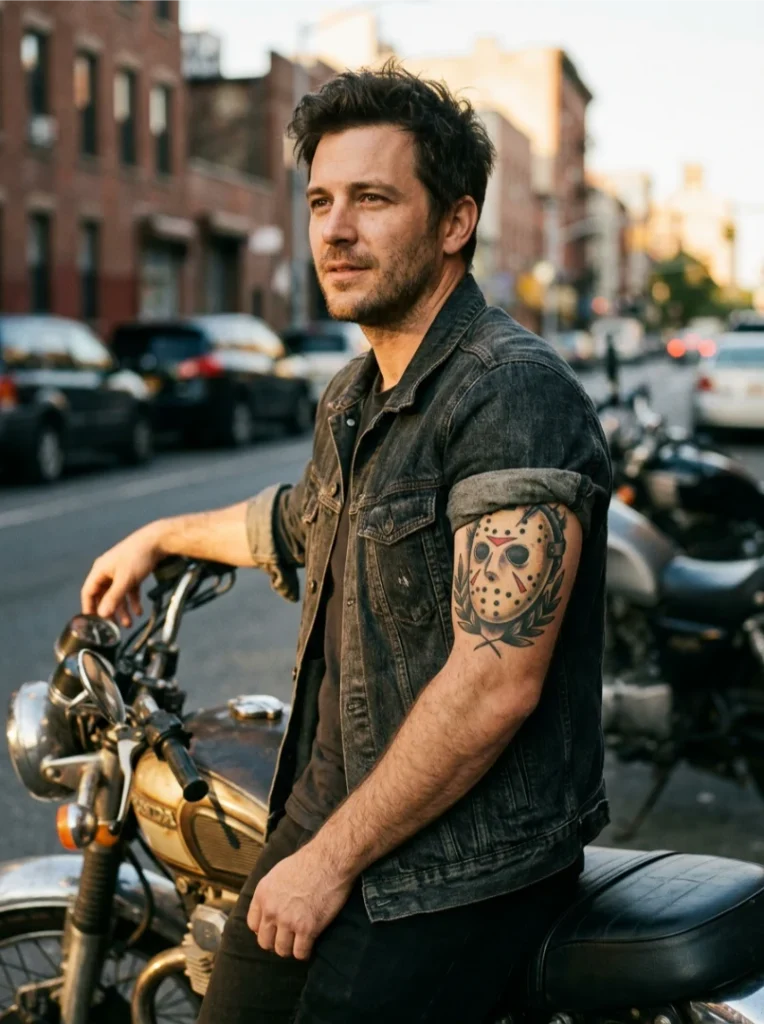
A color treatment using the mask’s actual cream base and red stripes, rendered with thick, consistent outlines and flat color fills rather than shading. Bold traditional-style linework tends to age more predictably than fine detail or soft gradients, making this a practical choice for anyone who wants color without sacrificing long-term clarity.
Black and White vs. Color
Most of the ideas above default to black and grey or black and white, and that’s not incidental. The mask’s defining feature — contrast between its cream base and dark stripes — is already close to monochrome, so a black and white treatment tends to preserve recognizability better than added color, especially once the tattoo is smaller than a few inches.
It’s worth clarifying a common mix-up here: most people searching for a black and white Jason Voorhees tattoo actually mean black and grey — shading built from grey tones rather than a flat two-color design. True black and white, with no grey at all, is a more graphic technique closer to the blackwork version above (Idea 2). Color versions, meanwhile, work best when the linework is bold enough to hold the color fills in place, as in the neo-traditional approach (Idea 9), rather than relying on fine shading to carry the detail.
Placement Options, Including the Hand
A Jason Voorhees hand tattoo suits the design’s graphic shape well, since the back of the hand gives a flat, visible canvas for a simplified mask. A few things are worth weighing before choosing that spot specifically:
- Hand tattoos see constant friction from washing, gripping, and sun exposure, and tend to fade or soften faster than tattoos placed elsewhere on the body, which can mean earlier touch-ups than expected
- The hand’s limited flat space usually forces the same simplification used in the minimalist outline idea above
- Hand tattoos are highly visible and difficult to cover, which is worth factoring in for work or social settings
Outside the hand, the forearm suits most mid-size ideas on this list, the calf works well for compositions involving the machete or water, and the chest or upper back is really the only practical space for a full Camp Crystal Lake scene.
What a Jason Voorhees Tattoo Means
Unlike symbols with an established cultural or historical meaning, what a Jason Voorhees tattoo means isn’t fixed or universally agreed upon. It generally comes down to the wearer’s personal connection to the franchise and to horror as a genre, rather than any symbolism attached to the character himself.
Common reasons people cite include a visible marker of horror fandom, nostalgia for 80s slasher cinema, or a loose appreciation for Jason as a character who keeps surviving across the film series. It’s worth being clear with yourself about which of these actually applies, since it can shape whether you want a straightforward mask portrait or something that leans further into the broader mythology.
Preparing a Stencil
If you’re bringing a Jason Voorhees tattoo stencil to your appointment, a few details affect how cleanly it transfers:
- Symmetry matters more than usual here, since an off-center mask or uneven stripe spacing is immediately noticeable to anyone familiar with the character
- High-contrast line stencils transfer more reliably than ones with heavy gradient shading, which is part of why the blackwork and minimalist versions above tend to be easier to execute accurately
- If you’re adapting a larger design down to a small or hand placement, it’s better to simplify the stencil before the appointment rather than asking your artist to improvise the reduction in the chair
Frequently Asked Questions
Does a Jason Voorhees tattoo have a specific meaning?
Not in the way traditional symbols do. Its meaning is mostly tied to personal fandom and genre appreciation rather than an agreed-upon symbolic interpretation.
Is black and white or color better for this design?
Black and grey generally preserves the mask’s detail better, especially at smaller sizes, since the design’s contrast is already close to monochrome. Color works best with bold, thick outlines rather than fine shading.
What’s the smallest size that still keeps the design detailed?
There’s no fixed minimum, but anything smaller than a few inches usually needs simplified stripes and solid black shapes rather than fine shading to stay legible as it heals and ages.
Will a hand tattoo of this design hold up as well as one on the forearm?
Hand tattoos are exposed to more friction and sun than most other placements, so they tend to need touch-ups sooner. That doesn’t rule out the hand as a placement, but it’s a trade-off worth expecting going in.
Can the mask be combined with other horror elements in one tattoo?
Yes. The machete, lake backdrop, and numeral accents shown above are all common additions, though combining more than one or two usually calls for a larger placement to avoid the composition feeling crowded.
Final Thoughts
The strongest version of this tattoo usually comes down to three decisions made in order: style (realism, blackwork, or color), size (which determines how much detail you can reasonably keep), and placement (which should match the size you’ve committed to, not the other way around). Working through those three in sequence, rather than starting from a reference image and hoping it scales, is what separates a design that still reads clearly in ten years from one that blurs into a dark smudge.