Chicano tattooing comes from a specific place: the Mexican-American barrios of East Los Angeles, where Pachuco culture of the 1940s and 50s developed a visual language of portraits, religious imagery, script lettering, and clown faces, all rendered in black and grey. The fine-line black-and-grey technique itself was refined under constraint, with improvised equipment, which is why the style prizes smooth grey wash and precise linework over bold color.
That history matters for anyone considering this style, because these aren’t neutral decorative motifs. They’re a cultural vocabulary. Wearing them well means understanding what you’re wearing, choosing a specialist artist, and giving the designs the scale they need. Fourteen ideas below, then the practical guidance that determines whether the result honors the style or just borrows its surface.
1. Smile Now, Cry Later Theater Masks for Chicano Style Tattoo
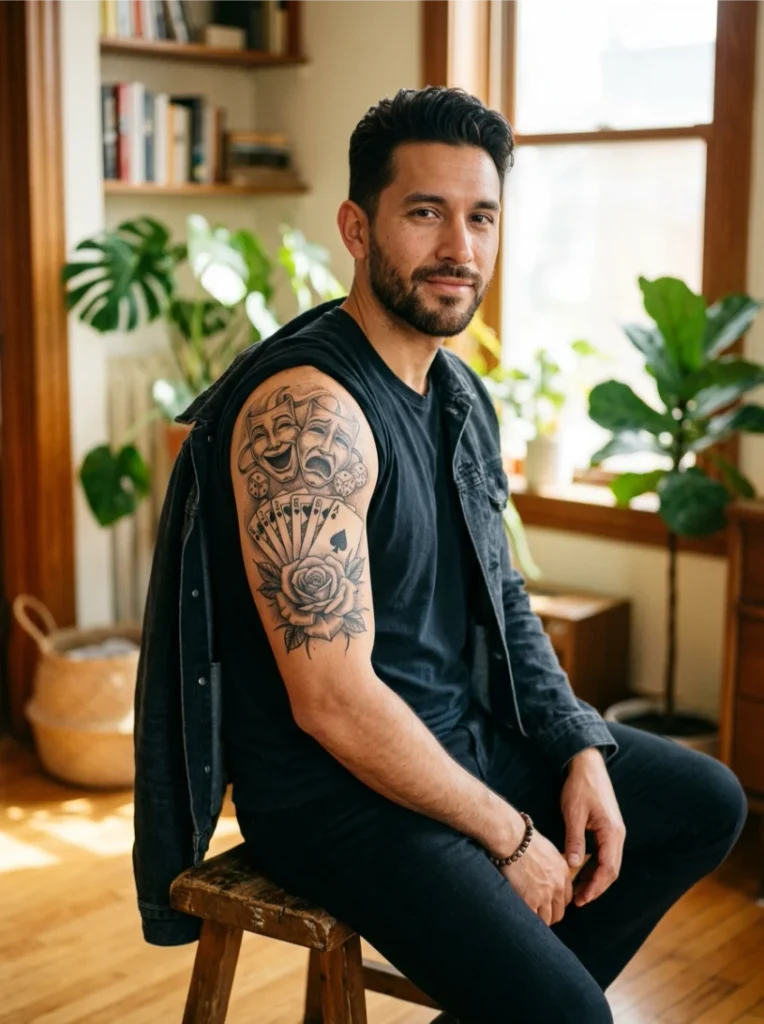
The twin theater masks, one laughing, one weeping, are the most recognizable Chicano image: life’s duality in a single composition. In the style’s vocabulary they read as resilience through hardship, not decoration.
This design needs symmetry and scale to work. The two faces must mirror each other closely, and at small sizes the expressions blur into generic faces. Give it at least four to five inches on the forearm, chest, or back where both masks can hold their detail.
2. Payaso Portrait for a Gangster Chicano Style Tattoo Design
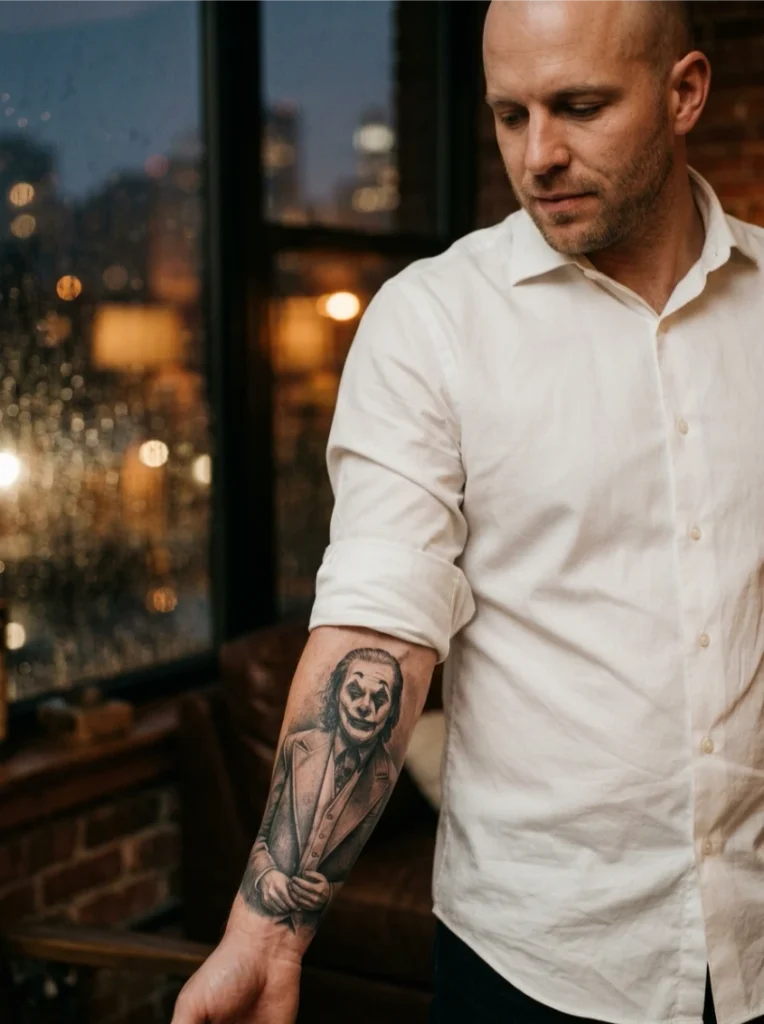
The payaso, the clown face, is one of the style’s signature portraits: painted clown makeup on a realistic face, often with a somber rather than comic expression. It carries the same duality theme as the masks, laughter as armor.
Be aware this is one of the images most associated with barrio and prison iconography. That’s not a reason to avoid it, but it is a reason to understand it. A payaso without any connection to the culture reads differently than one chosen with knowledge. If this imagery speaks to you, learn what it means before you wear it.
Know the weight
Some Chicano symbols carry genuine street associations. Research the specific imagery, talk to your artist honestly about your connection to it, and skip anything you’d be uncomfortable explaining.
3. Praying Hands with Rosary Beads for a Chicano Style Tattoo
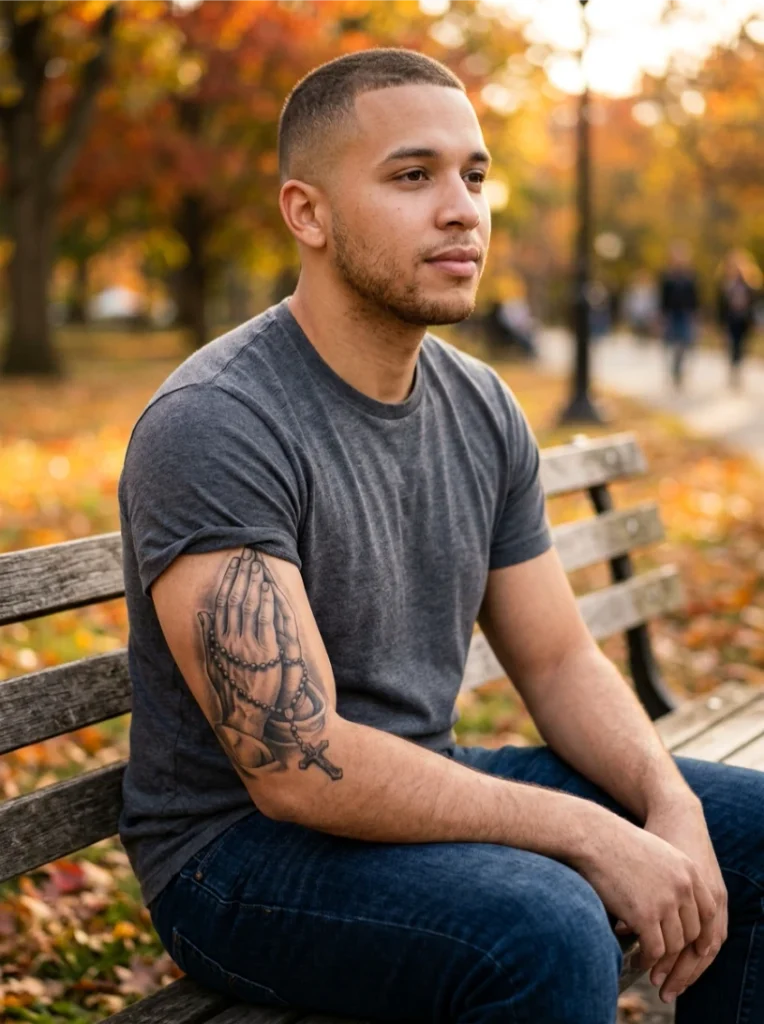
Praying hands wrapped in a rosary: faith rendered as portraiture. This is among the safest and most universal entries in the style, devotion without cultural baggage, and it suits anyone with a genuine connection to Catholic imagery.
The technical challenge is the hands themselves. Hands are famously hard to tattoo well; poorly drawn knuckles and fingers ruin the piece instantly. This design is a direct test of your artist’s portraiture skill. Ask to see healed hand and portrait work specifically, not just their general black-and-grey.
4. Chola Girl Portrait with Bandana in Chicano Style Tattoo Work
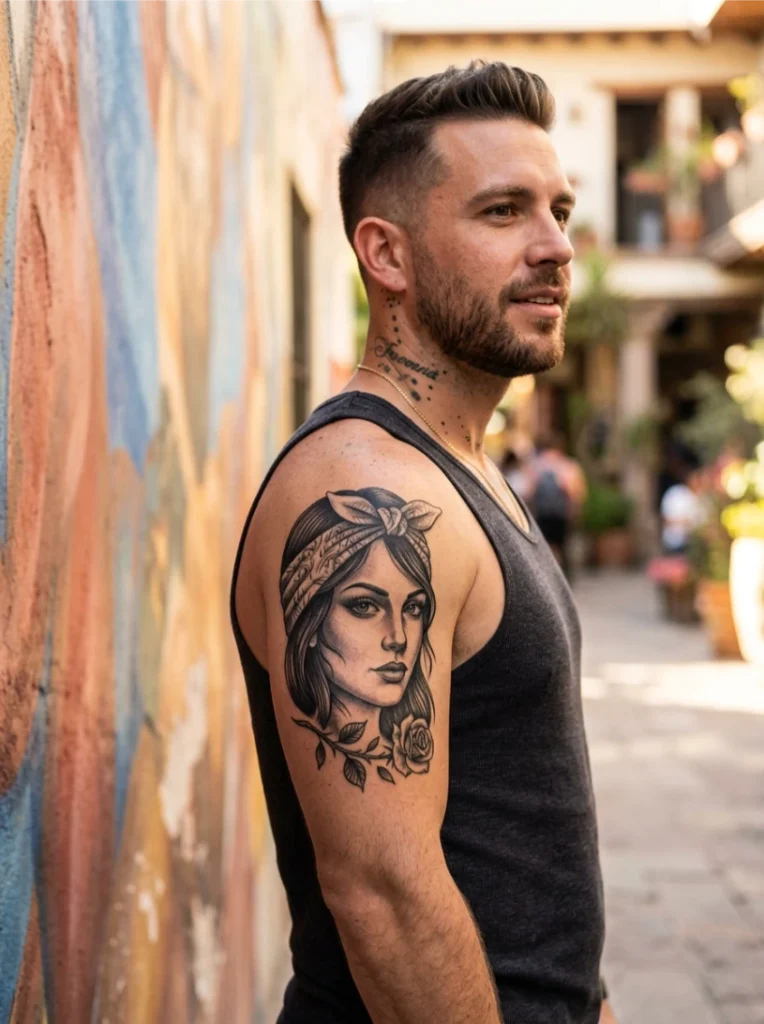
The chola portrait, a woman’s face framed by a bandana, hoop earrings, and sharp eyeliner, is a tribute image in the classic style. Like the payaso, it comes from a specific cultural place, and it deserves the same respect you’d give any portrait of a real tradition.
Portraiture is the most demanding discipline in this style. A good Chicano portrait needs smooth grey wash transitions, accurate facial structure, and detail that survives years of aging. This is not the design for a generalist or a budget shop. Expect multiple sessions and price accordingly.
5. Jesus Christ with Crown of Thorns as a Chicano Style Tattoo Centerpiece
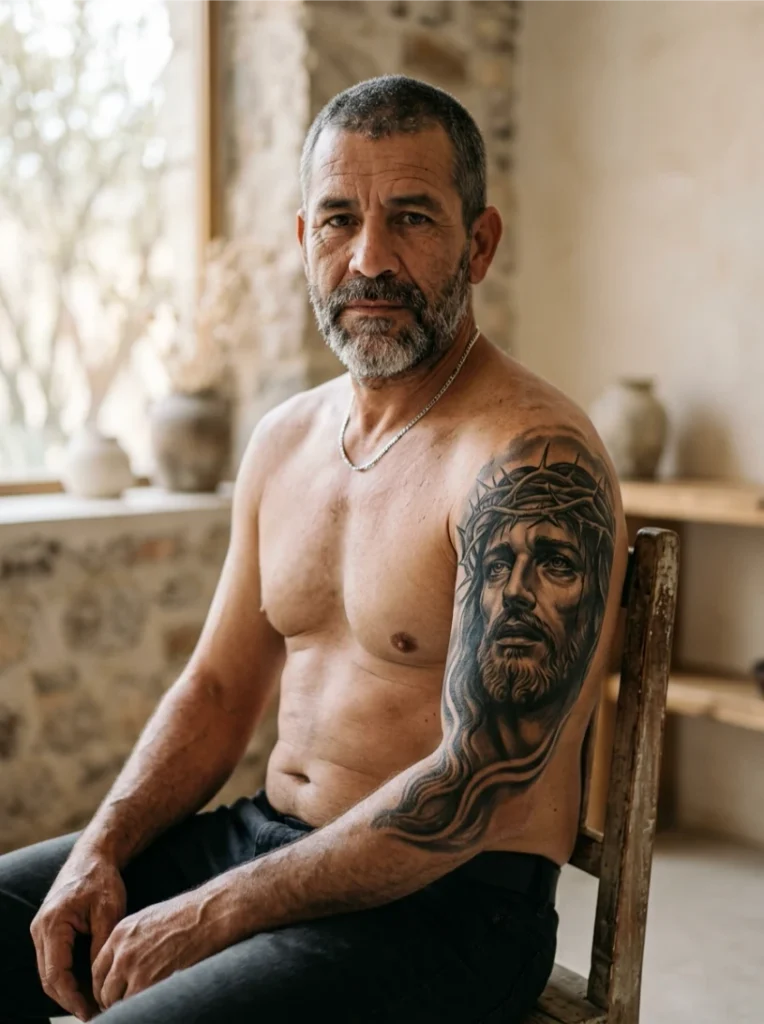
Religious centerpieces, Christ, the Virgin of Guadalupe, crosses, anchor many Chicano compositions. The crown of thorns adds texture and suffering rendered in fine detail, and as a centerpiece it usually anchors a larger composition rather than standing alone.
Scale is everything here. A religious portrait under four inches loses the facial detail that makes it reverent rather than generic. Plan for a chest, back, or full forearm piece, and discuss with your artist how it will compose with any future additions around it.
6. Lowrider Hydraulics with Playing Cards for a Chicano Style Tattoo
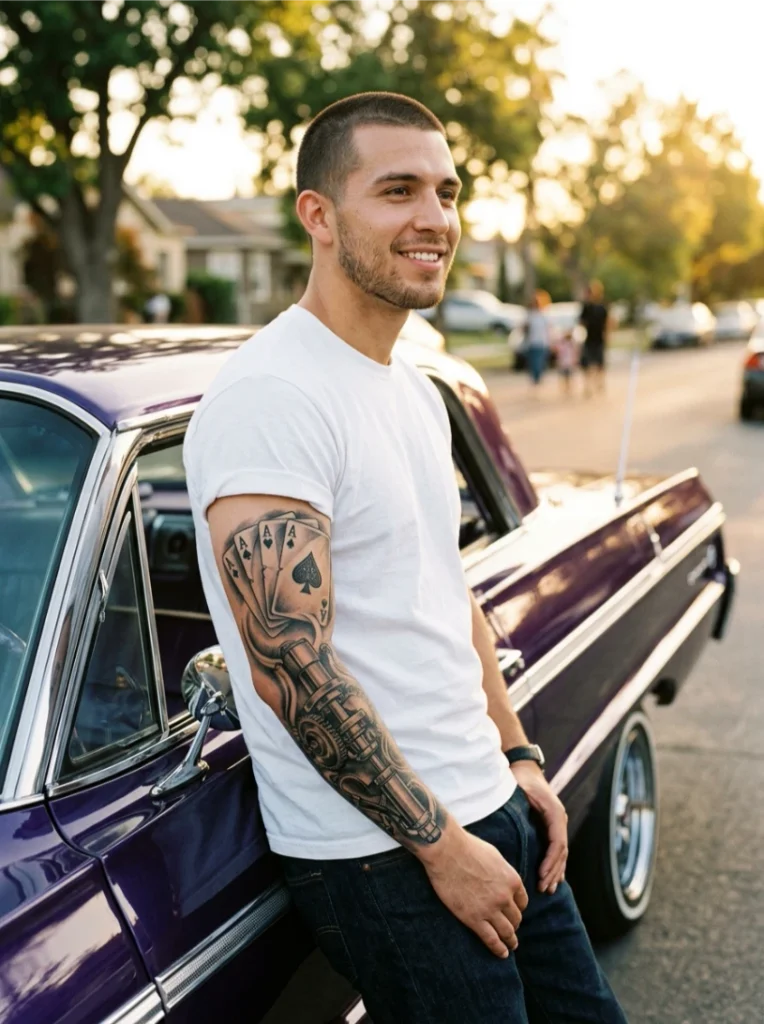
Lowrider culture, hydraulics, chrome, playing cards, is inseparable from the Chicano aesthetic, and this design celebrates the mechanical side: a car detailed enough to read as a lowrider specifically, not just a car, paired with cards for the gambling motif.
Mechanical detail is unforgiving. Chrome reflections and hydraulic lines need an artist comfortable with technical illustration, not just portraiture. Check their portfolio for vehicles or machinery before committing; a portrait specialist may not be the right hand for this one.
7. Small Chicano Style Tattoo for Men Hand Piece
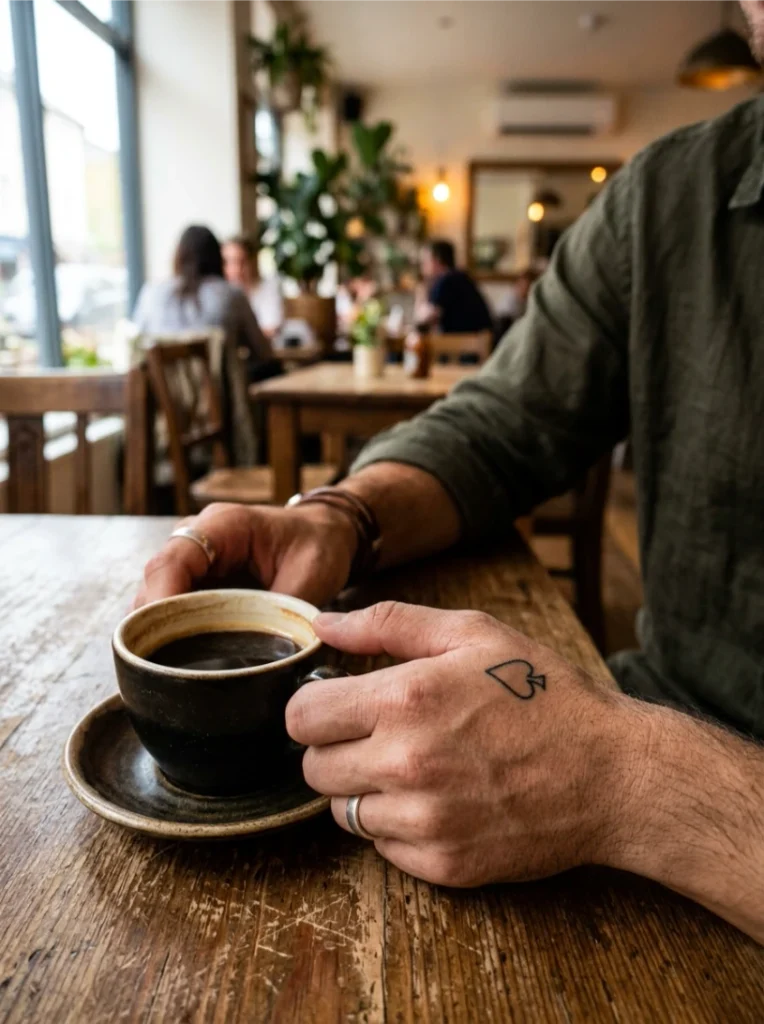
A compact Chicano design for the hand: a small portrait, script, or symbol sized for the back of the hand or fingers. Hands are high-visibility and high-maintenance placements, so this choice says something before you do.
Two honest warnings. First, hand tattoos fade faster than almost any other placement and will need touch-ups. Second, a small Chicano piece still needs the style’s detail density; shrinking a portrait to hand size often means losing the face. Simple script or a single bold symbol survives hand sizing better than portraiture.
8. Sugar Skull with Rose Combination for a Chicano Style Tattoo
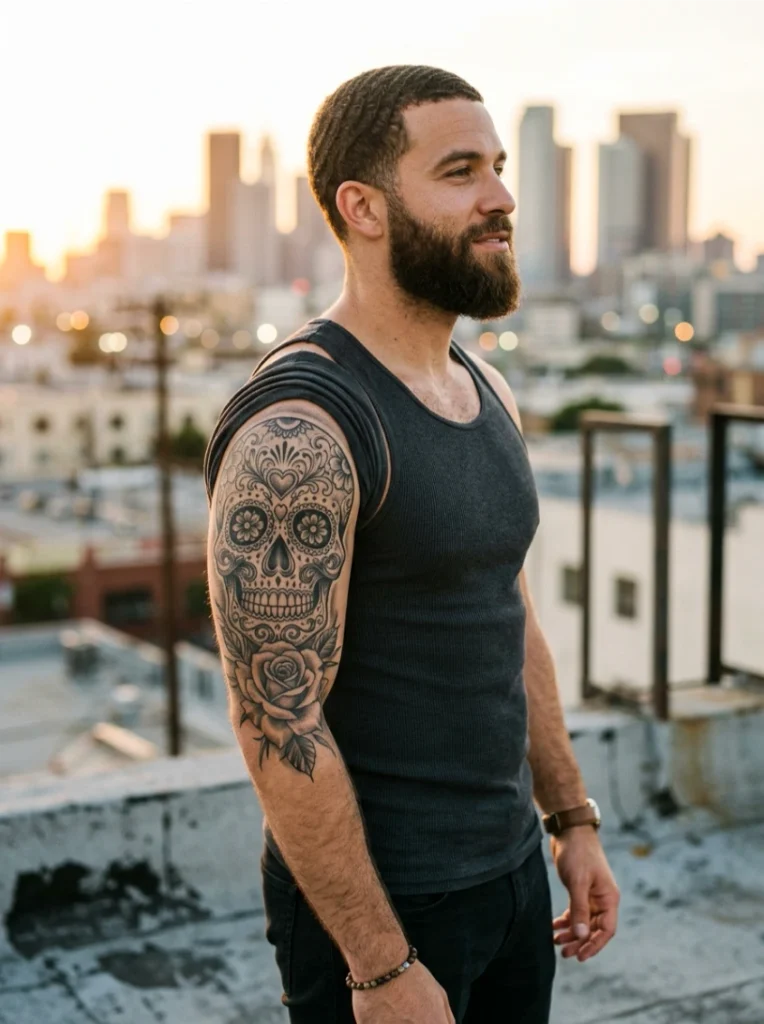
The sugar skull, calavera, paired with a rose: Día de los Muertos imagery meeting classic tattoo romance. This is broadly safe cultural territory, celebration of ancestry rather than anything with street associations, and it’s one of the most approachable entries for someone outside the culture.
The skull needs clean symmetry and the rose needs layered petals to read correctly. At three to four inches this pairing holds up well. It’s also one of the few designs on this list that can take a restrained color accent, a single red or orange in the rose, without breaking the black-and-grey discipline.
One accent, not two
If you add color, commit to exactly one accent and keep everything else grey. Two competing colors against grey wash looks indecisive.
9. Statue of Liberty with a Dollar Bill Portrait Chicano Style Tattoo
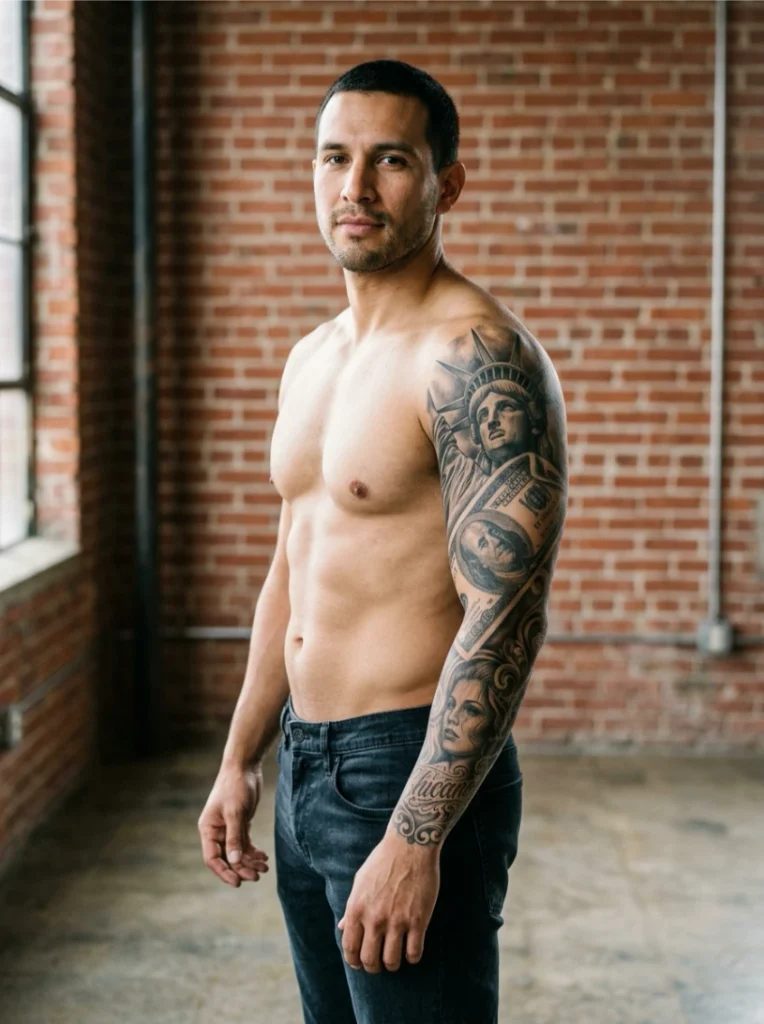
Liberty rendered in Chicano black-and-grey with currency imagery: a commentary piece about the American dream from the barrio perspective. This is concept tattooing, and the concept only lands if the execution is flawless.
Currency detail is miniature portraiture. Bill faces at small sizes become smudges, so this design needs real estate: forearm minimum, upper arm or thigh preferred. Discuss the composition as a single scene, not two pasted images; the integration is what makes it art instead of clip art.
10. Multi-Portrait Flash Collage Sleeve in Chicano Style Tattoo Form
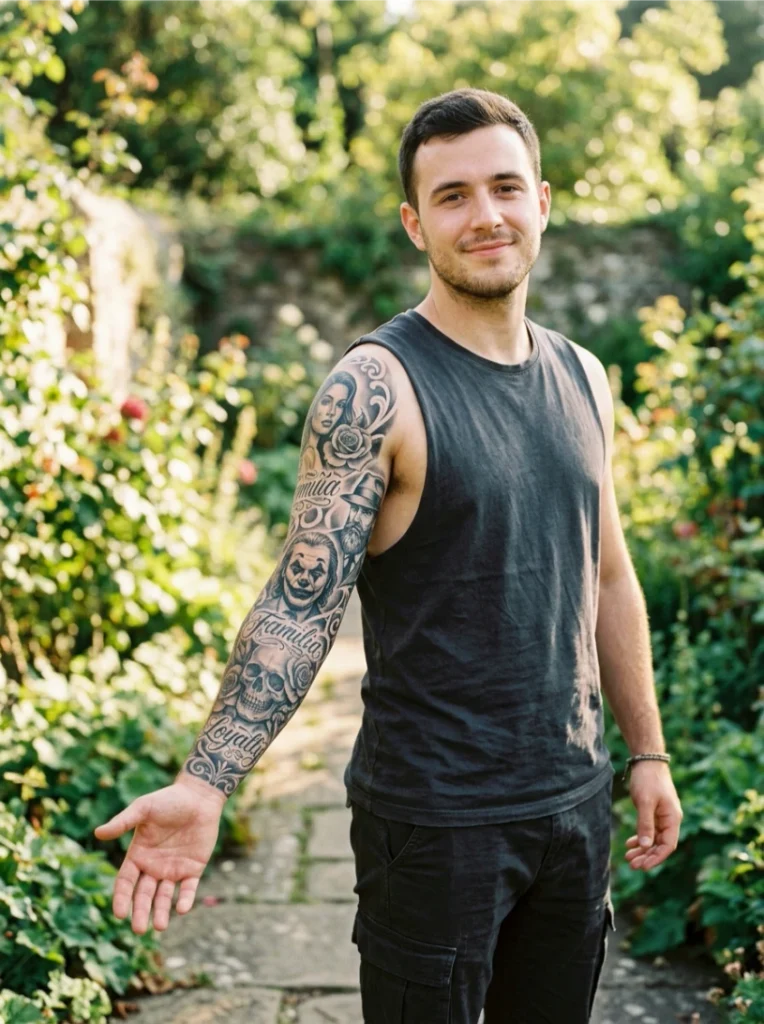
A full sleeve built as a collage: multiple portraits, lettering, and symbols composed into one flowing piece. This is the style’s natural endpoint, and it’s also its biggest commitment.
A collage sleeve is planned, not accumulated. The difference between a great sleeve and a crowded arm is compositional planning: consistent grey wash values, planned negative space, a visual hierarchy. Book a consultation specifically about composition before any needle touches skin, and expect the planning itself to take weeks.
11. Aztec Warrior Portrait for a Chicano Style Tattoo
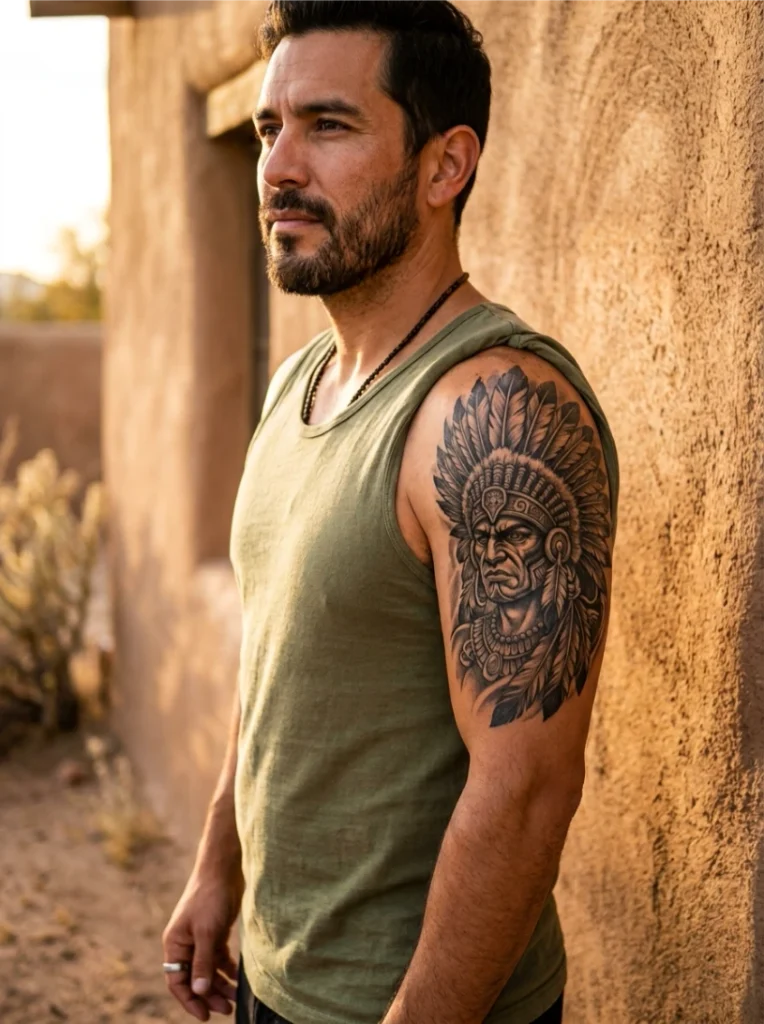
The Aztec warrior connects the style to pre-colonial Mexican heritage: feathered headdresses, stone textures, fierce portraiture. It’s ancestral pride rendered as black-and-grey realism, and it carries none of the street associations of the clown or gang-adjacent imagery.
Headdress feathers are the technical crux. Each feather needs individual definition, and at small sizes they merge into a textured blob. Five inches minimum for a warrior portrait, ideally more. This is a back, chest, or thigh piece by necessity, not preference.
12. Script Lettering Wrapped in Rosary Beads for a Chicano Style Tattoo
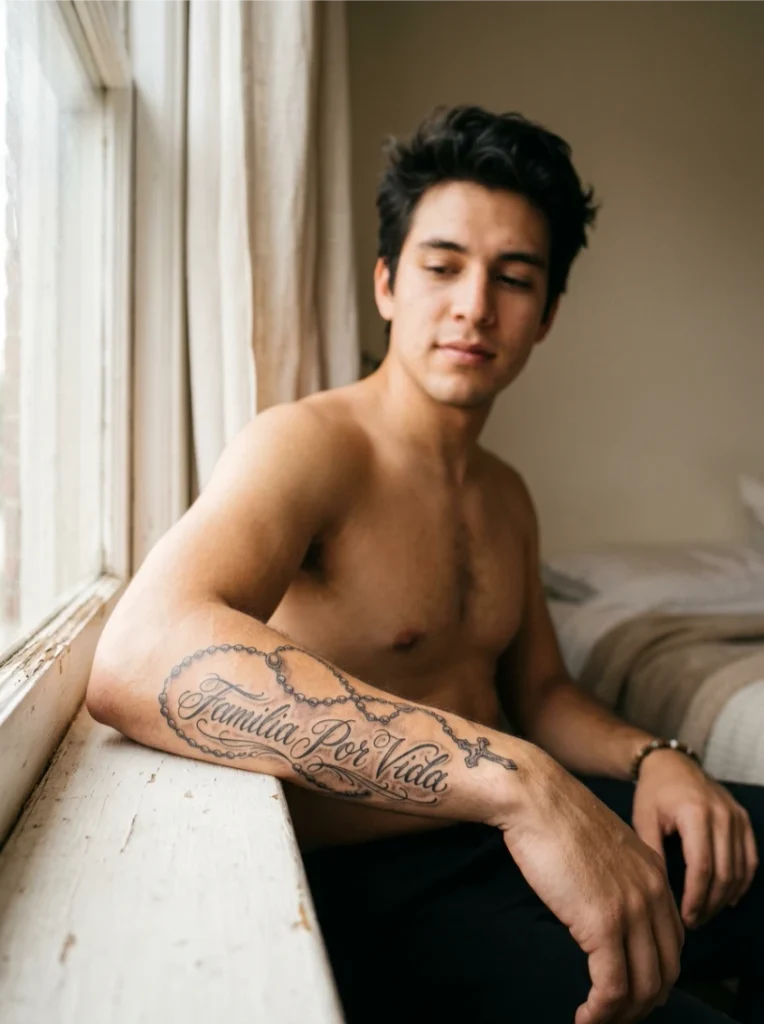
Chicano script, flowing Old English or custom lettering, wrapped in a rosary: words made sacred by their framing. Lettering is the style’s other pillar alongside portraiture, and it’s deceptively difficult.
Get the Spanish right. Accents, spelling, and phrasing errors in tattoo lettering are permanent and common. Have a native speaker verify every word, every accent mark, before the stencil is cut. “Por vida” versus “por vida” with the wrong accent is the difference between meaning and embarrassment. And choose lettering size for longevity: script under two inches tall softens into illegibility within years.
See Also: 16 Iconic Tribal Tattoo Men Ideas: Ultimate Placement Guide
13. Simple Chicano Style Tattoo for Men on the Shoulder
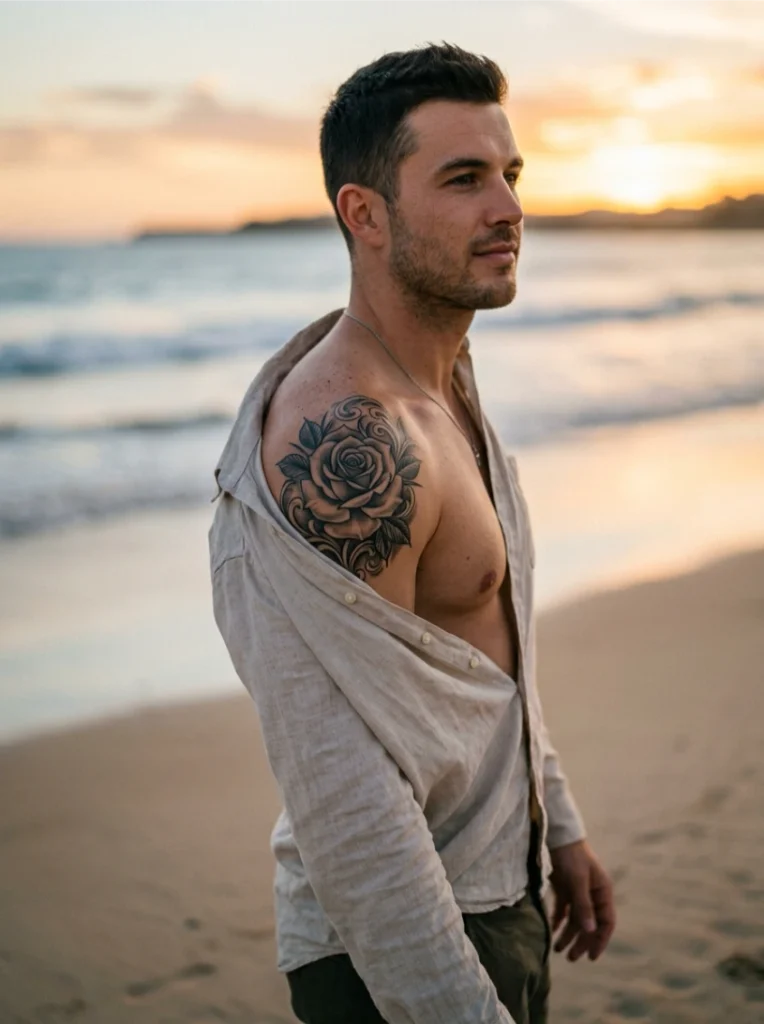
A single clean Chicano element on the shoulder: a small portrait, a cross, a script word. The shoulder’s natural curve suits the style’s rounded compositions, and it’s an easy placement to expand later.
The shoulder rewards simplicity. One strong element beats three crowded ones on this placement; the curve of the deltoid distorts anything too complex. This is the right entry point if you want the style without the sleeve commitment, and it leaves room to build outward when you’re ready. For more on how shoulder pieces develop, see our guide to the tattoo stencil ideas process, since stencil placement on a curved shoulder deserves extra care.
14. Skull, Cards, and Spider Micro-Collage for a Chicano Style Tattoo
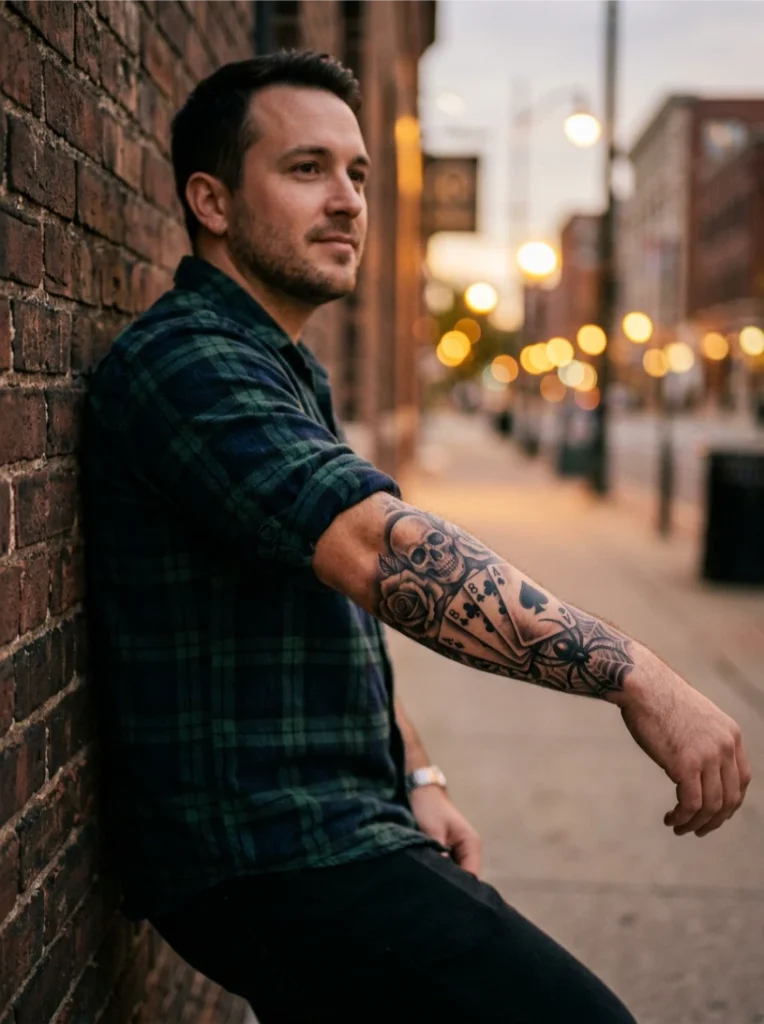
A dense little collage, skull, playing cards, spider web, packed into a compact composition. Micro-collages are the style’s answer to the patchwork trend: multiple symbols telling one story in a small space.
Density is the enemy of longevity here. Three detailed symbols in a small space means every line is fighting for room, and ink spread over the years will merge them. Either give it more size than feels necessary or drop one element. Two symbols with breathing room outlast three symbols fighting.
Know What You’re Wearing: A Cultural-Weight Guide
Not every Chicano symbol carries the same weight, and knowing the difference is the core of wearing this style respectfully. Broadly safe: religious imagery (Guadalupe, Christ, crosses, praying hands), sugar skulls and Día de los Muertos motifs, Aztec heritage imagery, lowrider culture, script lettering with personal meaning. Treat with knowledge: payaso clown faces, smile-now-cry-later masks, and anything with specific barrio or prison associations. These aren’t forbidden, but they mean something specific to the people who created them, and wearing them casually without understanding reads as costume.
The respect question has a simple test: can you explain why you chose this image, beyond “it looks cool”? If you can speak to what it means in the culture it comes from, you’re approaching it right. If not, that’s your sign to research first. And whenever possible, choose an artist connected to the tradition; they’ll guide you better than any article.
Vetting a Black-and-Grey Artist: The Checklist
This style fails in generalist hands more than any other, so vetting matters enormously. Demand healed photos of black-and-grey work, at least six months old; fresh grey wash always looks smooth, healed grey wash tells the truth. Look specifically for smooth gradient transitions, no blotchiness, no harsh lines where soft shading should be. Ask about their portraiture training and look for portrait pieces in their book. Ask how many sessions they estimate and why; a specialist can predict session counts accurately, a guesser can’t. And check that they do custom compositions, not just flash; Chicano work is compositional by nature.
Red flags: no healed photos available, portfolio is all color or fine-line with no grey wash, vague answers about session counts, or willingness to shrink a portrait below viable size to fit your budget. Any of these means keep looking.
What It Costs and How Long It Takes
Honest brackets, because nobody publishes them. A small single element (script word, small symbol): one session, shop minimum to a few hundred. A medium portrait piece (forearm portrait, shoulder piece): two to four sessions. A full sleeve: six to twelve sessions spread over months, and a proper Chicano sleeve is a four-figure commitment at specialist rates. These are ranges, not quotes; your artist’s rate, your city’s market, and the design’s complexity all move the numbers.
Never choose the artist by price alone in this style. The difference between a specialist’s grey wash and a generalist’s attempt is visible for the rest of your life. Save longer for the right artist rather than settling for the available one.
Lettering: Get the Spanish Right
Chicano lettering so often includes Spanish that this deserves its own warning. Misspelled or mis-accented Spanish is one of the most common and most permanent tattoo mistakes. Verify every word with a native speaker, check accent marks character by character, and be wary of online translators for slang or phrases. Old English lettering is traditional in the style, but legibility matters more than font loyalty; if the lettering can’t be read, it can’t be respected. Size it for aging: larger than your instinct, bolder than the reference.
Quick Comparison
| Design | Best Placement | Sessions | Cultural Weight |
|---|---|---|---|
| Smile Now, Cry Later | Forearm, chest | 2-3 | Know the meaning |
| Payaso Portrait | Upper arm, back | 3-4 | Know the meaning |
| Praying Hands | Forearm, chest | 2-3 | Broadly safe |
| Chola Portrait | Thigh, back | 3-5 | Respect the source |
| Christ Centerpiece | Chest, back | 3-5 | Broadly safe |
| Lowrider and Cards | Forearm, thigh | 2-4 | Broadly safe |
| Hand Piece | Hand | 1-2 | Design-dependent |
| Sugar Skull and Rose | Forearm, calf | 2-3 | Broadly safe |
| Liberty and Currency | Upper arm, thigh | 3-4 | Concept piece |
| Collage Sleeve | Full arm | 6-12 | Planned composition |
| Aztec Warrior | Back, chest | 4-6 | Ancestral pride |
| Script and Rosary | Forearm, ribs | 1-3 | Verify the Spanish |
| Shoulder Piece | Shoulder | 1-2 | Good entry point |
| Micro-Collage | Forearm, calf | 2-3 | Give it room |
Frequently Asked Questions
Is a Chicano style tattoo only meant for Mexican-American men?
The style comes from Mexican-American culture, and that origin deserves respect, but appreciation with knowledge is different from appropriation. Learn the imagery’s meaning, choose an artist connected to the tradition when possible, and wear it with understanding. What reads badly is wearing culturally loaded symbols as pure decoration with no knowledge behind them.
What’s the difference between a Chicano style tattoo and traditional black and grey work?
Chicano is a specific cultural tradition within black-and-grey, with its own iconography (payasos, chola portraits, religious imagery, script) and its own history. All Chicano tattoos are black-and-grey, but not all black-and-grey is Chicano. The distinction is in the imagery’s cultural vocabulary, not just the technique.
Do Chicano style tattoos have to stay black and grey, or can they include color?
Tradition says black and grey, and the style’s identity is built on grey wash mastery. A single restrained accent can work; full color converts it into something else. If you want color, you’re asking for a different style with Chicano imagery, which is a legitimate choice but a different commitment.
How much does a full Chicano style tattoo sleeve typically cost?
A proper sleeve from a specialist is a four-figure commitment spread across six to twelve sessions. Anyone quoting dramatically less is either not a specialist or planning to rush. Get an estimate in the consultation, understand the session count, and budget for the full project before starting.
Can a small Chicano style tattoo look as good as a full sleeve?
Yes, if the design is chosen for the size. Script, single symbols, and simple portraits work small; detailed multi-element compositions don’t. The mistake is shrinking a sleeve design instead of choosing a small design. Match the design’s complexity to the available skin.
Final Thought
Chicano tattooing rewards the wearer who approaches it with knowledge. The style’s power comes from its specificity: real portraits, real lettering, real cultural memory rendered in masterful grey wash. Choose with understanding, hire a specialist, give the design the scale it needs, and verify every word. Do that, and the result isn’t just a tattoo in a style. It’s a participation in a living tradition. And if you’re still deciding on placement, the right shoulder piece planning makes all the difference for how these designs sit on the body.