A sleeve is the biggest single design decision in tattooing, and the one that punishes impulse the hardest. What follows is sixteen directions for women’s sleeves, but more usefully, the two decisions that decide every outcome: where it shows and where it hides, and whether the delicate work you’re drawn to can survive a decade on skin.
This article is written for the planning stage, not the gallery scroll. Each idea gets the design analysis that matters, then the sections competitors skip: an honest aging ledger for delicate work, the coverability decision tree, how to absorb existing small tattoos, and what a women’s sleeve actually costs.
Start With the Visibility Decision
Before motifs, before styles, before artists: decide where your sleeve lives on the visibility spectrum. A shoulder-to-elbow sleeve hides under short sleeves; a full arm with forearm work is on display most of the time. Everything after this choice gets easier, because placement is the one part of a sleeve you cannot revise later.
The forearm is the most seen section of the body. Hands type, wrists rest on tables, sleeves get rolled up. That is an argument for putting your best, boldest work there, or your most coverable work above the elbow, depending on your life. Neither choice is wrong. The wrong move is choosing without thinking about it. For how the same planning questions play out on the other side of the aisle, our sleeve tattoos for men guide walks through the full-arm planning math from a different angle.
1. Forest Horizon Sleeve Tattoos Women
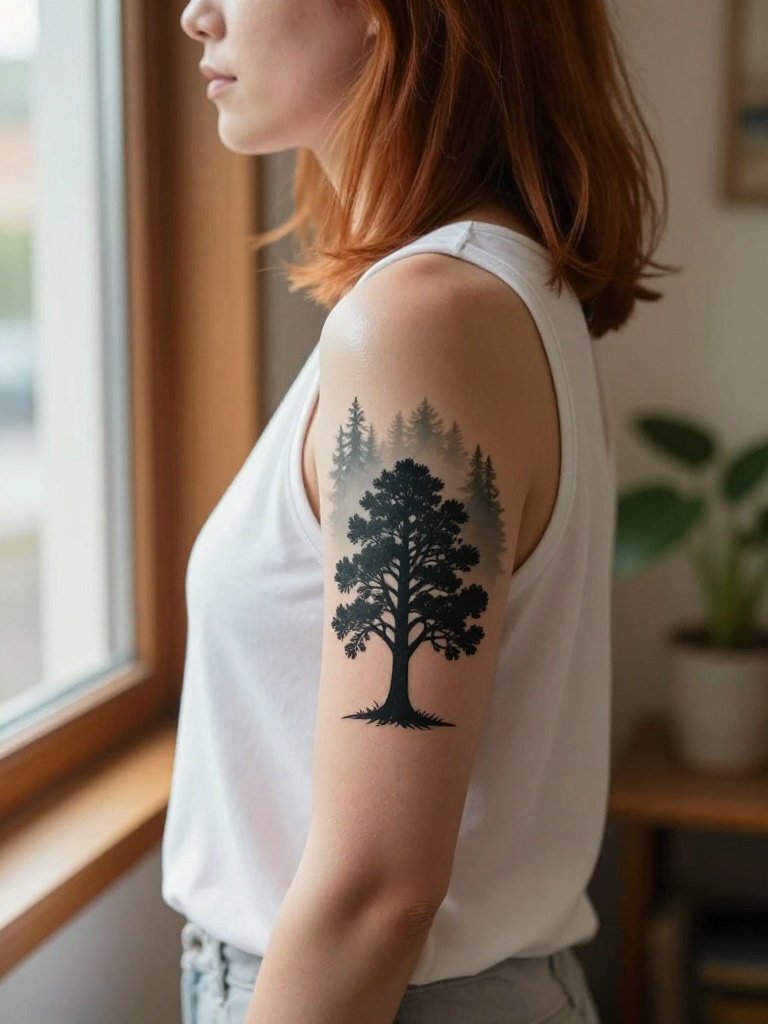
The strongest trick in this design is the value shift: near-solid black silhouette trees at the wrist, easing into looser, more detailed forest linework toward the shoulder. The eye reads it like a landscape receding into the distance, which is why it photographs so well against skin.
This is a composition piece, not a color piece. The shading gradient does all the work, and it needs a full outer arm to build the effect; a half sleeve loses the sense of distance the design depends on. Ask the artist how they plan the transition before you commit, because an abrupt jump from solid black to open linework reads as two tattoos, not one.
2. Pine Canopy Sleeve Tattoos Women
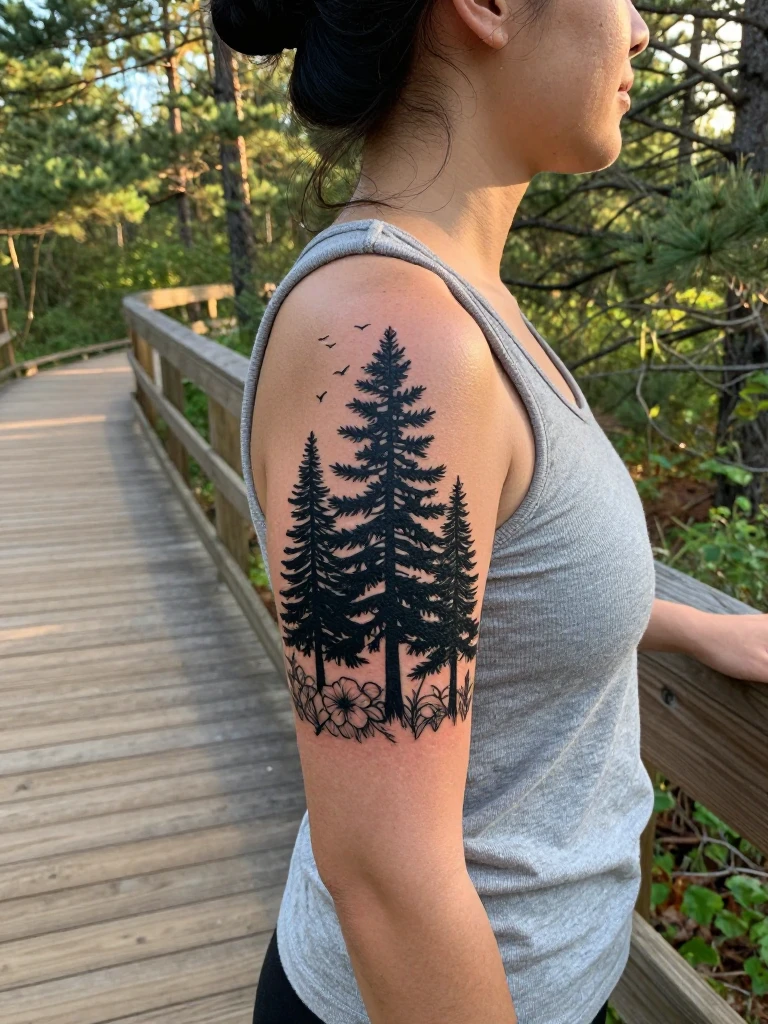
Layered pine silhouettes with small birds scattered toward the shoulder give a static forest scene a sense of motion. The birds are kept simplified and small on purpose. They are a compositional accent, not a focal point, which lets the canopy dominate while giving the eye somewhere to travel.
Florals worked into the lower canopy soften the high contrast, and the negative space between branches keeps the whole thing from feeling overcrowded. The shoulder-to-elbow zone suits it best, since the bird detail competes with wrist movement and reads cleaner higher up the arm.
3. Portrait and Koi Sleeve Tattoos Women
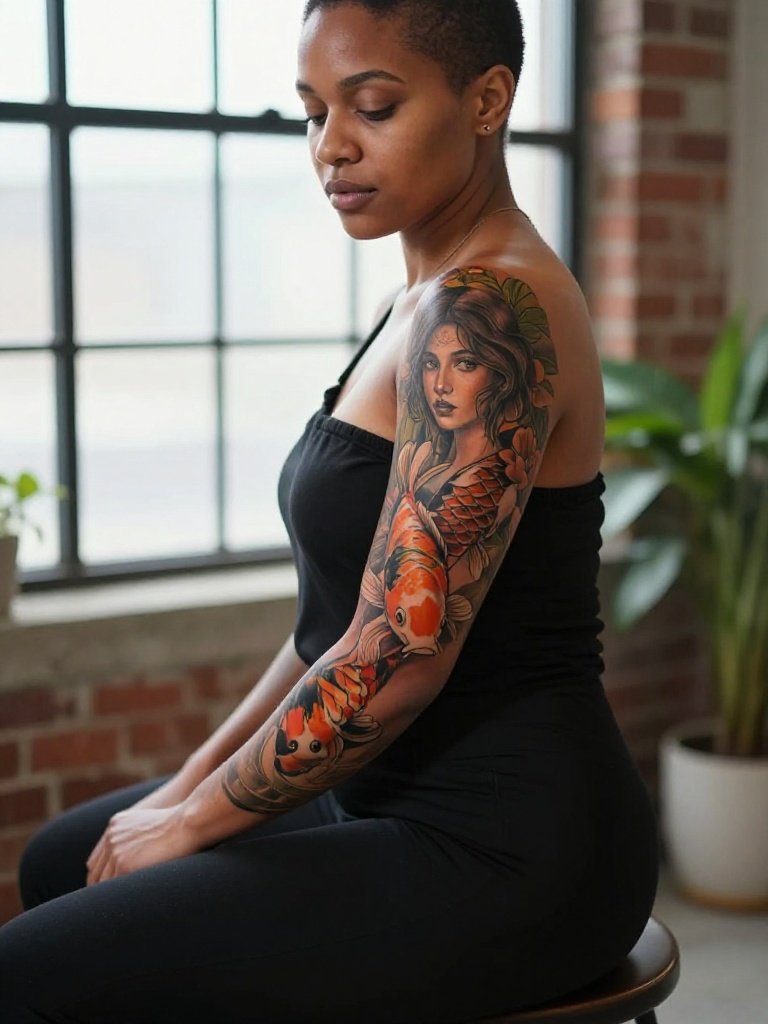
A semi-realistic portrait paired with koi and layered florals, in full color. This is the heaviest commitment on this list, and not because of the size. Color work at this density needs a skilled colorist, not just a solid line artist, plus a real conversation about color theory upfront so the palette reads as cohesive instead of scattered.
The koi trailing down toward the elbow does real structural work: it gives the portrait a secondary focal point and balances the visual weight. Shoulder-forward placement lets the portrait sit as the anchor. Treat the consult as an interview and ask to see healed color pieces, because fresh color always photographs well.
Find a colorist
4. Warm-Tone Peony Sleeve Tattoos Women
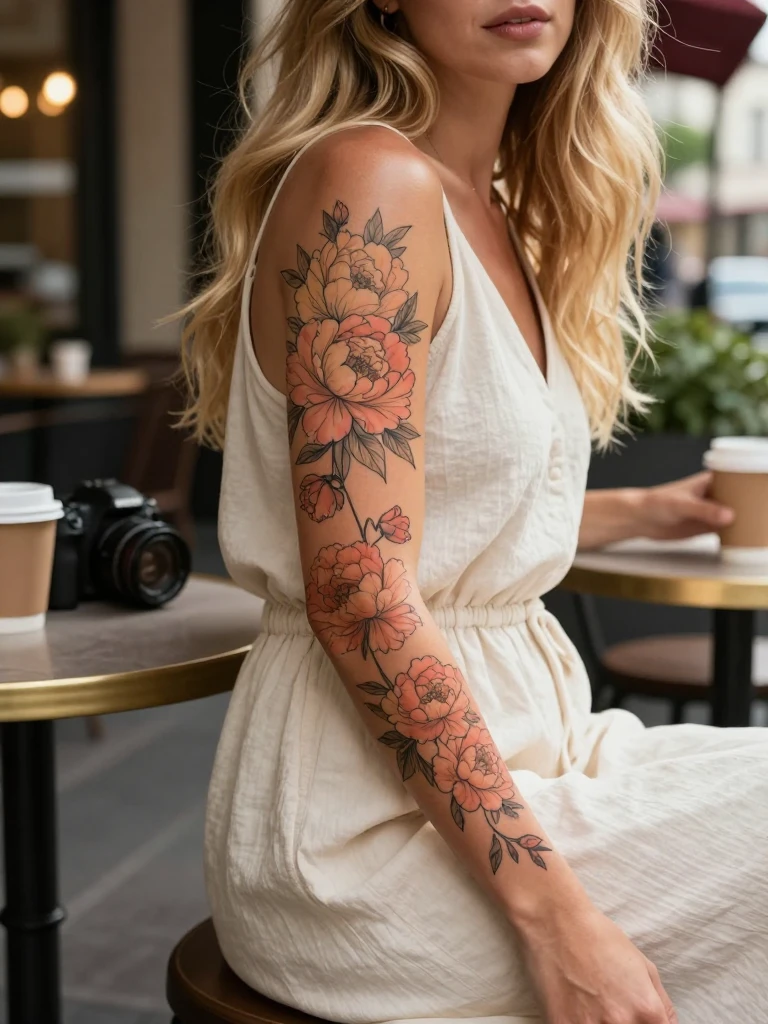
Instead of the black-and-grey botanical default, this one runs peach and coral through the peonies for a sun-warmed look. The technique is subtle color blending inside linework, not full illustration, so saturation stays restrained and the piece keeps its delicacy.
The cascade works because the motif repeats with variation: larger blooms near the shoulder, smaller buds toward the wrist, so it feels intentional rather than repetitive. Full arm coverage lets the flowers flow without an obvious stopping point. Ask about sun protection in the consult, because warm pastels fade faster than black under regular exposure.
5. Dotwork Rose Sleeve Tattoos Women
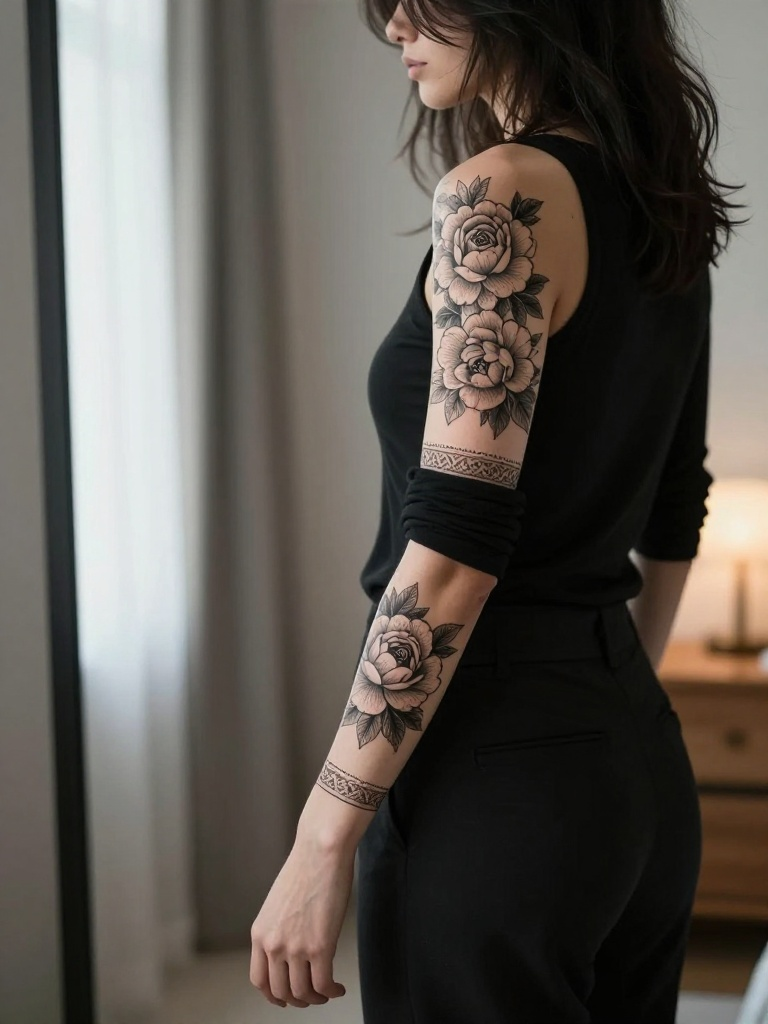
Fine dotwork instead of solid fill gives the roses an engraved, almost printed texture, and the ornamental band near the wrist or elbow frames the composition like a cuff instead of letting it trail off. That framed edge is what separates a planned sleeve from a collection of florals.
This is also the most adaptable design here for meaning. Individual blooms can be swapped in to mark people, dates, or milestones without breaking the symmetry. If the personal layer matters to you, bring the reference list to the first consult and let the artist assign each bloom its place.
Built-in cuff
6. Lion Portrait Sleeve Tattoos Women
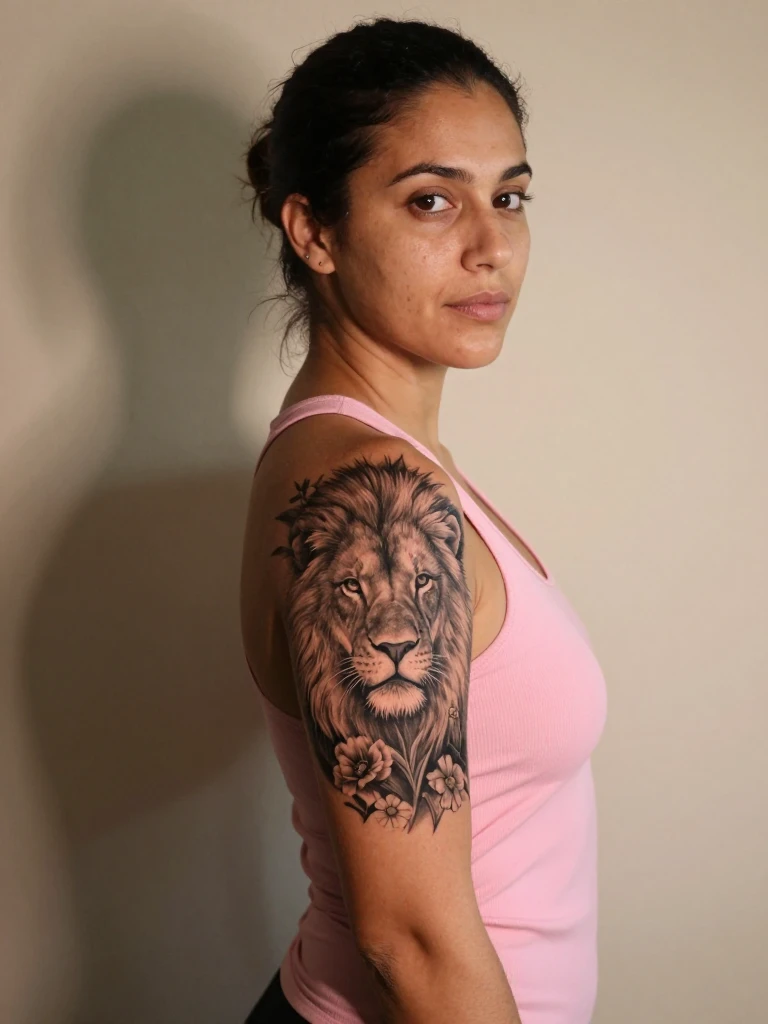
A tightly rendered lion face in black and grey realism, framed by loose peonies and daisies rather than a busy background. Keeping the background quiet is a deliberate choice: the eye stays on the portrait, and the florals soften what would otherwise be a fairly intense image.
This is the most technically demanding entry on the list. Wildlife realism lives or dies on the artist’s shading skill, specifically fur texture built through controlled needle work rather than heavy outlining. Portfolio review matters more here than with any other style on this list. Upper arm placement gives the portrait room to breathe without competing with forearm movement.
See Also: 16 Traditional Heart Tattoo Ideas That Still Feel Iconic
7. Butterfly Accent Sleeve Tattoos Women
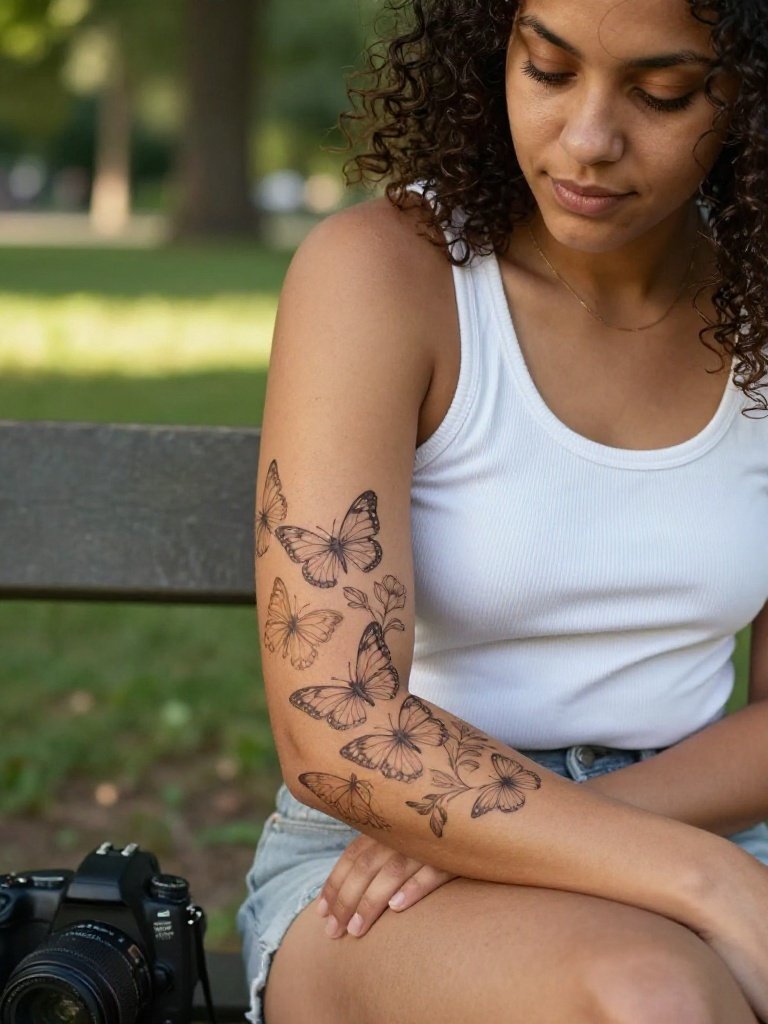
A cluster of butterflies worked into lower-arm floral fill adds a lighter note to a sleeve that might otherwise feel heavy, especially below a bolder upper-arm piece. The fine-line wing detail contrasts against denser shading, and artists often treat this as a bridge piece between two heavier elements.
It is also a strong staged-build entry: you can commit to the butterflies first and extend later. For how tiny winged subjects hold up at small scale, our hummingbird tattoo ideas guide compares delicate micro-detail styles side by side.
8. Japanese Crane Sleeve Tattoos Women
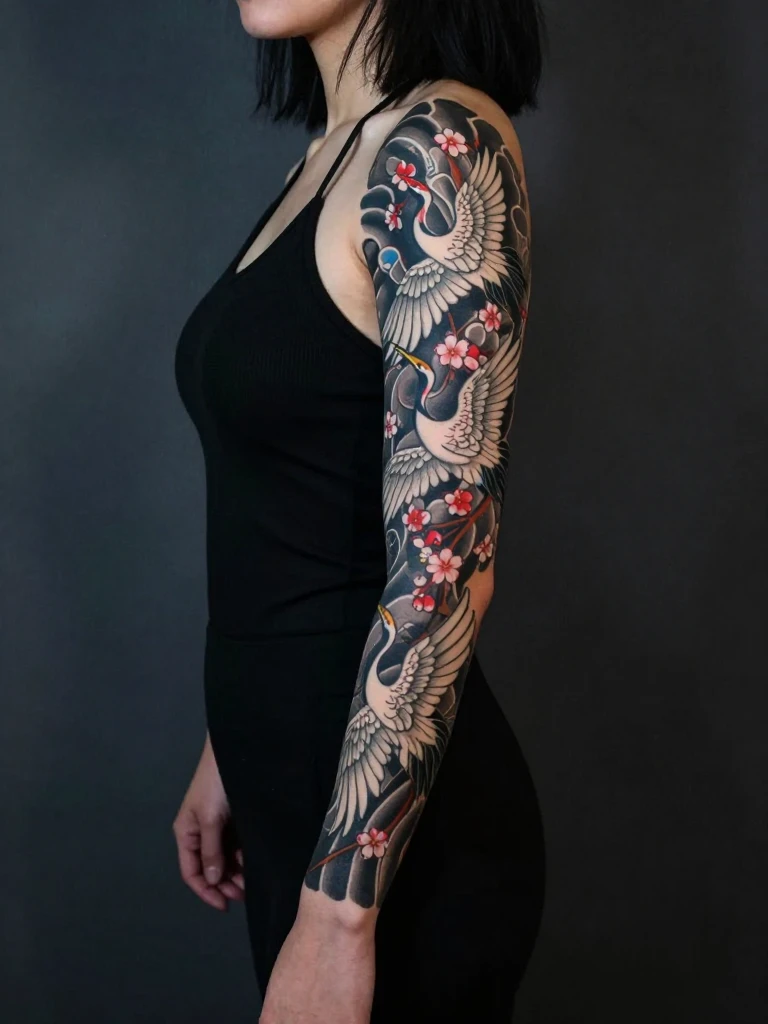
Full-color irezumi cranes against a solid dark background. The background is part of the design, not empty space, which is what gives traditional Japanese sleeves their density. Cherry blossom branches threaded between the cranes break the background into readable sections and add rhythm.
This calls for an artist trained in this lineage specifically, not a generalist. The style is built for full sleeve coverage; a half sleeve tends to read as unfinished because the background never gets room to establish itself. Budget for touch-ups in the first year, since dense color settles unevenly.
Lineage matters
9. Wave and Peony Sleeve Tattoos Women
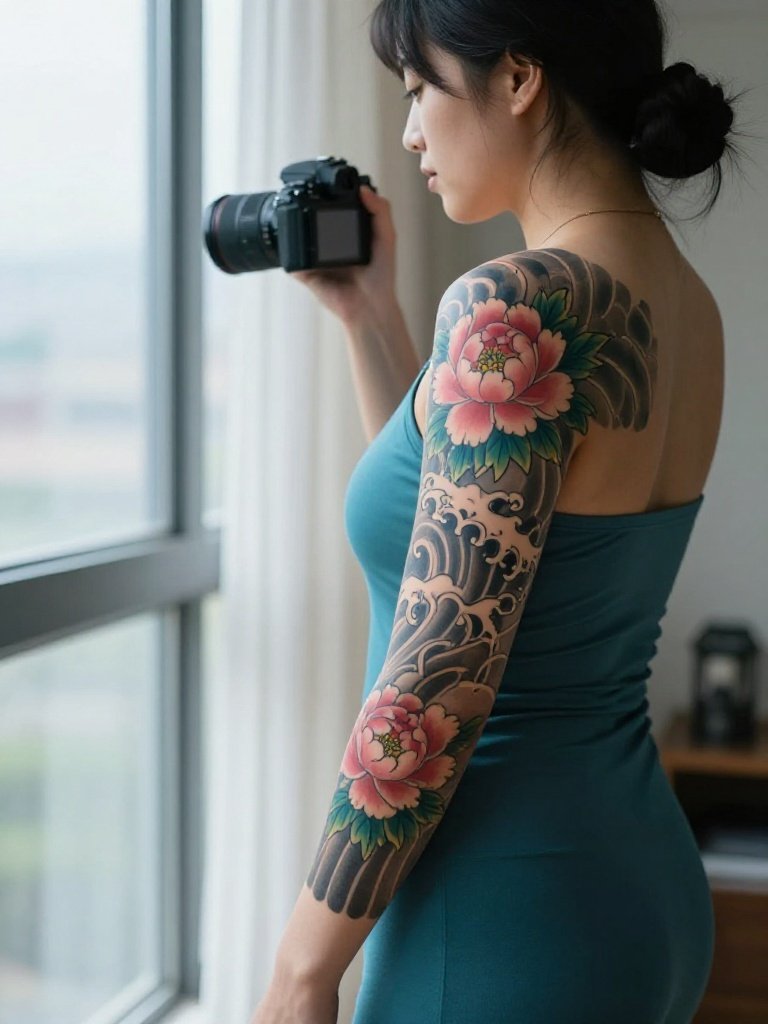
Same technical family as the crane piece, different compositional logic. The rolling wave behind the peonies becomes the connecting element, and its curved lines give the sleeve a continuous flow from shoulder to wrist. The symbolism shifts too: resilience and movement rather than the longevity cranes carry.
The wave needs a full wrap to work. Cut it short and the flow breaks at the elbow instead of carrying through. If you are weighing crane versus wave, the honest difference is temperament: cranes read as emblems, waves read as motion. Pick the one that matches the energy of the rest of your plans.
10. Leopard Portrait Sleeve Tattoos Women
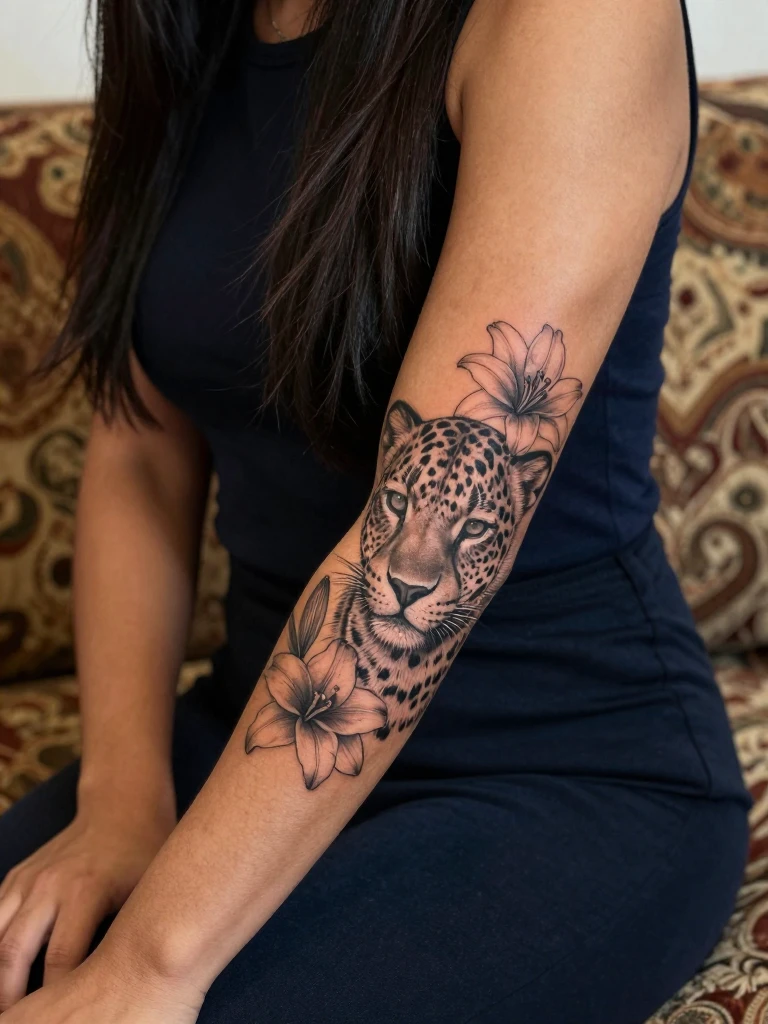
The tight crop is the whole idea. Isolating the leopard’s face instead of the full head keeps it from reading as a generic wildlife tattoo, and the lilies soften the intensity without diluting it. Rosette patterning needs a lot of small, deliberate marks, so the artist has to be comfortable with fine needle work, not just bold outlines.
Overly light shading blurs first, which is the practical warning: contrast is what this design survives on. The tight crop also makes it more forearm-friendly than a full head-and-mane portrait, since it fits a shorter canvas.
The tight crop
11. Amber Eye Sleeve Tattoos Women
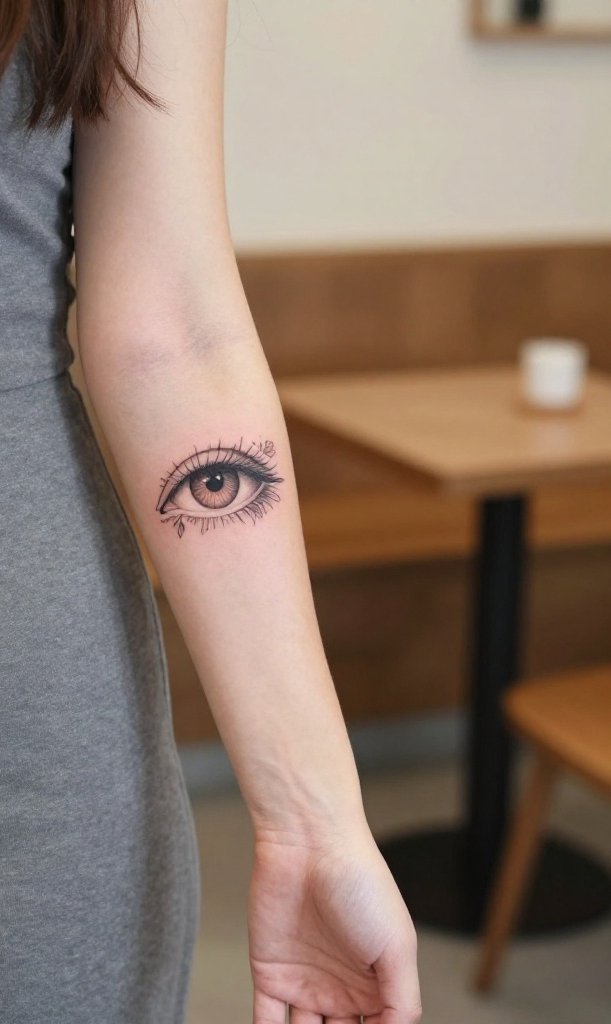
One eye, rendered with near-photographic shading, surrounded by smaller floral and leaf detail. It is the most restrained realism entry here, and deliberately so: the eye carries the entire piece, so nothing competes with it. Custom design work matters more here than anywhere else on this list, because there is nowhere to hide weak rendering.
The smaller footprint makes it the most approachable option for anyone still deciding how much forearm to commit. It also works as a planned first piece for a sleeve you build outward from over time.
12. Minimal Line Sleeve Tattoos Women
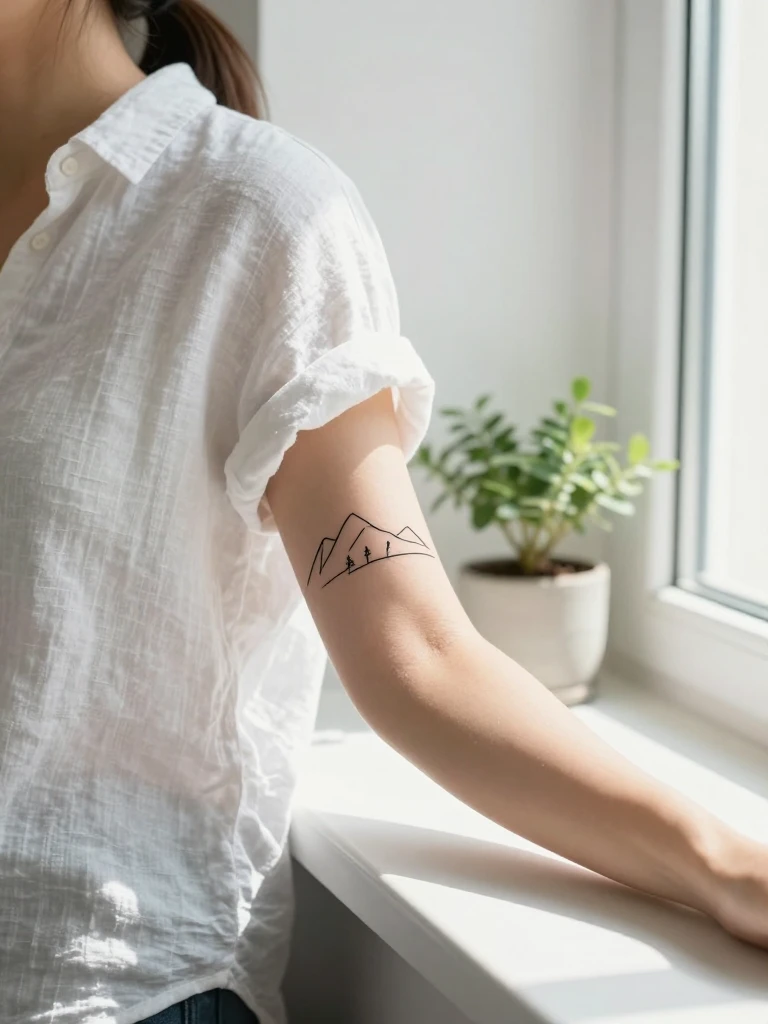
Thin, single-weight linework tracing a simplified tree line or mountain silhouette. Almost no shading, a single-needle technique keeping every line consistent. This is the entry that answers the demand for a simple women’s sleeve without looking unfinished.
The restraint is the point. Less visual noise means the design stays legible at a distance and ages cleanly, since there is no delicate shading to blur unevenly. It scales to any section of the arm, which makes it the most flexible commitment on this list.
One needle
13. Lotus Mandala Sleeve Tattoos Women
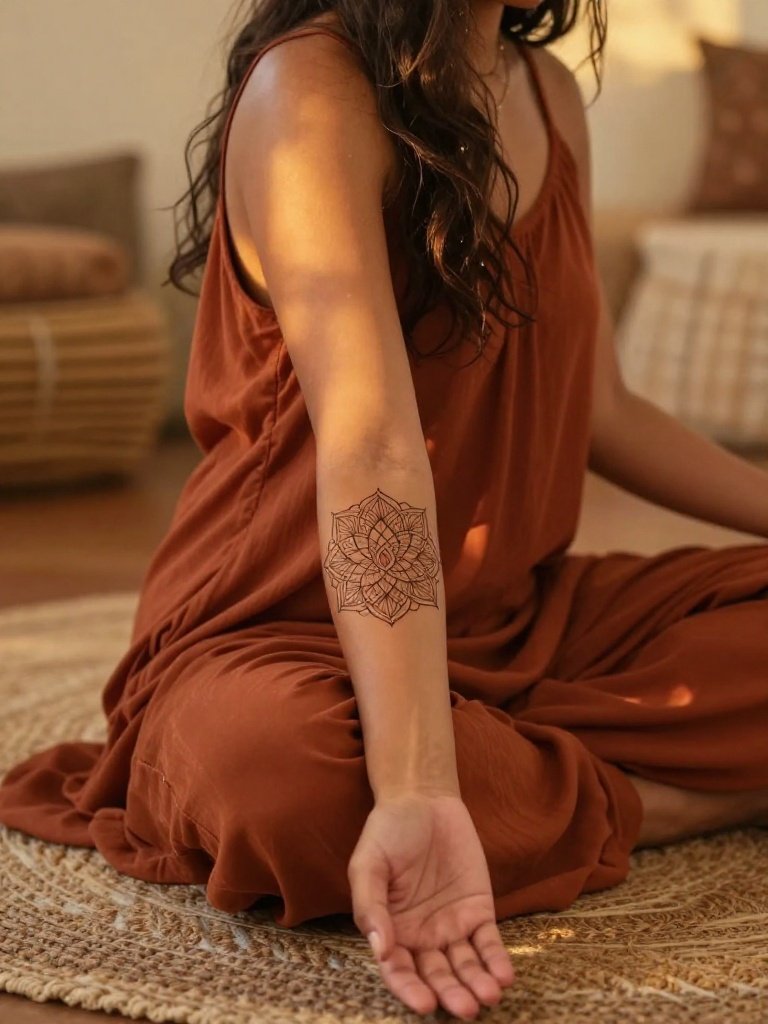
Geometric mandala patterns worked around a central lotus, sitting between ornamental pattern and personal symbolism. The geometry needs a steady hand: any wobble in the mandala lines shows immediately, which is why most artists work from a stencil first to lock the radial symmetry before adding freehand touches around the lotus.
The inner arm suits the symmetry better than the outer arm’s curve. For how ornamental pattern behaves on curved skin, our ornamental tattoo ideas guide breaks down the symmetry and spacing rules that carry linework-heavy designs.
Stencil first
14. Moon Phase Sleeve Tattoos Women
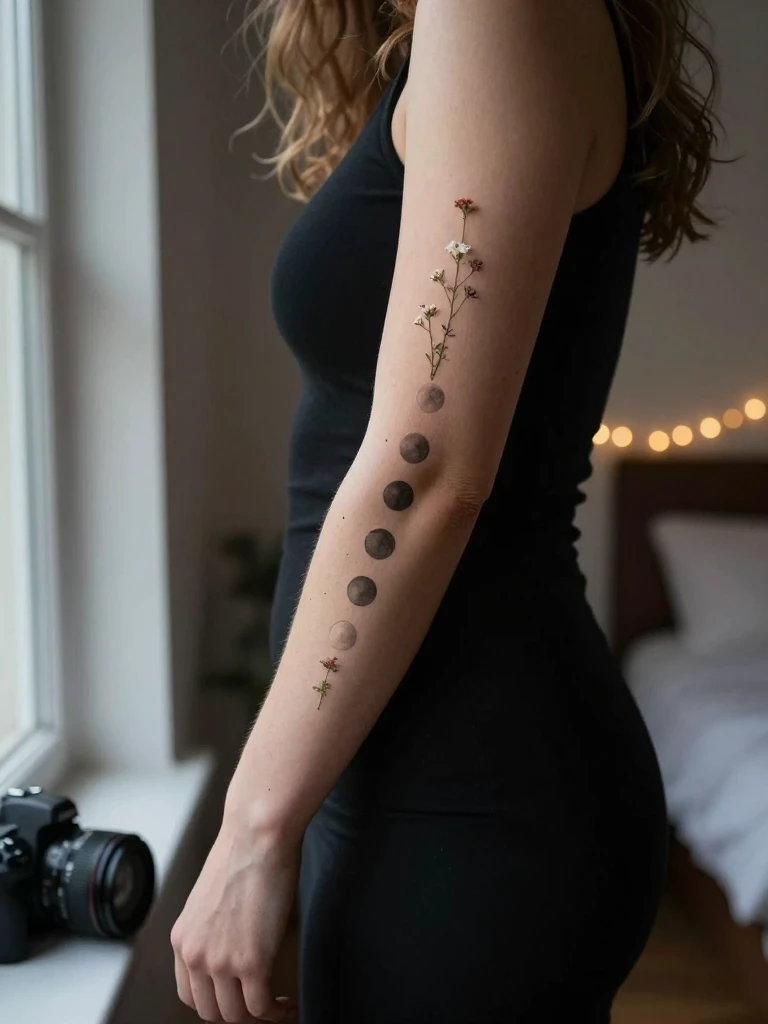
A vertical run of moon phases threaded with small wildflowers, tying celestial to botanical without either feeling like an afterthought. The vertical layout suits a narrower stretch of skin, and each phase reads as understated and personal rather than a bold statement.
The trade-off is maintenance. Small-scale fine linework is the easiest detail to lose over time, so touch-ups are more common here than on larger pieces. The inner forearm gives the phase progression a natural line to follow and keeps it readable in daily life.
15. Vine and Rose Half Sleeve Tattoos Women
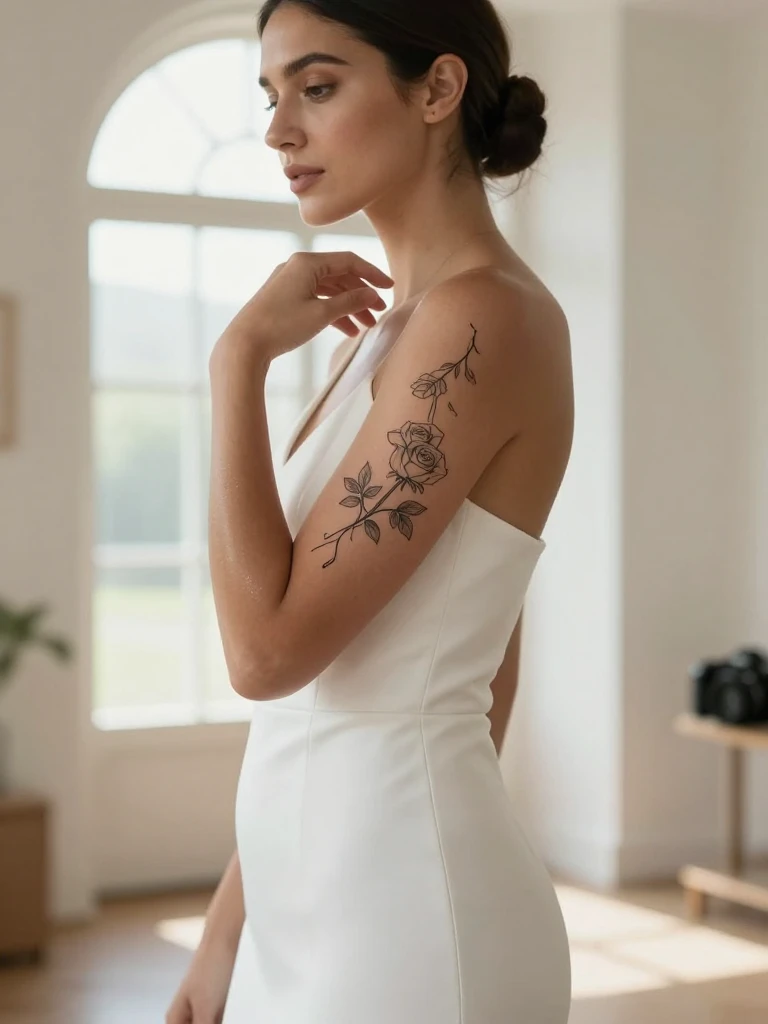
Elbow to wrist or shoulder to elbow, one trailing vine, a handful of roses, and negative space doing the heavy lifting. The vine’s natural curve gives the composition direction instead of scattered florals, which is why it reads as classy rather than sparse.
This is the best entry point on the list for anyone who wants the sleeve aesthetic without full shoulder-to-wrist commitment. And it leaves the door open: a half sleeve planned with room to expand becomes a full sleeve that looks intentional, not an extension that looks tacked on.
16. Wildflower Meadow Sleeve Tattoos Women
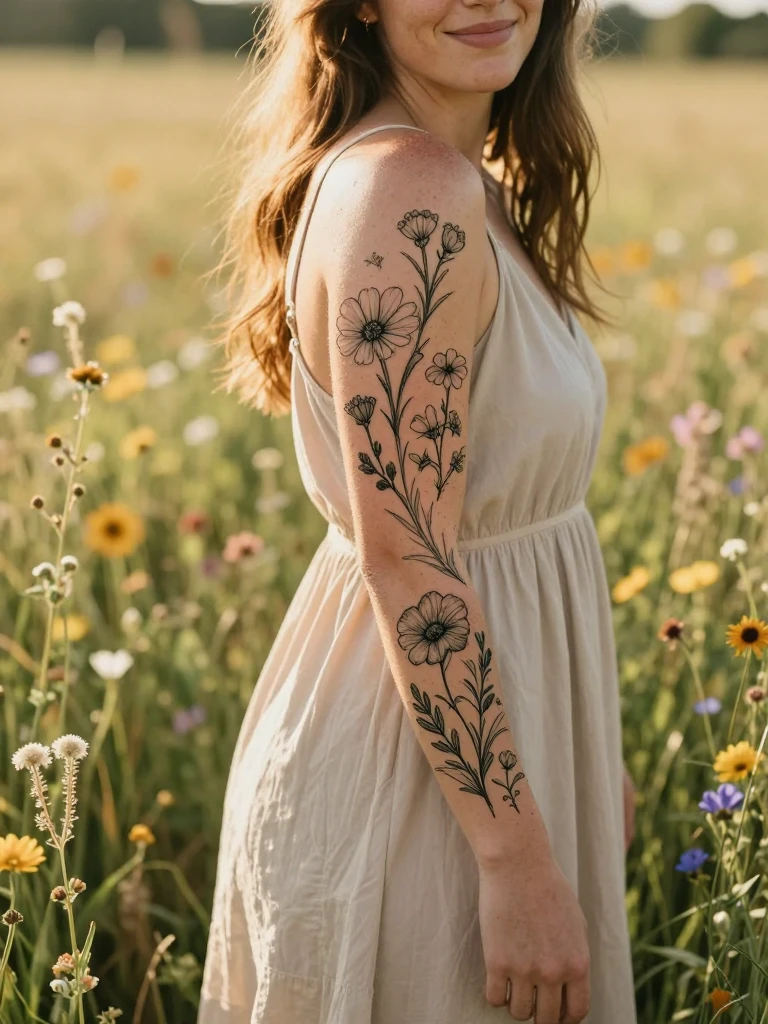
A meadow built from specific wildflowers, birth-month blooms, flowers tied to a place or a person. Of everything here, this is the one most directly built around personal narrative rather than pure aesthetics, which is exactly why it works best as a collaborative design process with your artist.
Sketch the composition together first. The specific flowers carry the meaning, and drawing it out beforehand is what prevents an uneven mix of scales and styles once it is on skin. Bring your list, but let the artist own the arrangement.
Bring a story
What “Feminine” Actually Means in Sleeve Language
There is no agreed definition, which is the honest starting point. In practice, “feminine” in sleeve language is a set of visual choices: softer subjects, finer line weights, more negative space, restrained palettes. None of those choices is weaker than the alternative. The contrast rule is what makes it work: feminine reads as a style when it is deliberate, not when it is just smaller.
Strength coding without bulk is the useful skill here. Oversized petals read tough because scale reads as confidence. A dark focal point inside a fine-line sleeve makes the delicacy look like a choice instead of a limitation. Negative-space blackout used sparingly is the boldest feminine move available, because it borrows from the heaviest style on the board without borrowing any of its weight.
The Delicate-Work Aging Ledger
This is the section nobody writes, and the one that matters most for this article’s audience, because fine-line floral is the default women’s sleeve and also the most fragile. Here is the honest ledger.
Thin lines spread as they age. Search-level consensus puts the spread at roughly 1.3 times over about five years, with 15 to 20 percent contrast loss in the same window. That means a hairline stem that looks perfect fresh will soften into something broader and lighter. It does not mean it ruins the tattoo. It means design for the healed version, not the fresh photo.
Survival design has four levers. First, a line-weight floor: nothing hair-thin, because the thinnest lines are the first to blur. Second, one dark anchor per panel, a bloom or band dense enough to hold its shape at year ten and carry the composition around it. Third, the silhouette test: step back to arm’s length and check whether the design still reads. Fourth, spacing: uncrowded fine-line ages dramatically better than packed detail. Add sun discipline and a touch-up window of three to seven years, and delicate work holds up.
Style by style: black-and-grey realism softens but stays legible, the most graceful aging here. Blackwork peony holds the boldest. Fine-line botanical is the softest, plan the touch-up. Watercolor needs a black framework or it fades to blur, the one structural rule of the style. Color illustrative fades fastest and usually asks for a refresh within the first years.
Black and Grey vs Color: The Honest Map
Black and grey realism, like the lion or leopard portraits above, ages more gracefully and needs less touch-up work over the years, but it demands a highly skilled artist to avoid looking flat. Color illustrative work, like the koi portrait or the crane sleeve, makes a bigger visual statement immediately but fades faster and usually needs at least one refresh session within the first few years.
For the styles women actually choose, the map looks like this. Fine-line botanical is the lowest maintenance of the delicate styles and the softest long-term. Blackwork peony is the boldest hold per session. Neo-traditional color sits in the middle: saturated enough to last, outlined enough to age. Watercolor is the highest maintenance, full stop. If you want sharp at year ten with minimal upkeep, black and grey is the safer bet. If you want maximum impact on day one and accept the upkeep, color earns its place.
Coverability and the Career Question
Nobody treats this as a planning axis for women, but it is one. The decision tree is simple: shoulder-to-elbow hides under short sleeves; forearm work is on display most of the time. Map your actual life against it. Scrubs, uniforms, client-facing roles, family events where you would rather not field questions.
The honest framing, not the fearful one: forearm pieces have not ended careers in 2026, but they have ended the option to hide. A half sleeve that stops at the elbow is the classic compromise, and it looks complete on its own, not like a sleeve that quit early. Make the decision once, deliberately, and then forget about it and enjoy the tattoo.
Absorbing Your Existing Tattoos
Many women arrive at a sleeve with small tattoos already on the arm, a wrist script, a forearm flower, a wrist bracelet. A planned sleeve can absorb them. The artist has four moves: make the small piece the anchor of a panel, frame it with florals so it reads as intentional, convert it into filler between larger elements, or laser it if it fights everything around it.
The one rule: disclose every existing piece in the first consult, even the ones you plan to cover. A sleeve designed around your current ink reads as a composition. A sleeve designed on top of it reads as a cover-up. Most smalls absorb fine. The ones that don’t are usually the ones the artist never got told about.
Sticker Sleeves Are a Plan, Not a Failure
The curated-chaos look is a legitimate 2026 format, not what happens when a sleeve goes wrong. But it has rules, and the rules are what separate a sticker sleeve from clutter. Consistent line weight across every piece, so the collection reads as one hand. Hierarchy: one or two larger anchor pieces with smaller fillers around them, not twenty equal pieces competing. Two or three motif families, not eight. Planned spacing, so each piece has room to breathe.
Done right, it is the friendliest format for building over time and the friendliest for coverability, since you can add pieces slowly and stop anywhere. Done without the rules, it is just clutter that happens to be on one arm.
Vetting an Artist for Delicate Work
Delicate work needs its own checklist. Demand healed fine-line photos, not fresh ones. Fresh fine-line always looks crisp; healed fine-line shows whether the lines stayed consistent or went patchy. Check line-weight consistency across different bodies in the portfolio, not just the one best example.
For realism, look for healed shading without muddiness. For irezumi, ask about lineage training specifically. For watercolor, confirm the black-framework rule is how they work. Red flags are the same ones that apply everywhere: no healed photos, inconsistent line weights across the book, no large-scale work shown. With delicate work the stakes are higher because the margin for error is thinner.
What a Women’s Sleeve Actually Costs
Reported ranges from working shops, not quotes, framed for the styles women actually choose. A full sleeve in black and grey typically lands between $3,000 and $8,000; full color runs $5,000 to $15,000 and up. A half sleeve sits around $1,200 to $4,500. Fine-line full sleeves usually price in the black-and-grey band but take more hours, since the work is slower. A sticker or patchwork build goes piece by piece, roughly $150 to $600 a piece.
Those are the headline numbers. The real total includes the deposit, design fees, 10 to 20 percent tips across sessions, and aftercare. Confirm the full picture before booking, not just the headline rate.
Quick Comparison
| Design | Style Fit | Hidden or Visible | Aging Outlook |
|---|---|---|---|
| Forest Horizon | Blackwork silhouette | Visible outer arm | Strong, solid black holds |
| Pine Canopy | Blackwork + fine-line | Visible, half sleeve | Strong; bird detail softens first |
| Portrait and Koi | Color realism | Visible, statement | Highest maintenance, refresh likely |
| Warm-Tone Peony | Warm color illustrative | Visible full arm | Pastels fade fastest; sun discipline |
| Dotwork Rose | Dotwork ornamental | Either | Strong; texture settles, holds |
| Lion Portrait | Black and grey realism | Visible upper arm | Graceful, minimal touch-ups |
| Butterfly Accent | Fine-line floral | Visible forearm | Soft; plan a touch-up window |
| Japanese Crane | Irezumi color | Visible full arm | Strong color, first-year touch-ups |
| Wave and Peony | Irezumi color | Visible full arm | Strong; bird detail softens first |
| Leopard Portrait | Black and grey realism | Visible forearm | Graceful if contrast holds |
| Amber Eye | Realism, restrained | Visible, small canvas | Graceful, small scale = watch detail |
| Minimal Line | Single-needle fine-line | Either | Clean; restraint ages well |
| Lotus Mandala | Ornamental geometric | Either, inner arm | Strong if lines were true |
| Moon Phase | Fine-line celestial | Visible forearm | Soft; touch-ups more common |
| Vine and Rose Half Sleeve | Botanical illustrative | Visible half sleeve | Strong; restraint helps |
| Wildflower Meadow | Botanical narrative | Either | Varies by line weight |
Frequently Asked Questions
What will a women’s sleeve tattoo really cost?
Reported ranges, not quotes. A full sleeve in black and grey typically runs $3,000 to $8,000; full color runs $5,000 to $15,000 and up. A half sleeve sits around $1,200 to $4,500, and a sticker or patchwork build goes piece by piece at roughly $150 to $600 each. Always confirm the full total, including deposit, design fees, and tips across sessions, before booking.
Can I get a sleeve if I already have small tattoos on my arm?
Yes, and it is common. A planned sleeve can absorb existing pieces by making one the anchor, framing it with florals, converting it into filler, or lasering it if it fights the composition. Tell your artist about every existing piece in the first consult, even ones you plan to cover, so the design accounts for them from the start.
Will a fine-line floral sleeve still look good in ten years?
It can, with the right design and maintenance. Fine lines spread and soften, roughly 1.3 times over five years with 15 to 20 percent contrast loss, so the design needs a line-weight floor, one dark anchor per panel, and uncrowded spacing. Plan a touch-up window of three to seven years and protect it from the sun. What fails is hair-thin detail packed too tight, not fine-line as a category.
Half sleeve or full sleeve: which is the smarter first move?
It depends on the coverability decision, not the budget. A half sleeve that stops at the elbow hides under short sleeves and reads as complete on its own. A full sleeve commits the forearm, which is on display most of the time. If you are unsure, start with the half and plan the composition with room to expand, so a later addition looks intentional.
How do I know an artist can actually do delicate work?
Ask for healed fine-line photos, not fresh ones, and check line-weight consistency across different bodies in the portfolio. For realism, look for healed shading without muddiness; for watercolor, confirm they build on a black framework. No healed photos, inconsistent line weights, and no large-scale work in the book are the red flags.
Closing
Sixteen directions, but two decisions carry the whole project. Decide where it shows and where it hides before you pick a motif. Design the delicate work for its healed version, not its fresh photo, and it will still be serving you at year ten. A sleeve is a long relationship with your own arm. Plan it like one.