A traditional heart tattoo is one of two completely different tattoos, and the first thing to sort is which one you actually want. There is the symbol heart, the stylized shape built in American traditional linework: thick black keyline, tight red-and-gold palette, a motif worked into the shape. Then there is the organ heart, the anatomical one, which needs a different artist, a different size, and a different conversation entirely. This article is about the symbol heart.
Sixteen takes on it below, organized around the classic canon, each with the design analysis the galleries skip. Then the sections nobody writes honestly: how old this style really is, which style suits which motif, the one rule for personalizing a classic, how bold color actually ages, and what the work costs.
How Old Is This, Really?
Older than the shops, younger than the folklore suggests. The heart symbol shows up in medieval European manuscript illumination and heraldry, long before anyone tattooed it. The American traditional version was refined by Norman “Sailor Jerry” Collins, a Navy veteran working a Honolulu shop on Hotel Street: bold black outlines and a saturated red-yellow-black palette engineered to survive sun and saltwater on sailors’ skin.
The “MOM” banner heart was a sailor talisman in that world. Be careful with the rest of the folklore. Claims like “the dagger heart means betrayal” or “the cupid arrow means struck by love” are repeated identically across every tattoo site, which should make you suspicious rather than confident. Those readings are internet folklore, not documented history. The veteran-era meanings that are documented are practical: a dagger-through-heart read as bravery, legible at a glance. For everything else, the only person who can tell you what a design means is the person wearing it.
1. The Dagger and Rose Traditional Heart Tattoo
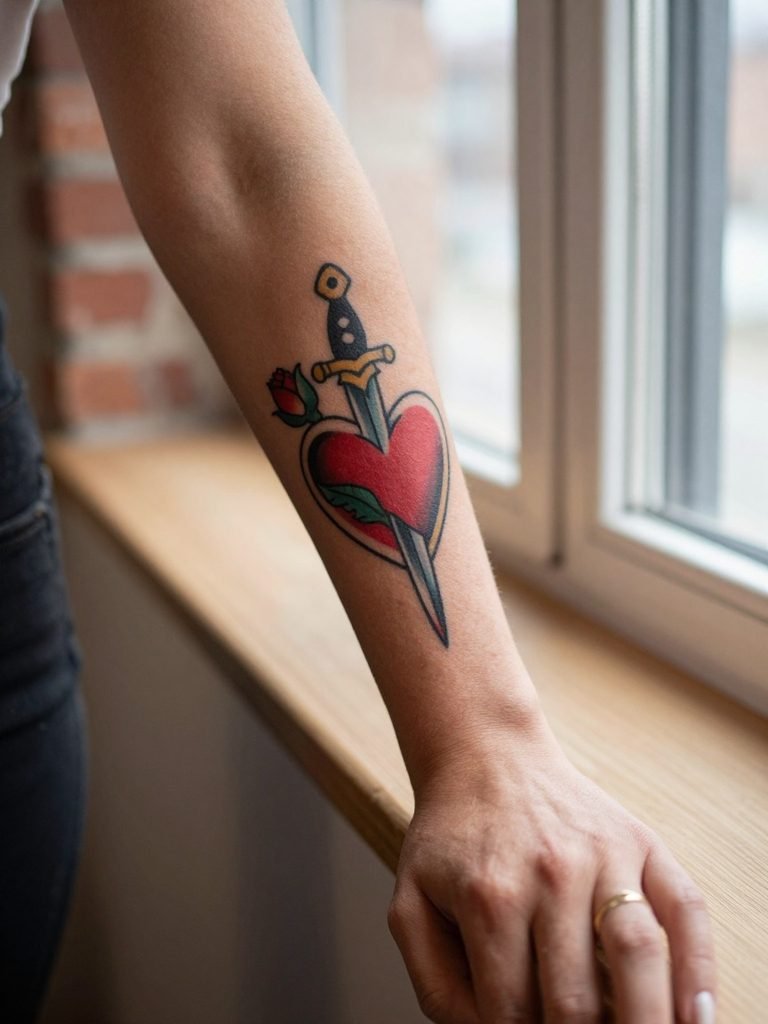
The blade sits at a slight diagonal instead of running dead center, and that small angle is what keeps the composition from reading stiff. Two small rose buds, not full blooms, tuck into the lower curves to soften the blade without pulling focus, and the crossguard is kept short on purpose, since an oversized handle throws off the weapon-to-heart balance.
The forearm or upper arm is the strongest canvas, because the dagger needs a long, uninterrupted stretch. On a smaller area the tip or handle gets cropped, which undercuts the whole proportion. Check it against your own arm in a mirror before booking, not against a photo of someone else’s.
2. The Flame and Thorn Traditional Heart Tattoo
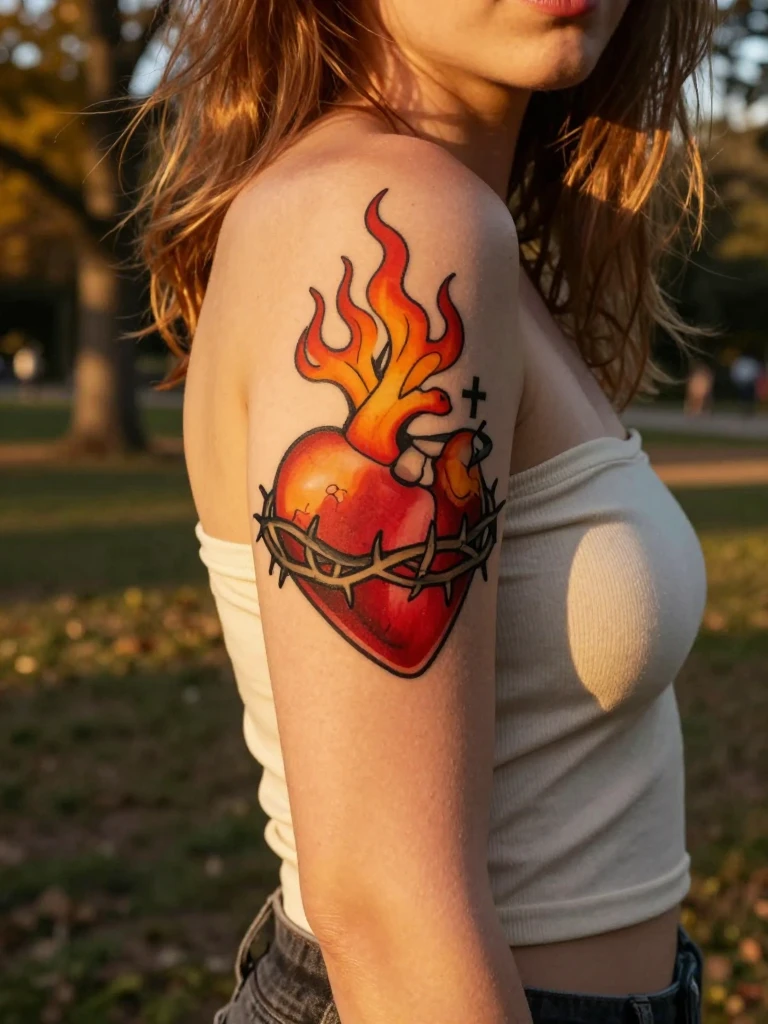
The most layered design on this list, and intentionally so. Flames rise in three or four defined tongues from the top of the heart, a thin crown of thorns wraps once around the middle, and a small cross anchors it as devotional rather than decorative. Every element carries the same keyline weight, so it still reads as one unified shape from across a room.
Flame count
Three or four tongues is the ceiling. More flames turns the top into noise, and the thorn wrap is already doing detail work at the middle. The upper arm or shoulder gives the tongues room to radiate symmetrically instead of compressing.
3. The Split-Color Traditional Heart Tattoo
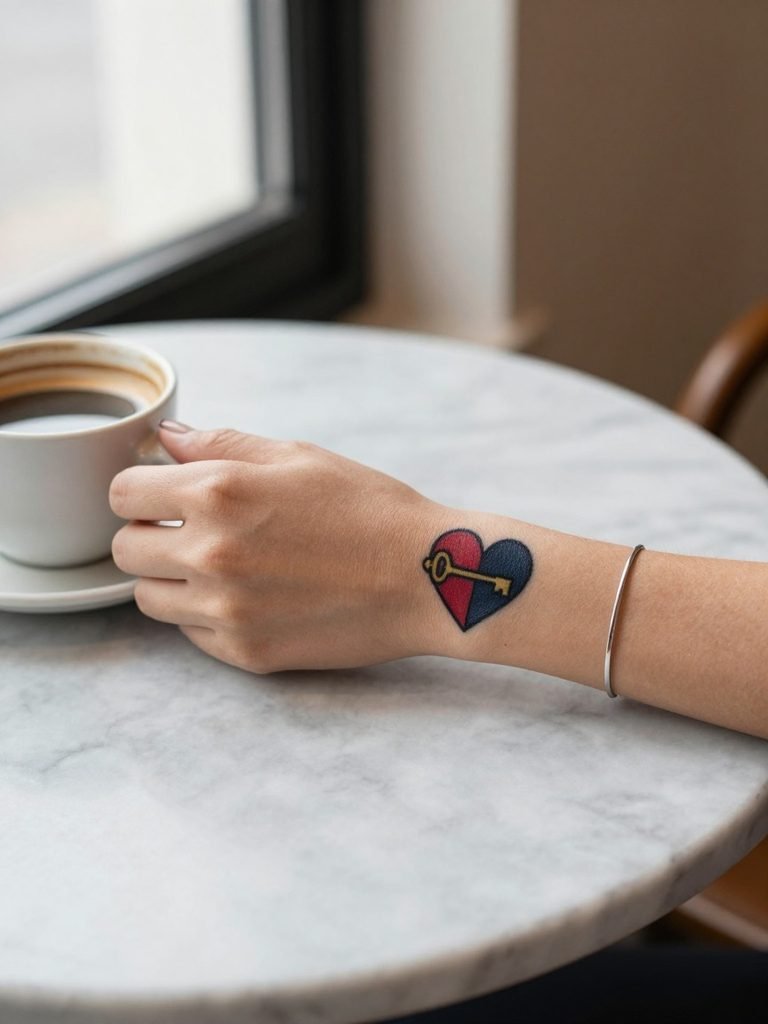
Instead of one solid fill, the heart is divided straight down the center into two contrasting tones, typically deep red on one half and black or navy on the other, split by a thin gold seam. A modern departure that keeps every rule the style depends on: heavy outline, flat color, no gradients, a shape that reads at a glance.
Smaller, flatter areas like the wrist or the back of the shoulder keep the split crisp. A flatter surface keeps the two halves from pulling apart visually. This also works well as a quieter accent near busier pieces. For more on what survives at small sizes, the small tattoo ideas guide covers the legibility math.
4. The Name Banner Traditional Heart Tattoo
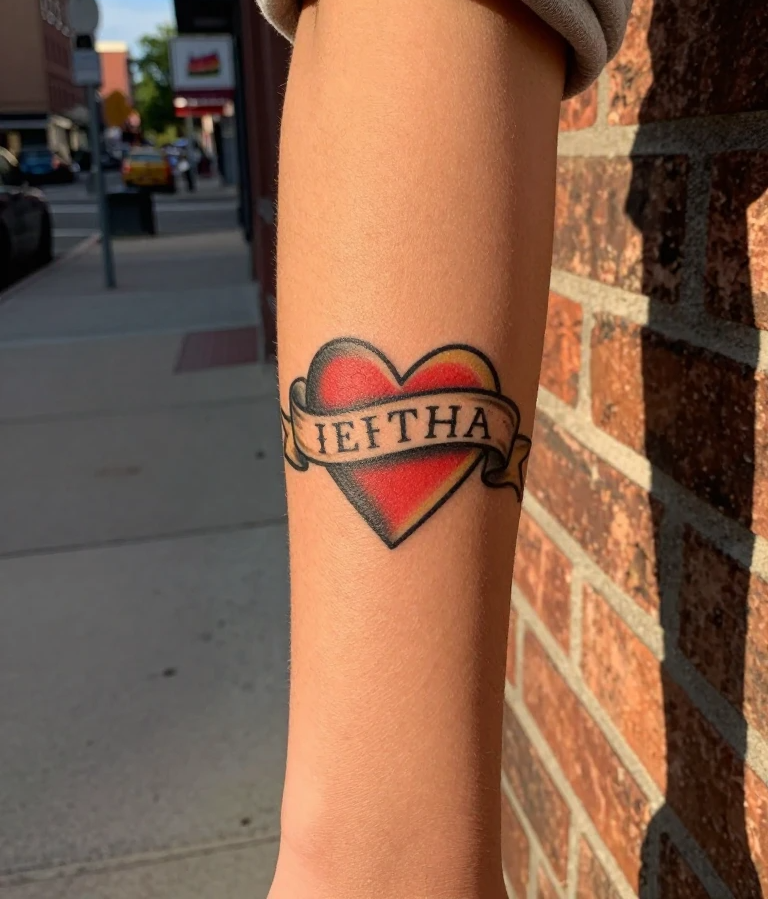
Short serif lettering sits in a ribbon banner that curves across the heart’s center, the ribbon’s ends flaring past the outer edge on both sides. The lettering style matters more than people expect: a slightly weathered, uneven serif reads as intentional and vintage, while a clean modern sans-serif clashes with the bold linework around it.
Short words win
Forearms and upper arms give lettering the horizontal width it needs to stay legible. Shorter names hold up considerably better; longer text either stretches the banner past its natural proportions or shrinks the letters past legibility. If the name is a partner’s, read the names-in-hearts section below before you book.
5. The Black and White Traditional Heart Tattoo
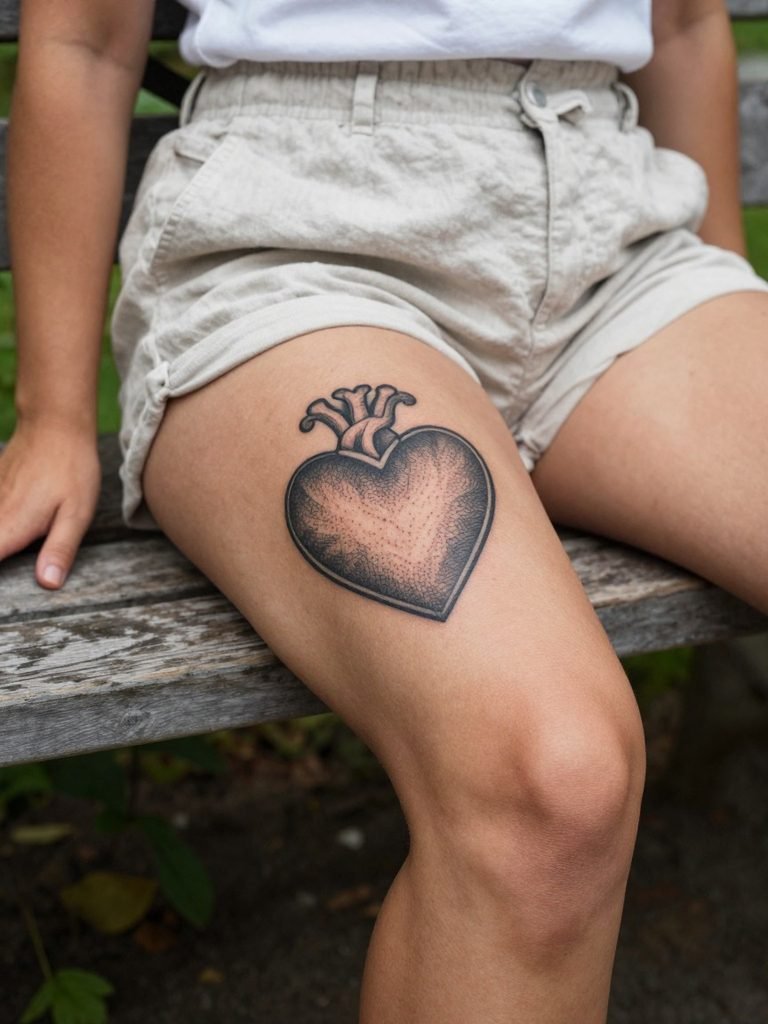
This version drops the red-and-gold palette entirely and builds volume through cross-hatching and dotwork. The core shape and outline weight stay identical to a color version. What changes is the shading: tighter hatching toward the shadowed underside, looser dotwork toward the highlighted top curve.
Tonal discipline
Ribs, thigh, or forearm suit this approach, since the design depends on contrast rather than a color field. The shading has to be disciplined, tighter at the underside, looser at the top, or the whole thing reads flat grey. An artist strong in blackwork texture earns their fee here. Our ornamental tattoo ideas guide shows how symmetry and negative space carry linework-heavy designs.
6. The Anchor and Chain Traditional Heart Tattoo
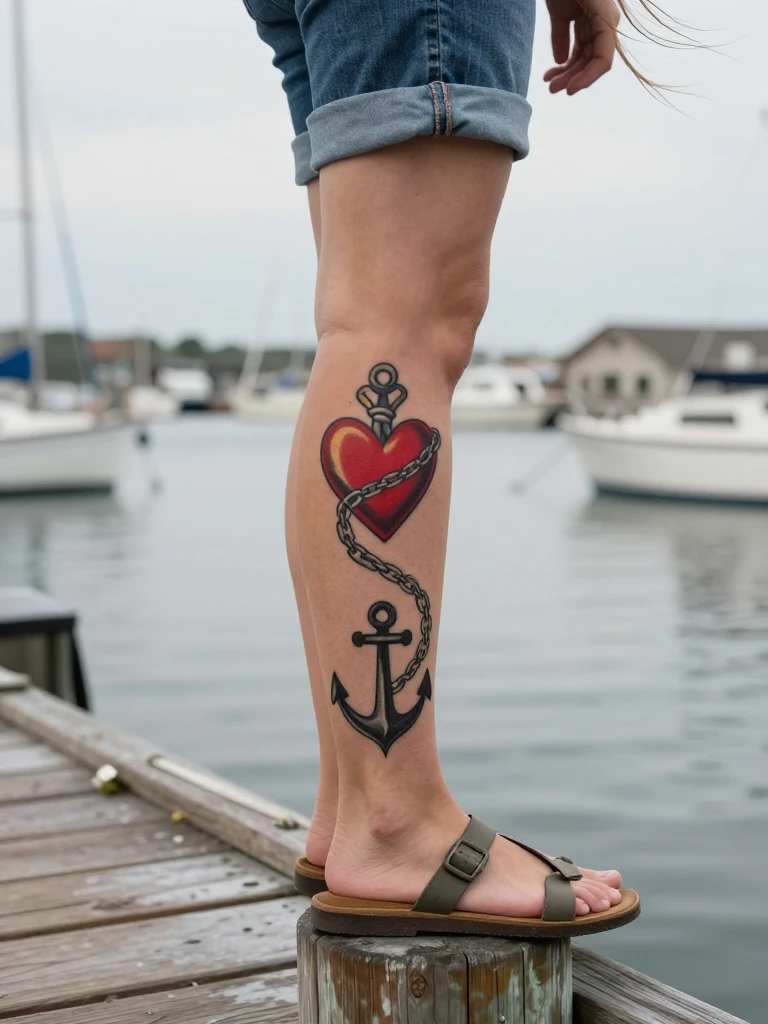
The anchor sits beside the heart rather than through it, connected only by a loosely draped chain that loops around the base without cutting into the shape. Keeping the two forms distinct, rather than fusing them into one merged symbol, is what stops this from looking overworked. It also makes a solid filler between larger pieces already in place.
The outer forearm or calf suits the anchor’s elongated vertical shape. This is a strong building block for a broader sailor-flash sleeve, since the symbols already share that visual tradition. Review an artist’s prior sailor work for proportion reference before finalizing.
See Also: 12 Elbow Tattoos for Women That Are Absolutely Iconic
7. The Bold Women’s Traditional Heart Tattoo
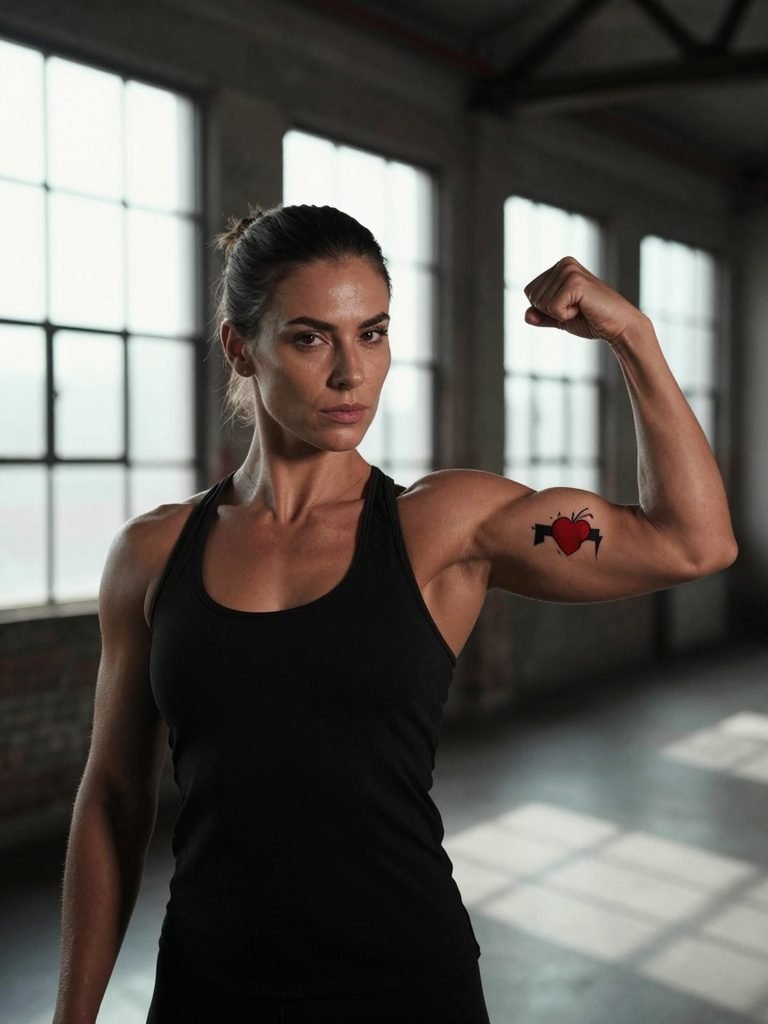
This take skips florals and banners for a heavier outline with squared-off corners instead of the usual soft curves. A single small lightning bolt cuts across one edge, kept thin enough to read as an accent rather than a competing focal point. The palette narrows too: black, red, and cool grey, gold dropped entirely.
Geometry shift
The bicep or chest suits the bolder, less ornamental shape. The masculine read comes from the restraint in palette and geometry, not from removing the heart as a subject. That distinction is worth stating plainly in the consult, because “make it tougher” is not a useful brief.
8. The Devotional Traditional Heart Tattoo
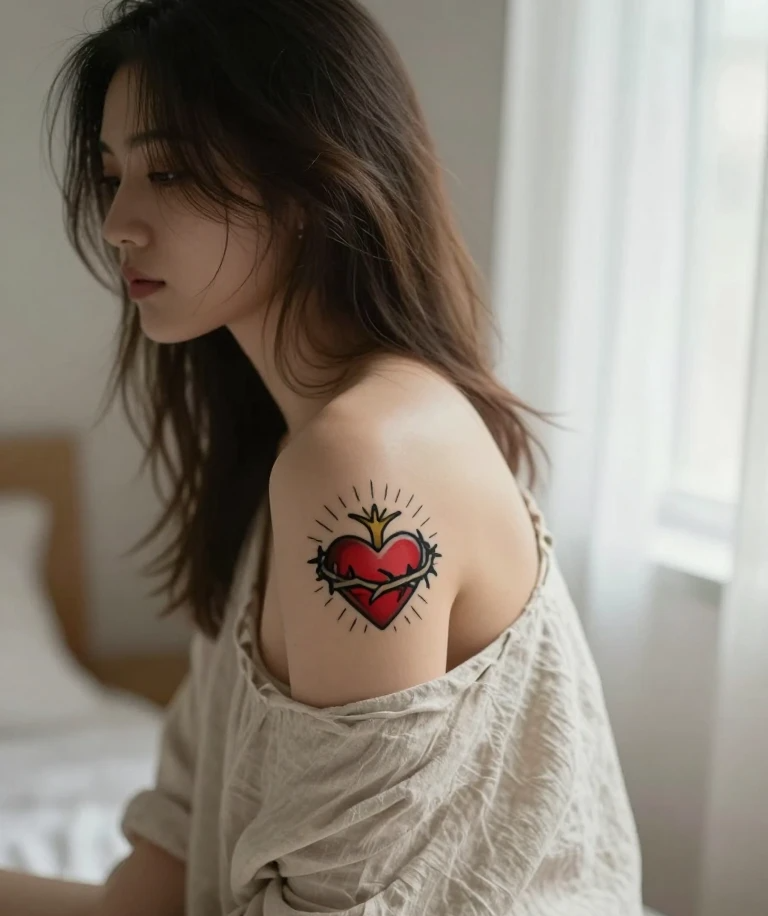
A quieter counterpart to entry two. It keeps the thorn wrap and a fine radiant halo behind the heart, dropping the flames and cross entirely. More compact, closer to classic devotional iconography, without losing the weight that made the symbolism resonate.
Its smaller footprint suits the wrist, the back of the shoulder, or the upper chest. If you are drawn to the devotional side but not to religious iconography, be honest about that at the consult: a devotional-looking tattoo carries expectations it cannot meet if the meaning is not there.
9. The Clasped Hands Traditional Heart Tattoo
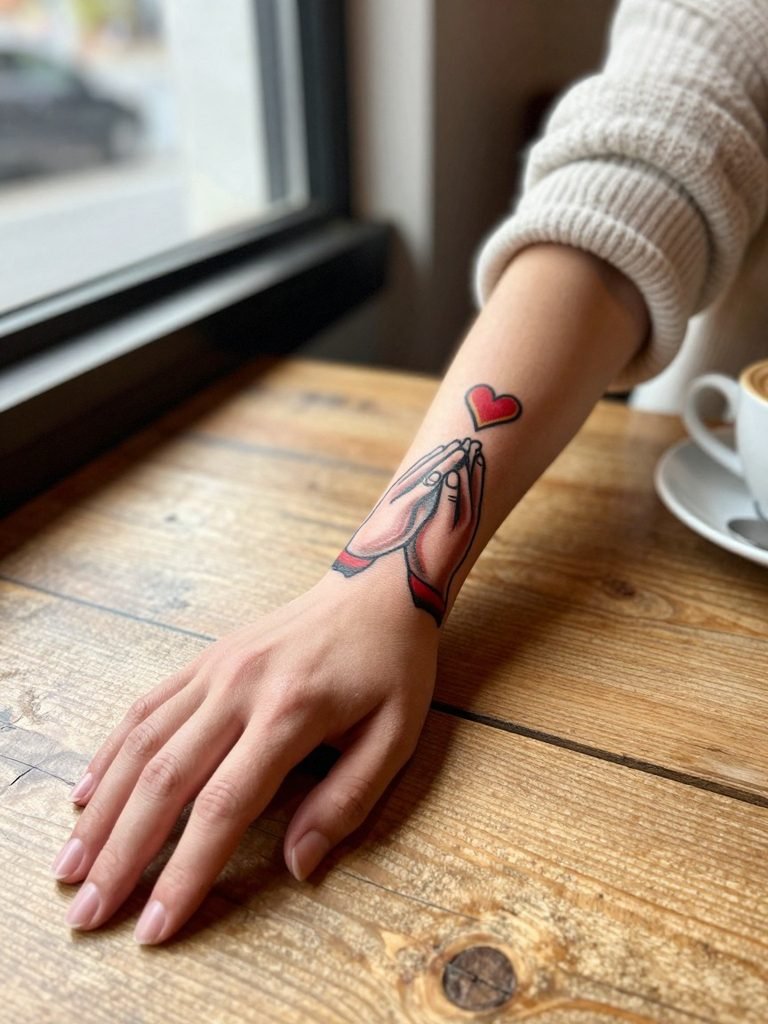
Two hands meet in a firm clasp, drawn stylized and slightly oversized in classic flash proportion rather than anatomically exact, with a small heart just above where the hands connect. This pairing predates most floral heart variations and traces back to some of the earliest friendship and loyalty motifs in traditional tattooing.
Flash scale
The forearm suits it best, since the hands need horizontal space to read clearly. It works as a matching tattoo shared between two people, and the composition holds up as a standalone too. Flash proportions are deliberate: oversized hands look wrong in a photo but right on skin.
10. The Rope-Wrapped Traditional Heart Tattoo
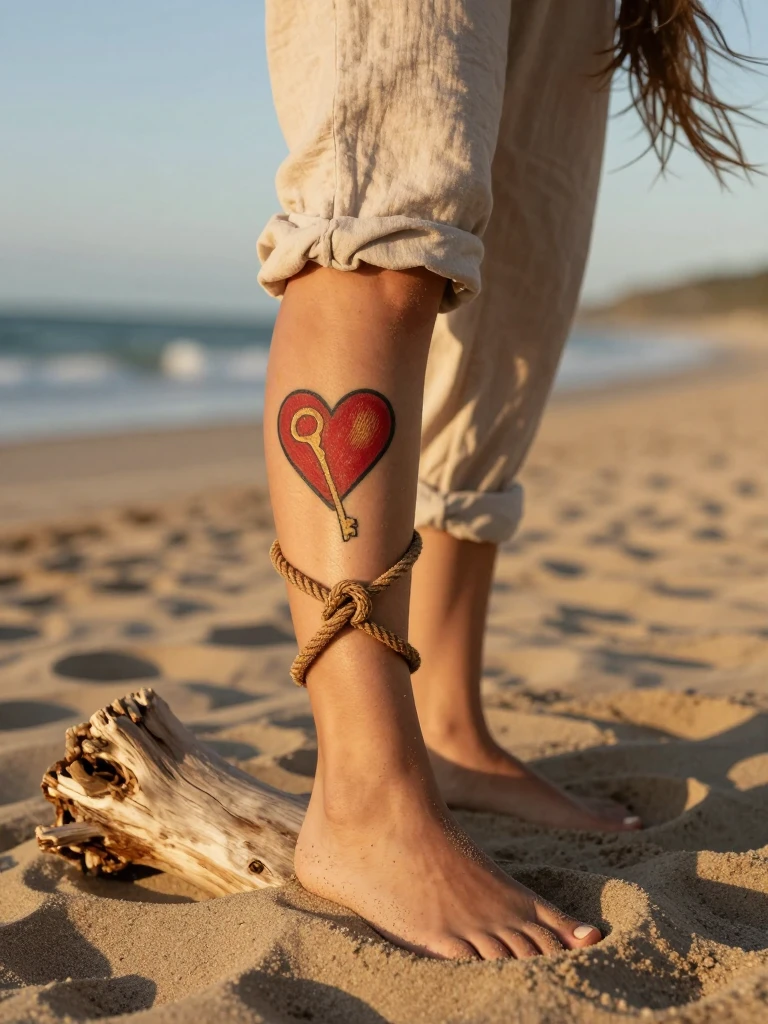
A single length of thick rope coils once around the heart’s midsection and knots at the front, giving the piece a weathered, seafaring character without going as far as a full ship-and-anchor composition. The rope’s texture comes from simple, evenly spaced parallel hatching rather than gradient shading, which keeps it consistent with the flat, bold style around it.
The calf or outer bicep gives the rope enough length to wrap convincingly without crowding the heart. This sits comfortably alongside other rope, chain, or ship pieces without repeating any of them.
11. The Swallow Pair Traditional Heart Tattoo
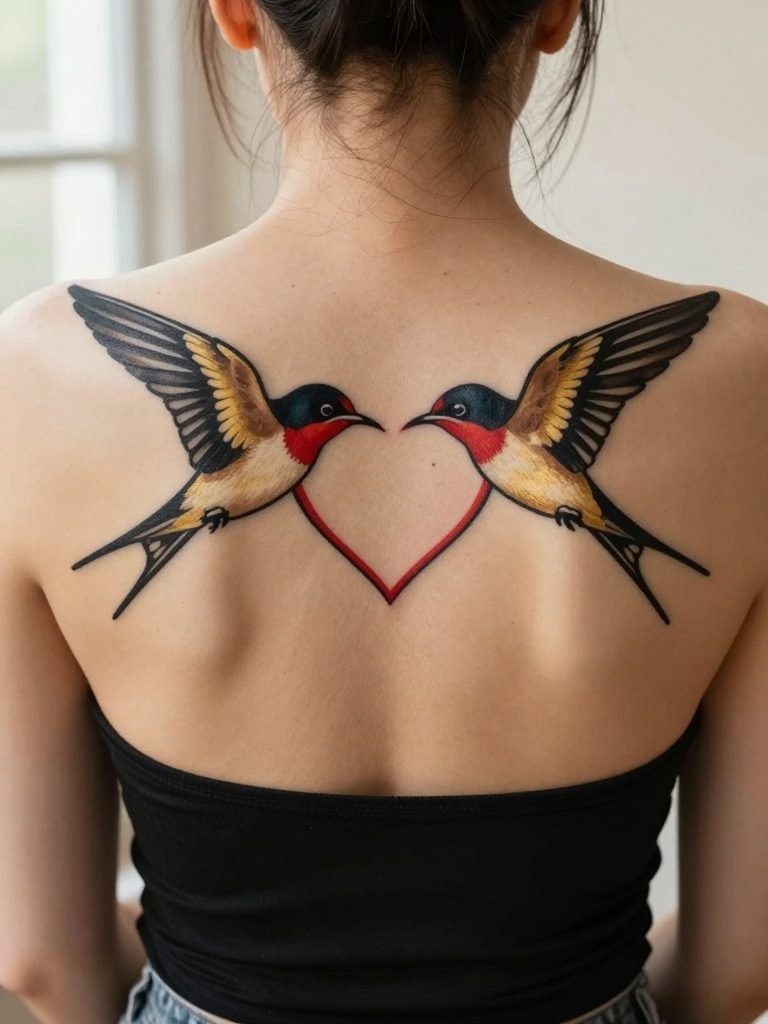
Two swallows flank the heart in mid-flight, wings angled outward, kept smaller than the heart so they frame it rather than pull focus. This pairing traces back to some of the earliest sailor flash sheets, where the birds marked distance traveled and a safe return home.
Sailor roots
The chest or upper back gives the wingspan room to spread symmetrically. If the historical weight behind classic flash matters to you, this is the pairing that carries it most honestly. Feather detail adds modest healing time, noticeably less than dense shading would require.
12. The Memento Mori Traditional Heart Tattoo
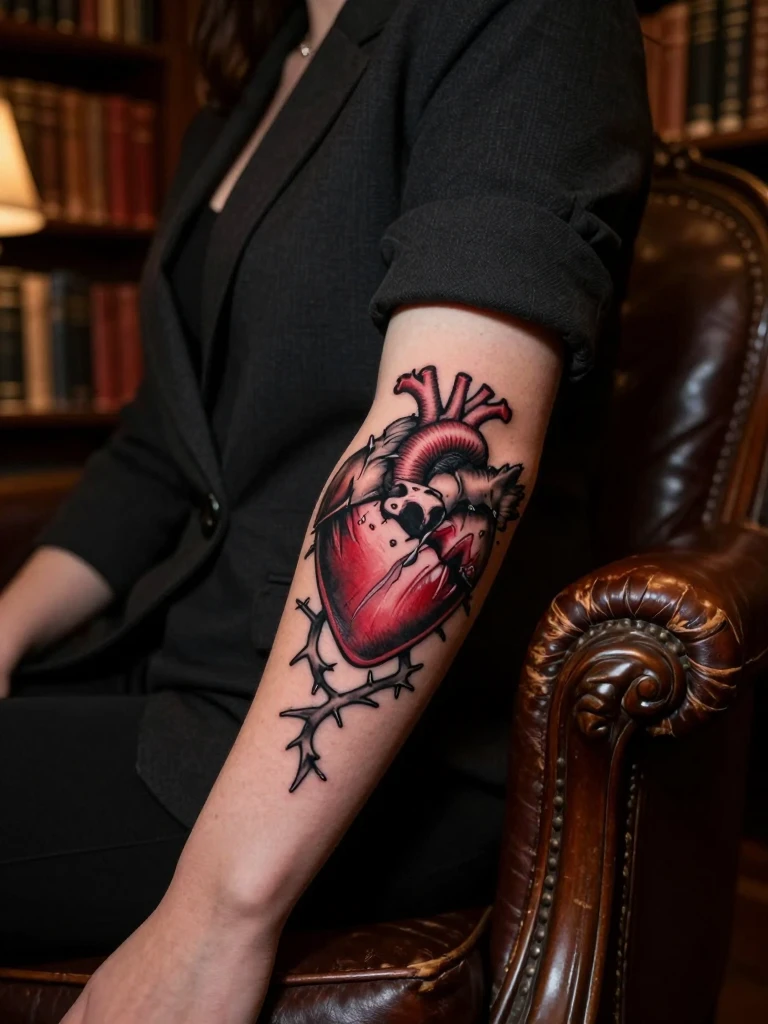
A small skull nestles into the upper curve of the heart, softened by being folded into the shape rather than sitting apart from it. Thorned stems without full blooms trail along the lower point, and a single fine line runs from the base like a subtle tear. A common memorial or tribute choice, since the imagery carries weight without anything overtly literal.
A slightly larger scale keeps the skull’s facial detail legible. The forearm or shoulder both work. If this is a memorial piece, give the design the same care a tribute deserves: personal and specific beats generic every time.
13. The Locket Traditional Heart Tattoo
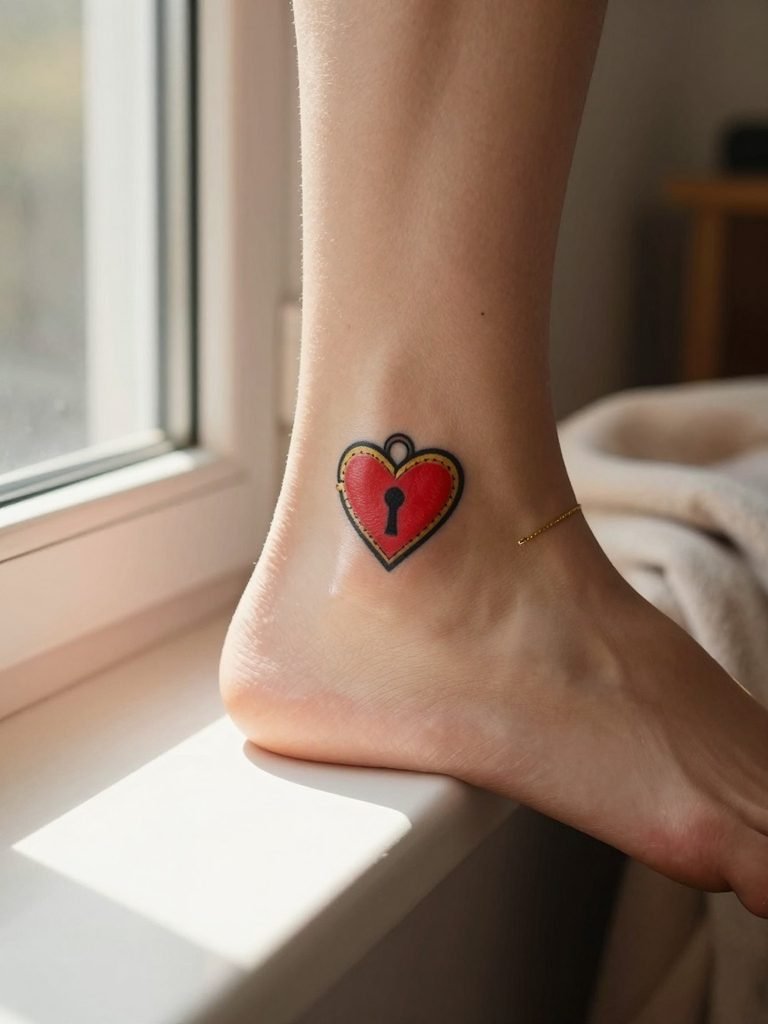
Rather than a plain silhouette, this borrows the hinged structure of a locket: a small keyhole etched into the front, a fine seam line marking where the two halves would open. A more ornamental, keepsake-leaning take that still sits on the same bold outline underneath.
The wrist or ankle suits the smaller, more delicate scale this design calls for. The seam and keyhole linework is the failure point: fine detail on a small piece, so the artist’s line weight needs to be right on the first pass.
14. The Rose Bouquet Traditional Heart Tattoo
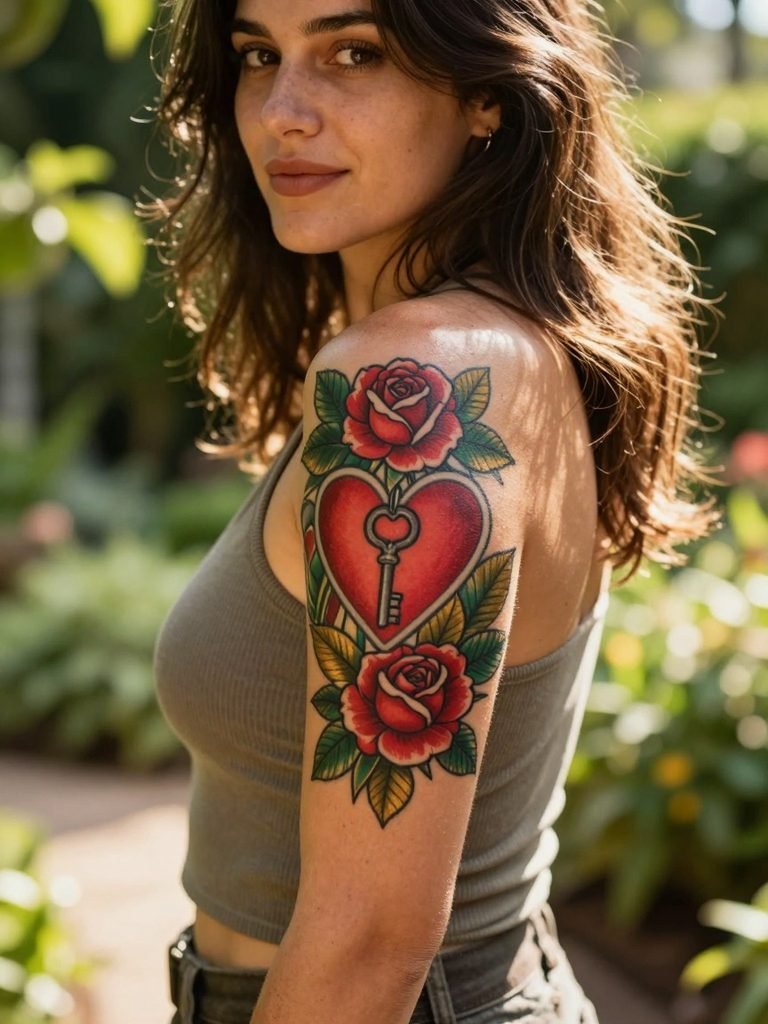
Three or four full blooms plus leaves surround the heart on all sides, though the heart stays the largest single shape so it doesn’t get visually swallowed. Each rose sits at a slightly different stage of bloom, one fully open, one just starting to unfurl, which adds variation without clutter.
Bloom rhythm
This design needs more surface area than most entries here: upper arm, shoulder, or thigh over wrist or ankle. Overcrowding the blooms is the single most common way this design goes wrong. Give the artist permission to cut one rose if the composition needs it.
15. The Star and Banner Traditional Heart Tattoo
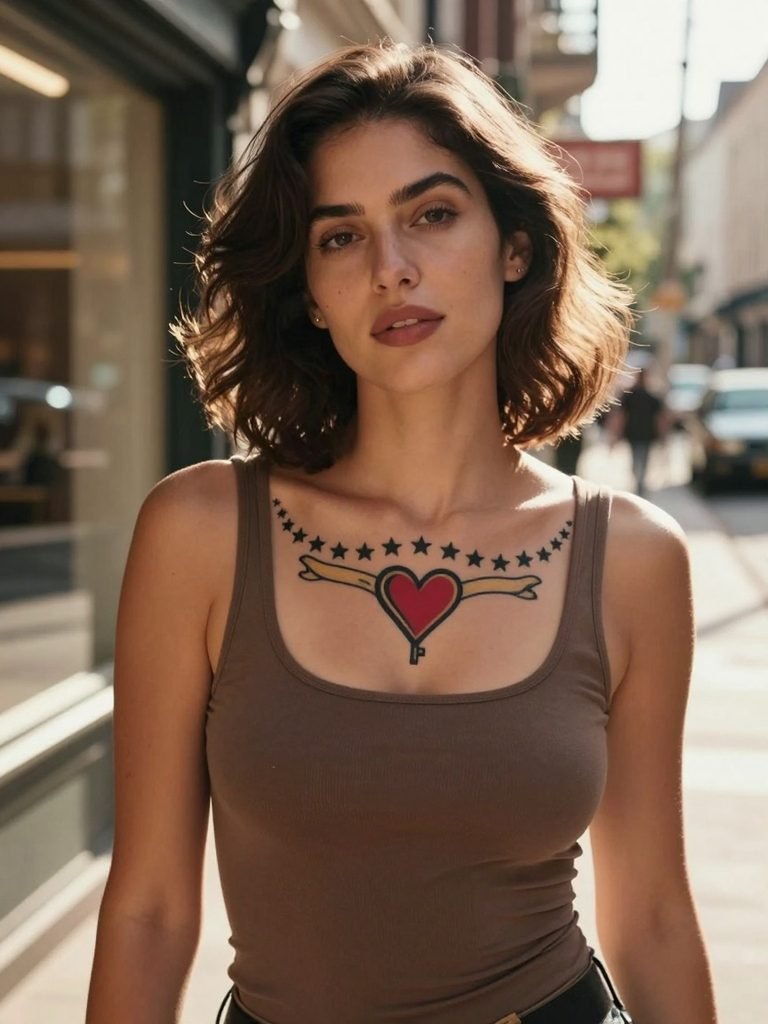
A row of small five-point stars arcs above the heart in a tight, evenly spaced line that echoes classic sailor-era flash sheets, with a slim banner running beneath that can be left blank or lettered. Keeping the stars uniform in size and spacing is what stops the design from reading as scattered rather than deliberate.
The chest or upper back gives the star arc the width to read as an arrangement rather than clutter. This fits naturally into a broader vintage Americana theme, beside anchors, ships, or swallow motifs already in progress.
16. The Minimalist Thorn Crown Traditional Heart Tattoo
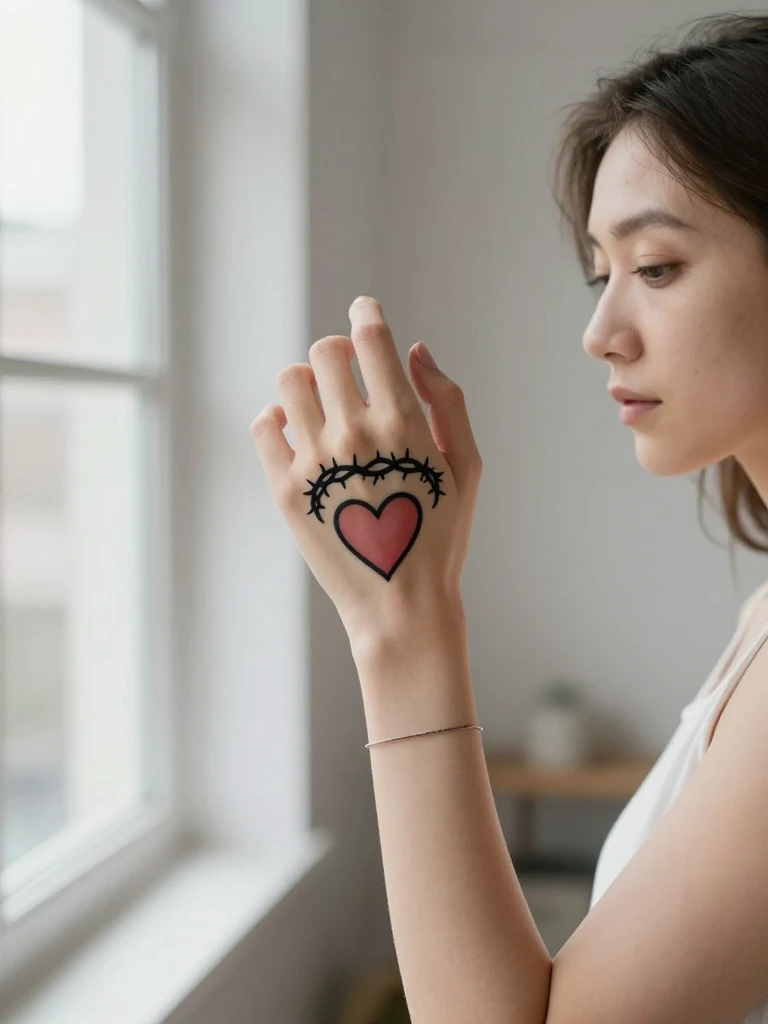
The simplest design on this list: a clean heart outline with a single thin crown of thorns circling just the top third. No flames, no cross, no banner. It takes the devotional heart concept and strips it down to the one element that carries the most weight on its own.
One element
This is small enough to work almost anywhere, wrist, behind the ear, or ankle. The discipline here is restraint: the design only works if the artist resists adding a second element. One crown, one line weight, done.
Match the Style to the Motif
Not every heart suits every style, and the mismatch is the most common reason these disappoint. The dagger-and-rose and banner hearts belong in American traditional: bold outlines, flat color, the flash-sheet language they were born in. Wings and devotional hearts suit illustrative or neo-traditional, where shading has room to breathe. Tiny hearts and single-line versions suit fine-line, which is the most forgiving at small sizes. Sacred Heart work suits neo-traditional or black-and-grey, where the thorn and flame detail can hold.
Match the motif to the style’s strength. A fine-line dagger heart wastes what makes the dagger work; a realistic banner wastes what makes the banner work.
Make It Yours Without Breaking It
Classics are classic because they survived contact with thousands of wearers. The way to personalize one without losing it is a single change. One personalization element, never three. A date in the banner. One nontraditional color accent. An era-specific reference, like a ship name in period lettering. Two changes make it a redesign; three make it a different tattoo wearing a classic’s clothes.
Banner lettering has its own floor. Keep phrases short, because the banner’s width is set by the heart, and letters below a certain size blur into texture within years. Decide the wording before the session, spell-check it twice, and accept that a five-word phrase belongs on a bigger heart.
Placement by Geometry
Everyone lists body zones. Geometry decides. Banners need a horizontal run: forearm, upper arm, chest. A banner on a curved ribcage fights the curve. Flames add vertical length: shoulder and upper arm give tongues room to rise. Wings need symmetric spread: chest and upper back, where the mirror axis is natural.
And the counterintuitive one: the chest-over-the-heart spot isn’t always right. A big devotional heart sits better slightly off-center on the chest panel, where the flat area gives it room, than directly over the nipple where the curve distorts the shape. Ask the artist where the shape wants to live, not where the symbolism says it should.
How Bold Color Ages
This is the structural reason traditional hearts survive decades. The bold black outline holds while the red drifts. Red pigment softens and warms over the years; the keyline is what keeps the shape legible. That is why traditional work looks better at year fifteen than fine-line color does at year five.
The maintenance is honest. Red needs sun protection and earlier touch-ups than black. Banner lettering survives because the bold shape carries the composition after the letters soften; even as text fades, the ribbon and heart still read. Tiny fine-line hearts are the opposite: expect a touch-up around year seven to ten, because there is so little ink holding the shape.
Names in Hearts, Done Safely
The one universally agreed fact in tattoo shops: partner-name hearts are the most common cover-up request in the business. Not because the tattoo was bad, but because relationships end. “MOM” survives structurally because the relationship never ends. A partner’s name does not get that guarantee.
The structural fix is simple. Build the heart so it works without the banner. A dagger-and-rose heart with an empty banner is still a complete tattoo. A heart that only works with “Kevin” inside it is a time bomb. If you want the name, get it: just make sure the design survives its removal.
And the honest part about cover-ups: a solid black heart is a one-way door. Nothing covers black cleanly. A red traditional heart can be covered; a black one usually means laser. For memorial hearts planned differently from celebratory ink, the Dolly Parton tattoos tribute section shows how tribute work is approached.
Vetting a Traditional Artist
Start with healed work, not fresh photos. Demand healed color in the portfolio, specifically saturated reds that stayed even and black outlines that stayed crisp. Fresh traditional always looks bold; healed traditional shows whether the fills settled or went patchy.
Read the flash wall. A shop that specializes in traditional should have walls of it, drawn by the artists working there, not printed from the internet. Ask: how do you size a banner for lettering? How many passes for the red fill? An artist who answers specifically has done the work. For the mechanics of getting the design onto skin accurately, the tattoo stencil ideas guide explains why the stencil stage deserves your attention, and the symmetry check in a mirror catches uneven heart lobes before any ink goes in.
What It Costs
Reported ranges from working shops, and every shop sets its own numbers. Treat these as planning brackets, not quotes. A traditional red heart, 2 to 4 inches, typically lands in the $150 to $300 range, mostly shop-minimum territory. Larger pieces with banners, bouquets, or devotional detail run $400 to $800. A Sacred Heart at 5 to 8 inches is a multi-session project, 4 to 6 sessions, priced accordingly. Deposits are normal and usually applied to the price; tip 15 to 20 percent.
Always confirm the total before booking, not the per-session estimate. A shop that quotes a flat $100 for a detailed color heart is telling you something about the detail level you will actually get.
Quick Comparison
| Design | Style Fit | Best Placement | Commitment |
|---|---|---|---|
| Dagger and Rose | Traditional | Forearm, upper arm | Low-medium |
| Flame and Thorn | Neo-traditional | Upper arm, shoulder | Medium |
| Split-Color | Traditional | Wrist, shoulder | Low |
| Name Banner | Traditional | Forearm, upper arm | Low-medium |
| Black and White | Blackwork | Ribs, thigh | Low |
| Anchor and Chain | Traditional | Forearm, calf | Low |
| Bold Women’s | Traditional | Bicep, chest | Low |
| Devotional | Illustrative | Wrist, shoulder | Low |
| Clasped Hands | Traditional | Forearm | Low-medium |
| Rope-Wrapped | Traditional | Calf, bicep | Low |
| Swallow Pair | Traditional | Chest, back | Medium |
| Memento Mori | Traditional | Forearm, shoulder | Low-medium |
| Locket | Fine-line | Wrist, ankle | Low |
| Rose Bouquet | Traditional | Upper arm, thigh | Medium-high |
| Star and Banner | Traditional | Chest, back | Medium |
| Thorn Crown | Fine-line | Wrist, ankle | Low |
Frequently Asked Questions
Does a heart tattoo in this style always need to be red?
No. Several designs on this list use black, grey, navy, or a split palette instead of the classic red-and-gold fill, and they still read clearly within the style’s rules. The outline weight and flat color carry the style, not the red.
How small can a traditional heart go before it stops working?
A plain outline or a thorn crown can work at wrist or ankle scale. Anything with a bouquet, a skull, or lettering needs more surface area to stay legible. Detail is the floor, not the heart itself.
Will the red fade faster than the black?
Yes. Red softens and warms over the years while the black keyline holds. That is the expected aging pattern, not a problem. Protect it from the sun and plan a touch-up, and the shape will keep reading for decades.
Can two of these designs be combined into one tattoo?
Possible, but risky. Stacking too many focal elements into a single piece is the most common way this style stops reading cleanly. One or two focal elements per design holds up far better than cramming every motif into one heart.
Is this style a safe first tattoo?
One of the safest. Bold linework heals predictably, the designs read at small sizes, and most shops have deep experience with the style. Ask to see healed examples anyway, because the style’s reliability doesn’t excuse a weak artist.
Closing
Sixteen ideas is proof enough that this style doesn’t default to the same dagger-and-roses combination every time. The minimalist thorn crown and the classic dagger design are the two strongest starting points here, precisely because neither one overreaches. Start with whichever version says the least while still saying it clearly. That restraint is what makes this kind of work age well in the first place.


Pingback: Which Sleeve Tattoos Women Actually Suit? 16 Stunning Ideas - Glow Vibes Spot