The Forearm You Look At Every Day
The forearm is the one visible spot you can look at yourself all day without a mirror. That changes what the design needs to do. It does not just have to impress strangers. It has to survive being familiar to you. A design that is clever once but tiresome on the five-thousandth glance is the wrong design for this spot.
Eighteen ideas below, each built around a genuinely different technique, with the design analysis the galleries skip. Then the sections nobody writes honestly: an inner-vs-outer decision framework, an aging ledger with real numbers, size floors by style, what the work actually costs, how to vet the artist, and how to leave the door open for a sleeve.
Inner vs Outer: Four Decisions, Not One
Everyone talks about inner or outer like it is one choice. It is four.
Who sees it. The outer forearm faces the world in short sleeves. The inner forearm faces you, readable in a mirror, easy to hide under a long sleeve.
Pain. The outer forearm has more muscle and padding underneath; most people describe it as a dull scratch. The inner forearm is thinner-skinned and feels sharper near the wrist and the elbow crease, where tendons and bone sit close to the surface.
Sun and fade. The outer forearm takes serious daily sun. Ink there fades faster and needs higher contrast plus real sunscreen discipline. The inner forearm is sheltered, so delicate detail holds longer there.
Coverability. Inner placements hide under a long sleeve easily. Outer placements, especially pieces that wrap wide, are much harder to conceal. Decide from your actual life: work dress codes, family events, how often you want the question “what is that tattoo?”
The working rule: put the piece that should age longest on the inner arm, and the piece that should impress on the outer arm. If one design has to do both, pick outer and budget for maintenance.
1. Delicate Fine Line Florals: An Inner Forearm Tattoo for Women
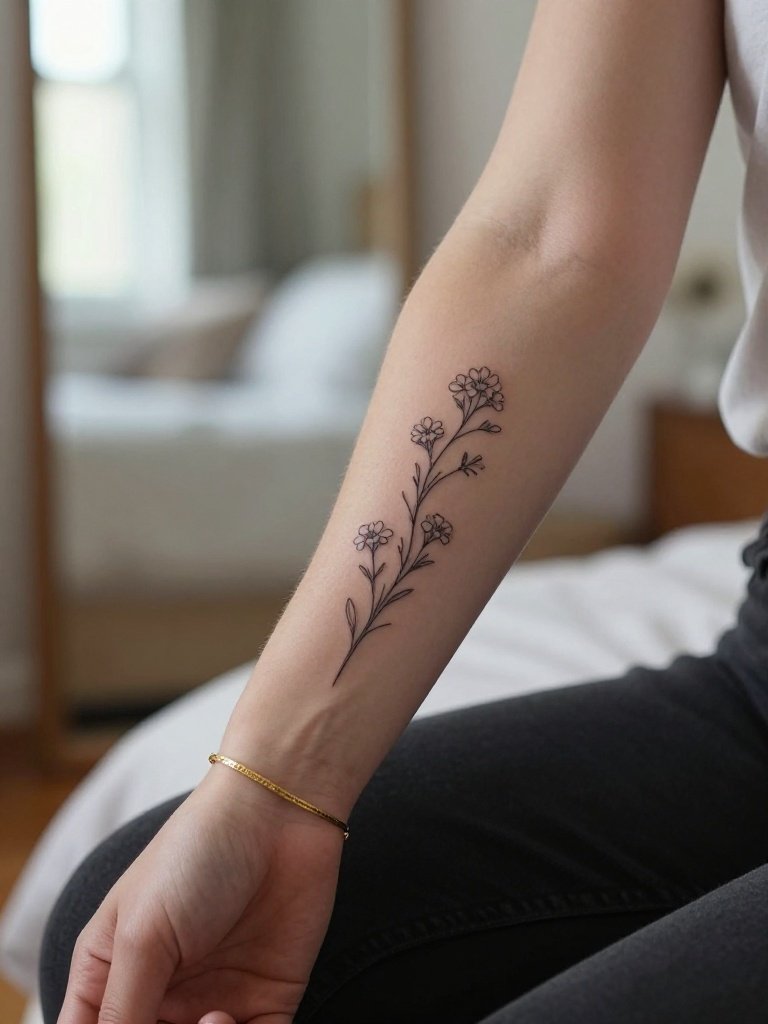
Fine single-needle linework traces small wildflowers, stems, and leaves running vertically from the wrist toward the elbow crease, with no shading or fill. The airy look comes entirely from line consistency: one steady weight held across the whole piece.
The make-or-break rule: nothing thinner than a fine-liner pen, nothing smaller than a coin. Below that floor, spreading ink blurs the lines together within years. Ask for single-needle technique specifically, and bring photos of real flowers rather than clip art, because botanical accuracy is what separates delicate from fragile.
This is the most requested inner-forearm style in the niche, and also the most copied. The aging ledger later in this article explains why spacing, not prettiness, decides how it looks at year five.
2. Bold Blackwork Sunflower: A Women’s Outer Forearm Tattoo
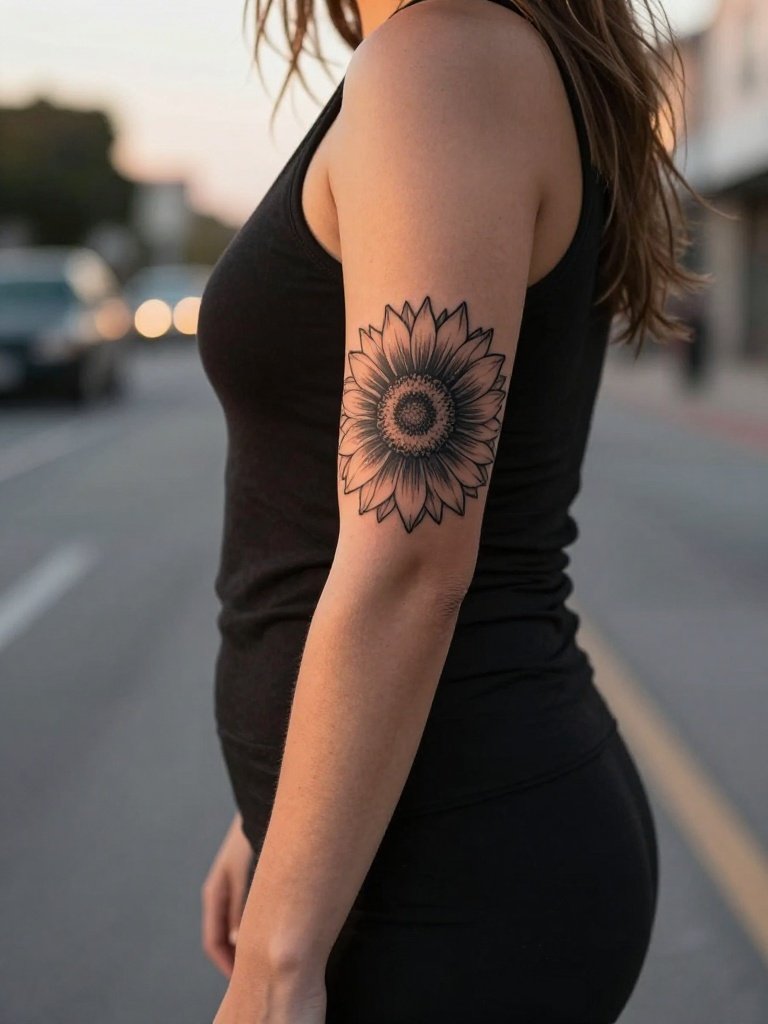
Solid black ink and heavy petal shading give this sunflower its weight, with a stippled, textured seed center wrapping partway around the arm. This is a statement piece, custom-sized to the individual’s arm length rather than pulled from flash.
The make-or-break rule: boldest ages best. Heavy blackwork holds contrast against years of sun far longer than anything delicate. The trade-off cuts the other way too: dense blackwork is the hardest style to cover or remove, so this is not the piece for someone still testing the water.
Ask for gradient shading rather than flat black fill, so the petals keep dimension instead of reading as one solid shape from a distance. Outer forearm is the right home: the muscle padding makes the session tolerable and the bold work stays fully visible.
3. Minimalist Single-Word Script: A Forearm Tattoo for Women
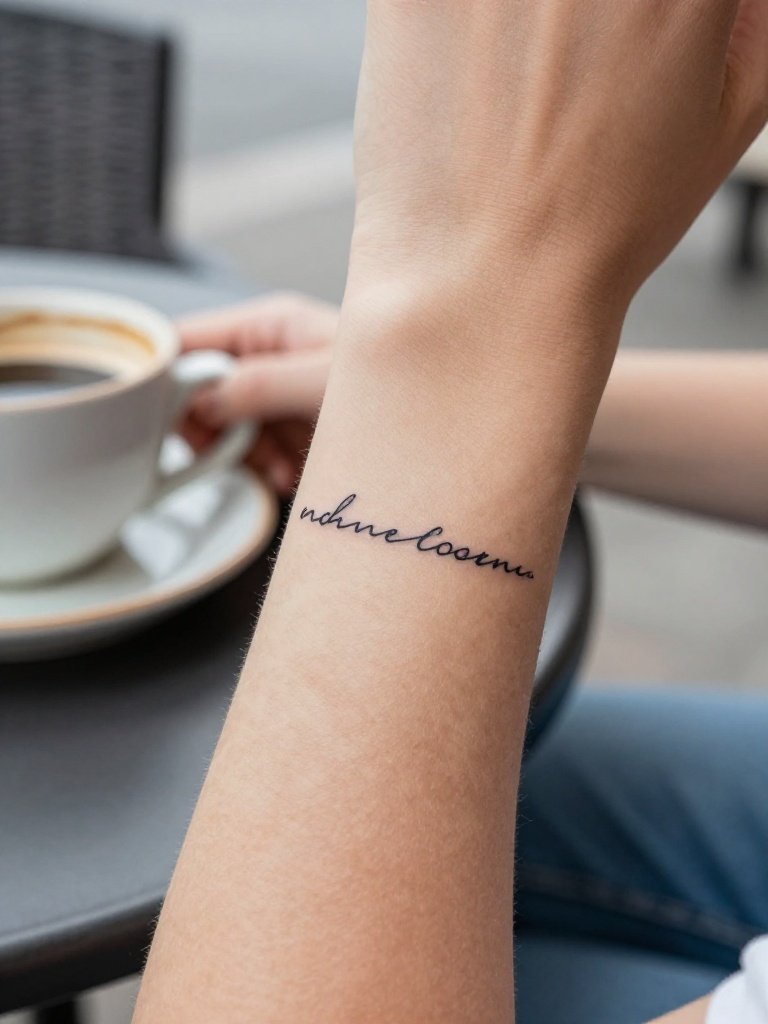
One short word in narrow, even cursive just above the wrist. No serifs, no flourishes. The whole piece often finishes in under an hour, which keeps cost and commitment low.
Script floors
The make-or-break rule: script runs along the arm, and thin lettering closes up. Letter height below a certain floor blurs into texture within years, and about four words is the legibility ceiling at arm’s length over time. Pick a font with consistent line weight, since scripts with dramatic thick-and-thin variation are the first to smudge. Bring your own handwriting if it is legible: it personalizes without adding size.
4. Watercolor Butterfly Cluster: An Outer Forearm Tattoo for Women
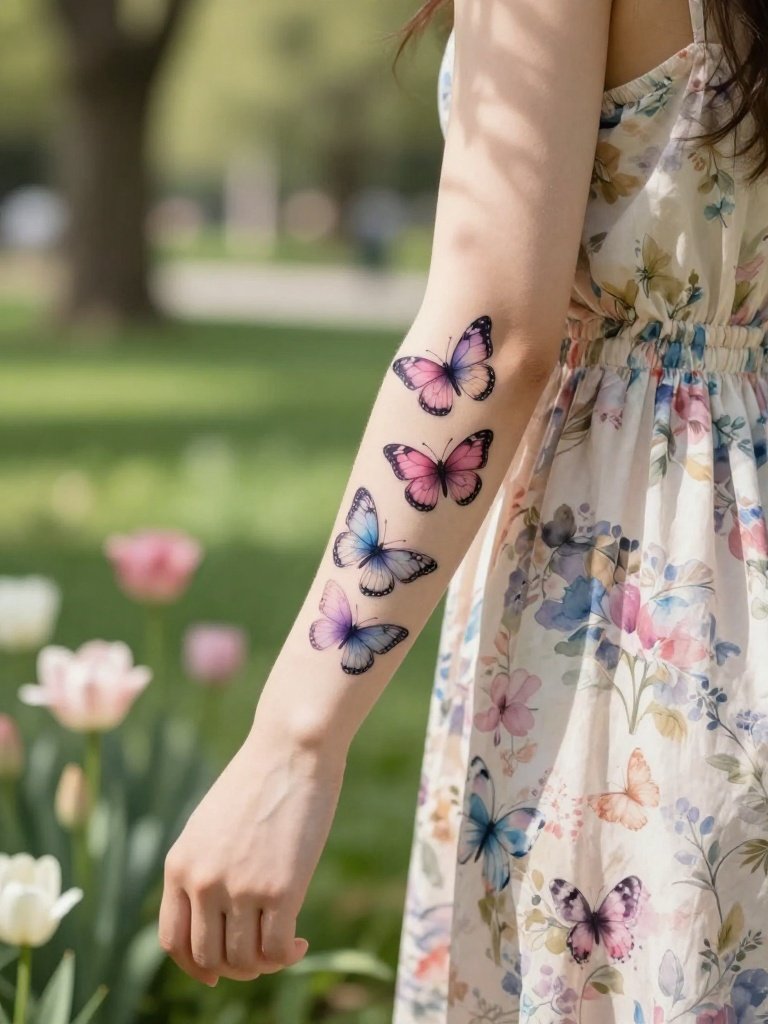
Fine black outlines hold three or four butterflies in varying sizes, filled with soft blended color washes in pink, purple, or blue. The washes mimic dripped watercolor paint rather than solid fill, and that is exactly the risk: pigment without outlines to anchor it fades faster than anything else on this list.
The make-or-break rule: judge the artist’s watercolor portfolio, not their Instagram grid. Blended color is harder to execute cleanly than standard color fill. Expect a touch-up after the first season of healing to keep the color saturated, and commit to sunscreen, because watercolor on the sun-exposed outer forearm is the highest-maintenance combination in this article.
5. Tiny Constellation Dots: A Forearm Tattoo for Women
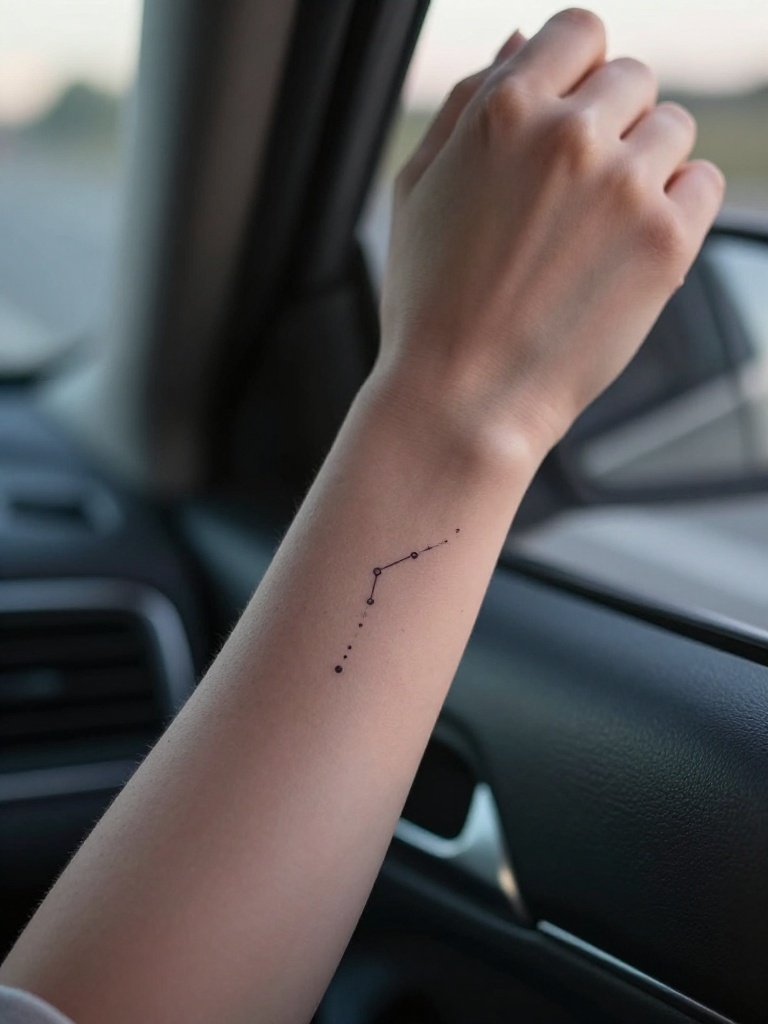
Dots of varying size connected by thin straight lines form a real constellation, Orion or the Little Dipper, running in a narrow strip up the inner forearm. From across a room it barely registers. Up close it has a story.
Dot density
The make-or-break rule: dots need gaps. Dotwork packed tight blurs into one grey field within years; spaced dots with visible skin between them hold. Pick a real, specific constellation rather than a generic star scatter, because the story is what carries this design past its tiny scale.
6. Sacred Geometry Mandala Band: A Women’s Outer Forearm Tattoo
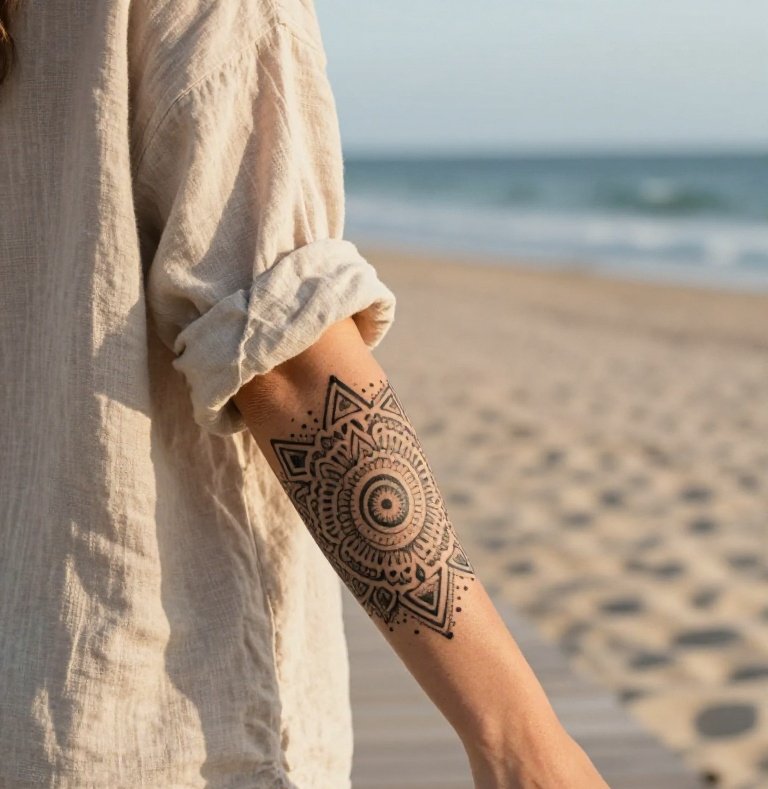
Repeating triangles, dots, and radiating lines form a circular mandala that wraps the outer forearm like a wide bracelet, with dense dotwork giving the pattern depth. Bare skin between the dots does real visual work: filling every inch would flatten it.
The make-or-break rule: wobble shows. Geometric work lives or dies on symmetry, so ask to see the artist’s healed geometry, not just fresh photos. A slightly off-center mandala reads worse than an imperfect floral. Our ornamental tattoo ideas go deeper on the symmetry and spacing rules that carry pattern-heavy work.
7. Soft Botanical Vine: A Quiet Inner Forearm Tattoo for Women
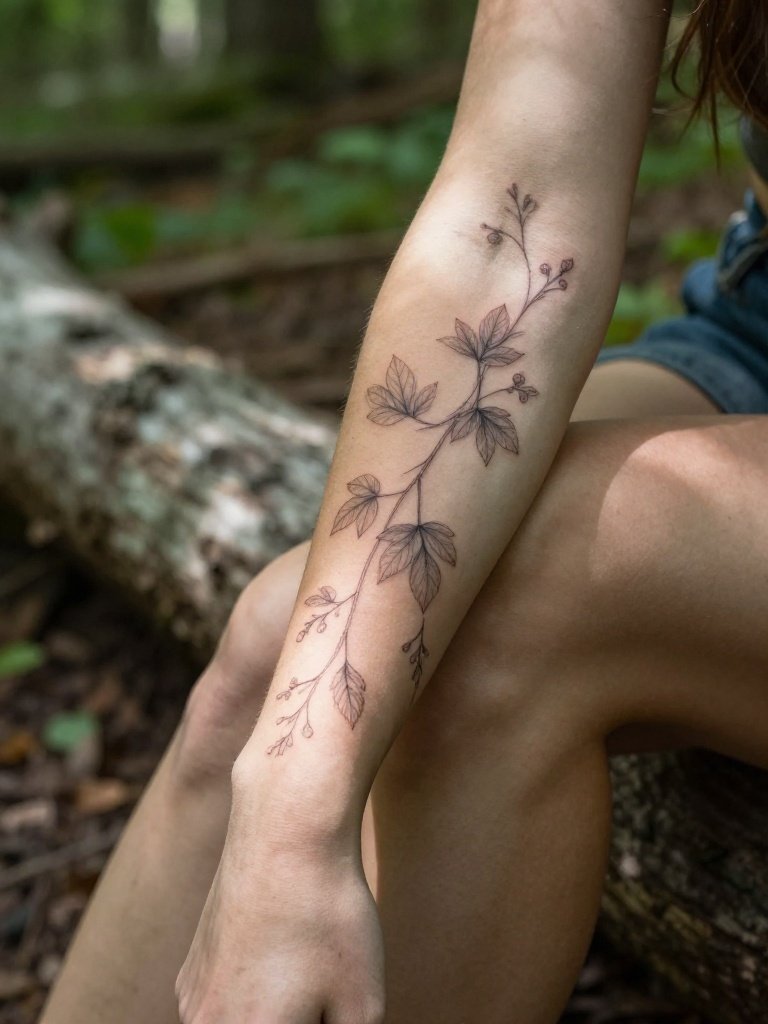
A single thin vine trails diagonally across the inner forearm, carrying small leaves and the occasional tiny bud in light whip shading rather than solid fill. The whole piece depends on line consistency. There is no shading to hide behind.
The make-or-break rule: keep it organic. A slightly wandering, asymmetrical line reads as grown. A rigid geometric path reads as drawn. Inner placement suits the quiet intent: angled toward the body it is private, turned outward it is visible.
See Also: 20 Stunning Snake Hand Tattoo Ideas Trending Right Now
8. Feather Turning Into Birds: A Classic Forearm Tattoo for Women
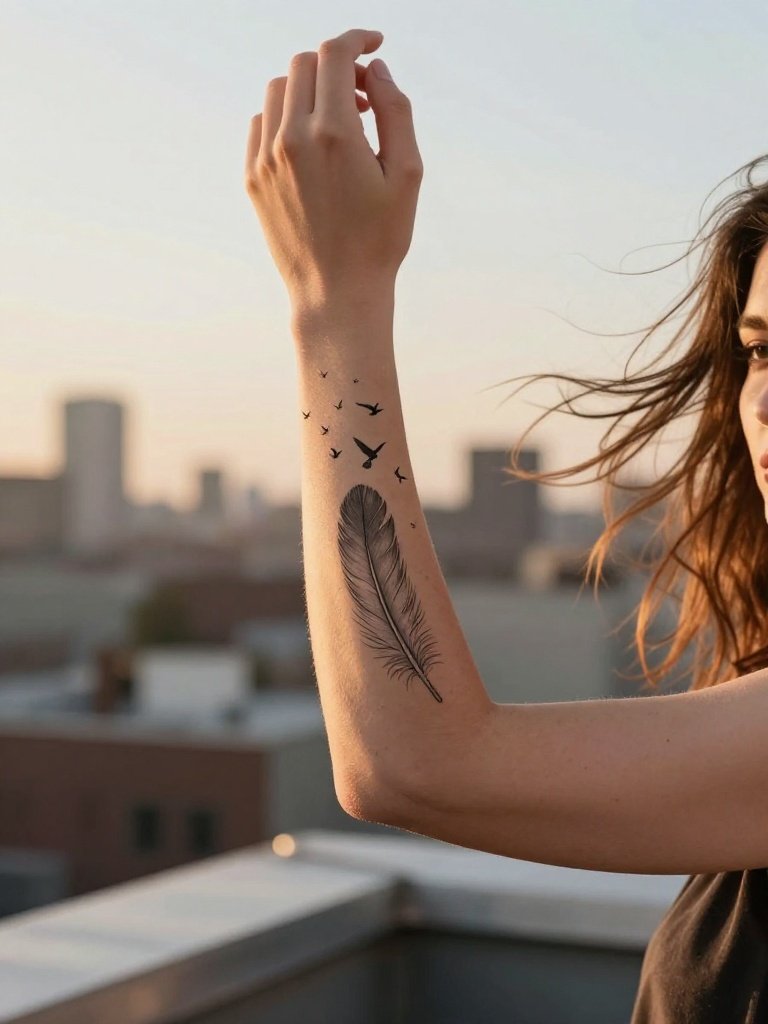
Near the elbow, a detailed feather dissolves into a small flock of birds in flight, fine barb linework against simple bird silhouettes. The storytelling drives the composition. This is illustrative work, not realism.
The make-or-break rule: shrink the birds. The flock has to decrease in size and detail as it moves away from the feather, because that gradient is what sells the sense of movement. Equal-sized birds in a row read as a stamp, not a transformation.
9. Chain-Link Bracelet: A Wrist-to-Forearm Tattoo Women
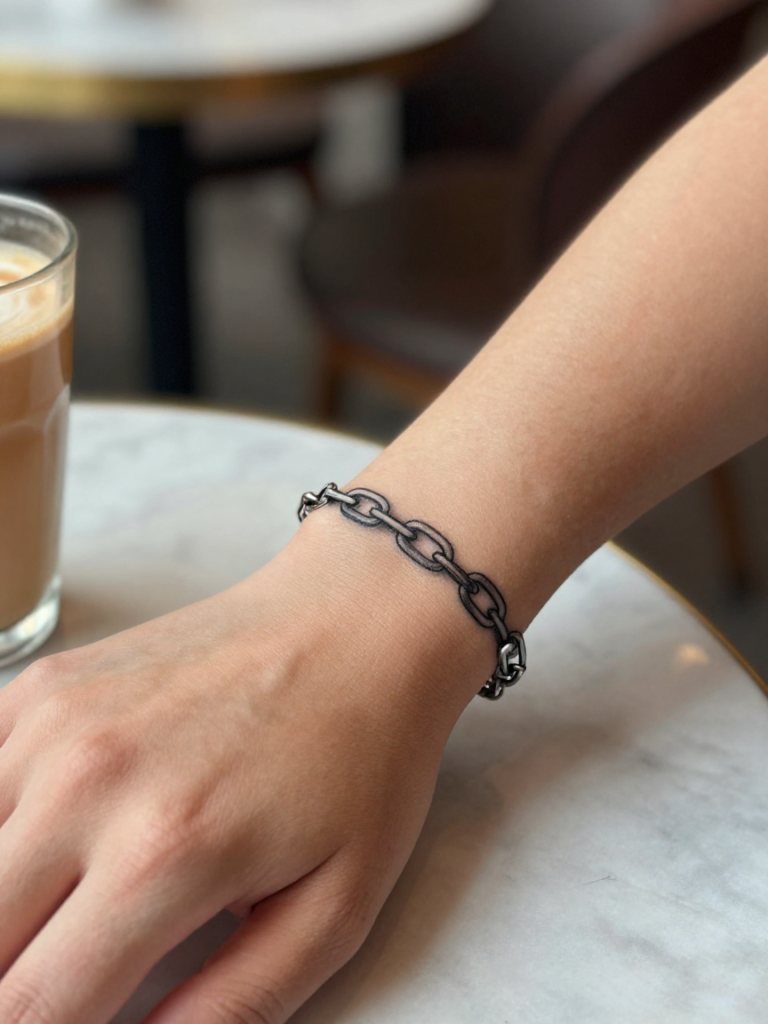
Dimensional shading gives this chain a metallic look, complete with a small clasp detail, wrapping the wrist and continuing up the lower forearm like a permanent bracelet. It reads as polished rather than decorative, jewelry rather than body art.
Wrist check
The make-or-break rule: the wrist moves. Skin at the wrist crease flexes constantly, so fine detail there heals less predictably than the same detail higher on the arm. Ask for slightly bolder line weight than you think you need, and a few highlight touches on the links so the metal does not read flat.
10. Fine Line Moon Phases: A Sequential Forearm Tattoo Women
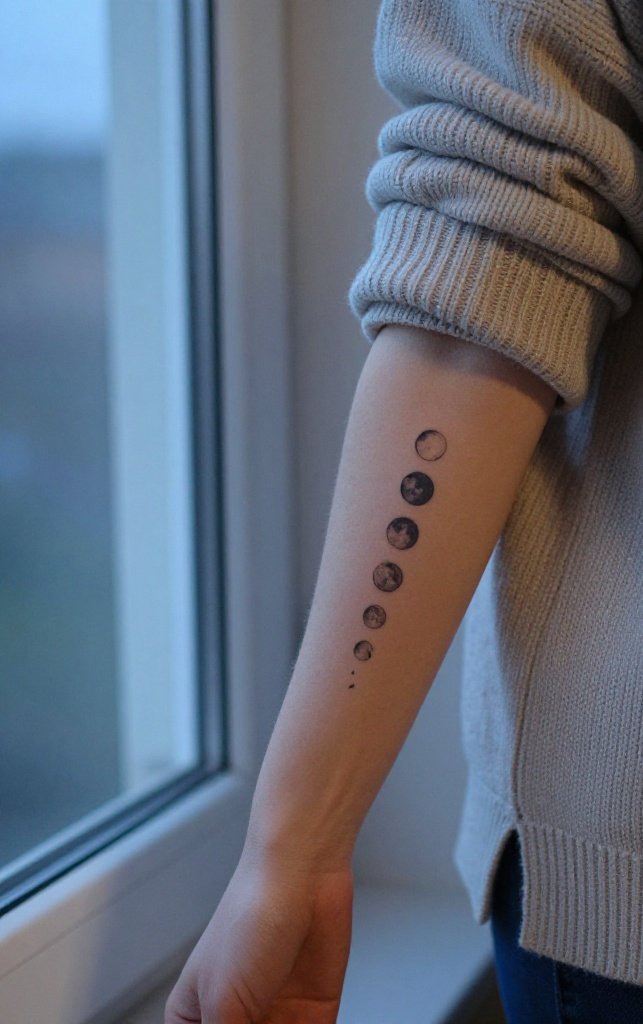
New moon to full and back again, a row of small circles running in a straight or gently curved line along the forearm in thin single-needle work. The sequence gives it motion that a single symbol cannot match.
Spacing matters
The make-or-break rule: size the moons bigger than feels necessary. Small circles shrink further as lines spread, and inconsistent spacing is the most common flaw in this design. Have the artist lay out the phases with a guide line first. Eyeballing spacing on a curved arm is how moons drift.
11. Abstract Ocean Wave Linework: A Modern Forearm Tattoo Women
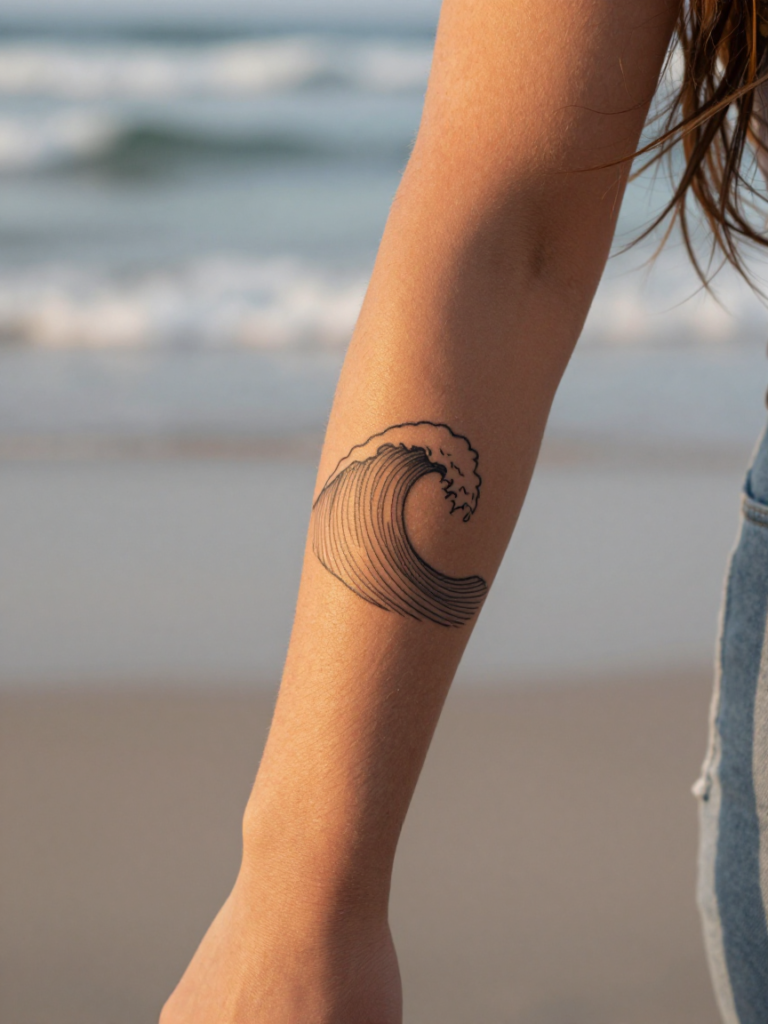
A single continuous line curls like a cresting wave across the outer forearm, varying in weight to suggest movement and foam without any literal water shading. Graphic, modern, low-commitment: a genuinely easy first piece.
The make-or-break rule: vary the weight. A single uniform line width flattens the motion the wave is meant to have. Ask the artist to thicken the line through the curl and thin it at the foam. That gradient is the whole design.
12. Symbolic Arrow With Hidden Meaning: A Forearm Tattoo Women
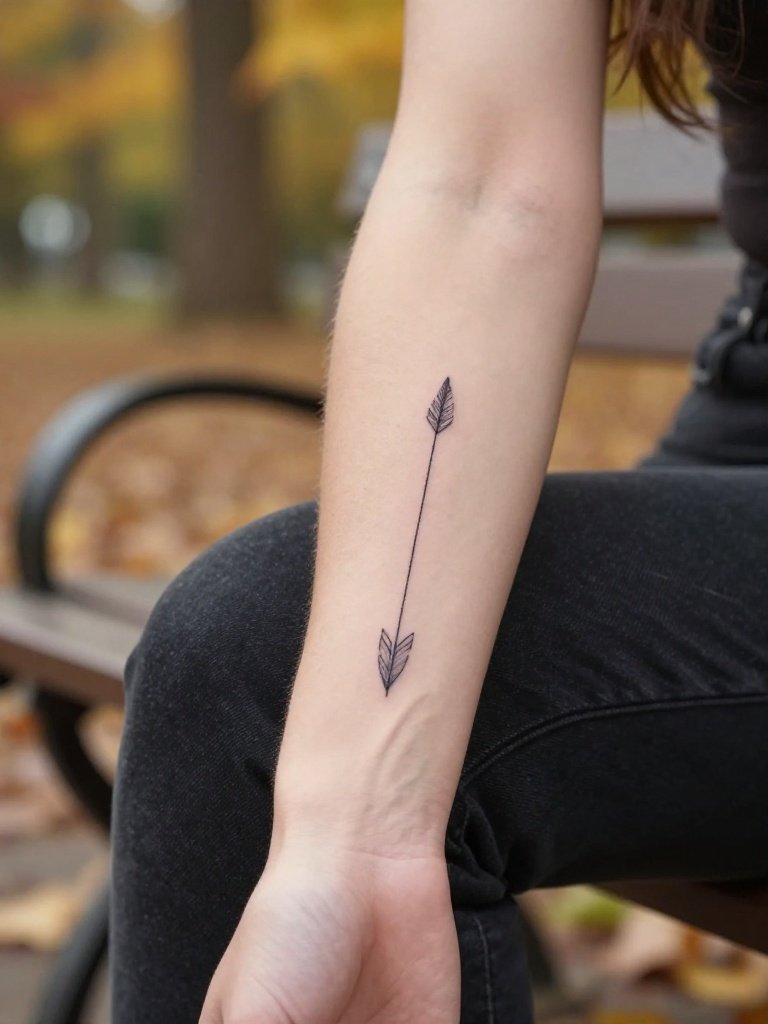
A thin straight arrow, sometimes broken in the middle or paired with a small feather at the tail. The message shifts with every small choice: where it is broken, how it is angled, what is paired with it.
Mean it first
The make-or-break rule: decide the meaning before the appointment. The arrow is a symbol-heavy design, so here is the honest version: arrows, moons, and florals do not carry universal meanings. An arrow “means” moving forward only if you decide it does. Anyone else’s decoding is decoration. Settle yours before you book.
13. Delicate Rose With Thorns: A Traditional Forearm Tattoo Women
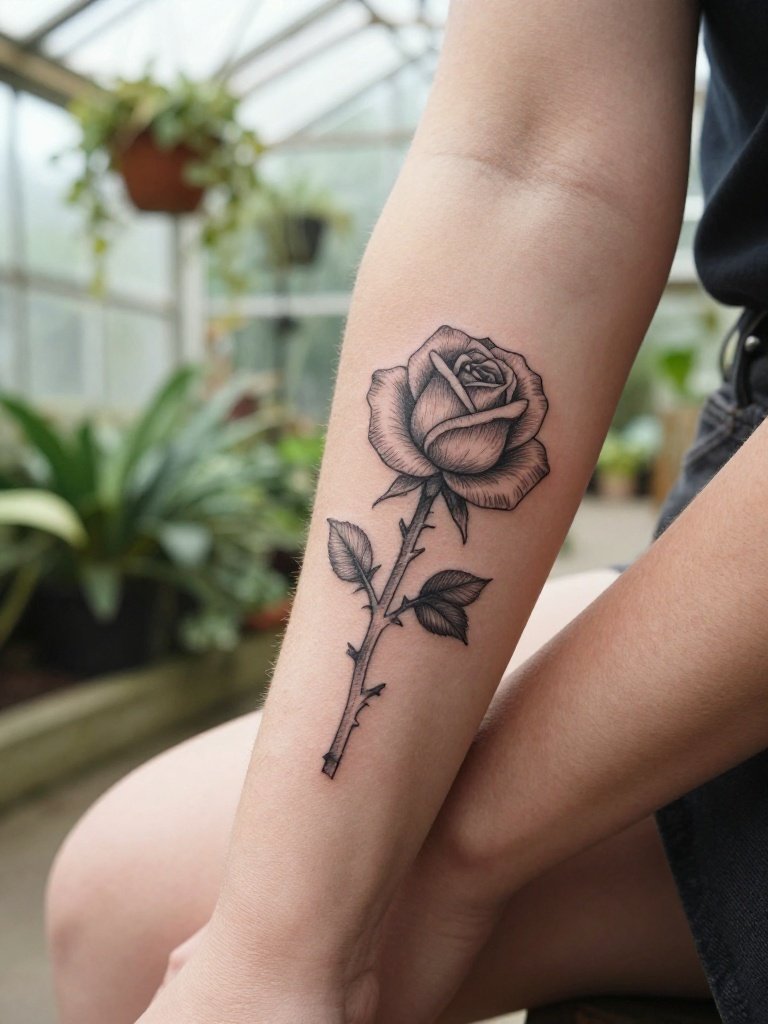
Visible thorns run along the stem of a single rose, petals built from fine linework and light cross-hatch shading, placed vertically on the inner forearm. This is not the bold neo-traditional rose. It is finer, colorless, softer: a modern take on the old-school subject.
The make-or-break rule: sparse thorns. A few pointed thorns accent the rose. A dense thorn thicket visually competes with it and muddies the silhouette at a glance.
14. Fox Silhouette Portrait: A Detailed Outer Forearm Tattoo Women
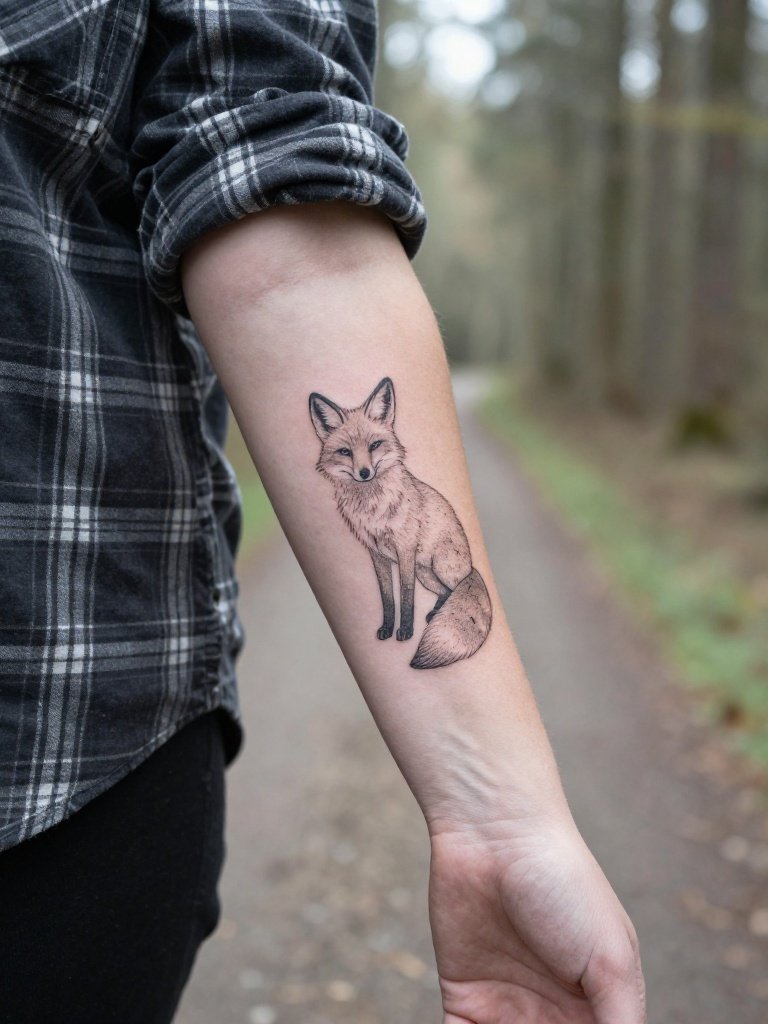
Fine linework builds a fox in profile on the outer forearm, subtle dotwork shading along the tail and ears suggesting fur without going fully realistic. The restraint is the point. It reads as illustration, not photograph, and that gives it more visual weight than the purely symbolic pieces on this list.
The make-or-break rule: contrast over detail. Animal work survives on blacks bold enough to anchor the fur texture. Keep the shading limited to the tail, ears, and chest so the body stays linework. Too much shading and the whole piece reads dark from a distance.
15. Dotwork Henna-Inspired Pattern: A Statement Forearm Tattoo Women
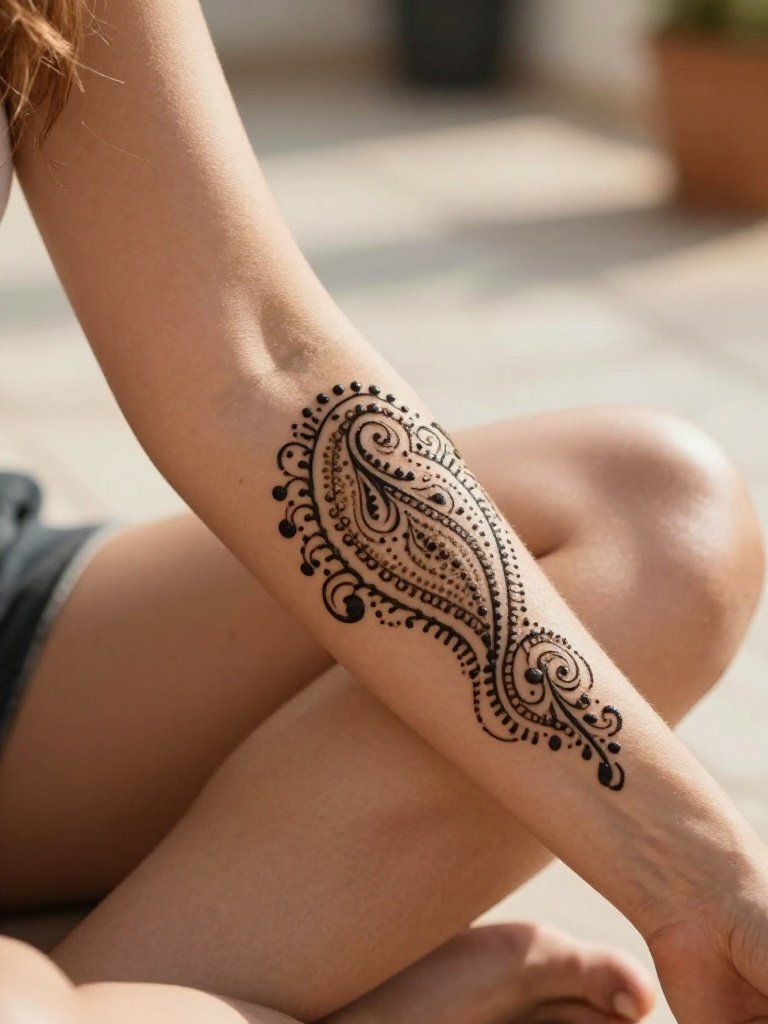
Dots, small curls, and paisley-style shapes trace a dense symmetrical pattern up the outer forearm, echoing henna but rendered permanently in black dotwork. Maximum visual impact on this list.
Density test
The make-or-break rule: flow with the arm. The pattern must follow the arm’s natural curve rather than sitting flat on it, and the dots need visible gaps to survive aging. Dense dotwork is one of the slowest techniques to sit for, and healing for a piece this detailed can run close to a month. Bring references of the specific henna motifs you like, because “paisley pattern” alone leaves too much open to interpretation.
16. Quote Band: A Lettered Lower Forearm Tattoo Women
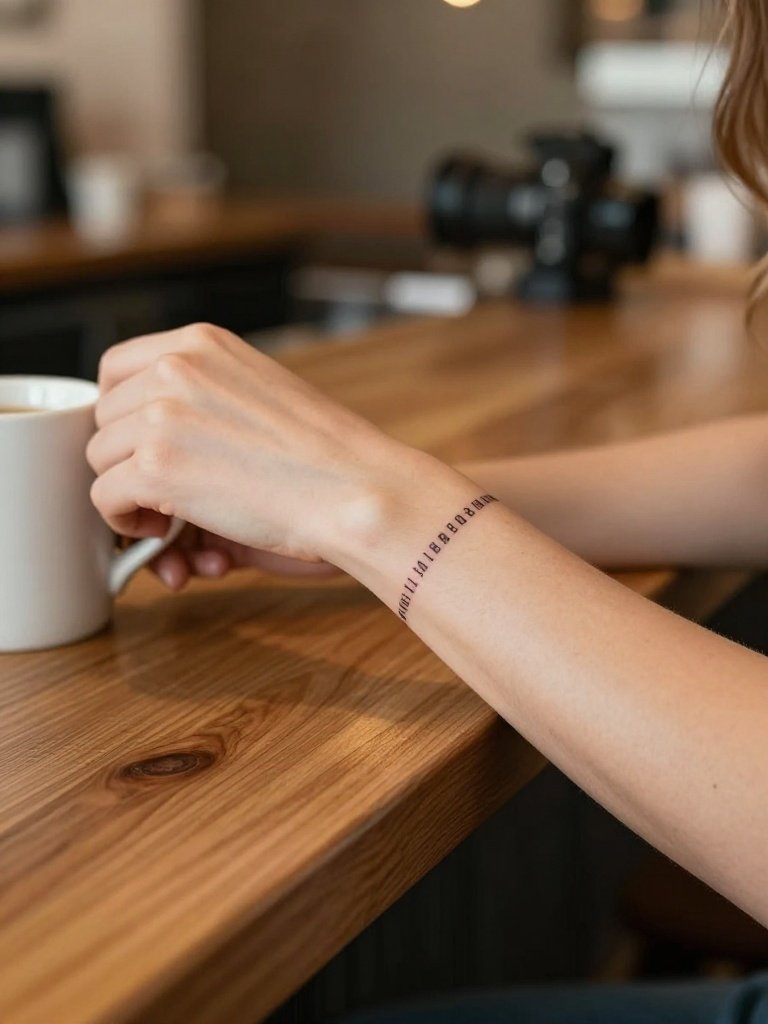
A short phrase in small, evenly spaced lettering wraps horizontally just above the wrist like a printed cuff. It reads like a cuff rather than a floating word, and it can double as a clean starting band if a sleeve comes later.
Letter discipline
The make-or-break rule: consistent letter height. Uneven sizing is the fastest way small lettering looks sloppy after healing, and wrapped text that varies in height makes the cuff look crooked. Keep the phrase short. Every extra word shrinks the letters closer to the blur threshold.
17. Snake Coiling Up the Arm: A Bold Forearm Tattoo Women
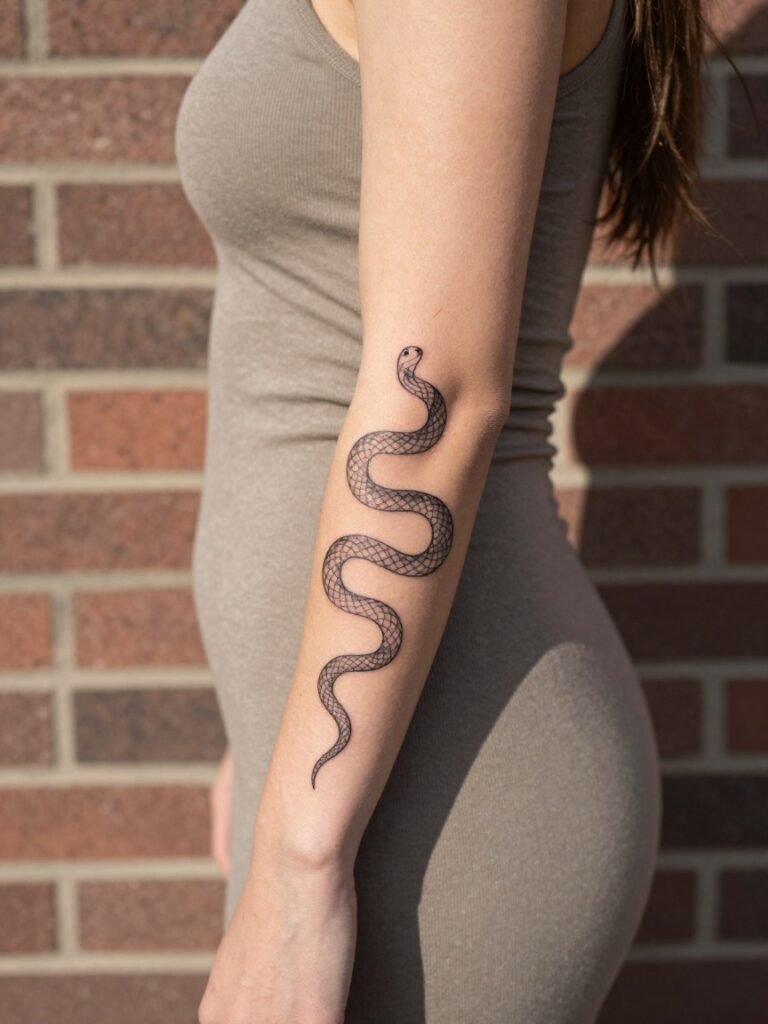
Diagonally from wrist to elbow, a slender snake coils upward with subtle diamond-pattern shading along its scales, its head stopping short of the elbow itself. Bolder than anything else here, carrying a different energy than the florals.
Arm length
The make-or-break rule: the diagonal needs length. A coiled snake only works on a long enough forearm; on a shorter arm it cramps. Have the artist mock the coil on your actual arm before committing. Subtle scale shading, not an outlined pattern, is what makes the texture read reptilian. The head stopping short of the elbow joint is deliberate: joint skin is harder to work cleanly, and our elbow tattoos for women ideas cover that territory separately.
18. Sun and Star Duo: A Petite Forearm Tattoo Women
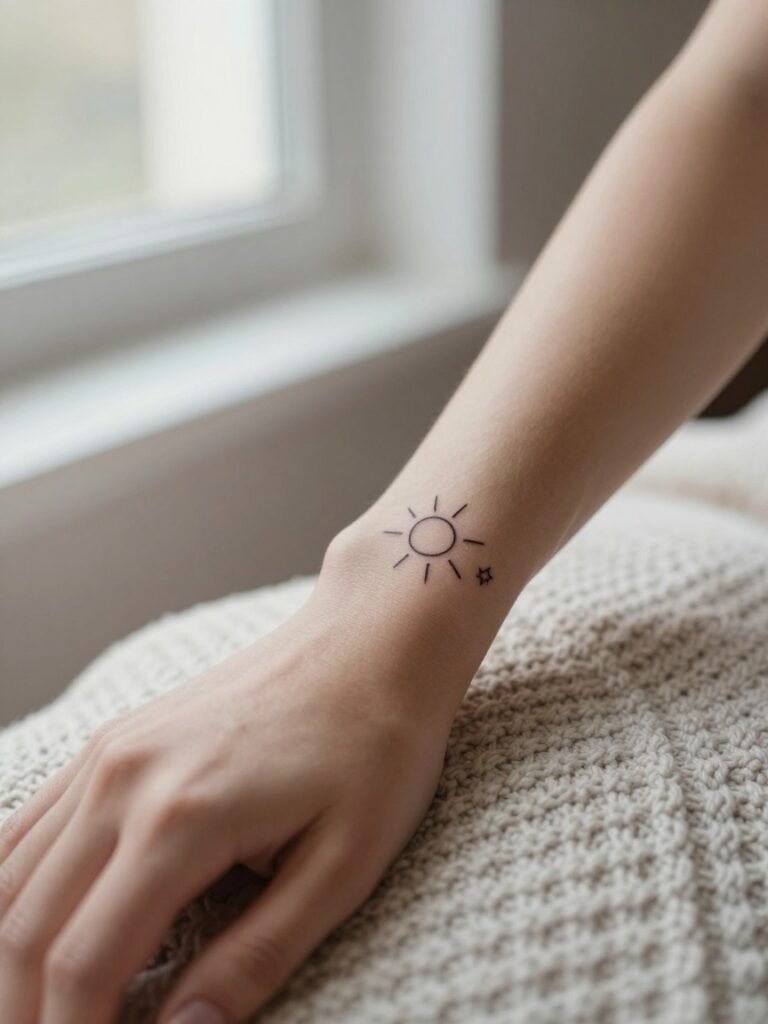
Just above the wrist on the inner forearm, a small sun with radiating lines sits beside a single five-point star in matching thin linework. Compact, low-commitment, a single short sitting: an easy entry point for a first tattoo.
The make-or-break rule: keep it compact. Short, evenly spaced rays keep the design from sprawling wider than intended. For what survives at tiny sizes, our small tattoo ideas guide covers the legibility math in depth.
The Aging Ledger: What Year Five Actually Looks Like
No gallery writes this, and it decides everything about fine-line forearm work.
Year one. Crisp. Exactly the reference. Lines at their thinnest, dotwork at its densest.
Years three to five. Fine lines soften as ink spreads. Thin script begins to close up. Dotwork packed tight starts merging. The reported touch-up window for fine-line work is five to eight years, earlier for hands and wrists, later for the protected inner forearm. Sun is the accelerant: the outer forearm’s daily exposure fades work noticeably faster than the sheltered inner arm.
Year ten. The survivors share two traits: a line-weight floor (nothing drawn thinner than a fine-liner pen) and generous spacing. Bold blackwork and high-contrast pieces still read clearly. Hair-thin detail packed tight does not. Watercolor work without a bold framework is usually on its second or third refresh by now.
Inner vs outer fade. The inner forearm has tender skin, slower healing, sharper pain, but less sun, so delicate detail holds longer there. The outer forearm has duller session pain and tougher skin, but serious sun exposure: it needs higher contrast and sunscreen discipline. Pick your placement as an aging decision, not just a visibility one.
Size Honesty: The Regret Nobody Plans
The most common regret in the niche is not pain or placement. It is size. Nobody wishes their tattoo were smaller. The regret runs one way: pieces that started at two inches and needed to be three.
The working rules: nothing thinner than a fine-liner pen, nothing smaller than a coin. A sun-and-star duo at two inches works because it is two elements. The same two inches trying to hold a quote band, a mandala, and a vine does not. Shrinking a design is not the same design. Details must be removed, not reduced.
If you are choosing between sizes, choose bigger. The difference between a two-inch and a three-inch piece is the difference between details that blur and details that survive.
Vetting the Artist: The Actual Process
“Choose a good artist” is not advice. Here is the process.
Healed photos, not fresh ones. Fresh work always looks sharp. Healed fine-line shows whether spacing decisions survived. Ask specifically for photos of work healed a year or more, in the style you are getting: a fine-line specialist for fine-line, a geometric specialist for geometry.
Style-specialist matching. A portrait artist and a dotwork artist are different trades. The portfolio should be full of the thing you want, not just good at everything.
The stencil check in a mirror. Before any needle touches skin, see the stencil placed on your arm, in a mirror, at arm’s length. This is where placement mistakes get caught: designs that look right on paper but wrong on the arm’s curve.
Consult questions that work. How do you set your line-weight floor for small pieces? What is your touch-up policy? For script: how small have you done it before it closed up? An artist who answers specifically has done the work. An artist who waves it away has not.
What It Costs: Real Brackets
Reported ranges from working shops, not quotes. Every shop sets its own numbers.
A small single done in under an hour, the single-word script or sun-and-star scale, typically lands in shop-minimum territory, commonly $80 to $150 depending on the city. Palm-sized pieces run roughly $150 to $400. A partial forearm piece sits around $250 to $600. A full forearm piece runs $700 to $1,200 and up. Wraparound work, mandala bands and chain links, prices higher for the technical difficulty: roughly $600 to $2,500.
Two honest wrinkles. Small pieces cost three to five times more per square inch than large ones: setup, stencil, and session overhead do not shrink with the design. And color and realism multiply chair time, which multiplies the bill, long before the ink itself matters.
Leave the Door Open: The Growth Plan
If a sleeve might be in your future, the forearm piece you get now should not block it later.
Tell your artist the sleeve is possible, even if it is years away. Leave a deliberate open edge toward the elbow rather than finishing the piece with a hard border. An open edge gives future work somewhere to connect. Keep the style consistent: a fine-line botanical forearm grows naturally into a fine-line sleeve, but it fights a bold blackwork addition. Geometric work extends cleanly. Heavy realism sets a tone everything after must match.
Our sleeve tattoos for women guide walks through full-arm planning when you are ready for that step. The forearm is the natural first panel: flat, stable skin, easy to show or hide, and every artist books it.
Quick Comparison
| Design | Style Fit | Best Side | Sessions | Price Bracket |
|---|---|---|---|---|
| Fine Line Florals | Fine-line botanical | Inner | 1 | $ |
| Blackwork Sunflower | Bold blackwork | Outer | 1-2 | $ |
| Single-Word Script | Fine-line script | Inner | 1 | $ |
| Watercolor Butterflies | Color wash | Outer | 1-2 | $ |
| Constellation Dots | Dotwork | Inner | 1 | $ |
| Mandala Band | Geometric dotwork | Outer | 1-2 | $ |
| Botanical Vine | Fine-line botanical | Inner | 1 | $ |
| Feather to Birds | Illustrative | Outer | 1-2 | $ |
| Chain-Link Bracelet | Illustrative realism | Wrist | 1 | $ |
| Moon Phases | Fine-line celestial | Either | 1 | $ |
| Ocean Wave | Single-line | Outer | 1 | $ |
| Arrow | Fine-line symbolic | Either | 1 | $ |
| Rose With Thorns | Fine-line traditional | Inner | 1 | $ |
| Fox Portrait | Illustrative | Outer | 1 | $ |
| Henna Dotwork | Dense dotwork | Outer | 2-3 | $$$ |
| Quote Band | Fine-line script | Inner | 1 | $ |
| Coiling Snake | Bold illustrative | Either | 1-2 | $ |
| Sun and Star Duo | Fine-line petite | Inner | 1 | $ |
Sessions and prices are reported ranges for the shown scale, not quotes.
Frequently Asked Questions
Which side of the forearm is better for a first tattoo?
The inner forearm, usually. It is easier to hide under a long sleeve, the sessions are shorter, the designs tend to be smaller, and delicate work ages better there because it is sheltered from the sun. The trade-off is sharper pain and slower healing than the outer arm. If you want the piece seen daily, outer is the honest choice. If you want the option of privacy, inner wins.
Do inner forearm tattoos hurt more than outer ones?
Generally yes. The inner forearm has thinner skin, with tendons and bone closer to the surface near the wrist and elbow crease, so it tends to feel sharper. The outer forearm has more muscle underneath and most people describe it as a dull scratch. Neither is considered a particularly painful area as tattoos go.
How small can a forearm tattoo be?
About two inches is the practical floor for most designs, smaller only if the design simplifies down to one or two elements. The fine-liner-pen-and-coin rule is the working test: nothing drawn thinner than a fine-liner pen, nothing smaller than a coin. Shrinking is not simplifying. Details must be removed, not reduced.
Will a fine-line forearm tattoo still look good in five years?
It can, with the right design. The reported touch-up window for fine-line work is five to eight years. What survives: a line-weight floor, generous spacing, and placement on the sheltered inner arm. What does not: hair-thin detail packed tight on the sun-exposed outer arm. Design for the healed version, not the fresh photo.
Can a forearm tattoo grow into a sleeve later?
Yes, if the piece was planned for it. Tell the artist about the possibility upfront, leave a deliberate open edge toward the elbow, and keep the style consistent so future work connects instead of colliding. A piece designed as a closed, finished object is much harder to extend gracefully.
Where To Start
Narrow it down by visibility first: how much of this do you want seen on an average day? That alone rules out half the list. From there, pick the technique, whether that is fine line, dotwork, or bold blackwork, that matches the level of upkeep and detail you are genuinely willing to sit for. Then book the artist whose healed portfolio already looks like the tattoo you want.